
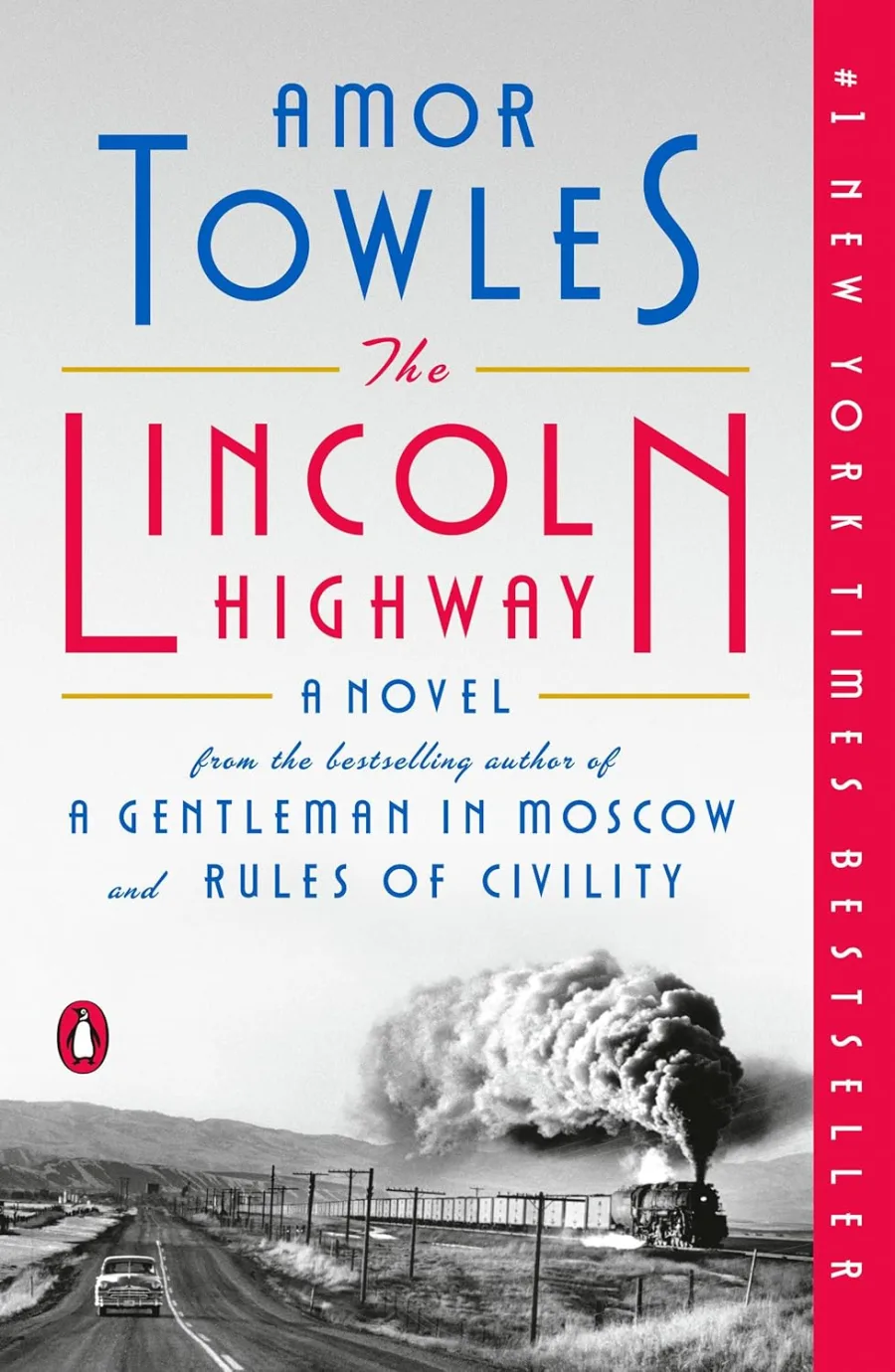
The Lincoln Highway: A Novel
Paperback
• 592 Pages
• USD 20.00
• English
• 9780735222366
No ratings yet
| Publisher | Penguin Books |
|---|---|
| ISBN13 | 9780735222366 |
| ASIN/SKU | 0735222363 |
| Book Format | Paperback |
| Language | English |
| Pages | 592 |
| List Price | USD 20.00 |
| Publishing Date | 21/03/2023 |
| Dimensions | 5.51 x 1.24 x 8.44 inche |
| Weight | 1.15 pounds |
| Book Code | BD00055951 |
Buy this Book
Amazon Stores
Ebook Stores
Other Stores
Discover The Lincoln Highway: A Novel by Amor Towles. This book is published by Penguin Books in Paperback format, ISBN 9780735222366, ASIN 0735222363, under Literature and Fiction, Coming of Age Fiction, Historical Fiction.
Book Description
#1 NEW YORK TIMES BESTSELLER
More than ONE MILLION copies sold
A TODAY Show Read with Jenna Book Club Pick
A New York Times Notable Book, a New York Times Readers’ Choice Best Book of the Century, and Chosen by Oprah Daily, Time, NPR, The Washington Post, Bill Gates and Barack Obama as a Best Book of the Year
“Wise and wildly entertaining . . . permeated with light, wit, youth.” —The New York Times Book Review
“A classic that we will read for years to come.” —Jenna Bush Hager, Read with Jenna book club
“A real joyride . . . elegantly constructed and compulsively readable.” —NPR
The bestselling author of A Gentleman in Moscow and Rules of Civility and master of absorbing, sophisticated fiction returns with a stylish and propulsive novel set in 1950s America
In June, 1954, eighteen-year-old Emmett Watson is driven home to Nebraska by the warden of the juvenile work farm where he has just served fifteen months for involuntary manslaughter. His mother long gone, his father recently deceased, and the family farm foreclosed upon by the bank, Emmett's intention is to pick up his eight-year-old brother, Billy, and head to California where they can start their lives anew. But when the warden drives away, Emmett discovers that two friends from the work farm have hidden themselves in the trunk of the warden's car. Together, they have hatched an altogether different plan for Emmett's future, one that will take them all on a fateful journey in the opposite direction—to the City of New York.
Spanning just ten days and told from multiple points of view, Towles's third novel will satisfy fans of his multi-layered literary styling while providing them an array of new and richly imagined settings, characters, and themes.
More than ONE MILLION copies sold
A TODAY Show Read with Jenna Book Club Pick
A New York Times Notable Book, a New York Times Readers’ Choice Best Book of the Century, and Chosen by Oprah Daily, Time, NPR, The Washington Post, Bill Gates and Barack Obama as a Best Book of the Year
“Wise and wildly entertaining . . . permeated with light, wit, youth.” —The New York Times Book Review
“A classic that we will read for years to come.” —Jenna Bush Hager, Read with Jenna book club
“A real joyride . . . elegantly constructed and compulsively readable.” —NPR
The bestselling author of A Gentleman in Moscow and Rules of Civility and master of absorbing, sophisticated fiction returns with a stylish and propulsive novel set in 1950s America
In June, 1954, eighteen-year-old Emmett Watson is driven home to Nebraska by the warden of the juvenile work farm where he has just served fifteen months for involuntary manslaughter. His mother long gone, his father recently deceased, and the family farm foreclosed upon by the bank, Emmett's intention is to pick up his eight-year-old brother, Billy, and head to California where they can start their lives anew. But when the warden drives away, Emmett discovers that two friends from the work farm have hidden themselves in the trunk of the warden's car. Together, they have hatched an altogether different plan for Emmett's future, one that will take them all on a fateful journey in the opposite direction—to the City of New York.
Spanning just ten days and told from multiple points of view, Towles's third novel will satisfy fans of his multi-layered literary styling while providing them an array of new and richly imagined settings, characters, and themes.
Author Biography
Amor Towles is the author of the New York Times bestsellers Rules of Civility, A Gentleman in Moscow, and The Lincoln Highway. The three novels have collectively sold millions of copies and have been translated into more than thirty-five languages. Towles lives in Manhattan with his wife and two children.
Editorial Reviews
Praise for The Lincoln Highway:
“[A] mischievous, wise and wildly entertaining novel . . . Towles goes all in on the kind of episodic, exuberant narrative haywire found in myth or Homeric epic . . . Each [character], Towles implies, is the central protagonist of an ongoing adventure that is both unique and universal . . . remarkably buoyant . . . permeated with light, wit, youth . . . Towles has snipped off a minuscule strand of existence—10 wayward days—and when we look through his lens we see that this brief interstice teems with stories, grand as legends.” —Chris Batcheldor, New York Times Book Review
“Not only is it one of the most beautifully written books I have ever picked up, it’s a story about hope, friendship and companionship in a time when we need it so much . . . Towles brilliantly captures the inner reality of each [character] with profound and poetic prose. All eight of them are incredible forces in literature . . . Amor Towles is one of those authors that I think will become a Steinbeck of our generation and [...] I think The Lincoln Highway will be a classic that we will read for years to come.” —Jenna Bush Hager, Read With Jenna book club
“[A] real joyride . . . hitch onto this delightful tour de force and you'll be pulled straight through to the end, helpless against the inventive exuberance of Towles' storytelling . . . The Lincoln Highway is elegantly constructed and compulsively readable . . . action-packed . . . There's so much to enjoy in this generous novel packed with fantastic characters [...] and filled with digressions, magic tricks, sorry sagas, retributions, and the messy business of balancing accounts.” —NPR
“Gorgeously crafted . . . Towles binds the novel with compassion and scrupulous detail . . . Towles draws a line between the social maladies of then and now, connecting the yearnings of his characters with our own volatile era. He does it with stylish, sophisticated storytelling . . . The novel embraces the contradictions of our character with a skillful hand, guiding the reader forward with 'a sensation of floating – like one who’s being carried down a wide river on a warm summer day.'” —Washington Post
“The astonishingly versatile author of Rules of Civility and A Gentleman in Moscow returns with an American picaresque destined to become a classic . . . adventures and memorable characters abound. Using multiple points-of-view and shifting from comedy to tragedy and back again, Towles enthralls.” —O Quarterly
“[A] captivating piece of historical fiction . . . transporting . . . a rollicking cross-country adventure, rife with unforgettable characters, vivid scenery and suspense that will keep readers flying through the pages.” —TIME
“[The] notion of American openness, of ever-fractalizing free will, coming up against the fickle realities of fate is the tension that powers Towles’ exciting, entertaining […] picaresque . . . Stories can bring us back to ourselves, Towles seems to say, if only we are open t
“[A] mischievous, wise and wildly entertaining novel . . . Towles goes all in on the kind of episodic, exuberant narrative haywire found in myth or Homeric epic . . . Each [character], Towles implies, is the central protagonist of an ongoing adventure that is both unique and universal . . . remarkably buoyant . . . permeated with light, wit, youth . . . Towles has snipped off a minuscule strand of existence—10 wayward days—and when we look through his lens we see that this brief interstice teems with stories, grand as legends.” —Chris Batcheldor, New York Times Book Review
“Not only is it one of the most beautifully written books I have ever picked up, it’s a story about hope, friendship and companionship in a time when we need it so much . . . Towles brilliantly captures the inner reality of each [character] with profound and poetic prose. All eight of them are incredible forces in literature . . . Amor Towles is one of those authors that I think will become a Steinbeck of our generation and [...] I think The Lincoln Highway will be a classic that we will read for years to come.” —Jenna Bush Hager, Read With Jenna book club
“[A] real joyride . . . hitch onto this delightful tour de force and you'll be pulled straight through to the end, helpless against the inventive exuberance of Towles' storytelling . . . The Lincoln Highway is elegantly constructed and compulsively readable . . . action-packed . . . There's so much to enjoy in this generous novel packed with fantastic characters [...] and filled with digressions, magic tricks, sorry sagas, retributions, and the messy business of balancing accounts.” —NPR
“Gorgeously crafted . . . Towles binds the novel with compassion and scrupulous detail . . . Towles draws a line between the social maladies of then and now, connecting the yearnings of his characters with our own volatile era. He does it with stylish, sophisticated storytelling . . . The novel embraces the contradictions of our character with a skillful hand, guiding the reader forward with 'a sensation of floating – like one who’s being carried down a wide river on a warm summer day.'” —Washington Post
“The astonishingly versatile author of Rules of Civility and A Gentleman in Moscow returns with an American picaresque destined to become a classic . . . adventures and memorable characters abound. Using multiple points-of-view and shifting from comedy to tragedy and back again, Towles enthralls.” —O Quarterly
“[A] captivating piece of historical fiction . . . transporting . . . a rollicking cross-country adventure, rife with unforgettable characters, vivid scenery and suspense that will keep readers flying through the pages.” —TIME
“[The] notion of American openness, of ever-fractalizing free will, coming up against the fickle realities of fate is the tension that powers Towles’ exciting, entertaining […] picaresque . . . Stories can bring us back to ourselves, Towles seems to say, if only we are open t
Book Summary
The Lincoln Highway by Amor Towles is a richly layered, bittersweet story about brothers, friendship, and the winding, unpredictable roads that shape a young man’s life. Set in 1954, it begins with eighteen-year-old Emmett Watson being driven home to Nebraska by Warden Williams after serving fifteen months in a juvenile work farm for accidentally killing another boy in a fight. Emmett is practical, serious, and feels older than his years. His father has recently died, their family farm has been foreclosed, and Emmett arrives with one clear plan: take his eight-year-old brother Billy, leave the ruins of their old life behind, and head west to California to start fresh. Emmett is determined to move forward, to escape the shame of his past and the limitations of their small town. He’s not dreaming of adventure so much as of stability—a clean slate, honest work, and a chance to build something that belongs only to them.
Billy is the emotional heart of the story: smart, earnest, and filled with hopeful imagination. He carries with him “Professor Abacus Abernathe’s Compendium of Heroes, Adventurers, and Other Intrepid Travelers,” a book of legendary figures and journeys that shapes the way he sees the world. Billy believes in quests, in the idea that life is a series of chapters leading toward something meaningful. He’s deeply attached to Emmett and trusts him like a hero from his book. Billy’s mother left years before, heading west along the Lincoln Highway and sending postcards that eventually stopped. Despite that abandonment, Billy believes that going west might reconnect them with her or at least honor the path she started. The Lincoln Highway itself—an early coast-to-coast road crossing America—becomes a symbol of possibility in his mind: a line on the map where their future awaits.
Emmett’s plan is simple: sell what little they have left, fix up his old Studebaker, and drive west with Billy. But almost immediately, his plan derails. Unbeknownst to Emmett, two fellow inmates from the work farm, Duchess and Woolly, have hidden themselves in the trunk of the warden’s car. Duchess is charismatic, theatrical, clever, and trouble—raised by a drifting, unreliable actor father, he’s learned to charm and scheme as survival tools. Woolly, by contrast, is gentle, wealthy, and childlike, born into a privileged New York family but struggling with anxiety, confusion, and a sense that he never quite fits. They arrive at Emmett’s farm with their own agenda: they want Emmett to help them get to New York, where Woolly insists there is a hidden family trust that could change all their lives.
From the moment Duchess and Woolly appear, the story shifts from a straightforward westward plan to a twisting journey eastward. Duchess, half sincere and half manipulative, convinces Billy that a detour to New York can be part of a grand adventure. He nudges Emmett, pushes his buttons, and plays on their friendship from the work farm to pull Emmett off course. There is an underlying sense that Duchess wants more than just the money; he wants to settle some old scores and rewrite the stories of his life where he feels he was wronged. Woolly, meanwhile, moves through the world with a kind of fragile wonder, often lost in his thoughts. He sees the treasure money as a way to finally do something good, something that will make his cousin and family proud and maybe give him a life where he isn’t constantly failing expectations.
Their journey becomes a series of episodes and encounters as they leave Nebraska and travel along parts of the Lincoln Highway, eventually heading toward New York City. Towles structures the novel over the span of ten days and uses multiple perspectives, allowing us to see events through different eyes: Emmett’s quiet determination, Billy’s earnest optimism, Duchess’s theatrical instincts, and Woolly’s drifting mind. Each viewpoint adds layers to the narrative, showing how the same moments can mean different things to different people. Along the way, they meet strangers, wander through small towns, and wind up in places they never intended to go. Instead of a straight line, their path becomes a looping, tangled journey full of missteps, opportunities, and near-misses, echoing how unpredictable coming-of-age can be.
Emmett repeatedly tries to steer things back toward his original plan. He feels the weight of responsibility for Billy, and he’s wary of Duchess’s schemes. He doesn’t want to owe anyone or break any more rules; prison taught him the cost of impulsive actions. Yet circumstances keep dragging him further into Duchess’s orbit. The trust fund in New York represents not only money, but the possibility of finally being free from debt, from the farm’s foreclosure, and from the judgment of others. Emmett’s practicality clashes with the chaos around him, but he can’t entirely resist the idea that a sizable sum might secure the future he wants for Billy. At the same time, Billy’s belief in stories and heroes makes him open to Duchess’s notion of a quest. He is drawn to the idea that their detour is part of a larger narrative—a test, like those in his beloved book—on the way to becoming the men they’re meant to be.
Duchess is both magnetic and dangerous. Throughout the book, he oscillates between acts of loyalty and acts of betrayal, between genuine kindness and self-serving manipulation. His past is filled with neglect and broken promises from adults who should have cared for him but did not, and he carries a deep resentment that fuels much of his behavior. He has a mental ledger of wrongs done to him and others, and he believes in balancing that ledger—often through questionable means. As the journey continues, Duchess’s grudges lead them into escalating complications. His sense of justice is personal, not legal or moral, and his attempts to “set things right” for himself and for Woolly have unintended consequences for everyone around him.
Woolly’s storyline is quietly tragic. He is sweet, generous, and often misunderstood, coming from a wealthy family that never quite knows what to do with him. Expectations weigh heavily on him, and his inability to meet them makes him feel like a perpetual disappointment. The trust fund he wants to access is, in his mind, a chance to do something brave and good—to provide for Emmett and Billy, to escape the confines of his family’s controlled life, and to prove he can contribute meaningfully. Yet Woolly’s vulnerabilities make him susceptible to pressure and misinterpretation. His presence gives the novel a tender undercurrent, reminding readers that not all wounds come from poverty or violence; some arise from being quietly out of place in a world designed for sharper, more conventional minds.
As the journey approaches New York, the stakes rise. The boys split up, reconnect, and clash over decisions. There are moments of danger, moral compromise, and near disasters. Emmett, who began as a straightforward hero in Billy’s eyes, is forced into morally complicated situations where there is no perfectly right choice. Duchess, driven by his own internal script of justice, pushes events to breaking points. Woolly, caught in the middle, becomes the center of one of the novel’s most poignant turns. Billy watches all of this, still holding onto the belief that stories, even risky ones, have lessons and that heroes are defined by what they do when things go wrong.
Throughout The Lincoln Highway Towles plays with the idea that life is more like a novel than a straight road. Plans shift. Supporting characters become central; central characters lose control. The highway of the title is both a physical road and a metaphor for the paths chosen and imposed. Emmett wants a simple, honest route to California. Billy imagines a heroic journey full of meaning. Duchess craves a narrative where he is no longer the victim but the one in charge. Woolly just wants a story where he belongs and is safe. Their perspectives intersect and collide, reshaping each other’s ideas of what the future can be.
By the novel’s end, not everyone gets the kind of resolution they hoped for. There is loss mixed with hope, success mixed with regret. Emmett and Billy’s bond, tested by danger and disappointment, remains strong, but altered: Billy has seen that even heroes can’t control everything, and Emmett has learned that he cannot shield his brother from all of life’s hurt. Duchess’s arc underscores how unresolved pain can lead to destructive choices, even when wrapped in the language of fairness. Woolly’s fate leaves a lingering ache, reminding the reader how fragile some souls are in a world that demands constant toughness.
Billy is the emotional heart of the story: smart, earnest, and filled with hopeful imagination. He carries with him “Professor Abacus Abernathe’s Compendium of Heroes, Adventurers, and Other Intrepid Travelers,” a book of legendary figures and journeys that shapes the way he sees the world. Billy believes in quests, in the idea that life is a series of chapters leading toward something meaningful. He’s deeply attached to Emmett and trusts him like a hero from his book. Billy’s mother left years before, heading west along the Lincoln Highway and sending postcards that eventually stopped. Despite that abandonment, Billy believes that going west might reconnect them with her or at least honor the path she started. The Lincoln Highway itself—an early coast-to-coast road crossing America—becomes a symbol of possibility in his mind: a line on the map where their future awaits.
Emmett’s plan is simple: sell what little they have left, fix up his old Studebaker, and drive west with Billy. But almost immediately, his plan derails. Unbeknownst to Emmett, two fellow inmates from the work farm, Duchess and Woolly, have hidden themselves in the trunk of the warden’s car. Duchess is charismatic, theatrical, clever, and trouble—raised by a drifting, unreliable actor father, he’s learned to charm and scheme as survival tools. Woolly, by contrast, is gentle, wealthy, and childlike, born into a privileged New York family but struggling with anxiety, confusion, and a sense that he never quite fits. They arrive at Emmett’s farm with their own agenda: they want Emmett to help them get to New York, where Woolly insists there is a hidden family trust that could change all their lives.
From the moment Duchess and Woolly appear, the story shifts from a straightforward westward plan to a twisting journey eastward. Duchess, half sincere and half manipulative, convinces Billy that a detour to New York can be part of a grand adventure. He nudges Emmett, pushes his buttons, and plays on their friendship from the work farm to pull Emmett off course. There is an underlying sense that Duchess wants more than just the money; he wants to settle some old scores and rewrite the stories of his life where he feels he was wronged. Woolly, meanwhile, moves through the world with a kind of fragile wonder, often lost in his thoughts. He sees the treasure money as a way to finally do something good, something that will make his cousin and family proud and maybe give him a life where he isn’t constantly failing expectations.
Their journey becomes a series of episodes and encounters as they leave Nebraska and travel along parts of the Lincoln Highway, eventually heading toward New York City. Towles structures the novel over the span of ten days and uses multiple perspectives, allowing us to see events through different eyes: Emmett’s quiet determination, Billy’s earnest optimism, Duchess’s theatrical instincts, and Woolly’s drifting mind. Each viewpoint adds layers to the narrative, showing how the same moments can mean different things to different people. Along the way, they meet strangers, wander through small towns, and wind up in places they never intended to go. Instead of a straight line, their path becomes a looping, tangled journey full of missteps, opportunities, and near-misses, echoing how unpredictable coming-of-age can be.
Emmett repeatedly tries to steer things back toward his original plan. He feels the weight of responsibility for Billy, and he’s wary of Duchess’s schemes. He doesn’t want to owe anyone or break any more rules; prison taught him the cost of impulsive actions. Yet circumstances keep dragging him further into Duchess’s orbit. The trust fund in New York represents not only money, but the possibility of finally being free from debt, from the farm’s foreclosure, and from the judgment of others. Emmett’s practicality clashes with the chaos around him, but he can’t entirely resist the idea that a sizable sum might secure the future he wants for Billy. At the same time, Billy’s belief in stories and heroes makes him open to Duchess’s notion of a quest. He is drawn to the idea that their detour is part of a larger narrative—a test, like those in his beloved book—on the way to becoming the men they’re meant to be.
Duchess is both magnetic and dangerous. Throughout the book, he oscillates between acts of loyalty and acts of betrayal, between genuine kindness and self-serving manipulation. His past is filled with neglect and broken promises from adults who should have cared for him but did not, and he carries a deep resentment that fuels much of his behavior. He has a mental ledger of wrongs done to him and others, and he believes in balancing that ledger—often through questionable means. As the journey continues, Duchess’s grudges lead them into escalating complications. His sense of justice is personal, not legal or moral, and his attempts to “set things right” for himself and for Woolly have unintended consequences for everyone around him.
Woolly’s storyline is quietly tragic. He is sweet, generous, and often misunderstood, coming from a wealthy family that never quite knows what to do with him. Expectations weigh heavily on him, and his inability to meet them makes him feel like a perpetual disappointment. The trust fund he wants to access is, in his mind, a chance to do something brave and good—to provide for Emmett and Billy, to escape the confines of his family’s controlled life, and to prove he can contribute meaningfully. Yet Woolly’s vulnerabilities make him susceptible to pressure and misinterpretation. His presence gives the novel a tender undercurrent, reminding readers that not all wounds come from poverty or violence; some arise from being quietly out of place in a world designed for sharper, more conventional minds.
As the journey approaches New York, the stakes rise. The boys split up, reconnect, and clash over decisions. There are moments of danger, moral compromise, and near disasters. Emmett, who began as a straightforward hero in Billy’s eyes, is forced into morally complicated situations where there is no perfectly right choice. Duchess, driven by his own internal script of justice, pushes events to breaking points. Woolly, caught in the middle, becomes the center of one of the novel’s most poignant turns. Billy watches all of this, still holding onto the belief that stories, even risky ones, have lessons and that heroes are defined by what they do when things go wrong.
Throughout The Lincoln Highway Towles plays with the idea that life is more like a novel than a straight road. Plans shift. Supporting characters become central; central characters lose control. The highway of the title is both a physical road and a metaphor for the paths chosen and imposed. Emmett wants a simple, honest route to California. Billy imagines a heroic journey full of meaning. Duchess craves a narrative where he is no longer the victim but the one in charge. Woolly just wants a story where he belongs and is safe. Their perspectives intersect and collide, reshaping each other’s ideas of what the future can be.
By the novel’s end, not everyone gets the kind of resolution they hoped for. There is loss mixed with hope, success mixed with regret. Emmett and Billy’s bond, tested by danger and disappointment, remains strong, but altered: Billy has seen that even heroes can’t control everything, and Emmett has learned that he cannot shield his brother from all of life’s hurt. Duchess’s arc underscores how unresolved pain can lead to destructive choices, even when wrapped in the language of fairness. Woolly’s fate leaves a lingering ache, reminding the reader how fragile some souls are in a world that demands constant toughness.
Sample Chapters
Sample Chapters will be added soon…
Reader Reviews
No reviews yet.
The Lincoln Highway: A Novel
Download Cover Image
Do you want to download the full cover image for The Lincoln Highway: A Novel?