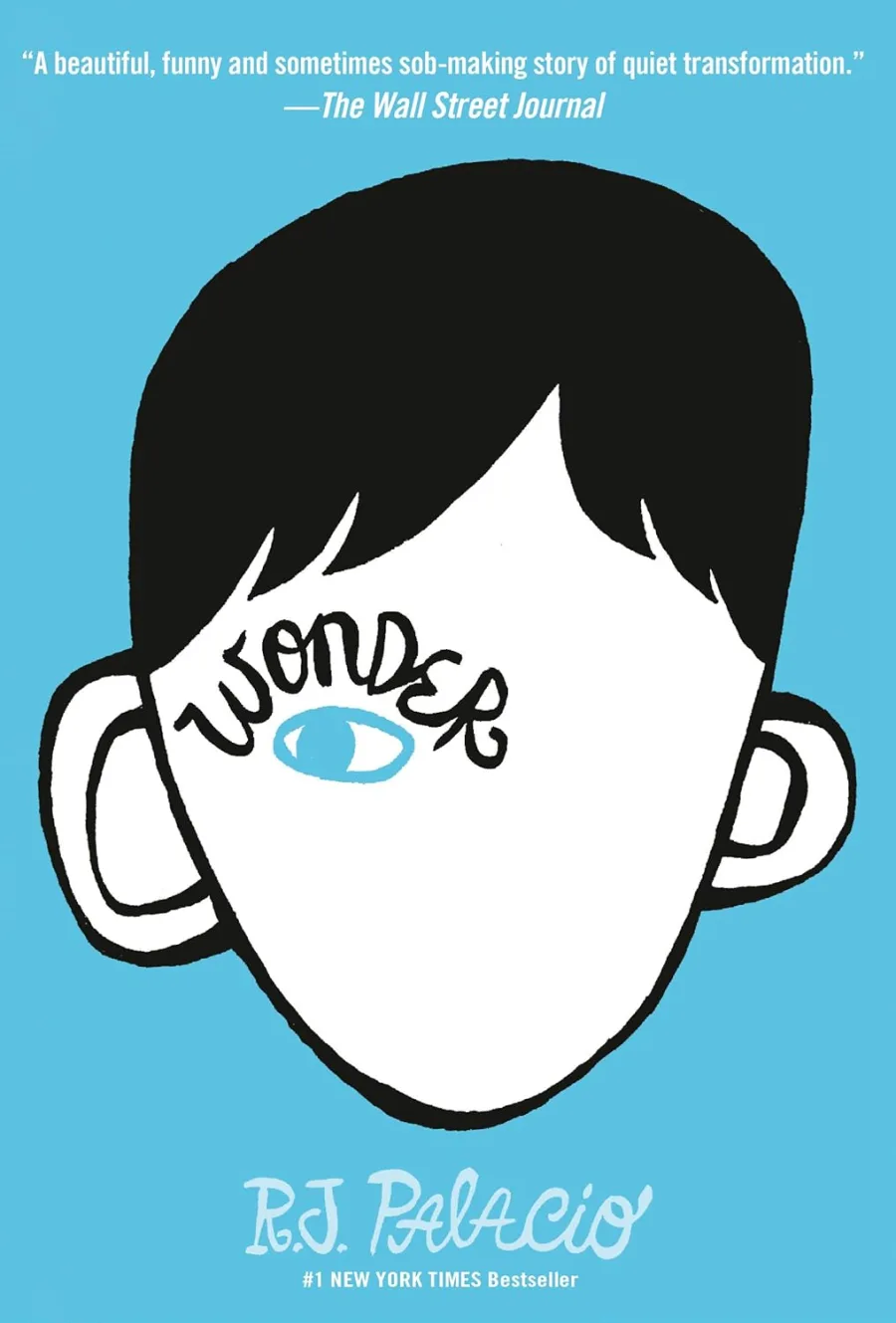
Wonder
Paperback
• 32 Pages
• USD 12.68
• English
• 9780552565974
No ratings yet
| Publisher | Random House UK |
|---|---|
| ISBN13 | 9780552565974 |
| ASIN/SKU | 0552565970 |
| Book Format | Paperback |
| Language | English |
| Pages | 32 |
| List Price | USD 12.68 |
| Publishing Date | 03/01/2014 |
| Dimensions | 5.12 x 0.79 x 7.76 inches |
| Weight | 9.4 ounces |
| Book Code | BD00055959 |
Buy this Book
Amazon Stores
Ebook Stores
Other Stores
Discover Wonder by R.J. Palacio. This book is published by Random House UK in Paperback format, ISBN 9780552565974, ASIN 0552565970, under Children's Books, Children's Disease Books, Children's eBooks on Disability.
Book Description
Whatever you're thinking, it's probably worse.'Auggie wants to be an ordinary ten-year-old. He does ordinary things - eating ice cream, playing on his Xbox. He feels ordinary - inside. But ordinary kids don't make other ordinary kids run away screaming
Author Biography
R. J. Palacio is the author of the #1 New York Times bestseller Wonder, which has sold over 16 million copies worldwide. The book’s message inspired the Choose Kind movement and has been embraced by readers around the world, with the book published in over fifty languages. Palacio’s other bestselling books include Pony, 365 Days of Wonder, Auggie & Me, the picture book We’re All Wonders, and the graphic novel White Bird. Palacio lives in Brooklyn with her husband and their dogs, Teddy and Vivian.
Editorial Reviews
#1 New York Times bestseller
USA Today bestseller
Time Magazine's 100 Best Young Adult Books of All Time
New York Times Book Review Notable Book
Washington Post Best Kids' Book
A School Library Journal Best of Children's Books
A Publishers Weekly Best of Children's Books
A Kirkus Reviews Best of Children's Books
A Booklist Best of Children's Books
Slate:
"Wonder is the best kids' book of the year."
Entertainment Weekly:
"In a wonder of a debut, Palacio has written a crackling page-turner filled with characters you can't help but root for."
The New York Times:
"Rich and memorable...It's Auggie and the rest of the children who are the real heart of 'Wonder,' and Palacio captures the voices of girls and boys, fifth graders and teenagers, with equal skill."
The Wall Street Journal:
"What makes R.J. Palacio's debut novel so remarkable, and so lovely, is the uncommon generosity with which she tells Auggie's story…The result is a beautiful, funny and sometimes sob-making story of quiet transformation.”
The Huffington Post:
"It's in the bigger themes that Palacio's writing shines. This book is a glorious exploration of the nature of friendship, tenacity, fear, and most importantly, kindness."
"Full of heart, full of truth, Wonder is a book about seeing the beauty that's all around us. I dare you not to fall in love with Auggie Pullman."
- Rebecca Stead, Newbery award-winning author of When You Reach Me
"It is the deceptive simplicity and honesty of the work that make Wonder so memorable. Every single character seems real and well drawn and oh-so human...This book is beautiful." - Christopher Paul Curtis, Newbery award-winning author of Bud, Not Buddy
"A beautiful story of kindness and courage. There are many real and well-developed characters, and they each have their shining moments. Of course, Auggie shines the brightest." - Clare Vanderpool, Newbery award-winning author of Moon Over Manifest
"Wonder is a beautifully told story about heartache, love, and the value of human life. One comes away from it wanting to be a better person." - Patricia Reilly Giff, two-time Newbery honor-winning author of Lily's Crossing and Pictures of Hollis Woods
"Wonder is a shining jewel of a story that cannot help but encourage readers of all ages to do better, to be better, in how they treat others in life. I'm totally in love with this novel." - Trudy Ludwig, anti-bullying advocate and author of My Secret Bully, Confessions of a Former Bully, Better Than You, and Just Kidding
Starred Review, Publishers Weekly:
“Few first novels pack more of a punch: it's a rare story with the power to open eyes--and hearts--to what it's like to be singled out for a difference you can't control, when all you want is to be just another face in the crowd.”
Starred Review, Booklist:
“Palacio makes it feel not only effortless but downright graceful, and by the stand-up-and-cheer conclusion, readers will be doing just that, and feeling as if they are part of this troubled but
USA Today bestseller
Time Magazine's 100 Best Young Adult Books of All Time
New York Times Book Review Notable Book
Washington Post Best Kids' Book
A School Library Journal Best of Children's Books
A Publishers Weekly Best of Children's Books
A Kirkus Reviews Best of Children's Books
A Booklist Best of Children's Books
Slate:
"Wonder is the best kids' book of the year."
Entertainment Weekly:
"In a wonder of a debut, Palacio has written a crackling page-turner filled with characters you can't help but root for."
The New York Times:
"Rich and memorable...It's Auggie and the rest of the children who are the real heart of 'Wonder,' and Palacio captures the voices of girls and boys, fifth graders and teenagers, with equal skill."
The Wall Street Journal:
"What makes R.J. Palacio's debut novel so remarkable, and so lovely, is the uncommon generosity with which she tells Auggie's story…The result is a beautiful, funny and sometimes sob-making story of quiet transformation.”
The Huffington Post:
"It's in the bigger themes that Palacio's writing shines. This book is a glorious exploration of the nature of friendship, tenacity, fear, and most importantly, kindness."
"Full of heart, full of truth, Wonder is a book about seeing the beauty that's all around us. I dare you not to fall in love with Auggie Pullman."
- Rebecca Stead, Newbery award-winning author of When You Reach Me
"It is the deceptive simplicity and honesty of the work that make Wonder so memorable. Every single character seems real and well drawn and oh-so human...This book is beautiful." - Christopher Paul Curtis, Newbery award-winning author of Bud, Not Buddy
"A beautiful story of kindness and courage. There are many real and well-developed characters, and they each have their shining moments. Of course, Auggie shines the brightest." - Clare Vanderpool, Newbery award-winning author of Moon Over Manifest
"Wonder is a beautifully told story about heartache, love, and the value of human life. One comes away from it wanting to be a better person." - Patricia Reilly Giff, two-time Newbery honor-winning author of Lily's Crossing and Pictures of Hollis Woods
"Wonder is a shining jewel of a story that cannot help but encourage readers of all ages to do better, to be better, in how they treat others in life. I'm totally in love with this novel." - Trudy Ludwig, anti-bullying advocate and author of My Secret Bully, Confessions of a Former Bully, Better Than You, and Just Kidding
Starred Review, Publishers Weekly:
“Few first novels pack more of a punch: it's a rare story with the power to open eyes--and hearts--to what it's like to be singled out for a difference you can't control, when all you want is to be just another face in the crowd.”
Starred Review, Booklist:
“Palacio makes it feel not only effortless but downright graceful, and by the stand-up-and-cheer conclusion, readers will be doing just that, and feeling as if they are part of this troubled but
Book Summary
Wonder by R.J. Palacio is a heartwarming and emotionally honest novel about a boy named August “Auggie” Pullman, who was born with a severe facial difference due to a genetic condition. Because of multiple surgeries and health issues, Auggie has never attended regular school; he has been homeschooled by his mother for years. At the start of the book, his parents decide it’s time for him to go to a mainstream school, Beecher Prep, for fifth grade. The story follows Auggie’s first year there—the friendships he makes, the cruelty he faces, and the quiet bravery it takes for him to simply show up every day. At its core, “Wonder” is about kindness, empathy, and seeing the person behind the appearance. It invites readers to reflect on how they treat others and how small acts of goodness can add up to something life changing.
Auggie is smart, funny, and loves Star Wars and science, but he’s very aware that his face is the first thing people notice. He knows that kids stare, whisper, or pull away. He worries that going to school will mean constant judgment and rejection. Still, he agrees to try, encouraged by his parents’ belief that he deserves a normal life and by his own quiet desire to belong. When he visits Beecher Prep before the year starts, he meets three students: Jack Will, Julian, and Charlotte, who are chosen by the principal, Mr. Tushman, to give him a tour. Julian is immediately rude and insensitive, asking inappropriate questions and making Auggie uncomfortable, while Jack and Charlotte are more polite and open. This early meeting sets the tone for much of Auggie’s experience: some people will be kind, some will be casually cruel, and others will not know how to act at all.
Once school begins, Auggie faces a mixture of curiosity, avoidance, and friendliness. Many classmates are unsure how to react to his appearance and choose to ignore him or keep their distance. There’s even a childish “game” started by some kids—the “plague”—where touching Auggie or his belongings is treated like something to avoid, as if he were contagious. These moments hurt deeply and reinforce his fear that he doesn’t belong. Yet amid the cruelty, there are bright spots. Jack Will becomes his friend, sitting with him in class and at lunch. Summer, a girl who chooses to sit with Auggie on the first day so he won’t be alone, turns into one of his most loyal companions. Their kindness isn’t grand or dramatic; it’s as simple as sitting together, talking, and treating him like any other kid. Through them, Auggie starts to feel that being at Beecher Prep might be possible.
One of the unique aspects of “Wonder” is that the story is told from multiple perspectives, not just Auggie’s. We hear from his older sister, Via (Olivia), from Jack Will, from Summer, and from others, each offering their own view of events and of Auggie himself. Via’s chapters show how being Auggie’s sister affects her life. She loves him dearly, but she sometimes feels overshadowed, as if the family’s energy and attention always have to revolve around his medical needs and challenges. When she starts high school, she faces her own struggles—old friendships shifting, new social circles forming—and she doesn’t always want to be defined by being “the kid whose brother has a facial deformity.” Her perspective adds depth, showing that while Auggie’s condition is central to the story, everyone around him is navigating complicated emotions and changing identities.
Jack Will’s viewpoint reveals the pressures of fitting in and doing the right thing at the same time. Jack genuinely likes Auggie and enjoys being his friend, but he also wants to be accepted by other boys at school, some of whom make fun of Auggie. At one point, Jack says something hurtful about Auggie behind his back, not realizing Auggie overhears. This leads to a painful falling out and shows how easy it is for kids to betray someone they care about when they’re afraid of losing social status. Later, Jack regrets his words deeply and works to earn back Auggie’s trust. His journey is about learning courage—not the kind you use to face physical danger, but the kind needed to stand up for a friend even when peers are watching and judging.
Summer’s chapters highlight simple, honest kindness. She befriends Auggie without being asked or pushed; she just feels it’s the right thing to do. Others sometimes question her choices, hinting that being close to Auggie could hurt her popularity, but she sticks by him anyway. For her, loyalty and empathy matter more than appearances or social games. Through Summer, the book shows how quietly powerful it can be when even one person chooses compassion over convenience. Her unwavering support becomes an anchor for Auggie during some of his hardest school days.
As the school year goes on, conflicts intensify. Julian continues to bully Auggie, making snide comments and encouraging others to exclude him. He also tries to turn classmates against Auggie and Jack by spreading rumors and creating drama. The adults in the story, like Mr. Tushman, eventually step in, investigating the bullying and holding students accountable. This subplot emphasizes that while cruelty exists, it can be challenged and stopped when people take responsibility. At the same time, other kids begin to see Auggie for who he is. A turning point comes during a school trip to a nature reserve. When Auggie and Jack are targeted by older kids from another school who mock Auggie and threaten them, several Beecher Prep boys step up to defend him. In that moment, the group shifts from passive onlookers to active protectors, and Auggie experiences a rare, powerful sense of acceptance.
Auggie’s parents and family form the emotional backbone of the story. His mother is loving and fiercely protective, sometimes anxious about exposing him to the wider world but determined not to shelter him so much that he misses out on life. His father is supportive and humorous, using jokes to ease tension and make Auggie feel normal. Via, as mentioned, wrestles with her own feelings but ultimately shows deep devotion to her brother. The family scenes remind us that beyond school, Auggie is simply a child in a home filled with ordinary routines—watching movies, dressing up for Halloween, arguing, laughing, and celebrating. This helps ground the story, showing that his life is not defined only by how strangers see him.
Throughout the book, Palacio threads the idea of “choosing kind” as a guiding principle. At Beecher Prep, Mr. Tushman and the staff emphasize precepts—short moral sayings—that students reflect on, such as “When given the choice between being right and being kind, choose kind.” These precepts shape Auggie’s classmates and become a lens through which readers are invited to view their own actions. Kindness in “Wonder” is not portrayed as something soft or weak; it is shown as brave and sometimes difficult, especially when peer pressure or fear of embarrassment push against it. The narrative suggests that character is revealed in how we treat those who are different, and that truly seeing someone means looking beyond the surface.
By the end of the school year, Auggie’s journey has been full of ups and downs—cruel jokes, tears, quiet victories, and surprising friendships. At the culminating school event, he receives a special award for his strength of character. The moment is emotional, not because he is being pitied, but because his classmates and teachers genuinely recognize his courage, resilience, and kindness. Auggie, who began the year worried he would always be seen as a “freak,” is now applauded as a valued member of the school community. The recognition symbolizes how far he and those around him have come. They have learned to look at him with understanding and respect, and many have grown kinder and more thoughtful in the process.
Wonder ends on a hopeful note. Auggie’s life is not magically made perfect—he will always face challenges related to how he looks—but he has proved to himself and others that he belongs. He has friends, memories, and the confidence that he can handle what comes next. The novel leaves readers with a strong, lingering message: people’s appearances never tell the whole story, and a single act of kindness can change someone’s world. Through Auggie’s eyes and the perspectives of those around him, “Wonder” becomes more than just a school story; it becomes a gentle call to empathy, urging us to be a little braver, a little gentler, and, above all, a little kinder in the way we see and treat others.
Auggie is smart, funny, and loves Star Wars and science, but he’s very aware that his face is the first thing people notice. He knows that kids stare, whisper, or pull away. He worries that going to school will mean constant judgment and rejection. Still, he agrees to try, encouraged by his parents’ belief that he deserves a normal life and by his own quiet desire to belong. When he visits Beecher Prep before the year starts, he meets three students: Jack Will, Julian, and Charlotte, who are chosen by the principal, Mr. Tushman, to give him a tour. Julian is immediately rude and insensitive, asking inappropriate questions and making Auggie uncomfortable, while Jack and Charlotte are more polite and open. This early meeting sets the tone for much of Auggie’s experience: some people will be kind, some will be casually cruel, and others will not know how to act at all.
Once school begins, Auggie faces a mixture of curiosity, avoidance, and friendliness. Many classmates are unsure how to react to his appearance and choose to ignore him or keep their distance. There’s even a childish “game” started by some kids—the “plague”—where touching Auggie or his belongings is treated like something to avoid, as if he were contagious. These moments hurt deeply and reinforce his fear that he doesn’t belong. Yet amid the cruelty, there are bright spots. Jack Will becomes his friend, sitting with him in class and at lunch. Summer, a girl who chooses to sit with Auggie on the first day so he won’t be alone, turns into one of his most loyal companions. Their kindness isn’t grand or dramatic; it’s as simple as sitting together, talking, and treating him like any other kid. Through them, Auggie starts to feel that being at Beecher Prep might be possible.
One of the unique aspects of “Wonder” is that the story is told from multiple perspectives, not just Auggie’s. We hear from his older sister, Via (Olivia), from Jack Will, from Summer, and from others, each offering their own view of events and of Auggie himself. Via’s chapters show how being Auggie’s sister affects her life. She loves him dearly, but she sometimes feels overshadowed, as if the family’s energy and attention always have to revolve around his medical needs and challenges. When she starts high school, she faces her own struggles—old friendships shifting, new social circles forming—and she doesn’t always want to be defined by being “the kid whose brother has a facial deformity.” Her perspective adds depth, showing that while Auggie’s condition is central to the story, everyone around him is navigating complicated emotions and changing identities.
Jack Will’s viewpoint reveals the pressures of fitting in and doing the right thing at the same time. Jack genuinely likes Auggie and enjoys being his friend, but he also wants to be accepted by other boys at school, some of whom make fun of Auggie. At one point, Jack says something hurtful about Auggie behind his back, not realizing Auggie overhears. This leads to a painful falling out and shows how easy it is for kids to betray someone they care about when they’re afraid of losing social status. Later, Jack regrets his words deeply and works to earn back Auggie’s trust. His journey is about learning courage—not the kind you use to face physical danger, but the kind needed to stand up for a friend even when peers are watching and judging.
Summer’s chapters highlight simple, honest kindness. She befriends Auggie without being asked or pushed; she just feels it’s the right thing to do. Others sometimes question her choices, hinting that being close to Auggie could hurt her popularity, but she sticks by him anyway. For her, loyalty and empathy matter more than appearances or social games. Through Summer, the book shows how quietly powerful it can be when even one person chooses compassion over convenience. Her unwavering support becomes an anchor for Auggie during some of his hardest school days.
As the school year goes on, conflicts intensify. Julian continues to bully Auggie, making snide comments and encouraging others to exclude him. He also tries to turn classmates against Auggie and Jack by spreading rumors and creating drama. The adults in the story, like Mr. Tushman, eventually step in, investigating the bullying and holding students accountable. This subplot emphasizes that while cruelty exists, it can be challenged and stopped when people take responsibility. At the same time, other kids begin to see Auggie for who he is. A turning point comes during a school trip to a nature reserve. When Auggie and Jack are targeted by older kids from another school who mock Auggie and threaten them, several Beecher Prep boys step up to defend him. In that moment, the group shifts from passive onlookers to active protectors, and Auggie experiences a rare, powerful sense of acceptance.
Auggie’s parents and family form the emotional backbone of the story. His mother is loving and fiercely protective, sometimes anxious about exposing him to the wider world but determined not to shelter him so much that he misses out on life. His father is supportive and humorous, using jokes to ease tension and make Auggie feel normal. Via, as mentioned, wrestles with her own feelings but ultimately shows deep devotion to her brother. The family scenes remind us that beyond school, Auggie is simply a child in a home filled with ordinary routines—watching movies, dressing up for Halloween, arguing, laughing, and celebrating. This helps ground the story, showing that his life is not defined only by how strangers see him.
Throughout the book, Palacio threads the idea of “choosing kind” as a guiding principle. At Beecher Prep, Mr. Tushman and the staff emphasize precepts—short moral sayings—that students reflect on, such as “When given the choice between being right and being kind, choose kind.” These precepts shape Auggie’s classmates and become a lens through which readers are invited to view their own actions. Kindness in “Wonder” is not portrayed as something soft or weak; it is shown as brave and sometimes difficult, especially when peer pressure or fear of embarrassment push against it. The narrative suggests that character is revealed in how we treat those who are different, and that truly seeing someone means looking beyond the surface.
By the end of the school year, Auggie’s journey has been full of ups and downs—cruel jokes, tears, quiet victories, and surprising friendships. At the culminating school event, he receives a special award for his strength of character. The moment is emotional, not because he is being pitied, but because his classmates and teachers genuinely recognize his courage, resilience, and kindness. Auggie, who began the year worried he would always be seen as a “freak,” is now applauded as a valued member of the school community. The recognition symbolizes how far he and those around him have come. They have learned to look at him with understanding and respect, and many have grown kinder and more thoughtful in the process.
Wonder ends on a hopeful note. Auggie’s life is not magically made perfect—he will always face challenges related to how he looks—but he has proved to himself and others that he belongs. He has friends, memories, and the confidence that he can handle what comes next. The novel leaves readers with a strong, lingering message: people’s appearances never tell the whole story, and a single act of kindness can change someone’s world. Through Auggie’s eyes and the perspectives of those around him, “Wonder” becomes more than just a school story; it becomes a gentle call to empathy, urging us to be a little braver, a little gentler, and, above all, a little kinder in the way we see and treat others.
Sample Chapters
Sample Chapters will be added soon…
Reader Reviews
No reviews yet.
Wonder