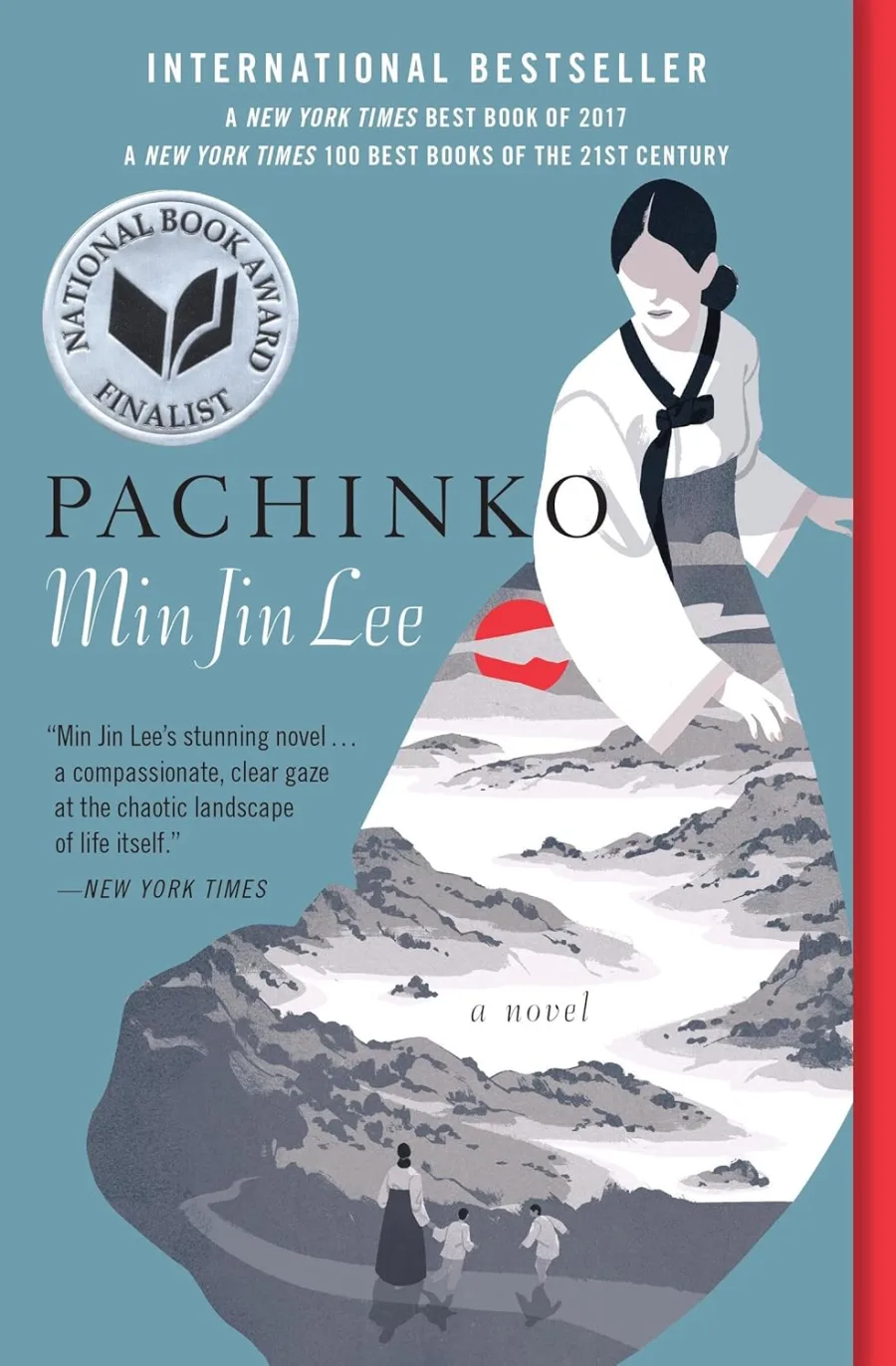
Pachinko
Paperback
• 544 Pages
• USD 21.99
• English
• 9781455563920
No ratings yet
| Publisher | Grand Central Publishing |
|---|---|
| ISBN13 | 9781455563920 |
| ASIN/SKU | 1455563927 |
| Book Format | Paperback |
| Language | English |
| Pages | 544 |
| List Price | USD 21.99 |
| Publishing Date | 14/11/2017 |
| Dimensions | 5.25 x 1.36 x 8 inches |
| Weight | 15.2 ounces |
| Book Code | BD00055960 |
Buy this Book
Amazon Stores
Ebook Stores
Other Stores
Discover Pachinko by Min Jin Lee. This book is published by Grand Central Publishing in Paperback format, ISBN 9781455563920, ASIN 1455563927, under Literature and Fiction, Asian American and Pacific Islander Literature, Cultural Heritage Fiction.
Book Description
One of the New York Times’ 100 Best Books of the 21st Century.
In this New York Times bestseller, four generations of a poor Korean immigrant family fight to control their destiny in 20th-century Japan.
“Stunning.” —New York Times Book Review
In the early 1900s, teenaged Sunja, the adored daughter of a crippled fisherman, falls for a wealthy stranger. When she discovers she is pregnant—and that her lover is married—she accepts an offer of marriage from a gentle, sickly minister passing through on his way to Japan. But her decision to abandon her home, and to reject her son's powerful father, sets off a dramatic saga that will echo down through the generations.
Profoundly moving, Pachinko is a story of love, sacrifice, ambition, and loyalty.
NEW YORK TIMES BESTSELLER • #1 BOSTON GLOBE BESTSELLER • USA TODAY BESTSELLER • WALL STREET JOURNAL BESTSELLER • WASHINGTON POST BESTSELLER
In this New York Times bestseller, four generations of a poor Korean immigrant family fight to control their destiny in 20th-century Japan.
“Stunning.” —New York Times Book Review
In the early 1900s, teenaged Sunja, the adored daughter of a crippled fisherman, falls for a wealthy stranger. When she discovers she is pregnant—and that her lover is married—she accepts an offer of marriage from a gentle, sickly minister passing through on his way to Japan. But her decision to abandon her home, and to reject her son's powerful father, sets off a dramatic saga that will echo down through the generations.
Profoundly moving, Pachinko is a story of love, sacrifice, ambition, and loyalty.
NEW YORK TIMES BESTSELLER • #1 BOSTON GLOBE BESTSELLER • USA TODAY BESTSELLER • WALL STREET JOURNAL BESTSELLER • WASHINGTON POST BESTSELLER
Author Biography
Min Jin Lee is a recipient of fellowships in Fiction from the Guggenheim Foundation (2018) and the Radcliffe Institute for Advanced Study at Harvard (2018-2019). Her novel Pachinko (2017) was a finalist for the National Book Award for Fiction, a runner-up for the Dayton Literary Peace Prize, winner of the Medici Book Club Prize, and one of the New York Times' "Ten Best Books of 2017." A New York Times bestseller, Pachinko was also one of the "Ten Best Books" of the year for BBC and the New York Public Library, and a "best international fiction" pick for the Canadian Broadcasting Corporation. In total, it was on over seventy-five best books of the year lists, including NPR, PBS, and CNN, and it was a selection for Now Read This, the joint book club of PBS NewsHour and the New York Times. Pachinko will be translated into twenty-seven languages. Lee's debut novel Free Food for Millionaires (2007) was one of the best books of the year for the Times of London, NPR's Fresh Air, and USA Today, and it was a national bestseller. Her writings have appeared in the New Yorker, NPR's Selected Shorts, One Story, the New York Review of Books, the New York Times Magazine, the New York Times Book Review, the Times Literary Supplement, the Guardian, Condé Nast Traveler, the Times of London, andthe Wall Street Journal. Lee served three consecutive seasons as a Morning Forum columnist of the Chosun Ilbo of South Korea. In 2018, she was named as one of Adweek's Creative 100 for being one of the "ten writers and editors who are changing the national conversation," and one of the Guardian's Frederick Douglass 200. She received an honorary doctor of humane letters degree from Monmouth College. She will be a Writer-in-Residence at Amherst College from 2019-2022.
Editorial Reviews
One of Buzzfeed's "32 Most Exciting Books Coming In 2017"
Included in The Millions' "Most Anticipated: The Great 2017 Book Preview"
One of Elle's "25 Most Anticipated Books by Women for 2017"
BBC: "Ten Books to Read in 2017"
One of BookRiot's "Most Anticipated Books of 2017"
One of Nylon's "50 Books We Can't Wait To Read In 2017"
One of Entertainment Weekly's Best New Books
One of BookBub's 22 Most Anticipated Book Club Reads of 2017
"Stunning... Despite the compelling sweep of time and history, it is the characters and their tumultuous lives that propel the narrative... A compassionate, clear gaze at the chaotic landscape of life itself. In this haunting epic tale, no one story seems too minor to be briefly illuminated. Lee suggests that behind the facades of wildly different people lie countless private desires, hopes and miseries, if we have the patience and compassion to look and listen."―The New York Times Book Review
"In 1930s Korea, an earnest young woman, abandoned by the lover who has gotten her pregnant, enters into a marriage of convenience that will take her to a new life in Japan. Thus begins Lee's luminous new novel PACHINKO--a powerful meditation on what immigrants sacrifice to achieve a home in the world. PACHINKO confirms Lee's place among our finest novelists."―Junot Díaz, Pulitzer Prize-winning author of The Brief Wondrous Life of Oscar Wao and This Is How You Lose Her
"A deep, broad, addictive history of a Korean family in Japan enduring and prospering through the 20th century."―David Mitchell, Guardian, New York Times bestselling author of The Bone Clocks
"Astounding. The sweep of Dickens and Tolstoy applied to a 20th century Korean family in Japan. Min Jin Lee's PACHINKO tackles all the stuff most good novels do-family, love, cabbage-but it also asks questions that have never been more timely. What does it mean to be part of a nation? And what can one do to escape its tight, painful, familiar bonds?"―Gary Shteyngart, New York Times bestselling author of Little Failure and Super Sad True Love Story
"Both for those who love Korea, as well as for those who know no more than Hyundai, Samsung and kimchi, this extraordinary book will prove a revelation of joy and heartbreak. I could not stop turning the pages, and wished this most poignant of sagas would never end. Min Jin Lee displays a tenderness and wisdom ideally matched to an unforgettable tale that she relates just perfectly."―Simon Winchester, New York Times bestselling author of The Professor and the Madman and Korea: A Walk through the Land of Miracles
"PACHINKO is elegant and soulful, both intimate and sweeping. This story of several generations of one Korean family in Japan is the story of every family whose parents sacrificed for their children, every family whose children were unable to recognize the cost, but it's also the story of a specific cultural struggle in a riveting time and place. Min Jin Lee has written a big, beautiful book filled with charact
Included in The Millions' "Most Anticipated: The Great 2017 Book Preview"
One of Elle's "25 Most Anticipated Books by Women for 2017"
BBC: "Ten Books to Read in 2017"
One of BookRiot's "Most Anticipated Books of 2017"
One of Nylon's "50 Books We Can't Wait To Read In 2017"
One of Entertainment Weekly's Best New Books
One of BookBub's 22 Most Anticipated Book Club Reads of 2017
"Stunning... Despite the compelling sweep of time and history, it is the characters and their tumultuous lives that propel the narrative... A compassionate, clear gaze at the chaotic landscape of life itself. In this haunting epic tale, no one story seems too minor to be briefly illuminated. Lee suggests that behind the facades of wildly different people lie countless private desires, hopes and miseries, if we have the patience and compassion to look and listen."―The New York Times Book Review
"In 1930s Korea, an earnest young woman, abandoned by the lover who has gotten her pregnant, enters into a marriage of convenience that will take her to a new life in Japan. Thus begins Lee's luminous new novel PACHINKO--a powerful meditation on what immigrants sacrifice to achieve a home in the world. PACHINKO confirms Lee's place among our finest novelists."―Junot Díaz, Pulitzer Prize-winning author of The Brief Wondrous Life of Oscar Wao and This Is How You Lose Her
"A deep, broad, addictive history of a Korean family in Japan enduring and prospering through the 20th century."―David Mitchell, Guardian, New York Times bestselling author of The Bone Clocks
"Astounding. The sweep of Dickens and Tolstoy applied to a 20th century Korean family in Japan. Min Jin Lee's PACHINKO tackles all the stuff most good novels do-family, love, cabbage-but it also asks questions that have never been more timely. What does it mean to be part of a nation? And what can one do to escape its tight, painful, familiar bonds?"―Gary Shteyngart, New York Times bestselling author of Little Failure and Super Sad True Love Story
"Both for those who love Korea, as well as for those who know no more than Hyundai, Samsung and kimchi, this extraordinary book will prove a revelation of joy and heartbreak. I could not stop turning the pages, and wished this most poignant of sagas would never end. Min Jin Lee displays a tenderness and wisdom ideally matched to an unforgettable tale that she relates just perfectly."―Simon Winchester, New York Times bestselling author of The Professor and the Madman and Korea: A Walk through the Land of Miracles
"PACHINKO is elegant and soulful, both intimate and sweeping. This story of several generations of one Korean family in Japan is the story of every family whose parents sacrificed for their children, every family whose children were unable to recognize the cost, but it's also the story of a specific cultural struggle in a riveting time and place. Min Jin Lee has written a big, beautiful book filled with charact
Book Summary
Pachinko by Min Jin Lee is a sweeping, multi generational family saga that follows a Korean family over several decades, beginning in the early 1900s in a small fishing village in Korea and moving through the years of Japanese occupation, migration to Japan, war, and the struggles of living as outsiders in a country that never fully accepts them. At its heart, the novel is about survival, dignity, and the quiet courage it takes to keep going when the world is stacked against you. It shows how history—colonialism, racism, poverty, and war—presses down on ordinary people, shaping their choices, loves, and loyalties. The story centers on Sunja, a poor but strong willed girl whose single decision as a teenager alters the course of her family’s life for generations.
The book begins with Hoonie, Sunja’s father, a gentle, disabled man who owns a boardinghouse in Yeongdo, near Busan. He is kind and hardworking, and though he is mocked for his physical differences, he marries Yangjin, and together they have Sunja. After Hoonie’s death, Yangjin and Sunja run the boardinghouse alone, renting rooms to fishermen and travelers. Their lives are modest and difficult, but stable. As Japan’s occupation of Korea tightens, the atmosphere grows more oppressive. Koreans are poor, discriminated against, and increasingly aware that their land is no longer their own. In this world, Sunja grows up knowing hardship but also learning resilience and practicality from her mother.
Sunja’s life changes when she meets Hansu, a wealthy, older Korean businessman who has strong ties to Japan and the criminal underworld. He is charming, confident, and worldly—very different from anyone Sunja has known. They begin an affair, and Sunja becomes pregnant. She assumes they will marry, but Hansu reveals he already has a Japanese wife and family in Osaka. He offers to support Sunja and her child financially but cannot give her legitimacy or a public relationship. Sunja, proud and morally grounded, refuses to become his mistress, even though accepting his offer would guarantee financial security. Her refusal is a key turning point: she chooses honor and independence over comfort, setting her life and her child’s life on a far more challenging path.
Around this time, a sickly Christian minister named Baek Isak comes to stay at the boardinghouse. He learns of Sunja’s situation and, moved by compassion and his own beliefs, offers to marry her and raise the child as his own. Sunja agrees, and they leave Korea for Japan, where Isak’s brother lives and works. The journey marks the beginning of the family’s immigrant story. Arriving in Osaka, Sunja and Isak are immediately confronted with harsh realities: Koreans are considered inferior, forced into poor neighborhoods, and restricted to low status jobs. They live with Isak’s brother Yoseb and his wife Kyunghee in cramped conditions, struggling to make ends meet. Despite the hardships, Kyunghee becomes a beloved sister to Sunja, and their domestic world—sharing food, chores, and worries—provides warmth against the coldness outside.
In Japan, Sunja gives birth to her first son, Noa, and later to her second son, Mozasu. Isak works for the church, and the family’s life revolves around faith, community, and survival. However, political tensions and war change everything. Isak is eventually arrested for his involvement in labor organizing and quietly disappears into the prison system, leaving the women and children alone. Sunja, now a single mother in a foreign country where she is despised, must find a way to support her family. She begins selling kimchi and other Korean food, working long hours and facing humiliation. Through Sunja’s struggle, the novel shows what it means to carry the weight of responsibility, especially for women who have little power but enormous expectations placed on them.
Hansu, though rejected as a husband, continues to affect their lives. He secretly watches over Sunja and her children, intervening at key moments to protect them from disaster. He pays for Noa’s education, wanting him to have opportunities that poverty would otherwise deny. Noa grows up bookish, serious, and deeply aware of the shame and stigma attached to being Korean in Japan. He idolizes the Japanese culture he’s immersed in and dreams of a respectable, quiet life. When he eventually discovers that his biological father is Hansu and that Hansu is involved in organized crime, Noa is devastated. He feels tainted and believes that his very blood marks him as unworthy. His reaction reveals a central theme of the book: how internalized shame can destroy a person even more thoroughly than external prejudice.
Mozasu, Sunja’s younger son, takes a different path. Less academic and more practical, he leaves school early and eventually finds success working in pachinko parlors. Pachinko—a gambling game housed in noisy, colorful parlors—is one of the few industries where Koreans can carve out some profit and power in Japan, even though it is viewed with suspicion and low status. Mozasu becomes wealthy through pachinko, but the stigma remains. The industry itself becomes a symbol in the novel: it is rigged, risky, and morally ambiguous, much like the social system Korean immigrants navigate. You can win, but the game is never truly fair, and the house always has the advantage. Min Jin Lee uses pachinko as a metaphor for the ways life is stacked against the family and how they still must play to survive.
As time moves forward, the focus shifts to the next generation, including Mozasu’s son, Solomon. Growing up in a more modern, globalized Japan, Solomon attends international schools and works in corporate environments. He speaks English, has broader horizons, and believes he might escape the limitations that defined his parents’ lives. Yet he discovers that prejudice is persistent and deeply rooted. In key moments, his Korean identity—and the assumptions people make about it—still affects his prospects and relationships. His story underscores how discrimination evolves but doesn’t simply vanish, and how the burden of history is passed down in ways that are both visible and invisible.
Throughout the novel, Min Jin Lee highlights the lives of women: Sunja, Yangjin, Kyunghee, and others who keep families together while men leave, die, or fail. These women cook, clean, earn money, raise children, and absorb the pain of loss, all while rarely being granted power or recognition. Sunja, in particular, embodies quiet heroism. She doesn’t give grand speeches; she works, sacrifices, and loves her children fiercely. She carries guilt over her early choices yet refuses self pity. Her life, and her refusal to bend to Hansu’s terms, becomes the moral spine of the narrative. Through her, the novel explores themes of motherhood, endurance, and the ways love can be both a blessing and a source of anguish.
Pachinko also deeply explores identity and belonging. The Korean characters in Japan are permanently in between—neither fully Korean anymore, since their homeland has changed and moved on without them, nor fully Japanese, since laws and social attitudes keep them at the margins. They are reminded constantly that they are guests, foreigners, and sometimes even enemies, no matter how long they have lived there or how well they speak the language. Names are changed, documents questioned, and citizenship denied or complicated. This condition of being “in between” shapes their self worth and choices. Some try to assimilate completely, others cling to Korean traditions, and many do both, depending on the day and circumstance.
By the end of Pachinko the reader has followed this family across almost a century. There are deaths, betrayals, small joys, and large sorrows. Not everyone gets a happy ending; in fact, the novel insists on the reality that life for marginalized people is often unfair and heartbreaking. Yet there are moments of grace: shared meals, loyal friendships, laughter, and the simple fact that the family persists. Sunja looks back on her life with a mixture of regret and pride, recognizing that though she could not protect everyone from pain, she did what she could in a world that offered her few choices. The title reminds us that like the pachinko machine, life spits people out in seemingly random patterns—but beneath that chaos, there are systems, histories, and decisions that explain why some people win and others lose. Pachinko ultimately is a richly human story about how people live, love, and hope under conditions that are profoundly unfair, and how, even when the game is rigged, they keep playing for the sake of the next generation.
The book begins with Hoonie, Sunja’s father, a gentle, disabled man who owns a boardinghouse in Yeongdo, near Busan. He is kind and hardworking, and though he is mocked for his physical differences, he marries Yangjin, and together they have Sunja. After Hoonie’s death, Yangjin and Sunja run the boardinghouse alone, renting rooms to fishermen and travelers. Their lives are modest and difficult, but stable. As Japan’s occupation of Korea tightens, the atmosphere grows more oppressive. Koreans are poor, discriminated against, and increasingly aware that their land is no longer their own. In this world, Sunja grows up knowing hardship but also learning resilience and practicality from her mother.
Sunja’s life changes when she meets Hansu, a wealthy, older Korean businessman who has strong ties to Japan and the criminal underworld. He is charming, confident, and worldly—very different from anyone Sunja has known. They begin an affair, and Sunja becomes pregnant. She assumes they will marry, but Hansu reveals he already has a Japanese wife and family in Osaka. He offers to support Sunja and her child financially but cannot give her legitimacy or a public relationship. Sunja, proud and morally grounded, refuses to become his mistress, even though accepting his offer would guarantee financial security. Her refusal is a key turning point: she chooses honor and independence over comfort, setting her life and her child’s life on a far more challenging path.
Around this time, a sickly Christian minister named Baek Isak comes to stay at the boardinghouse. He learns of Sunja’s situation and, moved by compassion and his own beliefs, offers to marry her and raise the child as his own. Sunja agrees, and they leave Korea for Japan, where Isak’s brother lives and works. The journey marks the beginning of the family’s immigrant story. Arriving in Osaka, Sunja and Isak are immediately confronted with harsh realities: Koreans are considered inferior, forced into poor neighborhoods, and restricted to low status jobs. They live with Isak’s brother Yoseb and his wife Kyunghee in cramped conditions, struggling to make ends meet. Despite the hardships, Kyunghee becomes a beloved sister to Sunja, and their domestic world—sharing food, chores, and worries—provides warmth against the coldness outside.
In Japan, Sunja gives birth to her first son, Noa, and later to her second son, Mozasu. Isak works for the church, and the family’s life revolves around faith, community, and survival. However, political tensions and war change everything. Isak is eventually arrested for his involvement in labor organizing and quietly disappears into the prison system, leaving the women and children alone. Sunja, now a single mother in a foreign country where she is despised, must find a way to support her family. She begins selling kimchi and other Korean food, working long hours and facing humiliation. Through Sunja’s struggle, the novel shows what it means to carry the weight of responsibility, especially for women who have little power but enormous expectations placed on them.
Hansu, though rejected as a husband, continues to affect their lives. He secretly watches over Sunja and her children, intervening at key moments to protect them from disaster. He pays for Noa’s education, wanting him to have opportunities that poverty would otherwise deny. Noa grows up bookish, serious, and deeply aware of the shame and stigma attached to being Korean in Japan. He idolizes the Japanese culture he’s immersed in and dreams of a respectable, quiet life. When he eventually discovers that his biological father is Hansu and that Hansu is involved in organized crime, Noa is devastated. He feels tainted and believes that his very blood marks him as unworthy. His reaction reveals a central theme of the book: how internalized shame can destroy a person even more thoroughly than external prejudice.
Mozasu, Sunja’s younger son, takes a different path. Less academic and more practical, he leaves school early and eventually finds success working in pachinko parlors. Pachinko—a gambling game housed in noisy, colorful parlors—is one of the few industries where Koreans can carve out some profit and power in Japan, even though it is viewed with suspicion and low status. Mozasu becomes wealthy through pachinko, but the stigma remains. The industry itself becomes a symbol in the novel: it is rigged, risky, and morally ambiguous, much like the social system Korean immigrants navigate. You can win, but the game is never truly fair, and the house always has the advantage. Min Jin Lee uses pachinko as a metaphor for the ways life is stacked against the family and how they still must play to survive.
As time moves forward, the focus shifts to the next generation, including Mozasu’s son, Solomon. Growing up in a more modern, globalized Japan, Solomon attends international schools and works in corporate environments. He speaks English, has broader horizons, and believes he might escape the limitations that defined his parents’ lives. Yet he discovers that prejudice is persistent and deeply rooted. In key moments, his Korean identity—and the assumptions people make about it—still affects his prospects and relationships. His story underscores how discrimination evolves but doesn’t simply vanish, and how the burden of history is passed down in ways that are both visible and invisible.
Throughout the novel, Min Jin Lee highlights the lives of women: Sunja, Yangjin, Kyunghee, and others who keep families together while men leave, die, or fail. These women cook, clean, earn money, raise children, and absorb the pain of loss, all while rarely being granted power or recognition. Sunja, in particular, embodies quiet heroism. She doesn’t give grand speeches; she works, sacrifices, and loves her children fiercely. She carries guilt over her early choices yet refuses self pity. Her life, and her refusal to bend to Hansu’s terms, becomes the moral spine of the narrative. Through her, the novel explores themes of motherhood, endurance, and the ways love can be both a blessing and a source of anguish.
Pachinko also deeply explores identity and belonging. The Korean characters in Japan are permanently in between—neither fully Korean anymore, since their homeland has changed and moved on without them, nor fully Japanese, since laws and social attitudes keep them at the margins. They are reminded constantly that they are guests, foreigners, and sometimes even enemies, no matter how long they have lived there or how well they speak the language. Names are changed, documents questioned, and citizenship denied or complicated. This condition of being “in between” shapes their self worth and choices. Some try to assimilate completely, others cling to Korean traditions, and many do both, depending on the day and circumstance.
By the end of Pachinko the reader has followed this family across almost a century. There are deaths, betrayals, small joys, and large sorrows. Not everyone gets a happy ending; in fact, the novel insists on the reality that life for marginalized people is often unfair and heartbreaking. Yet there are moments of grace: shared meals, loyal friendships, laughter, and the simple fact that the family persists. Sunja looks back on her life with a mixture of regret and pride, recognizing that though she could not protect everyone from pain, she did what she could in a world that offered her few choices. The title reminds us that like the pachinko machine, life spits people out in seemingly random patterns—but beneath that chaos, there are systems, histories, and decisions that explain why some people win and others lose. Pachinko ultimately is a richly human story about how people live, love, and hope under conditions that are profoundly unfair, and how, even when the game is rigged, they keep playing for the sake of the next generation.
Sample Chapters
Sample Chapters will be added soon…
Reader Reviews
No reviews yet.
Pachinko