
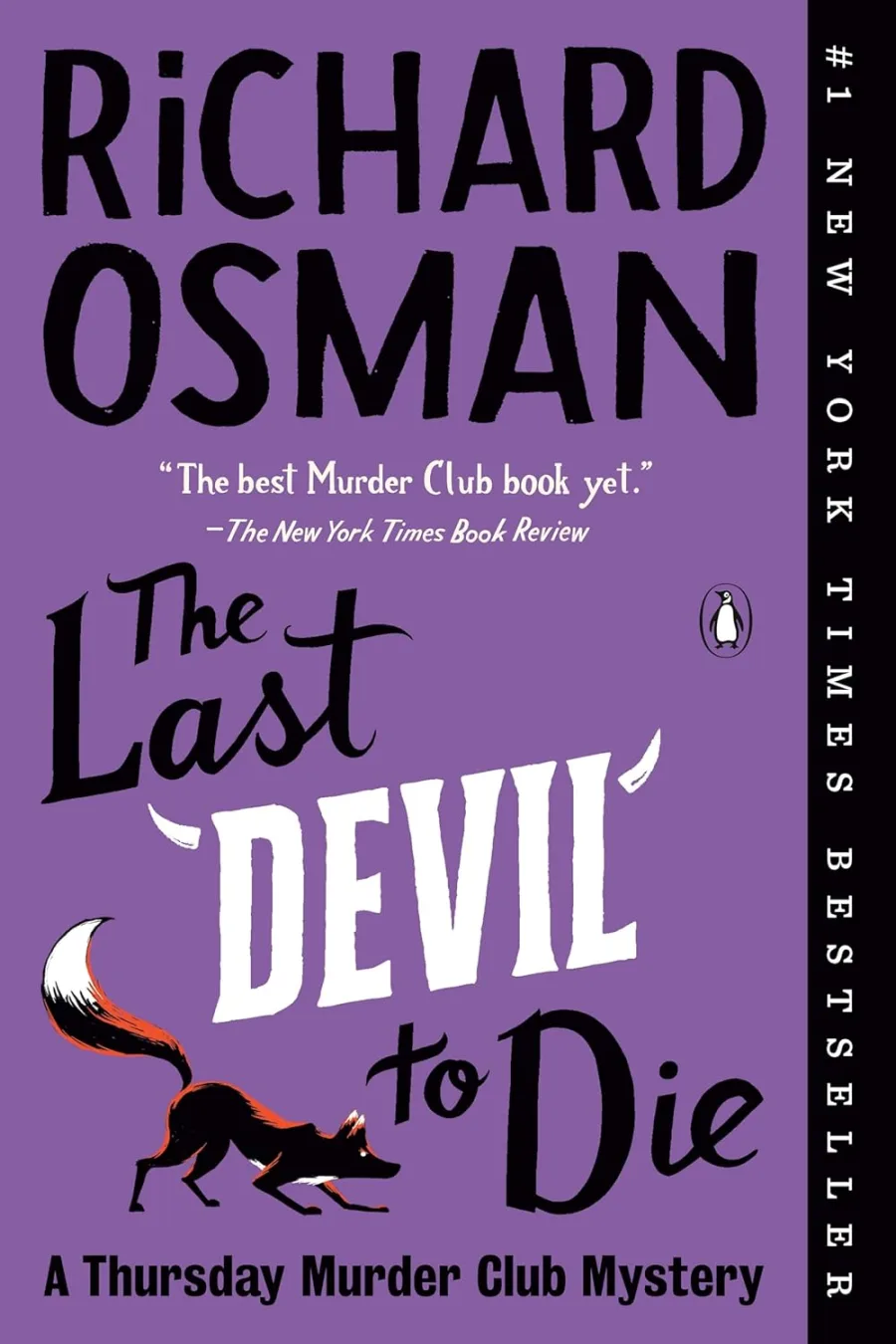
The Last Devil to Die: A Thursday Murder Club Mystery
Paperback
• 384 Pages
• USD 18.00
• English
• 9780593299449
No ratings yet
| Publisher | Penguin Books |
|---|---|
| ISBN13 | 9780593299449 |
| ASIN/SKU | 0593299442 |
| Book Format | Paperback |
| Language | English |
| Pages | 384 |
| List Price | USD 18.00 |
| Publishing Date | 13/08/2024 |
| Dimensions | 5.45 x 0.88 x 8.25 inches |
| Weight | 10.4 ounces |
| Book Code | BD00055971 |
Buy this Book
Amazon Stores
Ebook Stores
Other Stores
Discover The Last Devil to Die: A Thursday Murder Club Mystery by Richard Osman. This book is published by Penguin Books in Paperback format, ISBN 9780593299449, ASIN 0593299442, under Mystery, Thriller and Suspense, Cozy Mysteries, Amateur Sleuths.
Book Description
The fourth installment in the beloved and New York Times bestselling series from Richard Osman, now streaming on Netflix
“The best Murder Club book yet. . . A poignant complement to both the fair-play mystery plot and the characters’ lively humor.”
—The New York Times Book Review
It's rarely a quiet day for the Thursday Murder Club.
Shocking news reaches them—an old friend has been killed, and a dangerous package he was protecting has gone missing.
The gang's search leads them into the antiques business, where the tricks of the trade are as old as the objects themselves. As they encounter drug dealers, art forgers, and online fraudsters—as well as heartache close to home—Elizabeth, Joyce, Ron, and Ibrahim have no idea whom to trust.
With the body count rising, the clock ticking down, and trouble firmly on their tail, has their luck finally run out?
And who will be the last devil to die?
“The best Murder Club book yet. . . A poignant complement to both the fair-play mystery plot and the characters’ lively humor.”
—The New York Times Book Review
It's rarely a quiet day for the Thursday Murder Club.
Shocking news reaches them—an old friend has been killed, and a dangerous package he was protecting has gone missing.
The gang's search leads them into the antiques business, where the tricks of the trade are as old as the objects themselves. As they encounter drug dealers, art forgers, and online fraudsters—as well as heartache close to home—Elizabeth, Joyce, Ron, and Ibrahim have no idea whom to trust.
With the body count rising, the clock ticking down, and trouble firmly on their tail, has their luck finally run out?
And who will be the last devil to die?
Author Biography
Richard Osman is an author, producer and television presenter. The Thursday Murder Club is his first novel. He is well known for TV shows including Pointless and Richard Osman’s House of Games. As the creative director of Endemol UK, Richard has worked as an executive producer on numerous shows including Deal Or No Deal and 8 Out of 10 Cats. He is also a regular on panel and game shows such as Have I Got News For You, Would I Lie To You and Taskmaster.
Editorial Reviews
Praise for The Last Devil to Die:
“Skulduggery and laughs abound as our favorite gaggle of amateur-detective retirees tackle drug runners, dodgy antique dealers, art forgers and Battenberg cake recipes.”
—People
“The best Murder Club book yet. . . A poignant complement to both the fair-play mystery plot and the characters’ lively humor.”
—New York Times Book Review
“So what is it about the Thursday Murder Club books that make them so broadly appealing? The simple answer is that they are really good. The writing is pithy and fresh, so much so that I kept writing down lines from The Last Devil To Die. . . But there’s more than just quotable sentences at work here. Osman’s plots play fair with the reader, carefully placing 'red herrings' to fool the reader into picking the wrong possible murder suspect—a gambit that has improved with each successive book. The endings feel both inevitable and earned: the exact combination one wants in a good mystery. . . Osman’s greatest strength is fusing the puzzle-mastery of Christie and her Golden Age peers with emotional earnestness and wry humor.”
—Esquire
“There may be other aged detectives in print and on television, but for wit, intelligence and humanity, the Thursday Murder Club outranks them all.”
—Wall Street Journal
“While author Richard Osman will be moving on to write a second series, he assured me (and the many other readers who are similarly invested) that he’ll return to the funny, sweet stories of my favorite retirement home sleuths. The Last Devil to Die is a beautiful send-off that will get us through the wait."
—Elle
“Richard Osman’s books are a slyly sophisticated bunch, boasting emotional development equal to the memorable mysteries. . . Thursday Murder Club mystery stands up well on its own, but given the richness of character and relationships, as a set, they’re bloody brilliant.”
—NPR
“Osman doesn’t disappoint… Everything is here that fans of the series have come to expect: humour, warmth, the confounding of expectations as these pensioners investigate… Along with the laughs, there is grief, and an ending that is handled sensitively (I was weeping)… We all need a regular injection of the Thursday Murder Club to keep our spirits up.”
—The Guardian
“Richard Osman returns with an enchanting fourth installment of his retirement village mystery series. . . Osman takes readers on an emotional journey, penning a story that deals with love, life and dementia, for a softer, more thoughtful tale than previous books in the series. I found myself tearing up at times, so maybe keep a box of tissues nearby.”
—Seattle Times
“The Last Devil to Die is equal parts well-plotted mystery, scintillating repartee and deep reflection on what it means to love and live.”
—BookPage, starred review
“I cannot think of another series with a more moving exploration of love after a lifetime together, and The Last Devil To Die reduced me to tears at more than one point.”
—The Christian Science Monitor
“Skulduggery and laughs abound as our favorite gaggle of amateur-detective retirees tackle drug runners, dodgy antique dealers, art forgers and Battenberg cake recipes.”
—People
“The best Murder Club book yet. . . A poignant complement to both the fair-play mystery plot and the characters’ lively humor.”
—New York Times Book Review
“So what is it about the Thursday Murder Club books that make them so broadly appealing? The simple answer is that they are really good. The writing is pithy and fresh, so much so that I kept writing down lines from The Last Devil To Die. . . But there’s more than just quotable sentences at work here. Osman’s plots play fair with the reader, carefully placing 'red herrings' to fool the reader into picking the wrong possible murder suspect—a gambit that has improved with each successive book. The endings feel both inevitable and earned: the exact combination one wants in a good mystery. . . Osman’s greatest strength is fusing the puzzle-mastery of Christie and her Golden Age peers with emotional earnestness and wry humor.”
—Esquire
“There may be other aged detectives in print and on television, but for wit, intelligence and humanity, the Thursday Murder Club outranks them all.”
—Wall Street Journal
“While author Richard Osman will be moving on to write a second series, he assured me (and the many other readers who are similarly invested) that he’ll return to the funny, sweet stories of my favorite retirement home sleuths. The Last Devil to Die is a beautiful send-off that will get us through the wait."
—Elle
“Richard Osman’s books are a slyly sophisticated bunch, boasting emotional development equal to the memorable mysteries. . . Thursday Murder Club mystery stands up well on its own, but given the richness of character and relationships, as a set, they’re bloody brilliant.”
—NPR
“Osman doesn’t disappoint… Everything is here that fans of the series have come to expect: humour, warmth, the confounding of expectations as these pensioners investigate… Along with the laughs, there is grief, and an ending that is handled sensitively (I was weeping)… We all need a regular injection of the Thursday Murder Club to keep our spirits up.”
—The Guardian
“Richard Osman returns with an enchanting fourth installment of his retirement village mystery series. . . Osman takes readers on an emotional journey, penning a story that deals with love, life and dementia, for a softer, more thoughtful tale than previous books in the series. I found myself tearing up at times, so maybe keep a box of tissues nearby.”
—Seattle Times
“The Last Devil to Die is equal parts well-plotted mystery, scintillating repartee and deep reflection on what it means to love and live.”
—BookPage, starred review
“I cannot think of another series with a more moving exploration of love after a lifetime together, and The Last Devil To Die reduced me to tears at more than one point.”
—The Christian Science Monitor
Book Summary
The Last Devil to Die by Richard Osman is the fourth Thursday Murder Club novel, and it finds the familiar quartet—Elizabeth, Joyce, Ron, and Ibrahim—facing one of their most personal and emotionally difficult cases yet. The story still has the trademark humor, warmth, and clever plotting of the series, but it carries a heavier, more bittersweet tone as it deals with grief, aging, loyalty, and the cost of violence. The book opens with the murder of an old friend of the group, an antique dealer named Kuldesh Sharma, who gets caught up in a dangerous smuggling operation involving high-value heroin hidden inside ordinary-looking items. When Kuldesh is killed, the Thursday Murder Club aren’t just curious retirees trying to solve a crime—they are mourning someone they cared about and determined to find justice for him. This gives the investigation an emotional weight that runs through the entire novel.
The club quickly discovers that the drugs at the center of the case have gone missing, and several different criminal groups are desperate to track them down. The murder might be the first of many if the heroin is not recovered and the smuggling ring isn’t shut down. Elizabeth, the former spy with sharp instincts, leads much of the strategic thinking, even while facing her own private struggle: her husband Stephen is slipping further into dementia, and his condition has worsened since the previous book. Joyce, with her chatty, observant nature and deceptively sharp mind, continues to keep her own detailed notes and gently nudge people into revealing more than they intend. Ron brings his directness and stubborn courage, while Ibrahim adds psychological insight, caution, and meticulous planning. Together, they move between retirement-home coffee mornings and the shadowy world of traffickers, fraudsters, and killers, proving yet again that age doesn’t stop them from being formidable.
Kuldesh’s murder pushes the group into contact with several new and returning characters who enrich and complicate the plot. There is an ambitious and chilling criminal figure known as the “Viking,” as well as vulnerable people who have been dragged into illegal activity against their will. The heroin parcel has passed through multiple hands, meaning that each person who handled it has their own story—some greedy, some desperate, some simply unlucky. Osman uses these side characters to show how crime is rarely purely black-and-white; behind each act there are human fears, debts, and mistakes. The Thursday Murder Club must untangle these personal histories while staying one step ahead of dangerous people who have no problem killing again to get what they want.
Alongside the main drug-smuggling investigation, the book spends a great deal of time on Elizabeth and Stephen’s relationship. Stephen’s dementia has progressed, and Elizabeth finds herself torn between the ruthless efficiency that makes her such a brilliant investigator and the vulnerability of watching the person she loves slip away piece by piece. Moments with Stephen are tender and heartbreaking: he has flashes of clarity, times when his wit returns, and then episodes where he doesn’t fully recognize his surroundings. Elizabeth’s internal conflict—her fear, guilt, and helplessness—is portrayed with care and depth. The other members of the club support her as best they can, providing practical help and emotional comfort, showing how true friendship becomes a kind of lifeline when someone is facing such an intimate loss. These scenes give the book a strong emotional core, reminding readers that the biggest battles the characters face are not just with criminals, but with time and mortality.
Joyce, as always, brings a lighter, funny voice to the narrative through her diary-style commentary and curiosity. She loves dogs, crafts, and gossip, and she remains fascinated by every twist in the case. In this book, she becomes particularly invested in some of the more vulnerable figures caught up in the crime, showing her instinct to protect and care even when she’s wading through dangerous territory. She helps bridge the gap between serious investigation and the everyday life of the retirement community, often turning seemingly ordinary social interactions into channels for gathering information. Ron’s role emphasizes defiant energy: he refuses to be underestimated, and he often takes risks, driven by a strong sense of justice and loyalty to his friends. Ibrahim, cautious yet quietly brave, manages risk and safety, often insisting on careful planning and emotional support for witnesses or suspects who are clearly traumatized.
As the investigation widens, the Thursday Murder Club team discover links between Kuldesh’s antiques business, online fraud, and various underworld operators. The heroin parcel’s journey is like a trail across Britain, leaving behind people who know little fragments of the truth. Osman balances the puzzle elements of the mystery—who did what, when, and why—with emotional realism. There are red herrings, shifting loyalties, and revelations about characters who seemed minor at first but later become crucial. The police, including familiar officers such as Chris and Donna, remain intertwined with the club’s activities. Although officially in charge, they often rely on the older sleuths’ connections, ingenuity, and unconventional methods. The relationship between the club and the police continues to be one of mutual exasperation and respect, adding both comedy and heart to the story.
One of the striking aspects of “The Last Devil to Die” is its exploration of what it means to confront evil, not as action-movie heroes, but as ordinary people in their later years. The title suggests a focus on a particularly dangerous antagonist, and the book does indeed feature chilling criminal figures. Yet the real “devils” are not only the villains; they are also the horrors of memory loss, regret, and grief that the characters must face. Osman uses crime as a mirror for these more everyday devils. Elizabeth’s training and experience might make her able to handle dangerous gangsters, but she cannot simply outwit Stephen’s illness. In parallel, the group can solve the mystery of Kuldesh’s death, but they cannot undo the loss itself. This contrast makes the resolution of the case feel both satisfying and sobering. Justice can be achieved, but it does not erase pain.
Humor still permeates the book, despite its darker emotional themes. The residents of Coopers Chase are funny, nosy, and full of strong opinions. There are scenes of chaotic club meetings, awkward dates, community events gone slightly awry, and Joyce’s innocent but often wildly perceptive comments. These moments remind readers why the series is so beloved: it captures older characters as vibrant, fully alive people, not stereotypes. They flirt, argue, eat cake, complain about minor annoyances, and find joy even when life is hard. The contrast between everyday comedy and high-stakes crime is part of the charm.
In the final stretch of the novel, the threads of the heroin smuggling case come together. The identity of the killer, the fate of the missing drugs, and the reasons behind various betrayals and acts of violence are revealed. The Thursday Murder Club use their combined skills—Elizabeth’s strategic mind, Joyce’s listening and empathy, Ron’s courage, and Ibrahim’s insight—to outmaneuver dangerous criminals once again. However, the ending is not a simple victory. There are lasting consequences: losses that cannot be reversed, changes in relationships, and an unmistakable awareness that time is catching up with them all. The resolution is moving and reflective, offering both a clever solution to the puzzle and a poignant meditation on love and goodbye.
Overall, The Last Devil to Die continues Richard Osman’s blend of mystery, humor, and heart, but deepens the emotional stakes by confronting dementia, death, and the fragility of life head-on. The case they investigate is tense and cleverly plotted, full of drug deals, antique scams, and dangerous criminals, yet the book’s real power lies in its characters and the love they have for each other. It shows the Thursday Murder Club not just as crime-solvers, but as a family of choice, facing the hardest parts of life together. Readers are left with the sense that while villains can be beaten and puzzles solved, the most profound victories are found in loyalty, kindness, and the courage to keep loving even when loss is inevitable.
The club quickly discovers that the drugs at the center of the case have gone missing, and several different criminal groups are desperate to track them down. The murder might be the first of many if the heroin is not recovered and the smuggling ring isn’t shut down. Elizabeth, the former spy with sharp instincts, leads much of the strategic thinking, even while facing her own private struggle: her husband Stephen is slipping further into dementia, and his condition has worsened since the previous book. Joyce, with her chatty, observant nature and deceptively sharp mind, continues to keep her own detailed notes and gently nudge people into revealing more than they intend. Ron brings his directness and stubborn courage, while Ibrahim adds psychological insight, caution, and meticulous planning. Together, they move between retirement-home coffee mornings and the shadowy world of traffickers, fraudsters, and killers, proving yet again that age doesn’t stop them from being formidable.
Kuldesh’s murder pushes the group into contact with several new and returning characters who enrich and complicate the plot. There is an ambitious and chilling criminal figure known as the “Viking,” as well as vulnerable people who have been dragged into illegal activity against their will. The heroin parcel has passed through multiple hands, meaning that each person who handled it has their own story—some greedy, some desperate, some simply unlucky. Osman uses these side characters to show how crime is rarely purely black-and-white; behind each act there are human fears, debts, and mistakes. The Thursday Murder Club must untangle these personal histories while staying one step ahead of dangerous people who have no problem killing again to get what they want.
Alongside the main drug-smuggling investigation, the book spends a great deal of time on Elizabeth and Stephen’s relationship. Stephen’s dementia has progressed, and Elizabeth finds herself torn between the ruthless efficiency that makes her such a brilliant investigator and the vulnerability of watching the person she loves slip away piece by piece. Moments with Stephen are tender and heartbreaking: he has flashes of clarity, times when his wit returns, and then episodes where he doesn’t fully recognize his surroundings. Elizabeth’s internal conflict—her fear, guilt, and helplessness—is portrayed with care and depth. The other members of the club support her as best they can, providing practical help and emotional comfort, showing how true friendship becomes a kind of lifeline when someone is facing such an intimate loss. These scenes give the book a strong emotional core, reminding readers that the biggest battles the characters face are not just with criminals, but with time and mortality.
Joyce, as always, brings a lighter, funny voice to the narrative through her diary-style commentary and curiosity. She loves dogs, crafts, and gossip, and she remains fascinated by every twist in the case. In this book, she becomes particularly invested in some of the more vulnerable figures caught up in the crime, showing her instinct to protect and care even when she’s wading through dangerous territory. She helps bridge the gap between serious investigation and the everyday life of the retirement community, often turning seemingly ordinary social interactions into channels for gathering information. Ron’s role emphasizes defiant energy: he refuses to be underestimated, and he often takes risks, driven by a strong sense of justice and loyalty to his friends. Ibrahim, cautious yet quietly brave, manages risk and safety, often insisting on careful planning and emotional support for witnesses or suspects who are clearly traumatized.
As the investigation widens, the Thursday Murder Club team discover links between Kuldesh’s antiques business, online fraud, and various underworld operators. The heroin parcel’s journey is like a trail across Britain, leaving behind people who know little fragments of the truth. Osman balances the puzzle elements of the mystery—who did what, when, and why—with emotional realism. There are red herrings, shifting loyalties, and revelations about characters who seemed minor at first but later become crucial. The police, including familiar officers such as Chris and Donna, remain intertwined with the club’s activities. Although officially in charge, they often rely on the older sleuths’ connections, ingenuity, and unconventional methods. The relationship between the club and the police continues to be one of mutual exasperation and respect, adding both comedy and heart to the story.
One of the striking aspects of “The Last Devil to Die” is its exploration of what it means to confront evil, not as action-movie heroes, but as ordinary people in their later years. The title suggests a focus on a particularly dangerous antagonist, and the book does indeed feature chilling criminal figures. Yet the real “devils” are not only the villains; they are also the horrors of memory loss, regret, and grief that the characters must face. Osman uses crime as a mirror for these more everyday devils. Elizabeth’s training and experience might make her able to handle dangerous gangsters, but she cannot simply outwit Stephen’s illness. In parallel, the group can solve the mystery of Kuldesh’s death, but they cannot undo the loss itself. This contrast makes the resolution of the case feel both satisfying and sobering. Justice can be achieved, but it does not erase pain.
Humor still permeates the book, despite its darker emotional themes. The residents of Coopers Chase are funny, nosy, and full of strong opinions. There are scenes of chaotic club meetings, awkward dates, community events gone slightly awry, and Joyce’s innocent but often wildly perceptive comments. These moments remind readers why the series is so beloved: it captures older characters as vibrant, fully alive people, not stereotypes. They flirt, argue, eat cake, complain about minor annoyances, and find joy even when life is hard. The contrast between everyday comedy and high-stakes crime is part of the charm.
In the final stretch of the novel, the threads of the heroin smuggling case come together. The identity of the killer, the fate of the missing drugs, and the reasons behind various betrayals and acts of violence are revealed. The Thursday Murder Club use their combined skills—Elizabeth’s strategic mind, Joyce’s listening and empathy, Ron’s courage, and Ibrahim’s insight—to outmaneuver dangerous criminals once again. However, the ending is not a simple victory. There are lasting consequences: losses that cannot be reversed, changes in relationships, and an unmistakable awareness that time is catching up with them all. The resolution is moving and reflective, offering both a clever solution to the puzzle and a poignant meditation on love and goodbye.
Overall, The Last Devil to Die continues Richard Osman’s blend of mystery, humor, and heart, but deepens the emotional stakes by confronting dementia, death, and the fragility of life head-on. The case they investigate is tense and cleverly plotted, full of drug deals, antique scams, and dangerous criminals, yet the book’s real power lies in its characters and the love they have for each other. It shows the Thursday Murder Club not just as crime-solvers, but as a family of choice, facing the hardest parts of life together. Readers are left with the sense that while villains can be beaten and puzzles solved, the most profound victories are found in loyalty, kindness, and the courage to keep loving even when loss is inevitable.
Sample Chapters
Sample Chapters will be added soon…
Reader Reviews
No reviews yet.
The Last Devil to Die: A Thursday Murder Club Mystery
Download Cover Image
Do you want to download the full cover image for The Last Devil to Die: A Thursday Murder Club Mystery?