
12 Rules for Life: An Antidote to Chaos
Paperback
• 448 Pages
• USD 18.00
• English
• 9780141988511
No ratings yet
| Publisher | Penguin |
|---|---|
| ISBN13 | 9780141988511 |
| ASIN/SKU | 0141988517 |
| Book Format | Paperback |
| Language | English |
| Pages | 448 |
| List Price | USD 18.00 |
| Publishing Date | 02/05/2019 |
| Dimensions | 5.12 x 0.98 x 7.8 inches |
| Weight | 11.5 ounces |
| Book Code | BD00055976 |
Buy this Book
Amazon Stores
Ebook Stores
Other Stores
Discover 12 Rules for Life: An Antidote to Chaos by Jordan B. Peterson. This book is published by Penguin in Paperback format, ISBN 9780141988511, ASIN 0141988517, under Politics and Social Sciences, Social Philosophy, Job Hunting.
Book Description
The #1 Sunday Times and International Bestseller from 'the most influential public intellectual in the Western world right now' (New York Times)
What are the most valuable things that everyone should know?
Acclaimed clinical psychologist Jordan Peterson has influenced the modern understanding of personality, and now he has become one of the world's most popular public thinkers, with his lectures on topics from the Bible to romantic relationships to mythology drawing tens of millions of viewers. In an era of unprecedented change and polarizing politics, his frank and refreshing message about the value of individual responsibility and ancient wisdom has resonated around the world.
In this book, he provides twelve profound and practical principles for how to live a meaningful life, from setting your house in order before criticising others to comparing yourself to who you were yesterday, not someone else today. Happiness is a pointless goal, he shows us. Instead we must search for meaning, not for its own sake, but as a defence against the suffering that is intrinsic to our existence.
Drawing on vivid examples from the author's clinical practice and personal life, cutting edge psychology and philosophy, and lessons from humanity's oldest myths and stories, 12 Rules for Life offers a deeply rewarding antidote to the chaos in our lives: eternal truths applied to our modern problems.
What are the most valuable things that everyone should know?
Acclaimed clinical psychologist Jordan Peterson has influenced the modern understanding of personality, and now he has become one of the world's most popular public thinkers, with his lectures on topics from the Bible to romantic relationships to mythology drawing tens of millions of viewers. In an era of unprecedented change and polarizing politics, his frank and refreshing message about the value of individual responsibility and ancient wisdom has resonated around the world.
In this book, he provides twelve profound and practical principles for how to live a meaningful life, from setting your house in order before criticising others to comparing yourself to who you were yesterday, not someone else today. Happiness is a pointless goal, he shows us. Instead we must search for meaning, not for its own sake, but as a defence against the suffering that is intrinsic to our existence.
Drawing on vivid examples from the author's clinical practice and personal life, cutting edge psychology and philosophy, and lessons from humanity's oldest myths and stories, 12 Rules for Life offers a deeply rewarding antidote to the chaos in our lives: eternal truths applied to our modern problems.
Author Biography
Jordan Peterson is a Canadian clinical psychologist, cultural critic, and professor of psychology at the University of Toronto. His main areas of study are the psychology of religious and ideological belief, and the assessment and improvement of personality and performance.
From 1993 to 1997, Peterson lived in Arlington, Massachusetts, while teaching and conducting research at Harvard University as an assistant and an associate professor in the psychology department. During his time at Harvard, he studied aggression arising from drug and alcohol abuse, and supervised a number of unconventional thesis proposals. Afterwards, he returned to Canada and took up a post as a professor at the University of Toronto.
In 1999, Routledge published Peterson's Maps of Meaning: The Architecture of Belief. The book, which took Peterson 13 years to complete, describes a comprehensive theory for how we construct meaning, represented by the mythical process of the exploratory hero, and provides an interpretation of religious and mythical models of reality presented in a way that is compatible with modern scientific understanding of how the brain works. It synthesizes ideas drawn from narratives in mythology, religion, literature and philosophy, as well as research from neuropsychology, in "the classic, old-fashioned tradition of social science."
Peterson's primary goal was to examine why individuals, not simply groups, engage in social conflict, and to model the path individuals take that results in atrocities like the Gulag, the Auschwitz concentration camp and the Rwandan genocide. Peterson considers himself a pragmatist, and uses science and neuropsychology to examine and learn from the belief systems of the past and vice versa, but his theory is primarily phenomenological. In the book, he explores the origins of evil, and also posits that an analysis of the world's religious ideas might allow us to describe our essential morality and eventually develop a universal system of morality.
Harvey Shepard, writing in the Religion column of the Montreal Gazette, stated: "To me, the book reflects its author's profound moral sense and vast erudition in areas ranging from clinical psychology to scripture and a good deal of personal soul searching. ... Peterson's vision is both fully informed by current scientific and pragmatic methods, and in important ways deeply conservative and traditional."
In 2004, a 13-part TV series based on his book Maps of Meaning: The Architecture of Belief aired on TVOntario. He has also appeared on that network on shows such as Big Ideas, and as a frequent guest and essayist on The Agenda with Steve Paikin since 2008.
From 1993 to 1997, Peterson lived in Arlington, Massachusetts, while teaching and conducting research at Harvard University as an assistant and an associate professor in the psychology department. During his time at Harvard, he studied aggression arising from drug and alcohol abuse, and supervised a number of unconventional thesis proposals. Afterwards, he returned to Canada and took up a post as a professor at the University of Toronto.
In 1999, Routledge published Peterson's Maps of Meaning: The Architecture of Belief. The book, which took Peterson 13 years to complete, describes a comprehensive theory for how we construct meaning, represented by the mythical process of the exploratory hero, and provides an interpretation of religious and mythical models of reality presented in a way that is compatible with modern scientific understanding of how the brain works. It synthesizes ideas drawn from narratives in mythology, religion, literature and philosophy, as well as research from neuropsychology, in "the classic, old-fashioned tradition of social science."
Peterson's primary goal was to examine why individuals, not simply groups, engage in social conflict, and to model the path individuals take that results in atrocities like the Gulag, the Auschwitz concentration camp and the Rwandan genocide. Peterson considers himself a pragmatist, and uses science and neuropsychology to examine and learn from the belief systems of the past and vice versa, but his theory is primarily phenomenological. In the book, he explores the origins of evil, and also posits that an analysis of the world's religious ideas might allow us to describe our essential morality and eventually develop a universal system of morality.
Harvey Shepard, writing in the Religion column of the Montreal Gazette, stated: "To me, the book reflects its author's profound moral sense and vast erudition in areas ranging from clinical psychology to scripture and a good deal of personal soul searching. ... Peterson's vision is both fully informed by current scientific and pragmatic methods, and in important ways deeply conservative and traditional."
In 2004, a 13-part TV series based on his book Maps of Meaning: The Architecture of Belief aired on TVOntario. He has also appeared on that network on shows such as Big Ideas, and as a frequent guest and essayist on The Agenda with Steve Paikin since 2008.
Editorial Reviews
Editorial Reviews will be added soon…
Book Summary
12 Rules for Life: An Antidote to Chaos is a self-help and philosophy book in which Jordan B. Peterson argues that human beings need structure, discipline, and responsibility to live meaningful lives. The book is built around twelve rules, but it is not just a simple advice manual. Peterson mixes psychology, biology, religion, mythology, and personal stories to explain why order matters, why suffering is unavoidable, and why people often make their lives harder by avoiding truth, responsibility, and confrontation with reality. His central idea is that life naturally contains both order and chaos, and a good life depends on learning how to stand upright inside that tension instead of collapsing into confusion or bitterness.
Peterson begins with the idea that people should “stand up straight with your shoulders back,” which he uses as a metaphor for presenting yourself to the world with confidence and dignity. He explains this through the behavior of lobsters, arguing that even in nature, status and posture affect how organisms navigate life. From there, he moves into the importance of taking responsibility for one’s own existence. He repeatedly suggests that people should not wait for life to become fair before acting, because life is never fair in a complete sense. Instead, they should improve what is within their control, starting with themselves and their immediate surroundings.
Another major rule in the book is to treat yourself like someone you are responsible for helping. Peterson argues that many people are kinder to others than they are to themselves, often neglecting their own health, habits, and future. He says that self-respect is not about self-indulgence, but about recognizing that your own life matters enough to care for properly. This connects to his larger belief that meaning comes from responsibility rather than comfort alone. He often returns to the idea that people grow when they accept burdens voluntarily, especially burdens that serve family, community, or a worthwhile goal.
Peterson also gives practical advice about relationships, truth, and self-discipline. He tells readers to make friends with people who want the best for them, and not to compare themselves constantly with others. He believes envy is corrosive because it keeps people focused on what they lack instead of what they can build. He encourages people to compare themselves only with who they were yesterday, not with some imagined ideal or with people at different stages of life. This is part of his broader message that progress is usually slow and personal rather than dramatic and public.
One of the strongest themes in the book is truth-telling. Peterson insists that people should not lie, even in small ways, because lies distort both the self and the world. He sees dishonesty as something that creates chaos internally and externally. If people repeatedly tell falsehoods, they begin to act as if the falsehoods are real, and their lives become unstable. For Peterson, facing the truth, however painful, is essential to growth. This idea appears again in his advice to assume that the person you are speaking to may know something you do not. He presents conversation as a way to reduce ignorance and resentment, provided it is approached with humility.
The book also pays close attention to family life, especially the relationship between parents and children. Peterson argues that parents should not overprotect their children from all difficulty, because struggle is part of development. Children need limits, discipline, and responsibility in order to become capable adults. He believes that proper care involves both love and boundaries. This is why he emphasizes the importance of setting one’s house in order before criticizing the world. In his view, people who want to change society should first make their own lives more orderly, honest, and stable.
Peterson frequently uses stories from clinical psychology to show how human suffering works in real life. As a practicing psychologist, he has seen people burdened by anxiety, resentment, depression, and aimlessness. He suggests that many of these problems deepen when people avoid hard truths or fail to take responsibility. At the same time, he does not treat suffering as meaningless. Instead, he says that pain is part of existence and that meaning can be found by willingly carrying a worthy burden. This makes the book less about happiness in a shallow sense and more about resilience, purpose, and moral seriousness.
Another important rule is to “pet a cat when you encounter one on the street.” Peterson uses this as a reminder to notice moments of beauty and relief even in a difficult life. The rule suggests that people should not become so focused on duty and struggle that they forget small joys. It reflects the book’s balance between discipline and compassion, severity and tenderness. Life is hard, but not every moment needs to be treated as a battle. There are brief pauses, signs of grace, and simple pleasures that help people endure.
Peterson also warns against adopting a purely ideological view of the world. He is skeptical of systems that reduce human beings to categories or that promise simple solutions to complex problems. He argues that reality is too complicated for slogans and that people must deal with actual individuals, actual responsibilities, and actual consequences. In his view, the world improves not through abstract outrage alone, but through disciplined action at the local level. He believes that order is something humans must continually create, and that if they fail to do so, chaos will always return.
The final impression of 12 Rules for Life is that it is both practical and moral. Peterson wants readers to take life seriously, to clean up their rooms, to tell the truth, to carry their burdens, and to act as though their choices matter. He presents adulthood as a difficult but meaningful responsibility. Rather than promising comfort, he argues for courage, honesty, and self-mastery. The book’s underlying message is that life is suffering, but that suffering can be transformed into meaning through discipline, love, and a willingness to face reality directly.
Peterson begins with the idea that people should “stand up straight with your shoulders back,” which he uses as a metaphor for presenting yourself to the world with confidence and dignity. He explains this through the behavior of lobsters, arguing that even in nature, status and posture affect how organisms navigate life. From there, he moves into the importance of taking responsibility for one’s own existence. He repeatedly suggests that people should not wait for life to become fair before acting, because life is never fair in a complete sense. Instead, they should improve what is within their control, starting with themselves and their immediate surroundings.
Another major rule in the book is to treat yourself like someone you are responsible for helping. Peterson argues that many people are kinder to others than they are to themselves, often neglecting their own health, habits, and future. He says that self-respect is not about self-indulgence, but about recognizing that your own life matters enough to care for properly. This connects to his larger belief that meaning comes from responsibility rather than comfort alone. He often returns to the idea that people grow when they accept burdens voluntarily, especially burdens that serve family, community, or a worthwhile goal.
Peterson also gives practical advice about relationships, truth, and self-discipline. He tells readers to make friends with people who want the best for them, and not to compare themselves constantly with others. He believes envy is corrosive because it keeps people focused on what they lack instead of what they can build. He encourages people to compare themselves only with who they were yesterday, not with some imagined ideal or with people at different stages of life. This is part of his broader message that progress is usually slow and personal rather than dramatic and public.
One of the strongest themes in the book is truth-telling. Peterson insists that people should not lie, even in small ways, because lies distort both the self and the world. He sees dishonesty as something that creates chaos internally and externally. If people repeatedly tell falsehoods, they begin to act as if the falsehoods are real, and their lives become unstable. For Peterson, facing the truth, however painful, is essential to growth. This idea appears again in his advice to assume that the person you are speaking to may know something you do not. He presents conversation as a way to reduce ignorance and resentment, provided it is approached with humility.
The book also pays close attention to family life, especially the relationship between parents and children. Peterson argues that parents should not overprotect their children from all difficulty, because struggle is part of development. Children need limits, discipline, and responsibility in order to become capable adults. He believes that proper care involves both love and boundaries. This is why he emphasizes the importance of setting one’s house in order before criticizing the world. In his view, people who want to change society should first make their own lives more orderly, honest, and stable.
Peterson frequently uses stories from clinical psychology to show how human suffering works in real life. As a practicing psychologist, he has seen people burdened by anxiety, resentment, depression, and aimlessness. He suggests that many of these problems deepen when people avoid hard truths or fail to take responsibility. At the same time, he does not treat suffering as meaningless. Instead, he says that pain is part of existence and that meaning can be found by willingly carrying a worthy burden. This makes the book less about happiness in a shallow sense and more about resilience, purpose, and moral seriousness.
Another important rule is to “pet a cat when you encounter one on the street.” Peterson uses this as a reminder to notice moments of beauty and relief even in a difficult life. The rule suggests that people should not become so focused on duty and struggle that they forget small joys. It reflects the book’s balance between discipline and compassion, severity and tenderness. Life is hard, but not every moment needs to be treated as a battle. There are brief pauses, signs of grace, and simple pleasures that help people endure.
Peterson also warns against adopting a purely ideological view of the world. He is skeptical of systems that reduce human beings to categories or that promise simple solutions to complex problems. He argues that reality is too complicated for slogans and that people must deal with actual individuals, actual responsibilities, and actual consequences. In his view, the world improves not through abstract outrage alone, but through disciplined action at the local level. He believes that order is something humans must continually create, and that if they fail to do so, chaos will always return.
The final impression of 12 Rules for Life is that it is both practical and moral. Peterson wants readers to take life seriously, to clean up their rooms, to tell the truth, to carry their burdens, and to act as though their choices matter. He presents adulthood as a difficult but meaningful responsibility. Rather than promising comfort, he argues for courage, honesty, and self-mastery. The book’s underlying message is that life is suffering, but that suffering can be transformed into meaning through discipline, love, and a willingness to face reality directly.
Sample Chapters
Sample Chapters will be added soon…
Reader Reviews
No reviews yet.
12 Rules for Life: An Antidote to Chaos
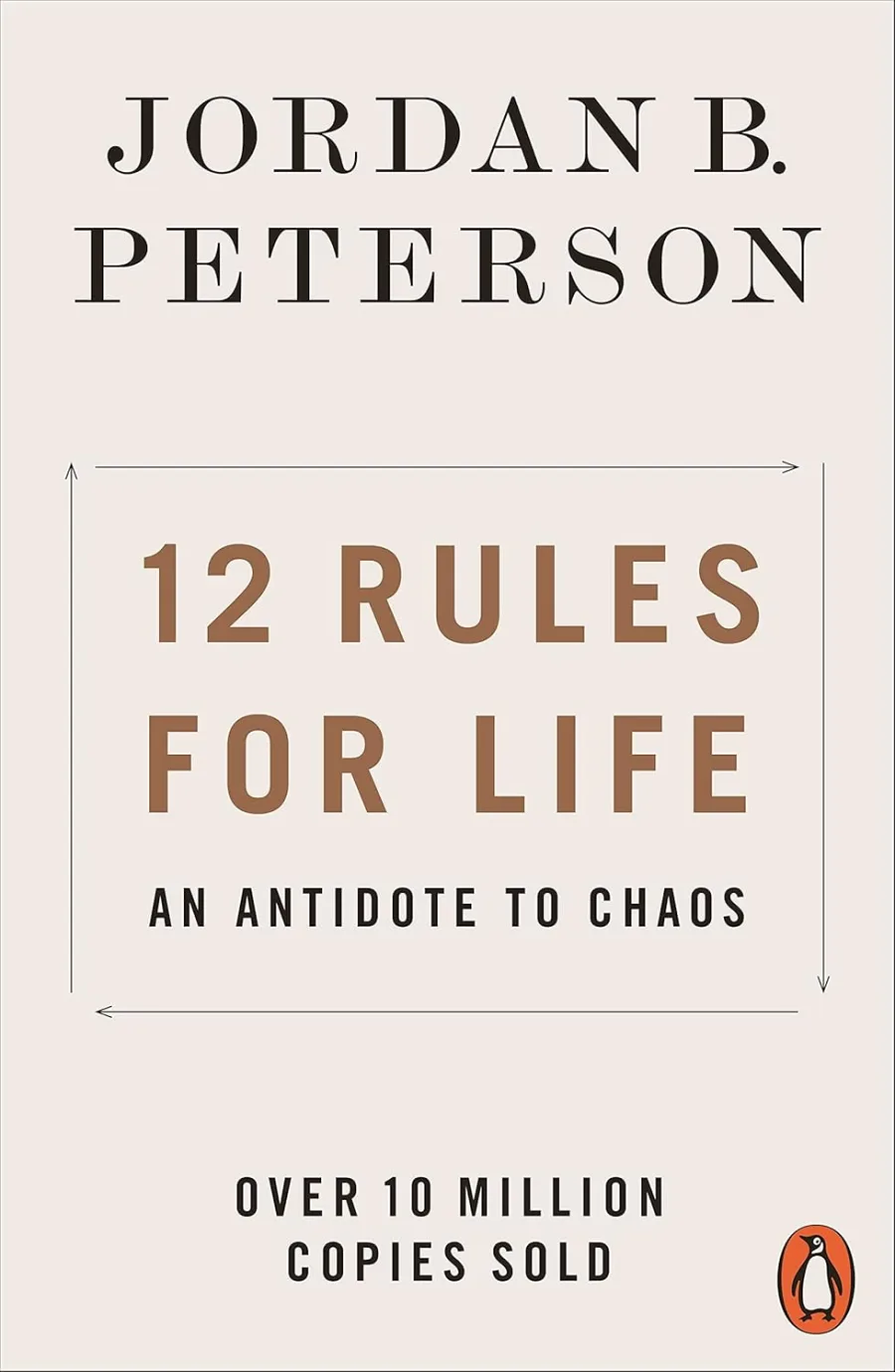
Download Cover Image
Do you want to download the full cover image for 12 Rules for Life: An Antidote to Chaos?