
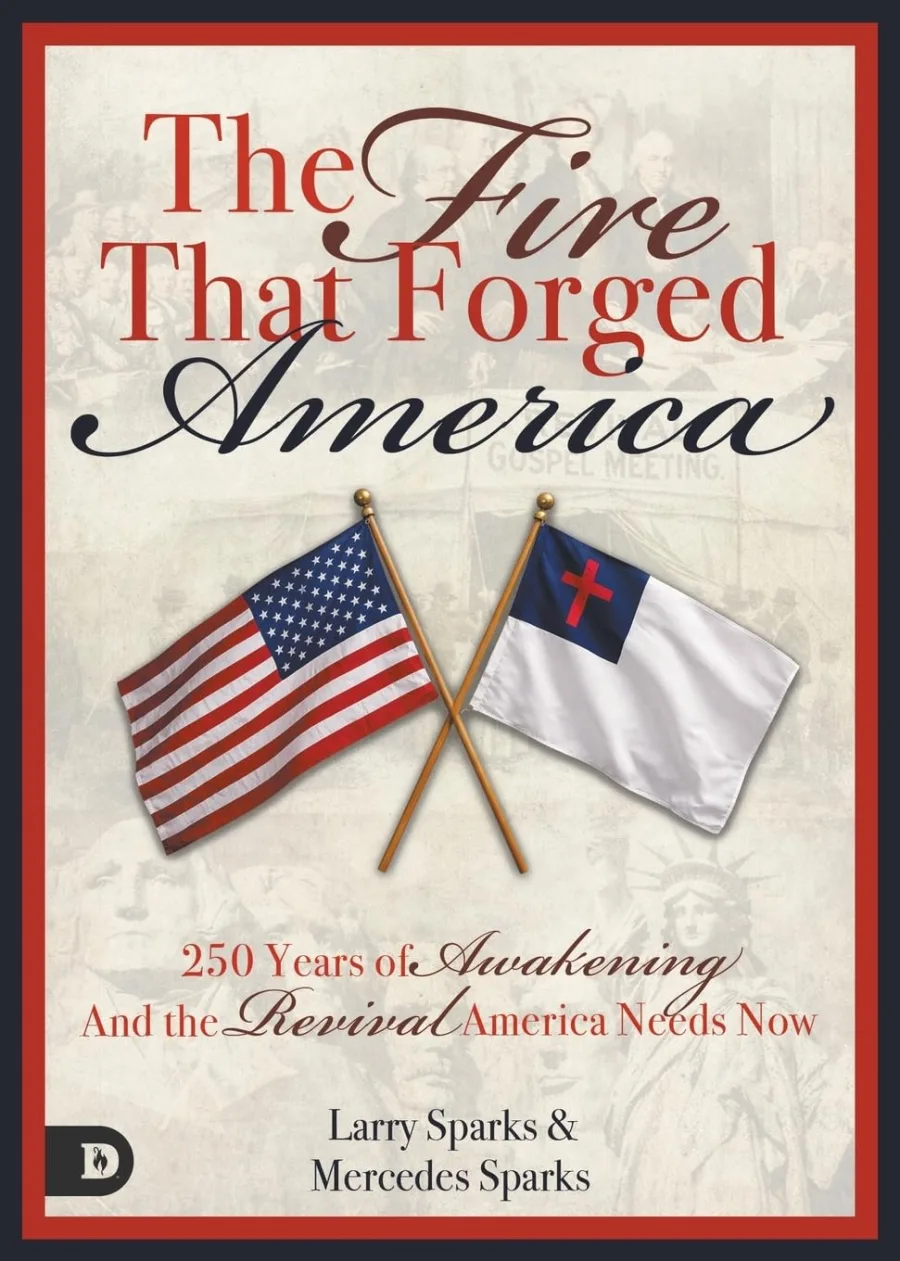
The Fire That Forged America
Paperback
• 132 Pages
• USD 17.99
• English
• 9798881508722
No ratings yet
| Publisher | Destiny Image Publishers |
|---|---|
| ISBN13 | 9798881508722 |
| ASIN/SKU | B0H36H57QT |
| Book Format | Paperback |
| Language | English |
| Pages | 132 |
| List Price | USD 17.99 |
| Publishing Date | 27/05/2026 |
| Dimensions | 5 x 0.3 x 7 inches |
| Weight | 4.2 ounces |
| Book Code | BD00056040 |
Buy this Book
Amazon Stores
Ebook Stores
Other Stores
Discover The Fire That Forged America by Larry Sparks. This book is published by Destiny Image Publishers in Paperback format, ISBN 9798881508722, ASIN B0H36H57QT, under Christian Books and Bibles, Christian Eschatology, Christian Inspirational.
Book Description
Reignite the Fire That Transforms Lives, Churches, and Nations.
Why does it feel like culture is unraveling while the Church grows quieter? Where is the power, the conviction, and the unmistakable presence of God that once defined believers? And is true revival still possible—or have we settled for something less?
The answers aren’t found in politics, programs, or human effort. They’re found in a divine pattern God has been revealing for generations.
Through years of ministry, historical insight, and prophetic clarity, Larry and Mercedes Sparks uncover the forgotten blueprint that shaped America’s greatest awakenings—and reveal how that same fire can burn again today. This breakthrough resource doesn’t just revisit revival history—it calls you into it.
In The Fire that Forged America, you’ll discover how to:
Break free from powerless religion and step into Spirit-empowered living.
Carry the fire of the Holy Spirit into your sphere of influence.
Reignite a passion for God’s presence that transforms your daily walk.
Restore the biblical balance between the Word of God and the Spirit of God.
Answer God’s call to become a voice of righteousness in your time.
You were never meant to watch from the sidelines. The same Spirit who ignited past awakenings is moving again—calling you to step into the fire, carry His presence, and become part of His redemptive plan. The enemy’s agenda is not greater than God’s purpose. Awakening is not only possible—it has already begun.
“The Fire is spreading again. The question before us is simple: Will we recognize it? Will we step into the flame?” - Larry Sparks
Key Revelations Include:
Revival, awakening, and reformation are a divine progression—not isolated events.
America’s strength has always flowed from spiritual awakening, not human systems.
The Holy Spirit is the Fire behind every true move of God in history.
The Church’s voice is essential to restoring moral clarity in culture.
Acts 2 Christianity is not history—it is the standard for today.
Perfect For:
Believers hungry for genuine revival and deeper intimacy with God
Church leaders seeking Spirit-filled, biblically grounded renewal
Intercessors and revivalists contending for awakening in their region
Christians burdened for the future of America and the next generation
Anyone tired of powerless religion and longing for authentic encounter
From historic awakenings to present-day outpourings, this book answers the question many are asking: What is God doing right now—and how can you be part of it? With prophetic urgency and scriptural depth, The Fire that Forged America equips you to move beyond observation into participation.
You’re not just witnessing history—you’re being called to help write it. Step into the fire and let God use you to ignite a nation.
Why does it feel like culture is unraveling while the Church grows quieter? Where is the power, the conviction, and the unmistakable presence of God that once defined believers? And is true revival still possible—or have we settled for something less?
The answers aren’t found in politics, programs, or human effort. They’re found in a divine pattern God has been revealing for generations.
Through years of ministry, historical insight, and prophetic clarity, Larry and Mercedes Sparks uncover the forgotten blueprint that shaped America’s greatest awakenings—and reveal how that same fire can burn again today. This breakthrough resource doesn’t just revisit revival history—it calls you into it.
In The Fire that Forged America, you’ll discover how to:
Break free from powerless religion and step into Spirit-empowered living.
Carry the fire of the Holy Spirit into your sphere of influence.
Reignite a passion for God’s presence that transforms your daily walk.
Restore the biblical balance between the Word of God and the Spirit of God.
Answer God’s call to become a voice of righteousness in your time.
You were never meant to watch from the sidelines. The same Spirit who ignited past awakenings is moving again—calling you to step into the fire, carry His presence, and become part of His redemptive plan. The enemy’s agenda is not greater than God’s purpose. Awakening is not only possible—it has already begun.
“The Fire is spreading again. The question before us is simple: Will we recognize it? Will we step into the flame?” - Larry Sparks
Key Revelations Include:
Revival, awakening, and reformation are a divine progression—not isolated events.
America’s strength has always flowed from spiritual awakening, not human systems.
The Holy Spirit is the Fire behind every true move of God in history.
The Church’s voice is essential to restoring moral clarity in culture.
Acts 2 Christianity is not history—it is the standard for today.
Perfect For:
Believers hungry for genuine revival and deeper intimacy with God
Church leaders seeking Spirit-filled, biblically grounded renewal
Intercessors and revivalists contending for awakening in their region
Christians burdened for the future of America and the next generation
Anyone tired of powerless religion and longing for authentic encounter
From historic awakenings to present-day outpourings, this book answers the question many are asking: What is God doing right now—and how can you be part of it? With prophetic urgency and scriptural depth, The Fire that Forged America equips you to move beyond observation into participation.
You’re not just witnessing history—you’re being called to help write it. Step into the fire and let God use you to ignite a nation.
Author Biography
Larry Sparks serves as publisher for Destiny Image (destinyimage.com), a Spirit-filled publishing house pioneered by Don Nori Sr. in 1983 with a mandate to publish the prophets. Larry has been a leader in the Christian publishing industry for over 10 years, first serving with the Adrian Rogers Pastor Training Institute, overseeing the development of resources and training curriculum for the late Dr. Adrian Rogers, and then at Destiny Image, helping authors take their messages and books to the next level. Larry’s primary role as Publisher is to help bestselling authors continue to amplify their messages through innovative publishing expressions, and also, provide platform and visibility to new, emerging prophetic voices. Working with all of Destiny Image’s authors, Larry has overseen the successful identification, development, publication and distribution of hundreds of books and resources.
Larry is a regular contributor to Charisma Magazine, he conducts seminars on revival, hosts regional Renewing South Florida gatherings, and has been featured on Sid Roth’s It’s Supernatural, TBN, CBN, the ElijahList, and Cornerstone TV. He is author of Breakthrough Faith, The Fire That Never Sleeps with Michael Brown and John Kilpatrick, compiler of Ask for the Rain, and co-author of Accessing the Greater Glory with Ana Wener. Larry hosts a TV program on GOD TV called The Prophetic Edge, he earned a Master of Divinity from Regent University and enjoys life in Texas with his beautiful wife and beloved daughter. (larrysparksministries.com)
Larry is a regular contributor to Charisma Magazine, he conducts seminars on revival, hosts regional Renewing South Florida gatherings, and has been featured on Sid Roth’s It’s Supernatural, TBN, CBN, the ElijahList, and Cornerstone TV. He is author of Breakthrough Faith, The Fire That Never Sleeps with Michael Brown and John Kilpatrick, compiler of Ask for the Rain, and co-author of Accessing the Greater Glory with Ana Wener. Larry hosts a TV program on GOD TV called The Prophetic Edge, he earned a Master of Divinity from Regent University and enjoys life in Texas with his beautiful wife and beloved daughter. (larrysparksministries.com)
Editorial Reviews
Editorial Reviews will be added soon…
Book Summary
The Fire That Forged America by Larry Sparks and Mercedes Sparks is a historical and spiritual reflection on the role of revival, faith, and moral crisis in the shaping of the United States. The book presents American history not simply as a sequence of political events, wars, and leaders, but as a story deeply influenced by religious awakening and the conviction that national identity has been shaped in moments of spiritual fire. Rather than focusing only on laws, economics, or military power, it argues that the heart of America was forged in times when ordinary people experienced profound encounters with God and when those experiences spilled outward into culture, reform, and nation-building. The authors treat revival as a force that helped define the country’s direction, sometimes correcting its failures and sometimes inspiring the courage to imagine a freer and more righteous society.
At the center of the book is the idea that America has repeatedly gone through seasons of crisis followed by renewal. The title itself suggests that fire can both destroy and purify, and the book uses that image throughout. The “fire” is not only the hardship of revolution, civil conflict, or social upheaval, but also the fire of spiritual awakening that the authors believe gave people the strength to endure and transform those crises. They describe revival as a powerful presence that stirred repentance, hope, moral responsibility, and public action. In this view, America’s progress did not come only from institutions or political leaders, but from the deep changes that occurred when individuals and communities were renewed in faith. The book therefore reads as both a historical narrative and a spiritual argument about what truly sustains a nation.
A major thread in the book is the connection between the American founding and religious liberty. The authors emphasize that many early Americans were searching for freedom not just from political oppression, but also for the right to worship and live according to conscience. They portray the religious atmosphere of the colonies and early republic as one in which debates about liberty, human dignity, and moral order were inseparable from questions of faith. The book suggests that the language of freedom that later became central to the American experiment was strengthened by revival movements that taught people they were accountable to a higher authority than kings or governments. This belief, in turn, encouraged resistance to tyranny and supported the idea that every person had worth before God.
The book also highlights the First and Second Great Awakenings as formative moments in American life. These revivals are presented as sweeping spiritual movements that crossed denominational and social lines, reaching farmers, merchants, frontier families, and city dwellers alike. The authors describe how preaching, prayer, and public conversion experiences created a sense of urgency and shared purpose. These awakenings are shown as more than private religious events; they inspired missionary work, reform movements, and a renewed sense of national destiny. In the authors’ telling, revival was never just about church attendance. It was about changing the moral climate of the country, calling people to accountability, and giving them the courage to confront injustice.
Another important part of the book is its treatment of reform. The authors connect spiritual awakening to movements that sought to improve society, including efforts against slavery, alcohol abuse, and other moral and social evils. They argue that many reformers were motivated by faith and that revival gave them both the language and the energy to pursue change. The book presents this as evidence that when people encounter God deeply, they are more likely to care about justice, compassion, and the well-being of others. This perspective gives the narrative an uplifting tone, because it frames American reform not as a dry civic process but as the fruit of conviction, sacrifice, and prayer. The authors seem especially interested in showing that faith has historically produced action rather than passivity.
The Civil War period appears in the book as another turning point in which the nation was tested by fire. The conflict exposed the deepest contradictions in American life, especially the contradiction between liberty and slavery. The authors treat this era as one of both judgment and mercy, where the nation’s sins came sharply into view and where spiritual renewal remained necessary amid terrible suffering. In their framework, the war was not just a political or military struggle; it was also a moral reckoning. The book suggests that the pain of that era forced Americans to confront what kind of nation they wanted to become, and that the language of repentance and renewal was essential in making sense of that struggle.
Throughout the book, the authors emphasize that history is not random. They present a worldview in which divine purpose can be seen in the rise and fall of nations, in the voices of preachers and reformers, and in the decisions of ordinary believers who shaped their communities. This gives the book a strong interpretive lens: instead of treating history as neutral or purely secular, it reads the past as a field where spiritual and cultural forces interact. That approach will appeal especially to readers who want a faith-based interpretation of American history. At the same time, the book is not written like a dense academic textbook. Its style is more accessible and inspirational, aiming to persuade readers emotionally as well as intellectually that revival mattered and still matters.
The title’s imagery of fire also carries a warning. Fire can warm and refine, but it can also consume what is weak or false. The book implies that America’s survival depends on whether it remembers its spiritual foundations. When the nation drifts from those foundations, the result is decline, confusion, or moral compromise. When it returns to them through repentance and awakening, it finds renewal. This gives the book a cyclical sense of history: the country is repeatedly tested, humbled, and restored. The authors use this pattern to argue that revival is not a one-time event from the past but an ongoing need.
By the end, The Fire That Forged America presents a clear message: America was shaped not only by revolution and constitution, but by revival and faith. The authors want readers to see spiritual awakening as one of the most powerful forces in the nation’s story, capable of changing hearts, reforming society, and helping a divided people move toward a shared future. The book is ultimately a celebration of the idea that when people are transformed inwardly, history itself can be transformed outwardly. It offers a patriotic and religious reading of the American past, one that sees the nation’s deepest strength not in power alone, but in moments when faith set hearts on fire and gave people the courage to build something lasting.
At the center of the book is the idea that America has repeatedly gone through seasons of crisis followed by renewal. The title itself suggests that fire can both destroy and purify, and the book uses that image throughout. The “fire” is not only the hardship of revolution, civil conflict, or social upheaval, but also the fire of spiritual awakening that the authors believe gave people the strength to endure and transform those crises. They describe revival as a powerful presence that stirred repentance, hope, moral responsibility, and public action. In this view, America’s progress did not come only from institutions or political leaders, but from the deep changes that occurred when individuals and communities were renewed in faith. The book therefore reads as both a historical narrative and a spiritual argument about what truly sustains a nation.
A major thread in the book is the connection between the American founding and religious liberty. The authors emphasize that many early Americans were searching for freedom not just from political oppression, but also for the right to worship and live according to conscience. They portray the religious atmosphere of the colonies and early republic as one in which debates about liberty, human dignity, and moral order were inseparable from questions of faith. The book suggests that the language of freedom that later became central to the American experiment was strengthened by revival movements that taught people they were accountable to a higher authority than kings or governments. This belief, in turn, encouraged resistance to tyranny and supported the idea that every person had worth before God.
The book also highlights the First and Second Great Awakenings as formative moments in American life. These revivals are presented as sweeping spiritual movements that crossed denominational and social lines, reaching farmers, merchants, frontier families, and city dwellers alike. The authors describe how preaching, prayer, and public conversion experiences created a sense of urgency and shared purpose. These awakenings are shown as more than private religious events; they inspired missionary work, reform movements, and a renewed sense of national destiny. In the authors’ telling, revival was never just about church attendance. It was about changing the moral climate of the country, calling people to accountability, and giving them the courage to confront injustice.
Another important part of the book is its treatment of reform. The authors connect spiritual awakening to movements that sought to improve society, including efforts against slavery, alcohol abuse, and other moral and social evils. They argue that many reformers were motivated by faith and that revival gave them both the language and the energy to pursue change. The book presents this as evidence that when people encounter God deeply, they are more likely to care about justice, compassion, and the well-being of others. This perspective gives the narrative an uplifting tone, because it frames American reform not as a dry civic process but as the fruit of conviction, sacrifice, and prayer. The authors seem especially interested in showing that faith has historically produced action rather than passivity.
The Civil War period appears in the book as another turning point in which the nation was tested by fire. The conflict exposed the deepest contradictions in American life, especially the contradiction between liberty and slavery. The authors treat this era as one of both judgment and mercy, where the nation’s sins came sharply into view and where spiritual renewal remained necessary amid terrible suffering. In their framework, the war was not just a political or military struggle; it was also a moral reckoning. The book suggests that the pain of that era forced Americans to confront what kind of nation they wanted to become, and that the language of repentance and renewal was essential in making sense of that struggle.
Throughout the book, the authors emphasize that history is not random. They present a worldview in which divine purpose can be seen in the rise and fall of nations, in the voices of preachers and reformers, and in the decisions of ordinary believers who shaped their communities. This gives the book a strong interpretive lens: instead of treating history as neutral or purely secular, it reads the past as a field where spiritual and cultural forces interact. That approach will appeal especially to readers who want a faith-based interpretation of American history. At the same time, the book is not written like a dense academic textbook. Its style is more accessible and inspirational, aiming to persuade readers emotionally as well as intellectually that revival mattered and still matters.
The title’s imagery of fire also carries a warning. Fire can warm and refine, but it can also consume what is weak or false. The book implies that America’s survival depends on whether it remembers its spiritual foundations. When the nation drifts from those foundations, the result is decline, confusion, or moral compromise. When it returns to them through repentance and awakening, it finds renewal. This gives the book a cyclical sense of history: the country is repeatedly tested, humbled, and restored. The authors use this pattern to argue that revival is not a one-time event from the past but an ongoing need.
By the end, The Fire That Forged America presents a clear message: America was shaped not only by revolution and constitution, but by revival and faith. The authors want readers to see spiritual awakening as one of the most powerful forces in the nation’s story, capable of changing hearts, reforming society, and helping a divided people move toward a shared future. The book is ultimately a celebration of the idea that when people are transformed inwardly, history itself can be transformed outwardly. It offers a patriotic and religious reading of the American past, one that sees the nation’s deepest strength not in power alone, but in moments when faith set hearts on fire and gave people the courage to build something lasting.
Sample Chapters
Sample Chapters will be added soon…
Reader Reviews
No reviews yet.
The Fire That Forged America
Download Cover Image
Do you want to download the full cover image for The Fire That Forged America?