
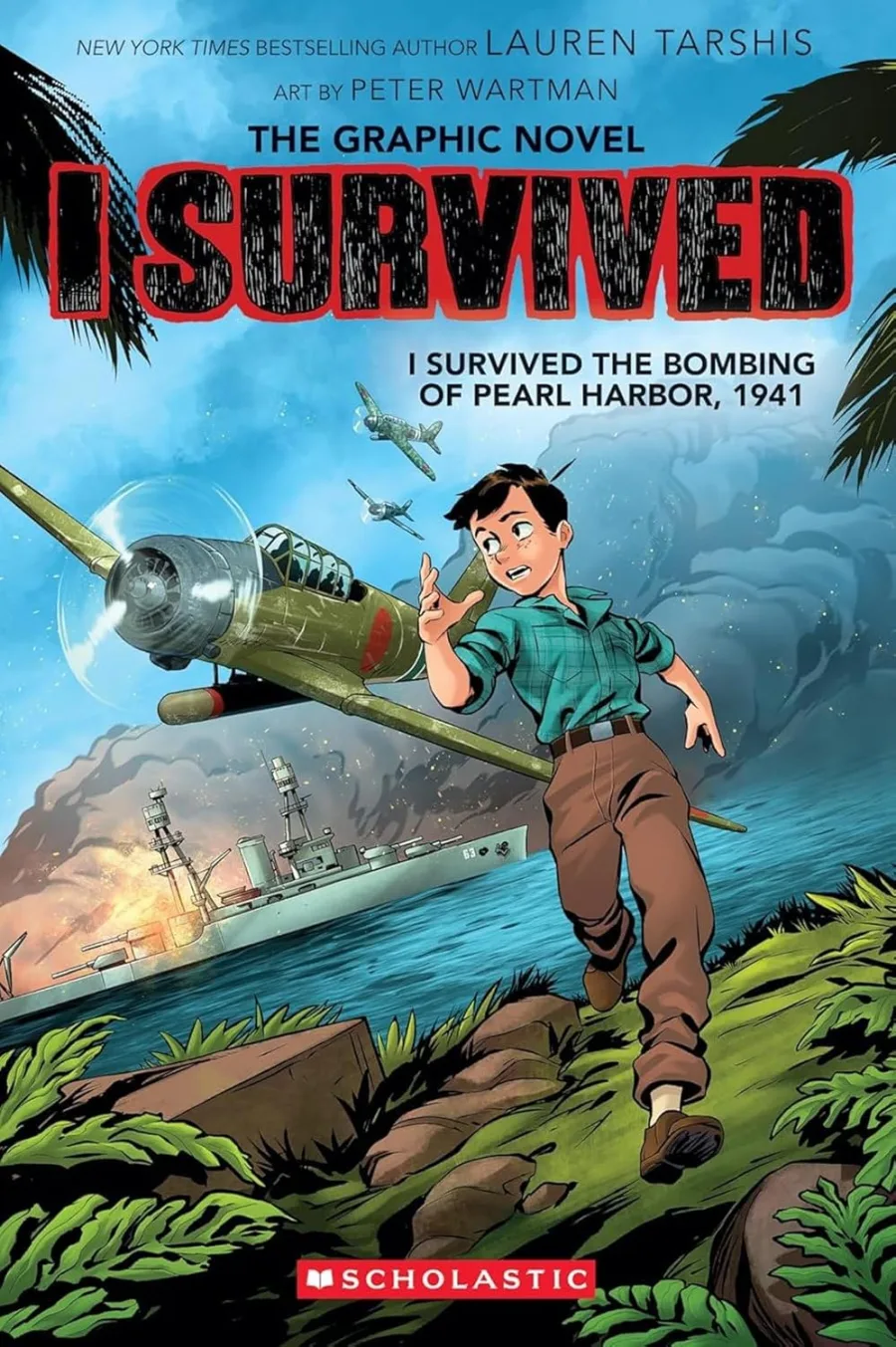
I Survived the Bombing of Pearl Harbor, 1941
Lauren Tarshis, Peter Wartman (Illustrator)
Paperback
• 160 Pages
• USD 14.99
• English
• 9781546137757
No ratings yet
Children's Books
Children's Action & Adventure Comics & Graphic Novels
Children's Historical Fiction on Military & Wars
| Publisher | Graphix |
|---|---|
| ISBN13 | 9781546137757 |
| ASIN/SKU | 1546137750 |
| Book Format | Paperback |
| Language | English |
| Pages | 160 |
| List Price | USD 14.99 |
| Publishing Date | 07/07/2026 |
| Dimensions | 6.01 x 0.51 x 8.91 inches |
| Weight | 13.5 ounces |
| Book Code | BD00056065 |
Buy this Book
Amazon Stores
Ebook Stores
Other Stores
Discover I Survived the Bombing of Pearl Harbor, 1941 by Lauren Tarshis. This book is published by Graphix in Paperback format, ISBN 9781546137757, ASIN 1546137750, under Children's Books, Children's Action and Adventure Comics and Graphic Novels, Children's Historical Fiction on Military and Wars.
Book Description
A vividly rendered graphic novel adaptation of Lauren Tarshis's bestselling I Survived the Bombing of Pearl Harbor, 1941 with text adapted by Georgia Ball and art by Peter Wartman.
A day no one will ever forget... Danny Crane and his mom moved from New York City to Pearl City, Hawaii two months ago. Every day since, Danny has been making a plan to get back to NYC. He's not afraid of the crime or dark alleys there. And he’s not afraid to stow away on the next ship out of Pearl Harbor.
But that morning, the skies fill with fighter planes. Bombs pound the harbor. Bullets rain down on the beaches. Danny is shocked -- and, for the first time, truly afraid. He’s a tough city kid. But can Danny survive the day that will live in infamy?
Lauren Tarshis's New York Times bestselling I Survived series comes to vivid life in this pulse-pounding graphic novel edition. Perfect for readers who prefer the graphic novel format, or for existing fans of the I Survived chapter book series, these graphic novels combine historical facts with high-action storytelling that's sure to keep readers turning the pages. Includes a nonfiction section at the back with facts and photos about the real-life event.
A day no one will ever forget... Danny Crane and his mom moved from New York City to Pearl City, Hawaii two months ago. Every day since, Danny has been making a plan to get back to NYC. He's not afraid of the crime or dark alleys there. And he’s not afraid to stow away on the next ship out of Pearl Harbor.
But that morning, the skies fill with fighter planes. Bombs pound the harbor. Bullets rain down on the beaches. Danny is shocked -- and, for the first time, truly afraid. He’s a tough city kid. But can Danny survive the day that will live in infamy?
Lauren Tarshis's New York Times bestselling I Survived series comes to vivid life in this pulse-pounding graphic novel edition. Perfect for readers who prefer the graphic novel format, or for existing fans of the I Survived chapter book series, these graphic novels combine historical facts with high-action storytelling that's sure to keep readers turning the pages. Includes a nonfiction section at the back with facts and photos about the real-life event.
Author Biography
Lauren Tarshis often wonders how she came to spend most of her waking moments thinking about disasters, as the author of the children's historical fiction series "I Survived." Each book takes readers into the heart of history's most thrilling and terrifying events, including the sinking of the Titanic, the Shark Attacks of 1916, Hurricane Katrina, the bombing of Pearl Harbor, the San Francisco earthquake, 9/11, the Battle of Gettysburg and many more.
Lauren conducts extensive research to bring her topics to life. She has traveled to most of the locations where her books are set. Her goal is to open readers' eyes to new chapters in history and to inspire them with stories of hope and resilience.
Lauren is also the author of the the award-winning Emma-Jean Lazarus Fell Out of a Tree, and is the editor of Storyworks Magazine.
For more information about Lauren, go to www.LaurenTarshis.com
To learn more about Storyworks, www.scholastic.com/storyworks
And check out the I Survived Website: www.Scholastic.com/ISurvived
Lauren conducts extensive research to bring her topics to life. She has traveled to most of the locations where her books are set. Her goal is to open readers' eyes to new chapters in history and to inspire them with stories of hope and resilience.
Lauren is also the author of the the award-winning Emma-Jean Lazarus Fell Out of a Tree, and is the editor of Storyworks Magazine.
For more information about Lauren, go to www.LaurenTarshis.com
To learn more about Storyworks, www.scholastic.com/storyworks
And check out the I Survived Website: www.Scholastic.com/ISurvived
Editorial Reviews
Praise for I Survived Pearl Harbor, 1941 (I Survived Graphic Novel #14): "True to the 'I Survived' brand, this graphic novel adaptation efficiently addresses and condenses a huge historical event. The authors use clear, concise language to communicate historical information to readers while allowing them to build an emotional bond with the protagonist." -- School Library Journal
Praise for I Survived the Sinking of the Titanic, 1912 (I Survived Graphic Novel #1): "The first installment of Tarshis' sprawling prose disaster oeuvre for young readers is reimagined in visually interesting full-color comic panels that support its recognizable thrilling pace and convenient twists. Many of the most exciting scenes are largely wordless, spotlighting the propulsive action amid growing tensions. A fresh and interesting adaptation, making for an easy crowd pleaser." -- Kirkus Reviews
"Dark, subdued, inky art sets a somber tone, while a parade of mostly small panels builds suspense and promises to engage readers." -- School Library Journal
Praise for I Survived the Nazi Invasion, 1944 (I Survived Graphic Novel #3): “A crowd pleaser … Those familiar with this installment will anticipate the traumas and triumphs of the story, while newcomers to the series will also be pulled in; all will be satisfied with the mostly happy resolution … Another effective comics translation in this first-rate series.” -- School Library Journal
Praise for I Survived the Attacks of September 11, 2001 (I Survived Graphic Novel #4): "The comic book format works well with intense pacing, searing images and edge-of-your-seat suspense." -- San Francisco Chronicle
Praise for I Survived the Battle of D-Day, 1944 (I Survived Graphic Novel #9): “A wartime adventure with extra 'ka-boom.' It makes you wonder why more graphic novels aren’t used to such brilliant, educational effect." -- The Times Children's Book of the Week
Praise for I Survived the Great Molasses Flood, 1919 (I Survived Graphic Novel #11): "The chronology of events paints a vivid picture of the time with complementary illustrations to the historical narrative. The delivery is easy to follow, making this graphic novel a useful look into the past for younger readers, bolstered by the art." -- School Library Journal
Praise for I Survived the California Wildfires, 2018 (I Survived Graphic Novel #13): ★ "This graphic novel adaptation of a 2020 entry in Tarshis’s “I Survived” series is relentlessly suspenseful, blending personal drama regarding family trust with the visceral terror of a natural disaster." -- School Library Journal, starred review
Praise for Lauren Tarshis's I Survived chapter books:
Praise for I Survived Hurricane Katrina, 2005: "Expressive illustrations capture the drama of the storm and its aftermath, but the book's real power comes from its exploration of what it means to be a hero." -- Booklist
Praise for I Survived the Sinking of the Titanic, 1912 (I Survived Graphic Novel #1): "The first installment of Tarshis' sprawling prose disaster oeuvre for young readers is reimagined in visually interesting full-color comic panels that support its recognizable thrilling pace and convenient twists. Many of the most exciting scenes are largely wordless, spotlighting the propulsive action amid growing tensions. A fresh and interesting adaptation, making for an easy crowd pleaser." -- Kirkus Reviews
"Dark, subdued, inky art sets a somber tone, while a parade of mostly small panels builds suspense and promises to engage readers." -- School Library Journal
Praise for I Survived the Nazi Invasion, 1944 (I Survived Graphic Novel #3): “A crowd pleaser … Those familiar with this installment will anticipate the traumas and triumphs of the story, while newcomers to the series will also be pulled in; all will be satisfied with the mostly happy resolution … Another effective comics translation in this first-rate series.” -- School Library Journal
Praise for I Survived the Attacks of September 11, 2001 (I Survived Graphic Novel #4): "The comic book format works well with intense pacing, searing images and edge-of-your-seat suspense." -- San Francisco Chronicle
Praise for I Survived the Battle of D-Day, 1944 (I Survived Graphic Novel #9): “A wartime adventure with extra 'ka-boom.' It makes you wonder why more graphic novels aren’t used to such brilliant, educational effect." -- The Times Children's Book of the Week
Praise for I Survived the Great Molasses Flood, 1919 (I Survived Graphic Novel #11): "The chronology of events paints a vivid picture of the time with complementary illustrations to the historical narrative. The delivery is easy to follow, making this graphic novel a useful look into the past for younger readers, bolstered by the art." -- School Library Journal
Praise for I Survived the California Wildfires, 2018 (I Survived Graphic Novel #13): ★ "This graphic novel adaptation of a 2020 entry in Tarshis’s “I Survived” series is relentlessly suspenseful, blending personal drama regarding family trust with the visceral terror of a natural disaster." -- School Library Journal, starred review
Praise for Lauren Tarshis's I Survived chapter books:
Praise for I Survived Hurricane Katrina, 2005: "Expressive illustrations capture the drama of the storm and its aftermath, but the book's real power comes from its exploration of what it means to be a hero." -- Booklist
Book Summary
I Survived the Bombing of Pearl Harbor, 1941 by Lauren Tarshis, illustrated by Peter Wartman, is a fast‑paced, emotional historical story told through the eyes of an eleven‑year‑old boy named Danny Crane. It blends real events from World War II with a fictional child’s perspective to help young readers understand what it was like to live through one of the most shocking days in American history. At the start of the book, Danny has just moved from New York City to Hawaii with his mother. His father stayed behind for work, and that separation weighs heavily on Danny. He misses his dad, feels out of place in this new, unfamiliar environment, and carries anger and frustration about the move. Hawaii’s beauty—the ocean, palm trees, and warm weather—doesn’t erase how lonely and unsettled he feels, and he struggles to adjust to life near the Pearl Harbor naval base.
Danny’s days are filled with small, ordinary worries: making new friends, navigating a different culture, and trying to be brave while living so far from his father. One bright spot is his friendship with a local boy, Aki, and Aki’s little sister, Taro. Through them, Danny starts to learn more about the island, Japanese American families, and the rhythms of daily life around Pearl Harbor. They explore together, share stories, and slowly help Danny feel less like a stranger. Still, he often thinks about his dad and clings to the hope that their family will be reunited soon. This personal longing makes Danny feel like the world around him is split in two—his old life in New York, and his new life in Hawaii that he doesn’t fully understand yet. That emotional divide sets the stage for how overwhelming the events of December 7, 1941 will be for him.
On the morning of the attack, things begin like any other day. Danny is outside near the harbor, enjoying the view of the battleships and the calm water, when he notices strange planes in the sky. At first, he’s curious rather than afraid, but very quickly the scene shifts into chaos. The planes have red circles on their sides—the symbol of Japan—and they begin bombing the ships and the base without warning. Explosions echo across the harbor, thick black smoke rises, and metal tears apart as bombs hit their targets. Danny sees enormous ships like the USS Arizona and USS Oklahoma being struck, men running and shouting, and fire everywhere. The peaceful morning transforms into a battlefield in seconds. Through Danny’s eyes, readers experience the confusion, terror, and disbelief of that day—how it felt to realize that America was under attack and that what seemed impossible was suddenly happening right in front of you.
Caught in the middle of the bombing, Danny has to move from being a scared kid to someone who has to act quickly to survive. He dodges falling debris, tries to find shelter, and makes split‑second decisions as the world around him explodes. His main thought, though, isn’t just about himself—he worries about his mother back in their home and about Aki and Taro. The attack separates families, leaving children and adults scattered across the island, desperate to know if their loved ones are alive. Danny’s fear for his mom is intense and raw. He doesn’t know if their neighborhood has been hit, whether she is hurt, or how he can reach her with roads blocked, fires burning, and bombs still falling. This desperate need to find her drives much of the story’s tension after the initial shock of the attack.
As Danny scrambles for safety, he sees many acts of bravery and panic. Soldiers and sailors rush to man guns and try to fight back. Medics and civilians begin to help the wounded. Some people are stunned into stillness; others run and scream. The book shows how ordinary people, including children, are forced into extraordinary situations. Danny’s own courage begins to surface as he tries to help where he can and refuses to give up on reuniting with his family. He finds himself making choices no eleven‑year‑old should have to make, like whether to risk running through a dangerous area to reach someone or shelter in place and hope they’re okay. These moments underline one of the series’ main themes: that kids can be brave, resourceful, and strong even when the world seems to be falling apart.
Danny’s friendship with Aki and Taro becomes even more important in the chaos that follows. The attack not only causes physical destruction but also changes how people see one another. Japanese Americans on the island, like Aki’s family, suddenly face suspicion and hostility from some of their neighbors and even from authorities, despite having nothing to do with the bombing. Through Danny’s eyes, readers witness this unfairness and the fear it creates. He cares deeply about his friends and sees that they are as shocked and scared as anyone else. This helps highlight the difference between the Japanese military planes attacking Pearl Harbor and the ordinary Japanese American families who are part of Hawaii’s community. The story quietly teaches about prejudice, empathy, and the importance of judging people by their actions and character, not by their background or appearance.
In the hours and days after the attack, the island is transformed. Pearl Harbor is ruined, ships are sunk, thousands are dead or injured, and America is thrust into World War II. For Danny, the bigger political consequences are less important than the human ones he sees up close: families searching for missing loved ones, hospitals overcrowded, homes damaged, and fear of more attacks. He and his mother, once they finally find each other, must figure out how to live in a place that feels permanently changed. Danny’s relationship with his mom deepens; the crisis forces them to talk openly, support one another, and face how fragile life can be. The danger makes the arguments they had about moving and being apart from his father feel smaller compared to the sheer relief of still being alive and together.
As the story moves toward its ending, Danny reflects on what he has lived through. He is still a child, but he is no longer the same boy who arrived in Hawaii angry and homesick. He has seen death and heroism, fear and kindness, and he understands that history isn’t just something in textbooks—sometimes, it crashes into your life without warning. He learns that surviving isn’t only about physical escape, but also about how you move forward emotionally after something terrible happens. There is sadness and grief in the aftermath of Pearl Harbor, but there is also resilience. People rebuild, comfort each other, and try to make sense of what comes next. Danny’s bond with his mother grows stronger, and his friendship with Aki and Taro remains important, even as the world around them steps into a new, uncertain wartime reality.
I Survived the Bombing of Pearl Harbor, 1941 ultimately gives young readers a way to imagine what it felt like to be there on that day—scared, confused, and forced to be brave. Through Danny’s story, they see how history touches real families and how children can find strength in the worst moments. The book doesn’t dwell on graphic detail, but it doesn’t shy away from showing the danger and loss either. It balances the horror of war with the hope that comes from survival, family love, and the determination to keep going. By the end, Danny’s journey is both a survival story and a growing‑up story, showing that even in the midst of bombs and fear, courage, friendship, and compassion can help someone find their way through.
Danny’s days are filled with small, ordinary worries: making new friends, navigating a different culture, and trying to be brave while living so far from his father. One bright spot is his friendship with a local boy, Aki, and Aki’s little sister, Taro. Through them, Danny starts to learn more about the island, Japanese American families, and the rhythms of daily life around Pearl Harbor. They explore together, share stories, and slowly help Danny feel less like a stranger. Still, he often thinks about his dad and clings to the hope that their family will be reunited soon. This personal longing makes Danny feel like the world around him is split in two—his old life in New York, and his new life in Hawaii that he doesn’t fully understand yet. That emotional divide sets the stage for how overwhelming the events of December 7, 1941 will be for him.
On the morning of the attack, things begin like any other day. Danny is outside near the harbor, enjoying the view of the battleships and the calm water, when he notices strange planes in the sky. At first, he’s curious rather than afraid, but very quickly the scene shifts into chaos. The planes have red circles on their sides—the symbol of Japan—and they begin bombing the ships and the base without warning. Explosions echo across the harbor, thick black smoke rises, and metal tears apart as bombs hit their targets. Danny sees enormous ships like the USS Arizona and USS Oklahoma being struck, men running and shouting, and fire everywhere. The peaceful morning transforms into a battlefield in seconds. Through Danny’s eyes, readers experience the confusion, terror, and disbelief of that day—how it felt to realize that America was under attack and that what seemed impossible was suddenly happening right in front of you.
Caught in the middle of the bombing, Danny has to move from being a scared kid to someone who has to act quickly to survive. He dodges falling debris, tries to find shelter, and makes split‑second decisions as the world around him explodes. His main thought, though, isn’t just about himself—he worries about his mother back in their home and about Aki and Taro. The attack separates families, leaving children and adults scattered across the island, desperate to know if their loved ones are alive. Danny’s fear for his mom is intense and raw. He doesn’t know if their neighborhood has been hit, whether she is hurt, or how he can reach her with roads blocked, fires burning, and bombs still falling. This desperate need to find her drives much of the story’s tension after the initial shock of the attack.
As Danny scrambles for safety, he sees many acts of bravery and panic. Soldiers and sailors rush to man guns and try to fight back. Medics and civilians begin to help the wounded. Some people are stunned into stillness; others run and scream. The book shows how ordinary people, including children, are forced into extraordinary situations. Danny’s own courage begins to surface as he tries to help where he can and refuses to give up on reuniting with his family. He finds himself making choices no eleven‑year‑old should have to make, like whether to risk running through a dangerous area to reach someone or shelter in place and hope they’re okay. These moments underline one of the series’ main themes: that kids can be brave, resourceful, and strong even when the world seems to be falling apart.
Danny’s friendship with Aki and Taro becomes even more important in the chaos that follows. The attack not only causes physical destruction but also changes how people see one another. Japanese Americans on the island, like Aki’s family, suddenly face suspicion and hostility from some of their neighbors and even from authorities, despite having nothing to do with the bombing. Through Danny’s eyes, readers witness this unfairness and the fear it creates. He cares deeply about his friends and sees that they are as shocked and scared as anyone else. This helps highlight the difference between the Japanese military planes attacking Pearl Harbor and the ordinary Japanese American families who are part of Hawaii’s community. The story quietly teaches about prejudice, empathy, and the importance of judging people by their actions and character, not by their background or appearance.
In the hours and days after the attack, the island is transformed. Pearl Harbor is ruined, ships are sunk, thousands are dead or injured, and America is thrust into World War II. For Danny, the bigger political consequences are less important than the human ones he sees up close: families searching for missing loved ones, hospitals overcrowded, homes damaged, and fear of more attacks. He and his mother, once they finally find each other, must figure out how to live in a place that feels permanently changed. Danny’s relationship with his mom deepens; the crisis forces them to talk openly, support one another, and face how fragile life can be. The danger makes the arguments they had about moving and being apart from his father feel smaller compared to the sheer relief of still being alive and together.
As the story moves toward its ending, Danny reflects on what he has lived through. He is still a child, but he is no longer the same boy who arrived in Hawaii angry and homesick. He has seen death and heroism, fear and kindness, and he understands that history isn’t just something in textbooks—sometimes, it crashes into your life without warning. He learns that surviving isn’t only about physical escape, but also about how you move forward emotionally after something terrible happens. There is sadness and grief in the aftermath of Pearl Harbor, but there is also resilience. People rebuild, comfort each other, and try to make sense of what comes next. Danny’s bond with his mother grows stronger, and his friendship with Aki and Taro remains important, even as the world around them steps into a new, uncertain wartime reality.
I Survived the Bombing of Pearl Harbor, 1941 ultimately gives young readers a way to imagine what it felt like to be there on that day—scared, confused, and forced to be brave. Through Danny’s story, they see how history touches real families and how children can find strength in the worst moments. The book doesn’t dwell on graphic detail, but it doesn’t shy away from showing the danger and loss either. It balances the horror of war with the hope that comes from survival, family love, and the determination to keep going. By the end, Danny’s journey is both a survival story and a growing‑up story, showing that even in the midst of bombs and fear, courage, friendship, and compassion can help someone find their way through.
Sample Chapters
Sample Chapters will be added soon…
Reader Reviews
No reviews yet.
I Survived the Bombing of Pearl Harbor, 1941
Download Cover Image
Do you want to download the full cover image for I Survived the Bombing of Pearl Harbor, 1941?