
Publication Manual (OFFICIAL) 7th Edition of the American Psychological Association
American Psychological Association
Paperback
• 428 Pages
• USD 17.19
• English
• 9781433832161
No ratings yet
| Publisher | American Psychological Association |
|---|---|
| ISBN13 | 9781433832161 |
| ASIN/SKU | 143383216X |
| Book Format | Paperback |
| Language | English |
| Pages | 428 |
| List Price | USD 17.19 |
| Publishing Date | 01/10/2019 |
| Dimensions | 6.75 x 0.75 x 9.75 inches |
| Weight | 1.54 pounds |
| Book Code | BD00066268 |
Buy this Book
Amazon Stores
Ebook Stores
Other Stores
Discover Publication Manual (OFFICIAL) 7th Edition of the American Psychological Association by American Psychological Association. This book is published by American Psychological Association in Paperback format, ISBN 9781433832161, ASIN 143383216X, under Medical Books, Medical Psychology Reference, Psychology Education and Training.
Book Description
A WALL STREET JOURNAL, USA TODAY, AND PUBLISHERS WEEKLY BESTSELLER
Winner of the IBPA’s Benjamin Franklin Award
Widely followed style guide for academic papers. ― The Wall Street Journal
I strongly encourage you to dig into the rich resource of the 7th Edition of the Publication Manual of the American Psychological Association. I am thoroughly energized about the ways this guide can push language forward. ― American Library Association’s Rainbow Round Table
Gather round, style hounds: the seventh edition of the American Psychological Association’s Publication Manual…includes some (pretty) significant changes. ― Inside Higher Ed
An endorsement from the APA is a big deal for the singular 'they.' The APA is the largest scientific and professional organization of psychologists in the United States, with over 118,000 members. The Publication Manual is used by all writers, researchers, editors, students, and educators in a wide variety of disciplines, so this clarification has the potential to significantly expand the use of inclusive language. ― Out
The Publication Manual of the American Psychological Association (APA) has gone through it’s first update in a decade. One of the major changes in this seventh edition is a full embracing of the singular ‘they’ pronoun…. This full acceptance in the APA style guide is major. And wonderful. ― Medium
One of the most popular guides for academic writing standards across the curriculum. For many editors, faculty, and students, this means mastering new rules in short order… all appearances indicate that the changes will be mostly user-friendly…The worst thing about change is often the unknown. This quick glimpse at what the APA has in store offers encouraging news about the road ahead. ― Faculty Focus
Winner of the IBPA’s Benjamin Franklin Award
Widely followed style guide for academic papers. ― The Wall Street Journal
I strongly encourage you to dig into the rich resource of the 7th Edition of the Publication Manual of the American Psychological Association. I am thoroughly energized about the ways this guide can push language forward. ― American Library Association’s Rainbow Round Table
Gather round, style hounds: the seventh edition of the American Psychological Association’s Publication Manual…includes some (pretty) significant changes. ― Inside Higher Ed
An endorsement from the APA is a big deal for the singular 'they.' The APA is the largest scientific and professional organization of psychologists in the United States, with over 118,000 members. The Publication Manual is used by all writers, researchers, editors, students, and educators in a wide variety of disciplines, so this clarification has the potential to significantly expand the use of inclusive language. ― Out
The Publication Manual of the American Psychological Association (APA) has gone through it’s first update in a decade. One of the major changes in this seventh edition is a full embracing of the singular ‘they’ pronoun…. This full acceptance in the APA style guide is major. And wonderful. ― Medium
One of the most popular guides for academic writing standards across the curriculum. For many editors, faculty, and students, this means mastering new rules in short order… all appearances indicate that the changes will be mostly user-friendly…The worst thing about change is often the unknown. This quick glimpse at what the APA has in store offers encouraging news about the road ahead. ― Faculty Focus
Author Biography
The American Psychological Association (APA) publishes the bestselling APA Publication Manual style guide, as well as an expansive collection of books, journals, videos, digital resources, and other products. Magination Press, the children’s book imprint of APA, publishes award-winning and bestselling books for toddlers through teenagers, including Something Happened in Our Park, Something Happened in Our Town, the What-To-Do Guides, The Feel Better Books, The Terrific Toddler series, the Bentley the Bee books, the Jacob books, and many more helpful titles that are written and/or vetted by psychologists.
Editorial Reviews
Editorial Reviews will be added soon…
Book Summary
The Publication Manual of the American Psychological Association, Seventh Edition, is much more than a rulebook for formatting academic papers. It is a practical guide to communicating research and scholarly ideas clearly, ethically, and consistently. Published by the American Psychological Association, the seventh edition updates APA style for contemporary academic and professional writing while trying to make the process more accessible to students, researchers, educators, and other writers. Its central purpose is simple: good scholarship should be easy to understand, properly documented, ethically presented, and respectful toward the people and communities being discussed. The manual therefore brings together rules for writing, organization, citations, references, tables, figures, language, publication ethics, and manuscript preparation.
One of the manual's most important contributions is its emphasis on clear and effective scholarly writing. APA style is sometimes reduced to a collection of rules about margins, page numbers, headings, and references, but the seventh edition places considerable importance on the quality of the writing itself. Academic writing should communicate ideas rather than hide them behind unnecessarily complicated language. Writers are encouraged to organize their arguments logically, use precise words, avoid ambiguity, and make sentences as direct as possible. The manual recognizes that technical and scholarly subjects can be complex without requiring unnecessarily difficult prose. This makes APA style not merely a formatting system but a philosophy of communication.
The manual gives particular attention to bias-free and inclusive language. The seventh edition recognizes that language shapes how readers understand people and communities, so writers should describe individuals accurately, respectfully, and specifically. Instead of relying on stereotypes or unnecessary labels, authors are encouraged to use language that acknowledges relevant identities and circumstances without reducing people to those characteristics. This principle applies to discussions involving age, disability, gender, racial and ethnic identity, sexual orientation, socioeconomic status, and other aspects of human experience. The underlying lesson is humane: scholarly accuracy includes being careful about how we represent other people.
Another major section concerns the structure of academic papers and manuscripts. The manual explains how different parts of a scholarly work should be organized, including title pages, abstracts, headings, introductions, main sections, conclusions, references, tables, and figures. Rather than treating organization as decoration, APA style uses structure to guide readers through an argument. Headings establish a hierarchy of ideas, while consistent formatting helps readers understand how individual sections relate to one another. For students, these rules provide a reliable framework for essays and research papers; for researchers, they create a recognizable structure that allows readers to locate information efficiently.
The seventh edition also provides extensive guidance on in-text citations and reference lists, which are among the most recognizable features of APA style. The basic principle is that readers should be able to distinguish an author's original ideas from information drawn from other sources. APA's author-date citation system allows readers to connect a statement in the text with its full bibliographic entry in the reference list. The manual explains how to cite books, journal articles, websites, reports, audiovisual materials, social media, and many other sources. It also addresses situations involving multiple authors, missing information, edited works, organizations as authors, and sources published in electronic formats.
Closely connected with citation is the issue of academic integrity and plagiarism. The manual treats proper attribution as an ethical responsibility, not simply a technical requirement. Writers must acknowledge the sources that shaped their work and must distinguish quotation, paraphrase, and original analysis. The broader message is that scholarship depends upon trust. A research paper is part of a conversation that has developed over time, and responsible writers show readers where their evidence and ideas come from. Proper citation therefore gives credit to previous contributors while allowing readers to investigate the evidence themselves.
The manual also explains how to present research data visually through tables and figures. Well-designed tables and figures can make complicated information much easier to understand, but they should not simply repeat what has already been explained in the text. APA style encourages authors to introduce visuals meaningfully, label them clearly, and make sure that readers can understand them without unnecessary confusion. The same emphasis on clarity extends to statistical and mathematical material. Writers should present numbers, statistical results, and quantitative information consistently so that readers can interpret findings accurately.
Another significant area is publication and research ethics. The manual addresses issues such as duplicate publication, conflicts of interest, authorship, data reporting, plagiarism, copyright, and the responsible presentation of research. These guidelines remind writers that publishing is not only about producing attractive or convincing work. Researchers have responsibilities toward participants, colleagues, readers, institutions, and the broader public. Scientific communication loses its value when information is manipulated, important limitations are hidden, or credit is improperly assigned.
The seventh edition is also designed to be more useful to students than previous editions. It simplifies certain requirements and provides guidance for student papers that do not necessarily follow the full structure of manuscripts prepared for professional publication. This distinction is important because a classroom assignment and a journal submission have different purposes. By recognizing those differences, APA style becomes more practical for everyday academic work without abandoning the standards expected in professional scholarship.
Ultimately, the Publication Manual, Seventh Edition is about creating a shared language for scholarly communication. Its rules about headings, citations, references, numbers, tables, figures, and formatting are useful because they reduce unnecessary uncertainty. Once writers understand the system, they can spend more energy developing ideas and less energy wondering how to present them.
The deepest lesson of the manual is that clarity, accuracy, consistency, and respect are essential parts of good scholarship. APA style gives writers a framework, but the framework exists to serve communication rather than replace it. A perfectly formatted paper with weak reasoning is still a weak paper. Conversely, strong ideas become more useful when readers can follow them easily, verify their sources, understand their evidence, and trust the way the author has presented the material. In this sense, the seventh edition is both a practical handbook and an introduction to the responsibilities of being a scholarly writer. It teaches not only how an academic paper should look, but how responsible academic communication should work.
One of the manual's most important contributions is its emphasis on clear and effective scholarly writing. APA style is sometimes reduced to a collection of rules about margins, page numbers, headings, and references, but the seventh edition places considerable importance on the quality of the writing itself. Academic writing should communicate ideas rather than hide them behind unnecessarily complicated language. Writers are encouraged to organize their arguments logically, use precise words, avoid ambiguity, and make sentences as direct as possible. The manual recognizes that technical and scholarly subjects can be complex without requiring unnecessarily difficult prose. This makes APA style not merely a formatting system but a philosophy of communication.
The manual gives particular attention to bias-free and inclusive language. The seventh edition recognizes that language shapes how readers understand people and communities, so writers should describe individuals accurately, respectfully, and specifically. Instead of relying on stereotypes or unnecessary labels, authors are encouraged to use language that acknowledges relevant identities and circumstances without reducing people to those characteristics. This principle applies to discussions involving age, disability, gender, racial and ethnic identity, sexual orientation, socioeconomic status, and other aspects of human experience. The underlying lesson is humane: scholarly accuracy includes being careful about how we represent other people.
Another major section concerns the structure of academic papers and manuscripts. The manual explains how different parts of a scholarly work should be organized, including title pages, abstracts, headings, introductions, main sections, conclusions, references, tables, and figures. Rather than treating organization as decoration, APA style uses structure to guide readers through an argument. Headings establish a hierarchy of ideas, while consistent formatting helps readers understand how individual sections relate to one another. For students, these rules provide a reliable framework for essays and research papers; for researchers, they create a recognizable structure that allows readers to locate information efficiently.
The seventh edition also provides extensive guidance on in-text citations and reference lists, which are among the most recognizable features of APA style. The basic principle is that readers should be able to distinguish an author's original ideas from information drawn from other sources. APA's author-date citation system allows readers to connect a statement in the text with its full bibliographic entry in the reference list. The manual explains how to cite books, journal articles, websites, reports, audiovisual materials, social media, and many other sources. It also addresses situations involving multiple authors, missing information, edited works, organizations as authors, and sources published in electronic formats.
Closely connected with citation is the issue of academic integrity and plagiarism. The manual treats proper attribution as an ethical responsibility, not simply a technical requirement. Writers must acknowledge the sources that shaped their work and must distinguish quotation, paraphrase, and original analysis. The broader message is that scholarship depends upon trust. A research paper is part of a conversation that has developed over time, and responsible writers show readers where their evidence and ideas come from. Proper citation therefore gives credit to previous contributors while allowing readers to investigate the evidence themselves.
The manual also explains how to present research data visually through tables and figures. Well-designed tables and figures can make complicated information much easier to understand, but they should not simply repeat what has already been explained in the text. APA style encourages authors to introduce visuals meaningfully, label them clearly, and make sure that readers can understand them without unnecessary confusion. The same emphasis on clarity extends to statistical and mathematical material. Writers should present numbers, statistical results, and quantitative information consistently so that readers can interpret findings accurately.
Another significant area is publication and research ethics. The manual addresses issues such as duplicate publication, conflicts of interest, authorship, data reporting, plagiarism, copyright, and the responsible presentation of research. These guidelines remind writers that publishing is not only about producing attractive or convincing work. Researchers have responsibilities toward participants, colleagues, readers, institutions, and the broader public. Scientific communication loses its value when information is manipulated, important limitations are hidden, or credit is improperly assigned.
The seventh edition is also designed to be more useful to students than previous editions. It simplifies certain requirements and provides guidance for student papers that do not necessarily follow the full structure of manuscripts prepared for professional publication. This distinction is important because a classroom assignment and a journal submission have different purposes. By recognizing those differences, APA style becomes more practical for everyday academic work without abandoning the standards expected in professional scholarship.
Ultimately, the Publication Manual, Seventh Edition is about creating a shared language for scholarly communication. Its rules about headings, citations, references, numbers, tables, figures, and formatting are useful because they reduce unnecessary uncertainty. Once writers understand the system, they can spend more energy developing ideas and less energy wondering how to present them.
The deepest lesson of the manual is that clarity, accuracy, consistency, and respect are essential parts of good scholarship. APA style gives writers a framework, but the framework exists to serve communication rather than replace it. A perfectly formatted paper with weak reasoning is still a weak paper. Conversely, strong ideas become more useful when readers can follow them easily, verify their sources, understand their evidence, and trust the way the author has presented the material. In this sense, the seventh edition is both a practical handbook and an introduction to the responsibilities of being a scholarly writer. It teaches not only how an academic paper should look, but how responsible academic communication should work.
Sample Chapters
Sample Chapters will be added soon…
Reader Reviews
No reviews yet.
Publication Manual (OFFICIAL) 7th Edition of the American Psychological Association
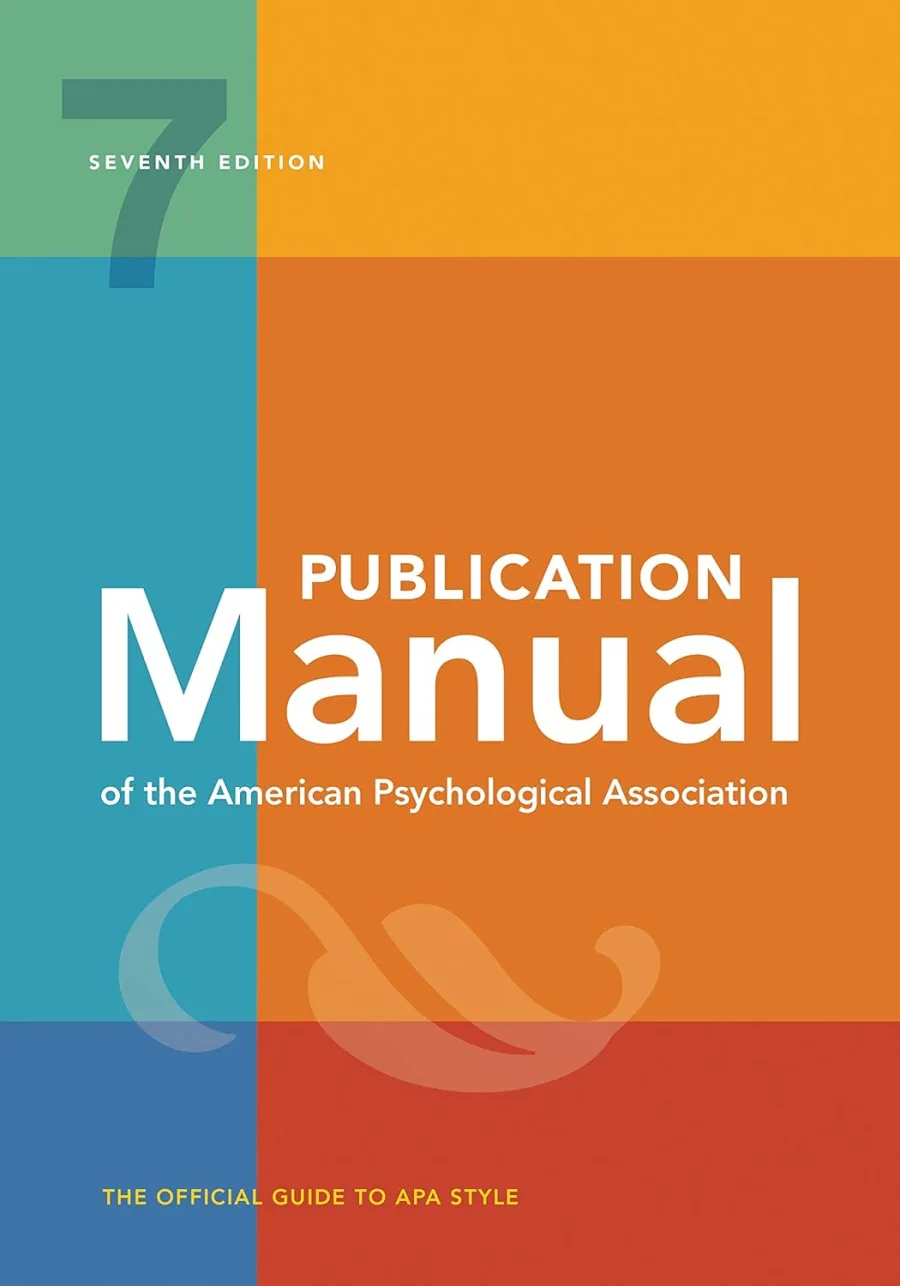
Download Cover Image
Do you want to download the full cover image for Publication Manual (OFFICIAL) 7th Edition of the American Psychological Association?