
Where's Spot?: A Lift-the-Flap Book
Board Book
• 22 Pages
• USD 7.99
• English
• 9780399240461
No ratings yet
| Publisher | Warne |
|---|---|
| ISBN13 | 9780399240461 |
| ASIN/SKU | 0399240462 |
| Book Format | Board Book |
| Language | English |
| Pages | 22 |
| List Price | USD 7.99 |
| Publishing Date | 30/06/2003 |
| Dimensions | 6.13 x 0.58 x 6.31 inches |
| Weight | 2.31 pounds |
| Book Code | BD00066303 |
Buy this Book
Amazon Stores
Ebook Stores
Other Stores
Discover Where's Spot?: A Lift-the-Flap Book by Eric Hill. This book is published by Warne in Board Book format, ISBN 9780399240461, ASIN 0399240462, under Children's Books, Children's Dog Books, Children's Activity Books.
Book Description
A sturdy board book edition of the first-ever lift-the-flap book! With hide-and-seek fun on every page, this interactive classic has had children across the globe searching for everyone’s favorite pup, who’s gone on to sell over 65 million copies worldwide!
“Spot is one of the essential experiences of childhood.” —Parents
Spot hasn’t eaten his dinner yet, but where can he be? Help Spot’s mom Sally as she searches for her pup throughout the home. As Sally searches, readers will discover the names of many household objects and the hidden animals they hold. Could he be behind the door? Inside the piano? Under the stairs? Along the way, Sally meets some interesting critters, including a brown bear, a crocodile, a trio of penguins, and more!
With its soothing rhythm, easy-to-understand vocabulary, and engaging, charming illustrations, Where’s Spot? is an essential addition to every child’s growing library.
“Spot is one of the essential experiences of childhood.” —Parents
Spot hasn’t eaten his dinner yet, but where can he be? Help Spot’s mom Sally as she searches for her pup throughout the home. As Sally searches, readers will discover the names of many household objects and the hidden animals they hold. Could he be behind the door? Inside the piano? Under the stairs? Along the way, Sally meets some interesting critters, including a brown bear, a crocodile, a trio of penguins, and more!
With its soothing rhythm, easy-to-understand vocabulary, and engaging, charming illustrations, Where’s Spot? is an essential addition to every child’s growing library.
Author Biography
Eric Hill OBE (1927-2014) was the creator of beloved children’s character Spot. He started his artistic career as an art studio messenger, before becoming a cartoonist and eventually, an art director at a leading advertising agency. In 1978, Eric made up a story about a small puppy to read to his son at bedtime and Spot was born. He published Where’s Spot? in 1980: an interactive children’s book with a pioneering lift-the-flap format combined with a simple story and charming, quirky illustrations. Its immediate success convinced him to become a full-time author, and Spot books have been enjoyed by children around the world ever since – as well as audio books, animation, toys and games.
Editorial Reviews
Editorial Reviews will be added soon…
Book Summary
Where's Spot? by Eric Hill is a beloved children's picture book that introduces young readers to the playful adventure of finding a mischievous puppy named Spot. Written as an interactive lift-the-flap story, the book combines simple text, engaging illustrations, and an element of surprise to encourage curiosity, observation, and participation. Although the story is brief, it has become a timeless classic because of its charming characters, repetitive structure, and the excitement it creates as children search alongside Spot's mother.
The story begins when Spot's mother notices that her playful little puppy is missing. Knowing that Spot enjoys exploring and hiding, she sets out to look for him around the house. Rather than becoming worried or upset, she calmly begins her search, turning what could have been a stressful situation into a fun game. This gentle approach immediately captures children's attention, inviting them to join the search and guess where Spot might be hiding.
As Spot's mother moves from one place to another, she checks a series of familiar hiding spots. Each time she looks somewhere, readers are encouraged to lift a flap to reveal what is underneath. Instead of finding Spot right away, she discovers a variety of friendly animals hiding in unexpected places. Every surprise adds a sense of excitement while keeping young readers eager to continue searching.
The first few hiding places contain animals that clearly do not match Spot. A large bear, a group of playful creatures, or other unexpected guests appear instead of the missing puppy. These amusing discoveries create gentle humor because each animal is far too different from the small dog everyone is looking for. The repeated question and answer pattern helps children anticipate what will happen next while also encouraging them to make their own predictions before lifting each flap.
As the search continues, Spot's mother remains patient and determined. She carefully checks every possible hiding place without becoming frustrated. Her calm persistence provides a reassuring example for young readers, showing that problems can often be solved by staying positive and continuing to look carefully. The story subtly demonstrates the value of patience and perseverance without presenting these ideas as formal lessons.
Each new page introduces another colorful animal character with its own distinctive appearance. The variety of animals keeps the story visually interesting while helping children recognize different species and learn their names. The simple illustrations make it easy for even very young readers to identify each animal, while the playful expressions give every character a friendly personality. The animals are never frightening or threatening, creating a warm and welcoming atmosphere throughout the book.
The interactive lift-the-flap design plays an important role in the reading experience. Instead of simply listening to the story, children become active participants. They eagerly lift each flap, hoping that Spot will finally be found. This physical interaction keeps young readers engaged and helps develop curiosity, anticipation, and fine motor skills. The excitement of revealing each hidden picture encourages children to stay involved from beginning to end.
As more hiding places are explored, the anticipation steadily builds. Every incorrect guess increases the excitement because readers know Spot must be somewhere nearby. The repetitive structure gives children confidence, as they quickly understand the pattern of the story and begin predicting what might happen next. This repetition also supports early language development by reinforcing familiar words and sentence structures.
Eventually, after searching through many different locations, Spot's mother finally discovers her playful puppy hiding inside a basket. The moment is joyful because both the characters and the readers have completed the search together. Spot happily emerges from his hiding place, ending the game with a sense of warmth and relief. His cheerful expression suggests that he never intended to worry his mother but was simply enjoying a game of hide-and-seek.
The reunion between Spot and his mother highlights the loving bond they share. Although Spot has been hiding for much of the story, there is never any suggestion of anger or punishment when he is found. Instead, the ending celebrates the happiness of being together again. This gentle conclusion reassures young readers and emphasizes the comfort and security that come from family relationships.
Beyond its entertaining storyline, Where's Spot? offers several educational benefits. The repeated questions encourage children to think, observe, and make predictions. The simple vocabulary supports early language development, while the familiar household settings help children connect the story to their own everyday experiences. Identifying the different animals also introduces basic concepts of classification and observation in a natural and enjoyable way.
The book's straightforward language makes it especially suitable for toddlers and preschool-aged children who are beginning to develop listening and reading skills. Parents and caregivers often enjoy reading the story aloud because the interactive format naturally invites conversation. Children can name the animals, guess where Spot might be next, and celebrate each surprising discovery, turning reading into a shared experience rather than a passive activity.
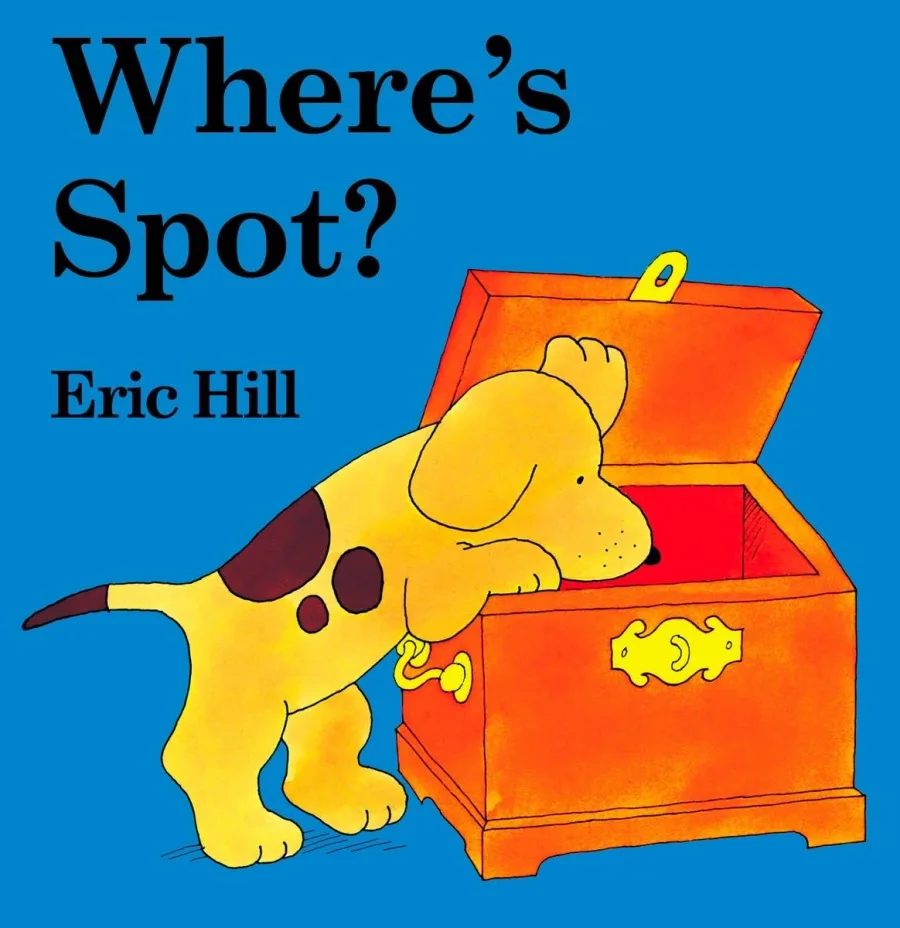
Eric Hill's illustrations contribute greatly to the book's lasting appeal. The bright colors, clear shapes, and expressive faces make every page easy to understand and visually engaging. The uncluttered artwork allows children to focus on the main action without distraction, while the lift-the-flap elements add an extra layer of excitement that has made the book popular across generations.
Overall, Where's Spot? is much more than a simple search story. It is a joyful celebration of curiosity, family, and playful exploration that encourages children to participate actively in the reading experience. Through its engaging interactive design, memorable animal characters, and reassuring ending, the book introduces important early learning concepts while creating moments of fun and discovery. Eric Hill's timeless classic continues to delight young readers because it transforms an ordinary game of hide-and-seek into an adventure filled with laughter, surprises, and the comforting reminder that loved ones are never far away.
The story begins when Spot's mother notices that her playful little puppy is missing. Knowing that Spot enjoys exploring and hiding, she sets out to look for him around the house. Rather than becoming worried or upset, she calmly begins her search, turning what could have been a stressful situation into a fun game. This gentle approach immediately captures children's attention, inviting them to join the search and guess where Spot might be hiding.
As Spot's mother moves from one place to another, she checks a series of familiar hiding spots. Each time she looks somewhere, readers are encouraged to lift a flap to reveal what is underneath. Instead of finding Spot right away, she discovers a variety of friendly animals hiding in unexpected places. Every surprise adds a sense of excitement while keeping young readers eager to continue searching.
The first few hiding places contain animals that clearly do not match Spot. A large bear, a group of playful creatures, or other unexpected guests appear instead of the missing puppy. These amusing discoveries create gentle humor because each animal is far too different from the small dog everyone is looking for. The repeated question and answer pattern helps children anticipate what will happen next while also encouraging them to make their own predictions before lifting each flap.
As the search continues, Spot's mother remains patient and determined. She carefully checks every possible hiding place without becoming frustrated. Her calm persistence provides a reassuring example for young readers, showing that problems can often be solved by staying positive and continuing to look carefully. The story subtly demonstrates the value of patience and perseverance without presenting these ideas as formal lessons.
Each new page introduces another colorful animal character with its own distinctive appearance. The variety of animals keeps the story visually interesting while helping children recognize different species and learn their names. The simple illustrations make it easy for even very young readers to identify each animal, while the playful expressions give every character a friendly personality. The animals are never frightening or threatening, creating a warm and welcoming atmosphere throughout the book.
The interactive lift-the-flap design plays an important role in the reading experience. Instead of simply listening to the story, children become active participants. They eagerly lift each flap, hoping that Spot will finally be found. This physical interaction keeps young readers engaged and helps develop curiosity, anticipation, and fine motor skills. The excitement of revealing each hidden picture encourages children to stay involved from beginning to end.
As more hiding places are explored, the anticipation steadily builds. Every incorrect guess increases the excitement because readers know Spot must be somewhere nearby. The repetitive structure gives children confidence, as they quickly understand the pattern of the story and begin predicting what might happen next. This repetition also supports early language development by reinforcing familiar words and sentence structures.
Eventually, after searching through many different locations, Spot's mother finally discovers her playful puppy hiding inside a basket. The moment is joyful because both the characters and the readers have completed the search together. Spot happily emerges from his hiding place, ending the game with a sense of warmth and relief. His cheerful expression suggests that he never intended to worry his mother but was simply enjoying a game of hide-and-seek.
The reunion between Spot and his mother highlights the loving bond they share. Although Spot has been hiding for much of the story, there is never any suggestion of anger or punishment when he is found. Instead, the ending celebrates the happiness of being together again. This gentle conclusion reassures young readers and emphasizes the comfort and security that come from family relationships.
Beyond its entertaining storyline, Where's Spot? offers several educational benefits. The repeated questions encourage children to think, observe, and make predictions. The simple vocabulary supports early language development, while the familiar household settings help children connect the story to their own everyday experiences. Identifying the different animals also introduces basic concepts of classification and observation in a natural and enjoyable way.
The book's straightforward language makes it especially suitable for toddlers and preschool-aged children who are beginning to develop listening and reading skills. Parents and caregivers often enjoy reading the story aloud because the interactive format naturally invites conversation. Children can name the animals, guess where Spot might be next, and celebrate each surprising discovery, turning reading into a shared experience rather than a passive activity.
Eric Hill's illustrations contribute greatly to the book's lasting appeal. The bright colors, clear shapes, and expressive faces make every page easy to understand and visually engaging. The uncluttered artwork allows children to focus on the main action without distraction, while the lift-the-flap elements add an extra layer of excitement that has made the book popular across generations.
Overall, Where's Spot? is much more than a simple search story. It is a joyful celebration of curiosity, family, and playful exploration that encourages children to participate actively in the reading experience. Through its engaging interactive design, memorable animal characters, and reassuring ending, the book introduces important early learning concepts while creating moments of fun and discovery. Eric Hill's timeless classic continues to delight young readers because it transforms an ordinary game of hide-and-seek into an adventure filled with laughter, surprises, and the comforting reminder that loved ones are never far away.
Sample Chapters
Sample Chapters will be added soon…
Reader Reviews
No reviews yet.
Where's Spot?: A Lift-the-Flap Book
Download Cover Image
Do you want to download the full cover image for Where's Spot?: A Lift-the-Flap Book?