
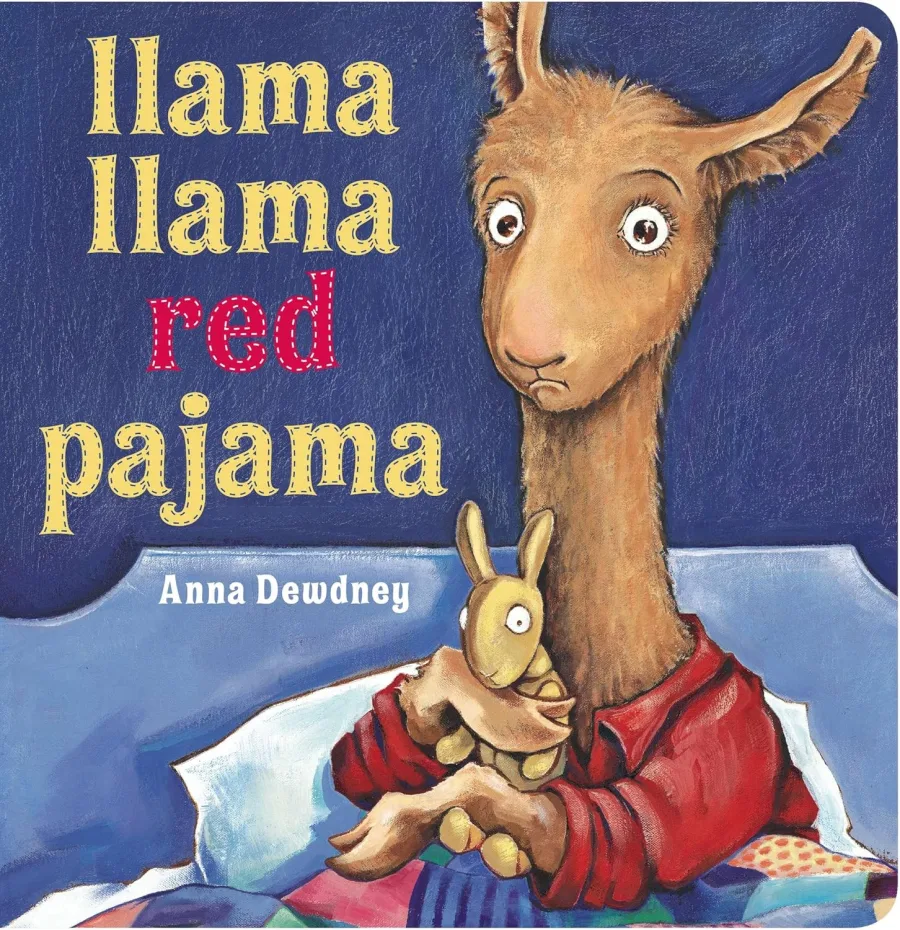
Llama Llama Red Pajama
Board Book
• 34 Pages
• USD 8.99
• English
• 9780451474575
No ratings yet
| Publisher | Viking Books for Young Readers |
|---|---|
| ISBN13 | 9780451474575 |
| ASIN/SKU | 0451474570 |
| Book Format | Board Book |
| Language | English |
| Pages | 34 |
| List Price | USD 8.99 |
| Series Title | Llama Llama |
| Publishing Date | 05/05/2015 |
| Dimensions | 7.52 x 0.63 x 7.76 inches |
| Weight | 1 pounds |
| Book Code | BD00066306 |
Buy this Book
Amazon Stores
Ebook Stores
Other Stores
Discover Llama Llama Red Pajama by Anna Dewdney. This book is published by Viking Books for Young Readers in Board Book format, ISBN 9780451474575, ASIN 0451474570, under Children's Books, Children’s Books on Sleep, Children's Mammal Books.
Book Description
NEW YORK TIMES BESTSELLER • Llama Llama learns to face the bedtime blues in this charmingly written board book, perfect for sending little ones off to sleep.
Llama, Llama red pajama
waiting, waiting for his mama.
Mama isn't coming yet.
Baby Llama starts to fret.
Tucked into bed by his mama, Baby Llama immediately starts worrying when she goes downstairs to do chores. As he waits and waits for her to come back, his soft whimpers turn to hollers as he turns bedtime into an all-out llama drama! But just in time, Mama Llama returns to set things right.
Complete with short, simple rhyming text, delightful illustrations, and a reassuring message, this sturdy board book is made for curious hands, and is sure to calm the minds of young readers preparing for bedtime.
Llama, Llama red pajama
waiting, waiting for his mama.
Mama isn't coming yet.
Baby Llama starts to fret.
Tucked into bed by his mama, Baby Llama immediately starts worrying when she goes downstairs to do chores. As he waits and waits for her to come back, his soft whimpers turn to hollers as he turns bedtime into an all-out llama drama! But just in time, Mama Llama returns to set things right.
Complete with short, simple rhyming text, delightful illustrations, and a reassuring message, this sturdy board book is made for curious hands, and is sure to calm the minds of young readers preparing for bedtime.
Author Biography
Anna Dewdney was an award-winning children's-book author, illustrator, teacher, mother, and enthusiastic proponent of literacy and reading aloud to children. She was the author of the bestselling Llama Llama Red Pajama series of picturebooks, among many others. She lived with her partner Reed Duncan in Vermont where she worked, gardened, and spent time with her daughters and dogs. Anna died in 2016.
Editorial Reviews
“A real charmer that will leave preschoolers giggling and parents appreciating the familiar scenario.” —Booklist
“Dewdney’s tale is bound to become a comical classic.” —Kirkus Reviews
“Dewdney’s tale is bound to become a comical classic.” —Kirkus Reviews
Book Summary
Llama Llama Red Pajama by Anna Dewdney is a warm, rhythmic bedtime story that gently captures a feeling almost every young child knows: the worry that comes when a parent leaves the room at night. The book follows Baby Llama, who is tucked into bed by his mama after a sweet bedtime routine. Everything seems calm at first. He is in his red pajamas, he has his mama nearby, and the night feels safe and familiar. But the moment Mama Llama goes downstairs, Baby Llama begins to feel uneasy. What starts as a small concern quickly grows into full-blown bedtime drama, and that emotional journey is what gives the book its heart.
The story is simple, but it is very effective because it treats Baby Llama’s feelings with honesty. He does not immediately fall asleep contentedly. Instead, he waits, wonders, and worries. He wants his mama nearby, and when she does not come back right away, his anxiety grows stronger. He calls for her, first softly and then with increasing urgency. His waiting turns into fretting, then whimpering, then crying out loudly in distress. This rise and fall of emotion is both funny and deeply relatable. Young children often experience exactly this kind of bedtime uncertainty, and the book reflects that feeling in a way that is comforting rather than dismissive.
What makes the book especially memorable is its rhythm. The repeated phrases and sing-song pattern make it feel like a chant or lullaby, which helps ease the tension even as Baby Llama grows more upset. The language is playful and easy to remember, and the repetition gives the story a strong musical quality. Children are naturally drawn to that kind of pattern, and adults reading aloud can use the rhythm to make the story lively and expressive. The famous refrain about “llama llama red pajama” becomes both a sound children enjoy and a marker of Baby Llama’s emotional state as he waits and worries.
While Baby Llama is having his emotional meltdown upstairs, Mama Llama is downstairs doing ordinary things and, importantly, not realizing how upset her child has become. That contrast adds humor to the story. Baby Llama imagines the worst, while Mama Llama is simply busy with everyday tasks. This difference between a child’s imagination and an adult’s perspective is at the center of the book’s humor and truth. The story shows how a small separation can feel enormous to a child, even when the parent is not far away at all. It is a reminder that children often need reassurance not because anything is actually wrong, but because they are still learning how to trust that love remains even when a parent is out of sight.
Eventually, Mama Llama returns and comforts her son. She reassures him that she is near, even when she is not right there beside him. Her return does not come with anger or impatience. Instead, it comes with tenderness and calm. She gives him the message that everything is okay and that her love has not gone anywhere. This is the emotional resolution of the story, and it is what gives the book its enduring appeal. The ending is not dramatic in a big sense, but it is emotionally satisfying because it offers exactly what a young child needs after a moment of fear: warmth, closeness, and rest.
The illustrations are an important part of the book’s charm as well. Anna Dewdney’s artwork gives Baby Llama a face and body language that make his emotions very clear. His expressions shift from mild concern to panic, which makes the story easy for children to follow even before they can read the words. The pictures help readers understand the growing intensity of his feelings, while also keeping the tone soft and inviting. The visual style supports the emotional arc of the book without making it feel heavy or scary.
At a deeper level, the book is about the development of trust and emotional security. It shows that bedtime can be hard because it asks children to separate from the comfort of their caregiver and face the quiet of the night. The story does not pretend that this is easy. Instead, it acknowledges the struggle and then gently resolves it. That is part of why it has become such a beloved read-aloud book. It helps children feel seen in their worries, and it helps parents offer reassurance in a familiar, soothing way.
The book also works because it balances drama and comfort so well. Baby Llama’s concern is exaggerated enough to be funny, but not so exaggerated that it loses emotional truth. The “llama drama” is entertaining, but it is also rooted in real childhood feeling. That blend of humor and empathy gives the book a lasting place in bedtime reading. It is fun to read aloud, easy to remember, and emotionally comforting at the end of the day.
Overall, Llama Llama Red Pajama is a simple but powerful story about bedtime anxiety, patience, and the reassurance of a parent’s love. It turns an ordinary nighttime moment into something memorable by using rhythm, repetition, and emotional honesty. The result is a picture book that feels playful on the surface but comforting at its core. It reminds children that even when a parent is out of sight, love is still close by, and that makes it one of the most cherished bedtime stories for young readers.
The story is simple, but it is very effective because it treats Baby Llama’s feelings with honesty. He does not immediately fall asleep contentedly. Instead, he waits, wonders, and worries. He wants his mama nearby, and when she does not come back right away, his anxiety grows stronger. He calls for her, first softly and then with increasing urgency. His waiting turns into fretting, then whimpering, then crying out loudly in distress. This rise and fall of emotion is both funny and deeply relatable. Young children often experience exactly this kind of bedtime uncertainty, and the book reflects that feeling in a way that is comforting rather than dismissive.
What makes the book especially memorable is its rhythm. The repeated phrases and sing-song pattern make it feel like a chant or lullaby, which helps ease the tension even as Baby Llama grows more upset. The language is playful and easy to remember, and the repetition gives the story a strong musical quality. Children are naturally drawn to that kind of pattern, and adults reading aloud can use the rhythm to make the story lively and expressive. The famous refrain about “llama llama red pajama” becomes both a sound children enjoy and a marker of Baby Llama’s emotional state as he waits and worries.
While Baby Llama is having his emotional meltdown upstairs, Mama Llama is downstairs doing ordinary things and, importantly, not realizing how upset her child has become. That contrast adds humor to the story. Baby Llama imagines the worst, while Mama Llama is simply busy with everyday tasks. This difference between a child’s imagination and an adult’s perspective is at the center of the book’s humor and truth. The story shows how a small separation can feel enormous to a child, even when the parent is not far away at all. It is a reminder that children often need reassurance not because anything is actually wrong, but because they are still learning how to trust that love remains even when a parent is out of sight.
Eventually, Mama Llama returns and comforts her son. She reassures him that she is near, even when she is not right there beside him. Her return does not come with anger or impatience. Instead, it comes with tenderness and calm. She gives him the message that everything is okay and that her love has not gone anywhere. This is the emotional resolution of the story, and it is what gives the book its enduring appeal. The ending is not dramatic in a big sense, but it is emotionally satisfying because it offers exactly what a young child needs after a moment of fear: warmth, closeness, and rest.
The illustrations are an important part of the book’s charm as well. Anna Dewdney’s artwork gives Baby Llama a face and body language that make his emotions very clear. His expressions shift from mild concern to panic, which makes the story easy for children to follow even before they can read the words. The pictures help readers understand the growing intensity of his feelings, while also keeping the tone soft and inviting. The visual style supports the emotional arc of the book without making it feel heavy or scary.
At a deeper level, the book is about the development of trust and emotional security. It shows that bedtime can be hard because it asks children to separate from the comfort of their caregiver and face the quiet of the night. The story does not pretend that this is easy. Instead, it acknowledges the struggle and then gently resolves it. That is part of why it has become such a beloved read-aloud book. It helps children feel seen in their worries, and it helps parents offer reassurance in a familiar, soothing way.
The book also works because it balances drama and comfort so well. Baby Llama’s concern is exaggerated enough to be funny, but not so exaggerated that it loses emotional truth. The “llama drama” is entertaining, but it is also rooted in real childhood feeling. That blend of humor and empathy gives the book a lasting place in bedtime reading. It is fun to read aloud, easy to remember, and emotionally comforting at the end of the day.
Overall, Llama Llama Red Pajama is a simple but powerful story about bedtime anxiety, patience, and the reassurance of a parent’s love. It turns an ordinary nighttime moment into something memorable by using rhythm, repetition, and emotional honesty. The result is a picture book that feels playful on the surface but comforting at its core. It reminds children that even when a parent is out of sight, love is still close by, and that makes it one of the most cherished bedtime stories for young readers.
Sample Chapters
Sample Chapters will be added soon…
Reader Reviews
No reviews yet.
Llama Llama Red Pajama
Download Cover Image
Do you want to download the full cover image for Llama Llama Red Pajama?