
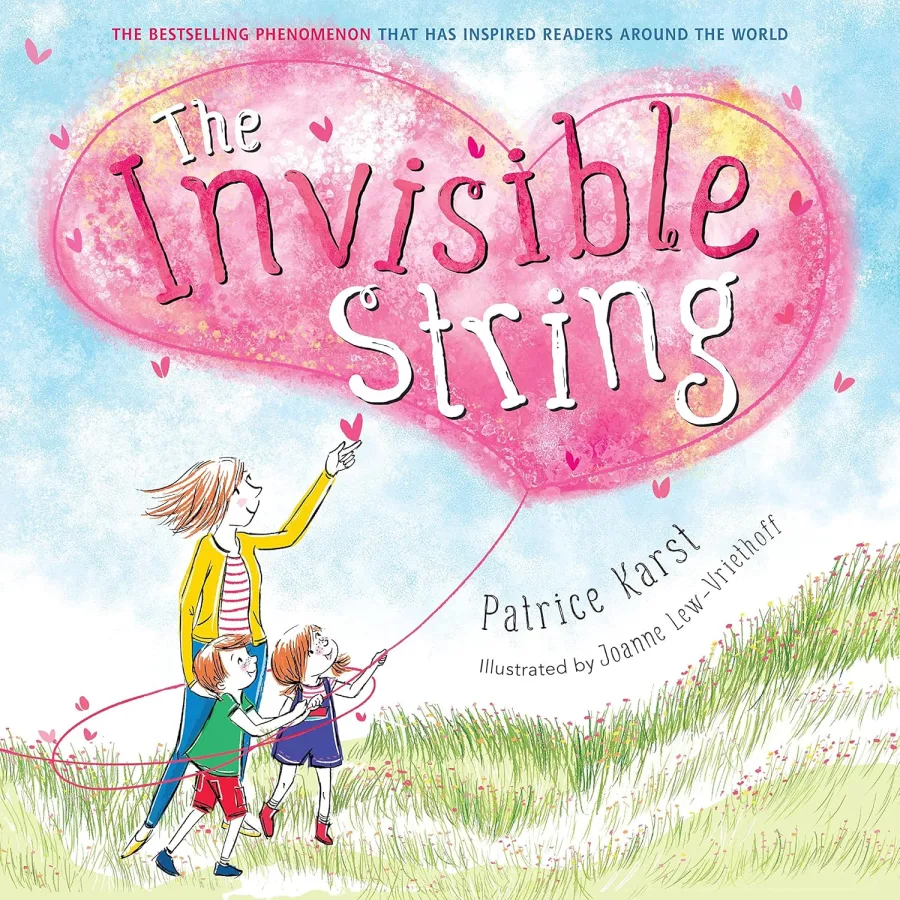
The Invisible String
Patrice Karst, Joanne Lew-Vriethoff (Illustrator)
Paperback
• 40 Pages
• USD 9.99
• English
• 9780316486231
No ratings yet
| Publisher | Little, Brown Books for Young Readers |
|---|---|
| ISBN13 | 9780316486231 |
| ASIN/SKU | 031648623X |
| Book Format | Paperback |
| Language | English |
| Pages | 40 |
| List Price | USD 9.99 |
| Series Title | The Invisible String |
| Publishing Date | 30/10/2018 |
| Dimensions | 10 x 0.3 x 10 inches |
| Weight | 7.1 ounces |
| Book Code | BD00066343 |
Buy this Book
Amazon Stores
Ebook Stores
Other Stores
Discover The Invisible String by Patrice Karst. This book is published by Little, Brown Books for Young Readers in Paperback format, ISBN 9780316486231, ASIN 031648623X, under Children's Books, Children's Books on Death and Dying, Children's Books on Marriage and Divorce.
Book Description
With over 2 million copies sold, this accessible, bestselling picture book phenomenon about the unbreakable connections between loved ones has healed generations of children and adults alike. A new version featuring many different families, The Invisible String Family Celebration, and a companion workbook, The Invisible String Workbook, are also available.
Parents, educators, therapists, and social workers alike have declared The Invisible String the perfect tool for coping with all kinds of separation anxiety, loss, and grief. It's also been joyfully embraced as a year-round celebration of love--gifted at births, graduations, weddings, Valentine's Day, and beyond. In this relatable and reassuring contemporary classic, a mother tells her two children that they're all connected by an invisible string. "That's impossible!" the children insist, but still they want to know more: "What kind of string?" The answer is the simple truth that binds us all: An Invisible String made of love. Even though you can't see it with your eyes, you can feel it deep in your heart, and know that you are always connected to the ones you love. Does everybody have an Invisible String? How far does it reach? Does it ever go away? This heartwarming picture book for all ages explores questions about the intangible yet unbreakable connections between us, and opens up deeper conversations about love.
Recommended and adopted by parenting blogs, bereavement support groups, hospice centers, foster care and social service agencies, military library services, church groups, and educators, The Invisible String offers a very simple approach to overcoming loneliness, separation, or loss with an imaginative twist that children easily understand and embrace, and delivers a particularly compelling message in today's uncertain times. This special paperback edition includes vibrant new illustrations and an introduction from the author.
Recommended by Oprah Daily! • A Good Housekeeping Best Children’s Book of All Time • As seen on CNN
"This book is a beautiful way to begin to try, as parents, to instill in children the impenetrable power of the heart, the energy of love, and the flow that can be felt from the grace in every moment." —Tony Robbins
Read all the books in The Invisible String series:
The Invisible String Family Celebration
The Invisible String Backpack: Your very own tool kit for school—and life!
The Invisible String Workbook: Creative Activities to Comfort, Calm, and Connect
The Invisible Leash: An Invisible String Story About the Loss of a Pet
The Invisible Web: An Invisible String Story Celebrating Love and Universal Connection
You Are Never Alone: An Invisible String Lullaby
Parents, educators, therapists, and social workers alike have declared The Invisible String the perfect tool for coping with all kinds of separation anxiety, loss, and grief. It's also been joyfully embraced as a year-round celebration of love--gifted at births, graduations, weddings, Valentine's Day, and beyond. In this relatable and reassuring contemporary classic, a mother tells her two children that they're all connected by an invisible string. "That's impossible!" the children insist, but still they want to know more: "What kind of string?" The answer is the simple truth that binds us all: An Invisible String made of love. Even though you can't see it with your eyes, you can feel it deep in your heart, and know that you are always connected to the ones you love. Does everybody have an Invisible String? How far does it reach? Does it ever go away? This heartwarming picture book for all ages explores questions about the intangible yet unbreakable connections between us, and opens up deeper conversations about love.
Recommended and adopted by parenting blogs, bereavement support groups, hospice centers, foster care and social service agencies, military library services, church groups, and educators, The Invisible String offers a very simple approach to overcoming loneliness, separation, or loss with an imaginative twist that children easily understand and embrace, and delivers a particularly compelling message in today's uncertain times. This special paperback edition includes vibrant new illustrations and an introduction from the author.
Recommended by Oprah Daily! • A Good Housekeeping Best Children’s Book of All Time • As seen on CNN
"This book is a beautiful way to begin to try, as parents, to instill in children the impenetrable power of the heart, the energy of love, and the flow that can be felt from the grace in every moment." —Tony Robbins
Read all the books in The Invisible String series:
The Invisible String Family Celebration
The Invisible String Backpack: Your very own tool kit for school—and life!
The Invisible String Workbook: Creative Activities to Comfort, Calm, and Connect
The Invisible Leash: An Invisible String Story About the Loss of a Pet
The Invisible Web: An Invisible String Story Celebrating Love and Universal Connection
You Are Never Alone: An Invisible String Lullaby
Author Biography
Patrice Karst is the bestselling author of The Invisible String, a contemporary children’s classic that has sold more than 2.5 million copies and been translated into 21 languages. Beloved by children, families, teachers, therapists, and grief counselors around the world, her work explores the enduring power of love, connection, and comfort across time and distance.
In addition to The Invisible String, Patrice is the author of many other children’s books including, The Invisible Leash, The Invisible Web, You Are Never Alone, The Invisible String Workbook, The Invisible String Backpack, The Invisible String Family Celebration, How Jackson Found His Joy Again, The Smile That Went Around the World, and Ruby and Lonely.
Her adult book, God Made Easy: A Simple Guide to Connecting with the Divine, brings the same warmth, clarity, and open-hearted wisdom to readers seeking a simpler, more personal way to understand and experience God. First inspired by a dream in 1995, the book invites people of all religions, spiritual paths, and levels of belief to rediscover the Divine as loving, present, accessible, and never far away.
Patrice has been on a lifelong mission to share the message that love transcends time and space and is the most powerful force in the universe. She lives in Santa Barbara, where she is currently working on her memoir.
In addition to The Invisible String, Patrice is the author of many other children’s books including, The Invisible Leash, The Invisible Web, You Are Never Alone, The Invisible String Workbook, The Invisible String Backpack, The Invisible String Family Celebration, How Jackson Found His Joy Again, The Smile That Went Around the World, and Ruby and Lonely.
Her adult book, God Made Easy: A Simple Guide to Connecting with the Divine, brings the same warmth, clarity, and open-hearted wisdom to readers seeking a simpler, more personal way to understand and experience God. First inspired by a dream in 1995, the book invites people of all religions, spiritual paths, and levels of belief to rediscover the Divine as loving, present, accessible, and never far away.
Patrice has been on a lifelong mission to share the message that love transcends time and space and is the most powerful force in the universe. She lives in Santa Barbara, where she is currently working on her memoir.
Editorial Reviews
Over 2 MILLION copies sold!
A USA Today Bestseller
An Amazon Bestseller
A Publishers Weekly Bestseller
A Good Housekeeping Best Children’s Book of All Time
Recommended by Oprah Daily
"A wonderful storybook for children experiencing separation anxiety."―Today's Parent
"It’s the most beautiful, beautiful book, and it actually makes me cry every time."―Sara Haines, ABC’s The View
“Unravel some of the complexities of grief for young children with this bestselling book.”―CNN Underscored
"Delivers a particularly compelling message in today's uncertain times that though we may be separated from the ones we care for, love is the unending connection that binds us all."―The American Academy of Pediatrics
"[Promotes] a vision of global unity and empathy...effective."
―Kirkus
"Whether kids are having separation anxiety or dealing with divorce or even death, this sweet story is very reassuring."
―Motherly
"Children of all ages (and yes, adults too!) feel a great sense of peace and joy realizing that we are all connected to the ones we love through The Invisible String."―The National Association of School Psychologists
"The message of The Invisible String resonates with children and adults alike.... The two ends of the treasured Invisible String are families and schools. This String, reinforced on each side, buoys students with love, guidance, direction. But when one end weakens, the entire String falters.... When we need support, reassurance, or simply a kindred spirit, just give the String a tug and someone will tug back. This is powerful, and will keep your child on track through...his or her education journey."―Carmen Fariña, former Chancellor, NYC Department of Education
Praise for the Spanish edition of The Invisible String, El Hilo Invisible:
"A lovely picture book depicting a love that connects everyone, and a wonderful choice for children who experience anxiety and worry when separated from their loved ones." —School Library Journal
A USA Today Bestseller
An Amazon Bestseller
A Publishers Weekly Bestseller
A Good Housekeeping Best Children’s Book of All Time
Recommended by Oprah Daily
"A wonderful storybook for children experiencing separation anxiety."―Today's Parent
"It’s the most beautiful, beautiful book, and it actually makes me cry every time."―Sara Haines, ABC’s The View
“Unravel some of the complexities of grief for young children with this bestselling book.”―CNN Underscored
"Delivers a particularly compelling message in today's uncertain times that though we may be separated from the ones we care for, love is the unending connection that binds us all."―The American Academy of Pediatrics
"[Promotes] a vision of global unity and empathy...effective."
―Kirkus
"Whether kids are having separation anxiety or dealing with divorce or even death, this sweet story is very reassuring."
―Motherly
"Children of all ages (and yes, adults too!) feel a great sense of peace and joy realizing that we are all connected to the ones we love through The Invisible String."―The National Association of School Psychologists
"The message of The Invisible String resonates with children and adults alike.... The two ends of the treasured Invisible String are families and schools. This String, reinforced on each side, buoys students with love, guidance, direction. But when one end weakens, the entire String falters.... When we need support, reassurance, or simply a kindred spirit, just give the String a tug and someone will tug back. This is powerful, and will keep your child on track through...his or her education journey."―Carmen Fariña, former Chancellor, NYC Department of Education
Praise for the Spanish edition of The Invisible String, El Hilo Invisible:
"A lovely picture book depicting a love that connects everyone, and a wonderful choice for children who experience anxiety and worry when separated from their loved ones." —School Library Journal
Book Summary
The Invisible String by Patrice Karst is a gentle, reassuring picture book about love, separation, loneliness, grief, and the invisible connections that keep people emotionally close even when they cannot be physically together. Originally published in 2000 and later republished in updated editions with illustrations by Joanne Lew-Vriethoff, the book has become a widely used children's story for helping young readers understand separation anxiety, loss, and the enduring nature of love. The publisher describes it as a contemporary classic about the unbreakable connections between loved ones, and it has sold more than two million copies and been translated into twenty languages.
At the center of the story is an imaginative idea that is extremely simple for a child to understand: everyone who loves us is connected to us by an invisible string. We cannot see this string with our eyes, but we can feel it in our hearts. The string represents love itself—a bond that continues across distance, separation, anger, fear, and even death. Karst takes an abstract emotional truth and gives it a concrete image that children can hold onto. Instead of explaining attachment, grief, or emotional security through complicated psychological language, she gives children something they can imagine: a string stretching from one heart to another.
The story begins during a frightening thunderstorm at night. Two young twins, Jeremy and Liza, are awakened by the storm and become frightened. They leave their beds and seek comfort from their mother. Their fear is not really about thunder alone. Like many children, they are looking for reassurance that the person who makes them feel safe is still close to them. Their mother responds by telling them that they are always connected, even when they are physically apart. When the children understandably question how that could be possible, she introduces them to the idea of the Invisible String.
This opening is important because the Invisible String is introduced at precisely the moment when children are most vulnerable. Darkness, loud noises, nighttime separation, unfamiliar surroundings, and the temporary absence of a parent can make children feel that something has changed permanently. The mother's explanation gives them another way to understand separation. Going to another room does not mean love has disappeared. Sleeping in a different bed does not mean the family has been broken apart. Distance is physical, but love can remain present.
The children's first reaction is naturally skeptical. An invisible string sounds impossible. They cannot touch it or see it, so why should they believe it exists? This question allows Karst to make the central distinction of the entire book: some of the most important things in life cannot be seen. Love, friendship, comfort, memories, trust, and emotional connection are not physical objects, yet they can have very real effects on how people feel and behave. The Invisible String is therefore not meant to be understood as a literal piece of string. It is a metaphor for emotional attachment and enduring love.
As the mother explains the idea, the children begin asking increasingly imaginative questions. If the string is real, how far can it stretch? Can it reach someone who is far away? Can it reach someone who is traveling? What happens if someone is underwater, on another continent, or somewhere unimaginably distant? The story answers these questions with the same reassuring principle: love is not limited by physical distance. The string can extend wherever the people we love may be.
This becomes one of the book's most comforting messages for children experiencing separation anxiety. A child may be separated from a parent because of school, work, travel, hospitalization, divorce, foster care, military service, or another circumstance. The physical situation may be complicated, but the emotional message can remain straightforward: You are still loved, and you are still connected. The book gives children a mental image they can return to whenever they feel lonely.
Karst then broadens the idea beyond the immediate parent-child relationship. The Invisible String can connect children with siblings, friends, pets, grandparents, and other loved ones. The illustrations and examples allow children to imagine the string crossing enormous distances and linking people who are not physically together. This is significant because childhood contains many small separations. Going to school for the first time, sleeping away from home, visiting relatives, moving to a new place, or simply being in a different room can all feel emotionally significant to a young child.
One of the book's strongest ideas is that love does not disappear simply because people are angry with each other. At one point, the children wonder whether the string remains when they are upset with their mother. The answer is reassuring: anger may temporarily affect a relationship, but it does not automatically destroy love. The story therefore makes an important distinction between an emotion and a bond. Children can be angry with someone and still love them. Parents can become frustrated with their children and still love them. A disagreement does not necessarily mean abandonment.
This message is particularly valuable because young children sometimes interpret conflict in absolute terms. A small argument can feel like the end of a relationship. A parent saying “I'm angry” may be heard as “I don't love you anymore.” The Invisible String offers a gentler framework. Feelings can change from moment to moment, but the underlying connection can remain. In this sense, the story quietly teaches emotional resilience: love can survive difficult feelings.
The book becomes especially powerful when it addresses death and grief. The Invisible String is described as capable of reaching loved ones who have died. The story does not attempt to explain death scientifically or philosophically. Instead, it addresses the emotional question underneath grief: If someone I love is gone, does my connection with that person disappear too? Karst's answer is no. Physical presence ends, but love and memory continue.
This is one reason the book has become widely used by bereavement organizations, hospice programs, social-service agencies, educators, and others who work with children experiencing loss. The publisher specifically notes that parents, educators, therapists, and social workers have used the book to help children cope with separation, loss, and grief. The story does not eliminate grief, and it does not pretend that missing someone is easy. Instead, it provides a language for talking about the continuing emotional relationship between the child and the person who is no longer physically present.
The Invisible String also gives children permission to feel connected without needing physical proof. Memories can become part of that connection. A child may remember a grandparent's voice, a parent's hug, a friend's laugh, or the presence of a beloved pet. These memories can become emotional reminders of the bond. The metaphor allows children to imagine that connection as something they can mentally “hold onto,” especially during moments when loneliness feels overwhelming.
Another important feature of the book is its universality. Although the story begins with a mother and her twins, its central idea is not limited to one particular family structure. The underlying message can be applied to parents and children, siblings, grandparents and grandchildren, friends, partners, and other loved ones. The later Invisible String Family Celebration was created specifically as a reimagining with a more diverse range of children and families, demonstrating how broadly the original concept can be applied.
The illustrations by Joanne Lew-Vriethoff play a major role in making the concept accessible. A young child does not need to understand abstract discussions about attachment or grief. The idea of a string connecting people is visual and immediate. The illustrations help turn an invisible emotional bond into something children can picture. This combination of simple language and expressive artwork is one reason the story works so well as a read-aloud book.
The writing itself is deliberately uncomplicated. Karst does not overwhelm young readers with explanations. Instead, she uses a conversational structure built around children's questions. This makes the book feel like a dialogue between a worried child and a reassuring parent rather than a formal lesson. The mother does not lecture her children about how they should feel. She listens to their fears and answers them using an imaginative idea they can understand.
That approach is particularly useful for parents reading The Invisible String with children. The book can become a starting point for conversations that might otherwise be difficult to initiate. A parent can ask a child whom they feel connected to, what happens when they miss someone, how love feels when someone is far away, or what memories make them feel safe. In this way, the book is not only a story but also a conversational tool.
The concept can also be useful in situations involving school anxiety and separation anxiety. A child starting kindergarten or changing schools may fear being away from a parent. The Invisible String offers a small ritual: before separation, parent and child can imagine the string connecting them. The child can then remember that leaving the room or entering the classroom does not mean losing the relationship. Patrice Karst's later Invisible String Backpack expands this emotional toolkit for school and life, showing how the original metaphor can be adapted to everyday challenges.
At a deeper level, The Invisible String is about the human need to know that we are not alone. Children naturally depend on relationships for security, but adults experience the same need. Separation, grief, relocation, illness, and uncertainty can make people wonder whether the relationships that matter most can survive difficult circumstances. Karst's answer is rooted in the enduring nature of love. The string becomes a symbol of continuity.
It is worth noting that the book is inspirational rather than a scientific explanation of attachment or grief. Its “string” is a metaphor, not a physical or scientifically demonstrated phenomenon. Its purpose is emotional reassurance. The strength of the metaphor lies precisely in its simplicity: when a child cannot see a loved one, the child can still imagine the relationship as present.
This simple idea explains why the book has remained popular for decades. The original edition appeared in 2000, and the publishing rights were later acquired by Little, Brown Books for Young Readers. Updated editions have introduced new illustrations and other material while preserving the central message. The continuing popularity of the book suggests that its core problem—how to help children understand separation and loss—remains deeply relevant.
The book's ultimate lesson is beautifully uncomplicated: physical distance does not erase emotional connection. A loved one can be in another room, another city, another country, or no longer alive, yet the love shared between people can continue to shape the heart. The Invisible String gives that truth a form children can understand and remember.
Overall, The Invisible String by Patrice Karst is a heartwarming children's book about love, connection, separation anxiety, grief, and emotional security. Its story is short and simple, but its emotional reach is much larger than its size. Through the frightened twins and their reassuring mother, Karst transforms an ordinary nighttime fear into a lesson about the permanence of love. The book does not promise that children will never feel lonely, scared, angry, or sad. Instead, it gives them a comforting idea to hold onto when those feelings arrive: somewhere beyond what the eyes can see, the bonds of love remain.
For parents searching for a book about separation anxiety, a children's grief book, a story about losing a loved one, a bedtime book about love and connection, or a comforting book for children experiencing separation, The Invisible String remains an especially accessible choice. Its greatest gift is its ability to put a complicated emotional truth into words a child can carry: you may not always be able to see the people you love, but love itself can keep you connected.
At the center of the story is an imaginative idea that is extremely simple for a child to understand: everyone who loves us is connected to us by an invisible string. We cannot see this string with our eyes, but we can feel it in our hearts. The string represents love itself—a bond that continues across distance, separation, anger, fear, and even death. Karst takes an abstract emotional truth and gives it a concrete image that children can hold onto. Instead of explaining attachment, grief, or emotional security through complicated psychological language, she gives children something they can imagine: a string stretching from one heart to another.
The story begins during a frightening thunderstorm at night. Two young twins, Jeremy and Liza, are awakened by the storm and become frightened. They leave their beds and seek comfort from their mother. Their fear is not really about thunder alone. Like many children, they are looking for reassurance that the person who makes them feel safe is still close to them. Their mother responds by telling them that they are always connected, even when they are physically apart. When the children understandably question how that could be possible, she introduces them to the idea of the Invisible String.
This opening is important because the Invisible String is introduced at precisely the moment when children are most vulnerable. Darkness, loud noises, nighttime separation, unfamiliar surroundings, and the temporary absence of a parent can make children feel that something has changed permanently. The mother's explanation gives them another way to understand separation. Going to another room does not mean love has disappeared. Sleeping in a different bed does not mean the family has been broken apart. Distance is physical, but love can remain present.
The children's first reaction is naturally skeptical. An invisible string sounds impossible. They cannot touch it or see it, so why should they believe it exists? This question allows Karst to make the central distinction of the entire book: some of the most important things in life cannot be seen. Love, friendship, comfort, memories, trust, and emotional connection are not physical objects, yet they can have very real effects on how people feel and behave. The Invisible String is therefore not meant to be understood as a literal piece of string. It is a metaphor for emotional attachment and enduring love.
As the mother explains the idea, the children begin asking increasingly imaginative questions. If the string is real, how far can it stretch? Can it reach someone who is far away? Can it reach someone who is traveling? What happens if someone is underwater, on another continent, or somewhere unimaginably distant? The story answers these questions with the same reassuring principle: love is not limited by physical distance. The string can extend wherever the people we love may be.
This becomes one of the book's most comforting messages for children experiencing separation anxiety. A child may be separated from a parent because of school, work, travel, hospitalization, divorce, foster care, military service, or another circumstance. The physical situation may be complicated, but the emotional message can remain straightforward: You are still loved, and you are still connected. The book gives children a mental image they can return to whenever they feel lonely.
Karst then broadens the idea beyond the immediate parent-child relationship. The Invisible String can connect children with siblings, friends, pets, grandparents, and other loved ones. The illustrations and examples allow children to imagine the string crossing enormous distances and linking people who are not physically together. This is significant because childhood contains many small separations. Going to school for the first time, sleeping away from home, visiting relatives, moving to a new place, or simply being in a different room can all feel emotionally significant to a young child.
One of the book's strongest ideas is that love does not disappear simply because people are angry with each other. At one point, the children wonder whether the string remains when they are upset with their mother. The answer is reassuring: anger may temporarily affect a relationship, but it does not automatically destroy love. The story therefore makes an important distinction between an emotion and a bond. Children can be angry with someone and still love them. Parents can become frustrated with their children and still love them. A disagreement does not necessarily mean abandonment.
This message is particularly valuable because young children sometimes interpret conflict in absolute terms. A small argument can feel like the end of a relationship. A parent saying “I'm angry” may be heard as “I don't love you anymore.” The Invisible String offers a gentler framework. Feelings can change from moment to moment, but the underlying connection can remain. In this sense, the story quietly teaches emotional resilience: love can survive difficult feelings.
The book becomes especially powerful when it addresses death and grief. The Invisible String is described as capable of reaching loved ones who have died. The story does not attempt to explain death scientifically or philosophically. Instead, it addresses the emotional question underneath grief: If someone I love is gone, does my connection with that person disappear too? Karst's answer is no. Physical presence ends, but love and memory continue.
This is one reason the book has become widely used by bereavement organizations, hospice programs, social-service agencies, educators, and others who work with children experiencing loss. The publisher specifically notes that parents, educators, therapists, and social workers have used the book to help children cope with separation, loss, and grief. The story does not eliminate grief, and it does not pretend that missing someone is easy. Instead, it provides a language for talking about the continuing emotional relationship between the child and the person who is no longer physically present.
The Invisible String also gives children permission to feel connected without needing physical proof. Memories can become part of that connection. A child may remember a grandparent's voice, a parent's hug, a friend's laugh, or the presence of a beloved pet. These memories can become emotional reminders of the bond. The metaphor allows children to imagine that connection as something they can mentally “hold onto,” especially during moments when loneliness feels overwhelming.
Another important feature of the book is its universality. Although the story begins with a mother and her twins, its central idea is not limited to one particular family structure. The underlying message can be applied to parents and children, siblings, grandparents and grandchildren, friends, partners, and other loved ones. The later Invisible String Family Celebration was created specifically as a reimagining with a more diverse range of children and families, demonstrating how broadly the original concept can be applied.
The illustrations by Joanne Lew-Vriethoff play a major role in making the concept accessible. A young child does not need to understand abstract discussions about attachment or grief. The idea of a string connecting people is visual and immediate. The illustrations help turn an invisible emotional bond into something children can picture. This combination of simple language and expressive artwork is one reason the story works so well as a read-aloud book.
The writing itself is deliberately uncomplicated. Karst does not overwhelm young readers with explanations. Instead, she uses a conversational structure built around children's questions. This makes the book feel like a dialogue between a worried child and a reassuring parent rather than a formal lesson. The mother does not lecture her children about how they should feel. She listens to their fears and answers them using an imaginative idea they can understand.
That approach is particularly useful for parents reading The Invisible String with children. The book can become a starting point for conversations that might otherwise be difficult to initiate. A parent can ask a child whom they feel connected to, what happens when they miss someone, how love feels when someone is far away, or what memories make them feel safe. In this way, the book is not only a story but also a conversational tool.
The concept can also be useful in situations involving school anxiety and separation anxiety. A child starting kindergarten or changing schools may fear being away from a parent. The Invisible String offers a small ritual: before separation, parent and child can imagine the string connecting them. The child can then remember that leaving the room or entering the classroom does not mean losing the relationship. Patrice Karst's later Invisible String Backpack expands this emotional toolkit for school and life, showing how the original metaphor can be adapted to everyday challenges.
At a deeper level, The Invisible String is about the human need to know that we are not alone. Children naturally depend on relationships for security, but adults experience the same need. Separation, grief, relocation, illness, and uncertainty can make people wonder whether the relationships that matter most can survive difficult circumstances. Karst's answer is rooted in the enduring nature of love. The string becomes a symbol of continuity.
It is worth noting that the book is inspirational rather than a scientific explanation of attachment or grief. Its “string” is a metaphor, not a physical or scientifically demonstrated phenomenon. Its purpose is emotional reassurance. The strength of the metaphor lies precisely in its simplicity: when a child cannot see a loved one, the child can still imagine the relationship as present.
This simple idea explains why the book has remained popular for decades. The original edition appeared in 2000, and the publishing rights were later acquired by Little, Brown Books for Young Readers. Updated editions have introduced new illustrations and other material while preserving the central message. The continuing popularity of the book suggests that its core problem—how to help children understand separation and loss—remains deeply relevant.
The book's ultimate lesson is beautifully uncomplicated: physical distance does not erase emotional connection. A loved one can be in another room, another city, another country, or no longer alive, yet the love shared between people can continue to shape the heart. The Invisible String gives that truth a form children can understand and remember.
Overall, The Invisible String by Patrice Karst is a heartwarming children's book about love, connection, separation anxiety, grief, and emotional security. Its story is short and simple, but its emotional reach is much larger than its size. Through the frightened twins and their reassuring mother, Karst transforms an ordinary nighttime fear into a lesson about the permanence of love. The book does not promise that children will never feel lonely, scared, angry, or sad. Instead, it gives them a comforting idea to hold onto when those feelings arrive: somewhere beyond what the eyes can see, the bonds of love remain.
For parents searching for a book about separation anxiety, a children's grief book, a story about losing a loved one, a bedtime book about love and connection, or a comforting book for children experiencing separation, The Invisible String remains an especially accessible choice. Its greatest gift is its ability to put a complicated emotional truth into words a child can carry: you may not always be able to see the people you love, but love itself can keep you connected.
Sample Chapters
Sample Chapters will be added soon…
Reader Reviews
No reviews yet.
The Invisible String
Download Cover Image
Do you want to download the full cover image for The Invisible String?