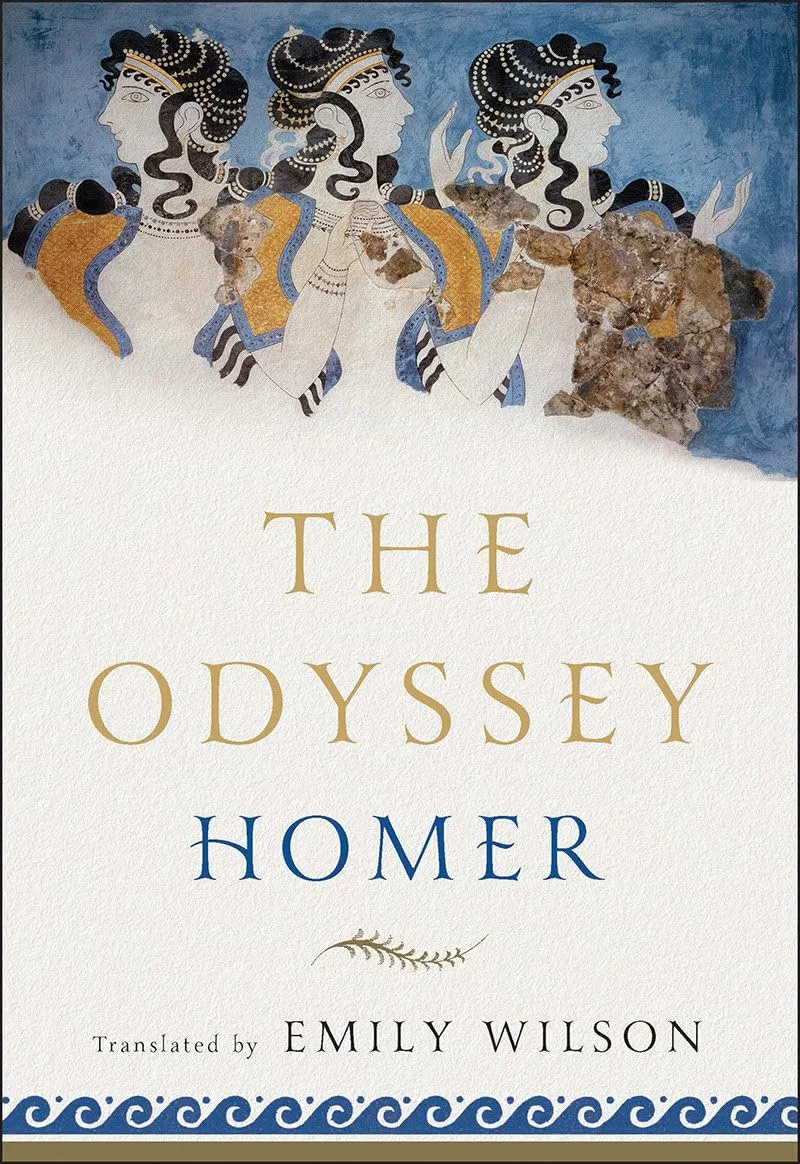
The Odyssey
Homer, Emily Wilson (Translator)
Paperback
• 592 Pages
• USD 18.95
• English
• 9780393356250
No ratings yet
| Publisher | W. W. Norton & Company |
|---|---|
| ISBN13 | 9780393356250 |
| ASIN/SKU | 0393356256 |
| Book Format | Paperback |
| Language | English |
| Pages | 592 |
| List Price | USD 18.95 |
| Publishing Date | 06/11/2018 |
| Dimensions | 5.8 x 1.2 x 8.3 inches |
| Weight | 2.31 pounds |
| Book Code | BD00066420 |
Buy this Book
Amazon Stores
Ebook Stores
Other Stores
Discover The Odyssey by Homer. This book is published by W. W. Norton and Company in Paperback format, ISBN 9780393356250, ASIN 0393356256, under Literature and Fiction, Epic Poetry, Ancient and Classical Literature.
Book Description
Homer’s great epic of a hero’s journey home―inspiration for the major motion picture by Christopher Nolan―in a bold, contemporary, and refreshingly readable translation.
"Wilson’s language is fresh, unpretentious and lean. . . . It is rare to find a translation that is at once so effortlessly easy to read and so rigorously considered." ―Madeline Miller, author of Circe
Composed at the rosy-fingered dawn of world literature almost three millennia ago, The Odyssey is a poem about violence and the aftermath of war; about wealth, poverty, and power; about marriage and family; about travelers, hospitality, and the yearning for home.
This fresh, authoritative translation captures the beauty of this ancient poem as well as the drama of its narrative. Its characters are unforgettable, none more so than the “complicated” hero himself, a man of many disguises, many tricks, and many moods, who emerges in this version as a more fully rounded human being than ever before.
Written in iambic pentameter verse and a vivid, contemporary idiom, Emily Wilson’s Odyssey sings with a voice that echoes the epic’s music, sailing along at Homer’s swift, smooth pace.
A fascinating, informative introduction explores the Bronze Age milieu that produced the epic, the poem’s major themes, the controversies about its origins, and the unparalleled scope of its impact and influence. Maps drawn especially for this volume, a pronunciation glossary, and extensive notes and summaries of each book make this an Odyssey that will be treasured by a new generation of readers.
3 maps
"Wilson’s language is fresh, unpretentious and lean. . . . It is rare to find a translation that is at once so effortlessly easy to read and so rigorously considered." ―Madeline Miller, author of Circe
Composed at the rosy-fingered dawn of world literature almost three millennia ago, The Odyssey is a poem about violence and the aftermath of war; about wealth, poverty, and power; about marriage and family; about travelers, hospitality, and the yearning for home.
This fresh, authoritative translation captures the beauty of this ancient poem as well as the drama of its narrative. Its characters are unforgettable, none more so than the “complicated” hero himself, a man of many disguises, many tricks, and many moods, who emerges in this version as a more fully rounded human being than ever before.
Written in iambic pentameter verse and a vivid, contemporary idiom, Emily Wilson’s Odyssey sings with a voice that echoes the epic’s music, sailing along at Homer’s swift, smooth pace.
A fascinating, informative introduction explores the Bronze Age milieu that produced the epic, the poem’s major themes, the controversies about its origins, and the unparalleled scope of its impact and influence. Maps drawn especially for this volume, a pronunciation glossary, and extensive notes and summaries of each book make this an Odyssey that will be treasured by a new generation of readers.
3 maps
Author Biography
Homer was probably born around 725BC on the Coast of Asia Minor, now the coast of Turkey, but then really a part of Greece. Homer was the first Greek writer whose work survives.
He was one of a long line of bards, or poets, who worked in the oral tradition. Homer and other bards of the time could recite, or chant, long epic poems. Both works attributed to Homer - The Iliad and The Odyssey - are over ten thousand lines long in the original. Homer must have had an amazing memory but was helped by the formulaic poetry style of the time.
In The Iliad Homer sang of death and glory, of a few days in the struggle between the Greeks and the Trojans. Mortal men played out their fate under the gaze of the gods. The Odyssey is the original collection of tall traveller's tales. Odysseus, on his way home from the Trojan War, encounters all kinds of marvels from one-eyed giants to witches and beautiful temptresses. His adventures are many and memorable before he gets back to Ithaca and his faithful wife Penelope.
We can never be certain that both these stories belonged to Homer. In fact 'Homer' may not be a real name but a kind of nickname meaning perhaps 'the hostage' or 'the blind one'. Whatever the truth of their origin, the two stories, developed around three thousand years ago, may well still be read in three thousand years' time.
He was one of a long line of bards, or poets, who worked in the oral tradition. Homer and other bards of the time could recite, or chant, long epic poems. Both works attributed to Homer - The Iliad and The Odyssey - are over ten thousand lines long in the original. Homer must have had an amazing memory but was helped by the formulaic poetry style of the time.
In The Iliad Homer sang of death and glory, of a few days in the struggle between the Greeks and the Trojans. Mortal men played out their fate under the gaze of the gods. The Odyssey is the original collection of tall traveller's tales. Odysseus, on his way home from the Trojan War, encounters all kinds of marvels from one-eyed giants to witches and beautiful temptresses. His adventures are many and memorable before he gets back to Ithaca and his faithful wife Penelope.
We can never be certain that both these stories belonged to Homer. In fact 'Homer' may not be a real name but a kind of nickname meaning perhaps 'the hostage' or 'the blind one'. Whatever the truth of their origin, the two stories, developed around three thousand years ago, may well still be read in three thousand years' time.
Editorial Reviews
"A masterpiece of translation."
― Rowan Williams, University of Cambridge
"A revelation. Never have I been so aware at once of the beauty of the poetry, the physicality of Homer’s world, and the moral ambiguity of those who inhabit it."
― Susan Chira, New York Times Book Review
"Emily Wilson’s crisp and musical version is a cultural landmark.… This translation will change the way the poem is read in English."
― Charlotte Higgins, Guardian
"In the history of Odyssey translations, few have exerted such a cultural influence that they become ‘classics’ in their own right.… I predict that Emily Wilson will win a place in this roll-call of the most significant translations of the poem in history. She certainly deserves the honour."
― Edith Hall, Daily Telegraph
"Emily Wilson has given us a staggeringly superior translation―true, poetic, lively and readable, and always closely engaged with the original Greek―that brings to life the fascinating variety of voices in Homer’s great epic."
― Richard F. Thomas, Harvard University
"When I first read these lines…, I was floored. I’d never read an Odyssey that sounded like this. It had such directness, the lines feeling not as if they were being fed into iambic pentameter because of some strategic decision but because the meter was a natural mode for its speaker."
― Wyatt Mason, New York Times Magazine
"In her powerful new translation, Emily Wilson… has chosen immediacy and naturalism over majestic formality. She preserves the musicality of Homer’s poetry, opting for an iambic pentameter whose approachable storytelling tone invites us in, only to startle us with eruptions of beauty.… Wilson’s transformation of such a familiar and foundational work is… astonishing."
― Rebecca Newberger Goldstein, Atlantic
"Wilson’s translation is a superb achievement and a striking departure from the tradition of Homeric translation into English.… There is no elaborate or antiquated diction, just a crispness and clear-headedness that will seem quite alien to anyone familiar with earlier versions.… Wilson has produced a wonderfully distinctive―and modern―version of the poem."
― Henry Power, Evening Standard
"Irresistibly readable, Wilson’s Odyssey turns Homeric epic into a poetic feast."
― Froma Zeitlin, Princeton University
"This translation is a marvel! Bold and timely and ever so exciting.… As majestic as literature gets."
― Max Porter, author of Grief Is the Thing With Feathers
― Rowan Williams, University of Cambridge
"A revelation. Never have I been so aware at once of the beauty of the poetry, the physicality of Homer’s world, and the moral ambiguity of those who inhabit it."
― Susan Chira, New York Times Book Review
"Emily Wilson’s crisp and musical version is a cultural landmark.… This translation will change the way the poem is read in English."
― Charlotte Higgins, Guardian
"In the history of Odyssey translations, few have exerted such a cultural influence that they become ‘classics’ in their own right.… I predict that Emily Wilson will win a place in this roll-call of the most significant translations of the poem in history. She certainly deserves the honour."
― Edith Hall, Daily Telegraph
"Emily Wilson has given us a staggeringly superior translation―true, poetic, lively and readable, and always closely engaged with the original Greek―that brings to life the fascinating variety of voices in Homer’s great epic."
― Richard F. Thomas, Harvard University
"When I first read these lines…, I was floored. I’d never read an Odyssey that sounded like this. It had such directness, the lines feeling not as if they were being fed into iambic pentameter because of some strategic decision but because the meter was a natural mode for its speaker."
― Wyatt Mason, New York Times Magazine
"In her powerful new translation, Emily Wilson… has chosen immediacy and naturalism over majestic formality. She preserves the musicality of Homer’s poetry, opting for an iambic pentameter whose approachable storytelling tone invites us in, only to startle us with eruptions of beauty.… Wilson’s transformation of such a familiar and foundational work is… astonishing."
― Rebecca Newberger Goldstein, Atlantic
"Wilson’s translation is a superb achievement and a striking departure from the tradition of Homeric translation into English.… There is no elaborate or antiquated diction, just a crispness and clear-headedness that will seem quite alien to anyone familiar with earlier versions.… Wilson has produced a wonderfully distinctive―and modern―version of the poem."
― Henry Power, Evening Standard
"Irresistibly readable, Wilson’s Odyssey turns Homeric epic into a poetic feast."
― Froma Zeitlin, Princeton University
"This translation is a marvel! Bold and timely and ever so exciting.… As majestic as literature gets."
― Max Porter, author of Grief Is the Thing With Feathers
Book Summary
The Trojan War is long over, and the great Greek heroes have either returned home to glory or died trying. Yet, one man remains missing: Odysseus, the brilliant and cunning king of Ithaca. Ten agonizing years have passed since the fall of Troy, making it twenty years since he first left his kingdom. At home, almost everyone assumes he is dead, except for his fiercely loyal wife, Penelope, and his son, Telemachus, who was just an infant when his father left. Ithaca has descended into chaos. A massive horde of arrogant, greedy suitors has taken over the royal palace, eating the estate dry and aggressively vying for Penelope’s hand in marriage to seize the throne. She stalls them with clever tricks, like weaving a burial shroud by day and unravelling it by night, but her time is rapidly running out. The suitors are growing restless, entitled, and increasingly dangerous, even plotting to assassinate young Telemachus.
Watching over this mess is the goddess Athena, Odysseus’s greatest divine champion. Taking pity on the fractured family, she descends to Ithaca in disguise and breathes a fiery sense of purpose into the young Telemachus. She urges him to stand up to the treacherous suitors and sail out into the Mediterranean to seek news of his father from other veteran kings. Telemachus visits old war heroes like Nestor in Pylos and Menelaus in Sparta. Through them, he—and we, the audience—learns that his father is indeed alive, but trapped. This coming-of-age journey transforms Telemachus from a helpless, grieving boy into a capable young prince, preparing him for the ultimate reunion with the father he has never truly known.
Meanwhile, we finally meet our hero, but he is far from the triumphant warrior of Troy. Odysseus is marooned on the lush, isolated island of Ogygia, held captive by the beautiful sea nymph Calypso. For seven years, she has kept him as her lover, offering him immortality if he will simply forget his past and stay with her forever. But Odysseus spends his days weeping on the rocky shoreline, staring out at the endless sea, yearning for his wife, his son, and his homeland. The gods finally intervene, sending the messenger Hermes to order Calypso to release him. With renewed hope, Odysseus builds a makeshift raft and sets sail, but the sea god Poseidon, who harbors a bitter grudge against him, shatters the raft in a furious storm. Barely clinging to life, Odysseus washes ashore on the island of the Phaeacians.
Exhausted, battered, and naked, he is discovered by the brave Phaeacian princess Nausicaa, who leads him to her father, King Alcinous. The Phaeacians are known for their spectacular hospitality, and they welcome the stranger without demanding his name. At a grand feast, a blind bard sings a tragic song of the Trojan War, which brings Odysseus to tears. Prompted by the king, Odysseus finally reveals his identity and begins to recount the spellbinding, horrifying, and magical tale of where he has been for the past decade. This massive flashback forms the core of his legendary wanderings.
His crew's journey homeward began disastrously. After sacking the city of the Cicones and being blown vastly off course, they encountered the Lotus-Eaters, whose narcotic fruit made men forget their longing for home. Escaping that trap, they landed on the island of the Cyclopes. Here, they were trapped inside a cavern by the giant, one-eyed cannibal Polyphemus. Relying on his legendary wits, Odysseus got the giant drunk, blinded him with a blazing, sharpened stake, and smuggled his surviving men out of the cave strapped to the bellies of massive sheep. But as they sailed away to freedom, Odysseus’s pride got the better of him. He shouted his real name back to the blinding giant. Polyphemus prayed to his father, Poseidon, cursing Odysseus to lose all his men and arrive home late and broken, setting the god's wrath squarely upon him.
The curse took hold almost immediately. Despite being gifted a leather bag containing all the contrary winds by Aeolus, the crew’s overwhelming greed led them to open it just as the shores of Ithaca were finally in sight, blowing them entirely off course again. They barely survived a brutal encounter with the Laestrygonians, a race of giant cannibals who destroyed all but one of Odysseus's ships. The lone surviving ship then landed on the island of the enchanting witch-goddess Circe. She turned half his men into swine, but with a little help from Hermes, Odysseus overpowered her magic. They ended up staying on her luxurious island for a year, recovering from their trauma, before Circe told him he had to travel to the Underworld to seek the wisdom of the dead prophet Tiresias.
The journey to the sunless realm of the dead was harrowing. There, Odysseus spoke with old comrades like Achilles and Agamemnon, and wept in shock at the sight of his own mother, who had died of grief waiting for him. Armed with dire prophecies, they sailed back into the treacherous realm of the living. They survived the hypnotic, deadly song of the Sirens by having the crew plug their ears with beeswax while Odysseus was lashed tightly to the mast, begging to be untied as he listened to their maddening melody. They navigated the narrow strait between Scylla, a multi-headed monster who snatched six of his men from the deck, and Charybdis, a massive ship-devouring whirlpool. The final blow came on the island of the sun god Helios. Despite strict warnings, his starving men slaughtered the god's sacred cattle while Odysseus slept. In furious retribution, Zeus struck their ship with a lightning bolt. Every man drowned except Odysseus, who drifted alone until he washed up on Calypso's island, bringing his tragic backstory full circle to where the Phaeacians found him.
Deeply moved by his harrowing tale, the Phaeacians load Odysseus with treasure and ferry him secretly home to Ithaca under the cover of night. He wakes up on his own misty shores, greeted by Athena, who disguises him as a withered old beggar so he can safely assess the dangerous situation at his palace. He first seeks refuge with Eumaeus, his fiercely loyal swineherd, who treats the ragged "stranger" with incredible kindness. It is here in the humble hut that Telemachus, returning from his own journey, meets the beggar. In a deeply emotional moment, Athena drops the disguise, and father and son weep together as they finally reunite and begin to plot a bloody revenge against the men who have plagued their home.
Disguised once more, Odysseus enters his own grand palace. The dramatic irony is thick as he endures the terrible mockery, physical abuse, and arrogance of the suitors, silently observing their complete lack of honor. Only his dying old dog, Argos, and his elderly nurse, Eurycleia, recognize him. Penelope, unaware of the beggar's true identity but intrigued by his claim that he has news of her husband, finally decides she can wait no longer to choose a new king. She sets a seemingly impossible challenge for the suitors: whoever can string her husband’s massive, stiff hunting bow and shoot an arrow cleanly through the small rings of twelve axe heads will win her hand. One by one, the wealthy, arrogant young men fail to even bend the mighty bow.
Amidst the jeers of the suitors, the ragged beggar asks for a try. To their absolute horror, he strings the bow as easily as a musician stringing a lyre and sends the arrow flying perfectly through the twelve axes. Stripping off his rags, Odysseus reveals himself in all his terrifying, vengeful glory. With Telemachus and his loyal servants at his side, and Athena guiding their strikes, Odysseus locks the doors and turns his bow on the suitors in a brutal slaughter until not a single one remains standing. The palace is cleansed, but Odysseus must still reveal himself to Penelope. Cautious and fiercely intelligent, she tests him one last time, asking a servant to move their heavy bridal bed. Odysseus flares up in anger, revealing the secret only they know: the bed cannot be moved because he built it around a living olive tree rooted deeply in the foundation of the palace. Penelope embraces him, her long nightmare finally over. The next day, the furious families of the dead suitors march on the palace, but Athena descends from the heavens, commanding them to drop their weapons and swearing a pact of peace, finally restoring order and healing to Ithaca after twenty long, agonizing years.
Watching over this mess is the goddess Athena, Odysseus’s greatest divine champion. Taking pity on the fractured family, she descends to Ithaca in disguise and breathes a fiery sense of purpose into the young Telemachus. She urges him to stand up to the treacherous suitors and sail out into the Mediterranean to seek news of his father from other veteran kings. Telemachus visits old war heroes like Nestor in Pylos and Menelaus in Sparta. Through them, he—and we, the audience—learns that his father is indeed alive, but trapped. This coming-of-age journey transforms Telemachus from a helpless, grieving boy into a capable young prince, preparing him for the ultimate reunion with the father he has never truly known.
Meanwhile, we finally meet our hero, but he is far from the triumphant warrior of Troy. Odysseus is marooned on the lush, isolated island of Ogygia, held captive by the beautiful sea nymph Calypso. For seven years, she has kept him as her lover, offering him immortality if he will simply forget his past and stay with her forever. But Odysseus spends his days weeping on the rocky shoreline, staring out at the endless sea, yearning for his wife, his son, and his homeland. The gods finally intervene, sending the messenger Hermes to order Calypso to release him. With renewed hope, Odysseus builds a makeshift raft and sets sail, but the sea god Poseidon, who harbors a bitter grudge against him, shatters the raft in a furious storm. Barely clinging to life, Odysseus washes ashore on the island of the Phaeacians.
Exhausted, battered, and naked, he is discovered by the brave Phaeacian princess Nausicaa, who leads him to her father, King Alcinous. The Phaeacians are known for their spectacular hospitality, and they welcome the stranger without demanding his name. At a grand feast, a blind bard sings a tragic song of the Trojan War, which brings Odysseus to tears. Prompted by the king, Odysseus finally reveals his identity and begins to recount the spellbinding, horrifying, and magical tale of where he has been for the past decade. This massive flashback forms the core of his legendary wanderings.
His crew's journey homeward began disastrously. After sacking the city of the Cicones and being blown vastly off course, they encountered the Lotus-Eaters, whose narcotic fruit made men forget their longing for home. Escaping that trap, they landed on the island of the Cyclopes. Here, they were trapped inside a cavern by the giant, one-eyed cannibal Polyphemus. Relying on his legendary wits, Odysseus got the giant drunk, blinded him with a blazing, sharpened stake, and smuggled his surviving men out of the cave strapped to the bellies of massive sheep. But as they sailed away to freedom, Odysseus’s pride got the better of him. He shouted his real name back to the blinding giant. Polyphemus prayed to his father, Poseidon, cursing Odysseus to lose all his men and arrive home late and broken, setting the god's wrath squarely upon him.
The curse took hold almost immediately. Despite being gifted a leather bag containing all the contrary winds by Aeolus, the crew’s overwhelming greed led them to open it just as the shores of Ithaca were finally in sight, blowing them entirely off course again. They barely survived a brutal encounter with the Laestrygonians, a race of giant cannibals who destroyed all but one of Odysseus's ships. The lone surviving ship then landed on the island of the enchanting witch-goddess Circe. She turned half his men into swine, but with a little help from Hermes, Odysseus overpowered her magic. They ended up staying on her luxurious island for a year, recovering from their trauma, before Circe told him he had to travel to the Underworld to seek the wisdom of the dead prophet Tiresias.
The journey to the sunless realm of the dead was harrowing. There, Odysseus spoke with old comrades like Achilles and Agamemnon, and wept in shock at the sight of his own mother, who had died of grief waiting for him. Armed with dire prophecies, they sailed back into the treacherous realm of the living. They survived the hypnotic, deadly song of the Sirens by having the crew plug their ears with beeswax while Odysseus was lashed tightly to the mast, begging to be untied as he listened to their maddening melody. They navigated the narrow strait between Scylla, a multi-headed monster who snatched six of his men from the deck, and Charybdis, a massive ship-devouring whirlpool. The final blow came on the island of the sun god Helios. Despite strict warnings, his starving men slaughtered the god's sacred cattle while Odysseus slept. In furious retribution, Zeus struck their ship with a lightning bolt. Every man drowned except Odysseus, who drifted alone until he washed up on Calypso's island, bringing his tragic backstory full circle to where the Phaeacians found him.
Deeply moved by his harrowing tale, the Phaeacians load Odysseus with treasure and ferry him secretly home to Ithaca under the cover of night. He wakes up on his own misty shores, greeted by Athena, who disguises him as a withered old beggar so he can safely assess the dangerous situation at his palace. He first seeks refuge with Eumaeus, his fiercely loyal swineherd, who treats the ragged "stranger" with incredible kindness. It is here in the humble hut that Telemachus, returning from his own journey, meets the beggar. In a deeply emotional moment, Athena drops the disguise, and father and son weep together as they finally reunite and begin to plot a bloody revenge against the men who have plagued their home.
Disguised once more, Odysseus enters his own grand palace. The dramatic irony is thick as he endures the terrible mockery, physical abuse, and arrogance of the suitors, silently observing their complete lack of honor. Only his dying old dog, Argos, and his elderly nurse, Eurycleia, recognize him. Penelope, unaware of the beggar's true identity but intrigued by his claim that he has news of her husband, finally decides she can wait no longer to choose a new king. She sets a seemingly impossible challenge for the suitors: whoever can string her husband’s massive, stiff hunting bow and shoot an arrow cleanly through the small rings of twelve axe heads will win her hand. One by one, the wealthy, arrogant young men fail to even bend the mighty bow.
Amidst the jeers of the suitors, the ragged beggar asks for a try. To their absolute horror, he strings the bow as easily as a musician stringing a lyre and sends the arrow flying perfectly through the twelve axes. Stripping off his rags, Odysseus reveals himself in all his terrifying, vengeful glory. With Telemachus and his loyal servants at his side, and Athena guiding their strikes, Odysseus locks the doors and turns his bow on the suitors in a brutal slaughter until not a single one remains standing. The palace is cleansed, but Odysseus must still reveal himself to Penelope. Cautious and fiercely intelligent, she tests him one last time, asking a servant to move their heavy bridal bed. Odysseus flares up in anger, revealing the secret only they know: the bed cannot be moved because he built it around a living olive tree rooted deeply in the foundation of the palace. Penelope embraces him, her long nightmare finally over. The next day, the furious families of the dead suitors march on the palace, but Athena descends from the heavens, commanding them to drop their weapons and swearing a pact of peace, finally restoring order and healing to Ithaca after twenty long, agonizing years.
Sample Chapters
Sample Chapters will be added soon…
Reader Reviews
No reviews yet.
The Odyssey