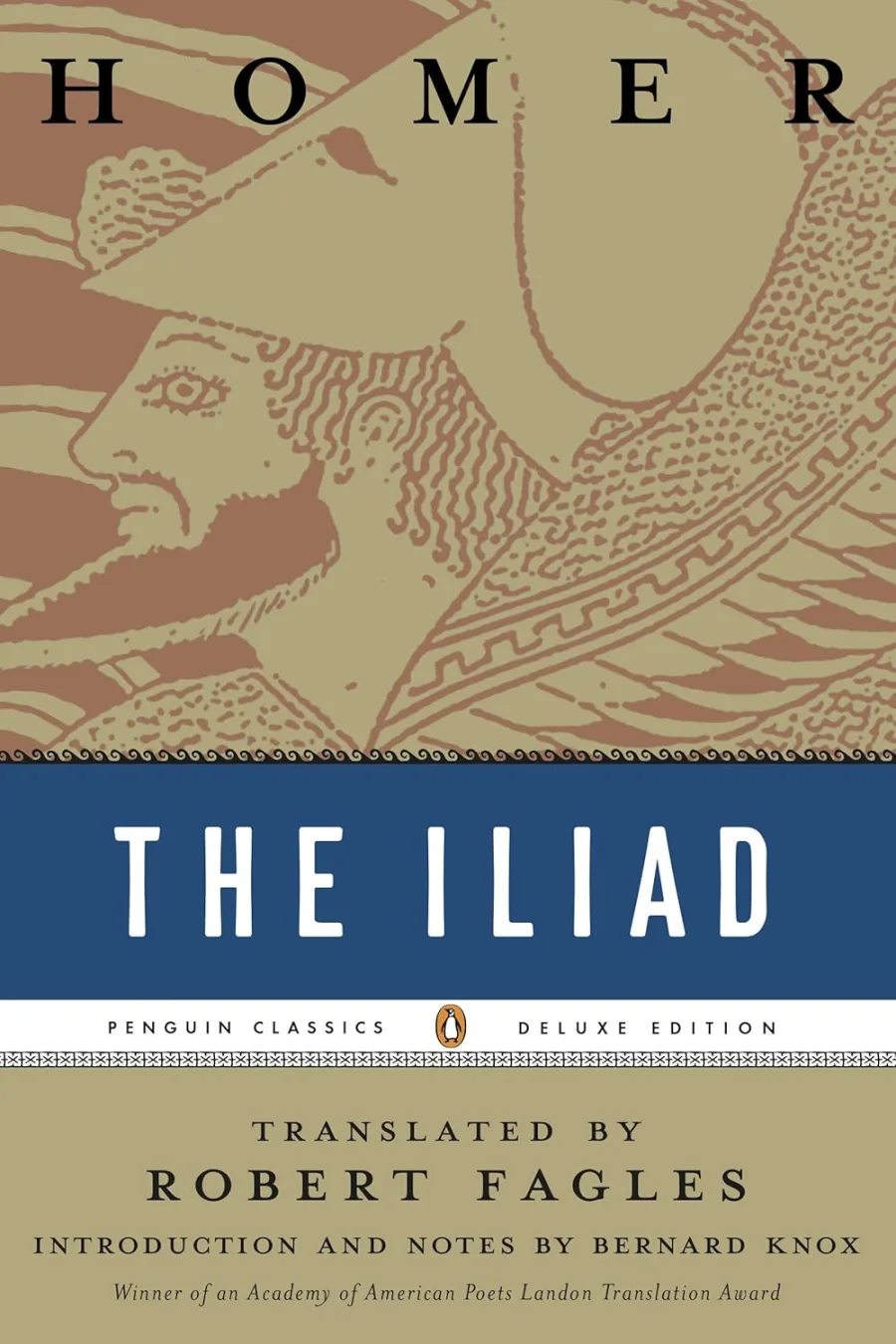
The Iliad
Homer, Robert Fagles (Translator)
Paperback
• 704 Pages
• USD 21.00
• English
• 9780140275360
No ratings yet
| Publisher | Penguin Classics |
|---|---|
| ISBN13 | 9780140275360 |
| ASIN/SKU | 0140275363 |
| Book Format | Paperback |
| Language | English |
| Pages | 704 |
| List Price | USD 21.00 |
| Publishing Date | 01/01/1998 |
| Dimensions | 8.4 x 5.7 x 1.9 inches |
| Weight | 1.73 pounds |
| Book Code | BD00066422 |
Buy this Book
Amazon Stores
Ebook Stores
Other Stores
Discover The Iliad by Homer. This book is published by Penguin Classics in Paperback format, ISBN 9780140275360, ASIN 0140275363, under Literature and Fiction, Mythology, European Poetry.
Book Description
The great war epic of Western literature, translated by acclaimed classicist Robert Fagles, and featured in the Netflix series The OA
A Penguin Classic
Dating to the ninth century B.C., Homer’s timeless poem still vividly conveys the horror and heroism of men and gods wrestling with towering emotions and battling amidst devastation and destruction, as it moves inexorably to the wrenching, tragic conclusion of the Trojan War. Renowned classicist Bernard Knox observes in his superb introduction that although the violence of the Iliad is grim and relentless, it coexists with both images of civilized life and a poignant yearning for peace.
Combining the skills of a poet and scholar, Robert Fagles, winner of the PEN/Ralph Manheim Medal for Translation and a 1996 Academy Award in Literature from the American Academy of Arts and Letters, brings the energy of contemporary language to this enduring heroic epic. He maintains the drive and metric music of Homer’s poetry, and evokes the impact and nuance of the Iliad’s mesmerizing repeated phrases in what Peter Levi calls “an astonishing performance.”
This Penguin Classics Deluxe edition also features French flaps and deckle-edged paper.
For more than seventy years, Penguin has been the leading publisher of classic literature in the English-speaking world. With more than 1,700 titles, Penguin Classics represents a global bookshelf of the best works throughout history and across genres and disciplines. Readers trust the series to provide authoritative texts enhanced by introductions and notes by distinguished scholars and contemporary authors, as well as up-to-date translations by award-winning translators.
A Penguin Classic
Dating to the ninth century B.C., Homer’s timeless poem still vividly conveys the horror and heroism of men and gods wrestling with towering emotions and battling amidst devastation and destruction, as it moves inexorably to the wrenching, tragic conclusion of the Trojan War. Renowned classicist Bernard Knox observes in his superb introduction that although the violence of the Iliad is grim and relentless, it coexists with both images of civilized life and a poignant yearning for peace.
Combining the skills of a poet and scholar, Robert Fagles, winner of the PEN/Ralph Manheim Medal for Translation and a 1996 Academy Award in Literature from the American Academy of Arts and Letters, brings the energy of contemporary language to this enduring heroic epic. He maintains the drive and metric music of Homer’s poetry, and evokes the impact and nuance of the Iliad’s mesmerizing repeated phrases in what Peter Levi calls “an astonishing performance.”
This Penguin Classics Deluxe edition also features French flaps and deckle-edged paper.
For more than seventy years, Penguin has been the leading publisher of classic literature in the English-speaking world. With more than 1,700 titles, Penguin Classics represents a global bookshelf of the best works throughout history and across genres and disciplines. Readers trust the series to provide authoritative texts enhanced by introductions and notes by distinguished scholars and contemporary authors, as well as up-to-date translations by award-winning translators.
Author Biography
Homer was probably born around 725BC on the Coast of Asia Minor, now the coast of Turkey, but then really a part of Greece. Homer was the first Greek writer whose work survives.
He was one of a long line of bards, or poets, who worked in the oral tradition. Homer and other bards of the time could recite, or chant, long epic poems. Both works attributed to Homer - The Iliad and The Odyssey - are over ten thousand lines long in the original. Homer must have had an amazing memory but was helped by the formulaic poetry style of the time.
In The Iliad Homer sang of death and glory, of a few days in the struggle between the Greeks and the Trojans. Mortal men played out their fate under the gaze of the gods. The Odyssey is the original collection of tall traveller's tales. Odysseus, on his way home from the Trojan War, encounters all kinds of marvels from one-eyed giants to witches and beautiful temptresses. His adventures are many and memorable before he gets back to Ithaca and his faithful wife Penelope.
We can never be certain that both these stories belonged to Homer. In fact 'Homer' may not be a real name but a kind of nickname meaning perhaps 'the hostage' or 'the blind one'. Whatever the truth of their origin, the two stories, developed around three thousand years ago, may well still be read in three thousand years' time.
He was one of a long line of bards, or poets, who worked in the oral tradition. Homer and other bards of the time could recite, or chant, long epic poems. Both works attributed to Homer - The Iliad and The Odyssey - are over ten thousand lines long in the original. Homer must have had an amazing memory but was helped by the formulaic poetry style of the time.
In The Iliad Homer sang of death and glory, of a few days in the struggle between the Greeks and the Trojans. Mortal men played out their fate under the gaze of the gods. The Odyssey is the original collection of tall traveller's tales. Odysseus, on his way home from the Trojan War, encounters all kinds of marvels from one-eyed giants to witches and beautiful temptresses. His adventures are many and memorable before he gets back to Ithaca and his faithful wife Penelope.
We can never be certain that both these stories belonged to Homer. In fact 'Homer' may not be a real name but a kind of nickname meaning perhaps 'the hostage' or 'the blind one'. Whatever the truth of their origin, the two stories, developed around three thousand years ago, may well still be read in three thousand years' time.
Editorial Reviews
Fitzgerald has solved virtually every problem that has plagued translators of Homer. The narrative runs, the dialogue speaks, the military action is clear, and the repetitive epithets become useful text rather than exotic relics. "Atlantic Monthly "
Fitzgerald s swift rhythms, bright images, and superb English make Homer live as never before This is for every reader in our time and possibly for all time. "Library Journal "
[Fitzgerald s "Odyssey" and "Iliad"] open up once more the unique greatness of Homer s art at the level above the formula; yet at the same time they do not neglect the brilliant texture of Homeric verse at the level of the line and the phrase. "The Yale Review
"
What an age can read in Homer, what its translators can manage to say in his presence, is one gauge of its morale, one index to its system of exultations and reticences. The supple, the iridescent, the ironic, these modes are among our strengths, and among Mr. Fitzgerald s. "National Review"
With an Introduction by Gregory Nagy"
"Fitzgerald has solved virtually every problem that has plagued translators of Homer. The narrative runs, the dialogue speaks, the military action is clear, and the repetitive epithets become useful text rather than exotic relics." -"Atlantic Monthly "
"Fitzgerald's swift rhythms, bright images, and superb English make Homer live as never before...This is for every reader in our time and possibly for all time."-"Library Journal "
"[Fitzgerald's "Odyssey" and "Iliad"] open up once more the unique greatness of Homer's art at the level above the formula; yet at the same time they do not neglect the brilliant texture of Homeric verse at the level of the line and the phrase." -"The Yale Review
"
"What an age can read in Homer, what its translators can manage to say in his presence, is one gauge of its morale, one index to its system of exultations and reticences. The supple, the iridescent, the ironic, these modes are among our strengths, and among Mr. Fitzgerald's." -"National Review"
With an Introduction by Gregory Nagy
Fitzgerald s swift rhythms, bright images, and superb English make Homer live as never before This is for every reader in our time and possibly for all time. "Library Journal "
[Fitzgerald s "Odyssey" and "Iliad"] open up once more the unique greatness of Homer s art at the level above the formula; yet at the same time they do not neglect the brilliant texture of Homeric verse at the level of the line and the phrase. "The Yale Review
"
What an age can read in Homer, what its translators can manage to say in his presence, is one gauge of its morale, one index to its system of exultations and reticences. The supple, the iridescent, the ironic, these modes are among our strengths, and among Mr. Fitzgerald s. "National Review"
With an Introduction by Gregory Nagy"
"Fitzgerald has solved virtually every problem that has plagued translators of Homer. The narrative runs, the dialogue speaks, the military action is clear, and the repetitive epithets become useful text rather than exotic relics." -"Atlantic Monthly "
"Fitzgerald's swift rhythms, bright images, and superb English make Homer live as never before...This is for every reader in our time and possibly for all time."-"Library Journal "
"[Fitzgerald's "Odyssey" and "Iliad"] open up once more the unique greatness of Homer's art at the level above the formula; yet at the same time they do not neglect the brilliant texture of Homeric verse at the level of the line and the phrase." -"The Yale Review
"
"What an age can read in Homer, what its translators can manage to say in his presence, is one gauge of its morale, one index to its system of exultations and reticences. The supple, the iridescent, the ironic, these modes are among our strengths, and among Mr. Fitzgerald's." -"National Review"
With an Introduction by Gregory Nagy
Book Summary
Homer’s The Iliad is not a comprehensive history of the decade-long Trojan War, but rather an intense, microscopic focus on a few pivotal weeks during its tenth and final year. The driving force of the epic is not the war itself, but a devastating internal conflict: the rage of Achilles. The story begins in the Greek camp, where a plague has decimated the army. This plague is a divine punishment sent by the god Apollo because the Greek commander, Agamemnon, has arrogantly refused to return a captured maiden, Chryseis, to her father, a priest of Apollo. Forced to surrender her to appease the god and save his men, a deeply bruised Agamemnon demands compensation. He asserts his dominance by seizing Briseis, another captured maiden who had been awarded to Achilles, the greatest and most lethal of the Greek warriors. Deeply dishonored and consumed by a fierce, blinding pride, Achilles withdraws himself and his men from the fighting, asking his mother, the sea nymph Thetis, to call in a favor from Zeus. He wants the Greeks to suffer heavy losses so they will realize exactly how desperately they need him.
With Achilles refusing to fight, the battlefield dynamic shifts dramatically. For the Greeks, the war becomes a desperate struggle for survival. The epic paints a vivid, brutal picture of bronze-age combat, where heroes clash in visceral, bloody duels and gods constantly meddle in mortal affairs. Deities like Athena and Hera aid the Greeks, while Apollo and Aphrodite protect the Trojans, treating the human battlefield like a cosmic chessboard. The Trojan forces are led by their crown prince, Hector, a fiercely loyal and noble warrior who fights not for glory, but out of a desperate sense of duty to protect his city, his wife Andromache, and his infant son. Unlike the seemingly invincible, god-like Achilles, Hector is profoundly human. As the days pass, Hector pushes the Greek army back across the plains of Troy, eventually breaching their fortified camp and setting fire to their ships. The Greeks are pushed to the absolute brink of destruction. Agamemnon, realizing his catastrophic mistake, sends an embassy of leaders to offer Achilles massive wealth and the return of Briseis if he will just rejoin the fight. Stubborn and still nursing his wounded pride, Achilles refuses.
However, the impending destruction of the Greek ships is too much for Achilles’ closest companion and beloved friend, Patroclus, to bear. Patroclus begs Achilles to let him lead their men into battle wearing Achilles’ iconic armor, hoping the mere sight of him will terrify the Trojans into retreating. Achilles agrees, but strictly warns Patroclus to only drive the Trojans away from the ships and not to pursue them to the city walls. Drunk on the adrenaline of battle and his own success, Patroclus ignores this warning. He sweeps across the plains, slaughtering Trojans until the god Apollo actively intervenes, striking Patroclus and knocking off his helmet. Disoriented and vulnerable, Patroclus is impaled by a Trojan soldier and finally finished off by Hector. In a fateful move, Hector strips the armor from Patroclus’s body, claiming it as his own prize.
When the news of Patroclus’s death reaches Achilles, his pride completely evaporates, replaced by an agonizing, earth-shattering grief that quickly morphs into a monstrous thirst for revenge. He lets out a cry so terrifying that it sends the Trojans fleeing in panic. Clad in magnificent new armor forged overnight by the blacksmith god Hephaestus, Achilles returns to the battlefield not as a man, but as a force of absolute annihilation. He slaughters Trojans with such merciless fury that he literally clogs the local river with corpses, prompting the river god itself to rise up and fight him. The Trojans retreat behind the safety of their massive city walls, leaving only Hector outside to face the Greek champion.
When Achilles charges, Hector momentarily loses his nerve and runs. The two greatest warriors of their age sprint around the walls of Troy three times before the goddess Athena tricks Hector into making a stand. The duel is swift and inevitable. Achilles drives his spear through Hector’s neck, rejecting Hector’s dying plea for a proper burial. In a shocking display of barbarism, Achilles ties Hector’s corpse to the back of his chariot and drags it through the dust, parading his mutilated enemy before the weeping eyes of Hector's family on the city walls.
Yet, the epic does not end in a crescendo of violence; it concludes with a profound moment of shared humanity. After days of abusing Hector's body, Achilles' camp is infiltrated under the cover of night by King Priam, the elderly ruler of Troy and Hector’s father. In a deeply moving scene, Priam falls to his knees and kisses the hands of the man who slaughtered his sons, begging for Hector's body. Looking at the broken, grieving king, Achilles is suddenly reminded of his own aging father. His rage finally breaks, replaced by a quiet, tragic empathy. The two enemies weep together—Priam for his son, and Achilles for Patroclus and his own looming, inevitable death. Achilles grants a temporary truce for the Trojans to mourn. The epic closes not with the fall of Troy, but with the funeral fires of Hector, a quiet, somber testament to the terrible cost of war, the limits of human pride, and the universal reality of grief.
With Achilles refusing to fight, the battlefield dynamic shifts dramatically. For the Greeks, the war becomes a desperate struggle for survival. The epic paints a vivid, brutal picture of bronze-age combat, where heroes clash in visceral, bloody duels and gods constantly meddle in mortal affairs. Deities like Athena and Hera aid the Greeks, while Apollo and Aphrodite protect the Trojans, treating the human battlefield like a cosmic chessboard. The Trojan forces are led by their crown prince, Hector, a fiercely loyal and noble warrior who fights not for glory, but out of a desperate sense of duty to protect his city, his wife Andromache, and his infant son. Unlike the seemingly invincible, god-like Achilles, Hector is profoundly human. As the days pass, Hector pushes the Greek army back across the plains of Troy, eventually breaching their fortified camp and setting fire to their ships. The Greeks are pushed to the absolute brink of destruction. Agamemnon, realizing his catastrophic mistake, sends an embassy of leaders to offer Achilles massive wealth and the return of Briseis if he will just rejoin the fight. Stubborn and still nursing his wounded pride, Achilles refuses.
However, the impending destruction of the Greek ships is too much for Achilles’ closest companion and beloved friend, Patroclus, to bear. Patroclus begs Achilles to let him lead their men into battle wearing Achilles’ iconic armor, hoping the mere sight of him will terrify the Trojans into retreating. Achilles agrees, but strictly warns Patroclus to only drive the Trojans away from the ships and not to pursue them to the city walls. Drunk on the adrenaline of battle and his own success, Patroclus ignores this warning. He sweeps across the plains, slaughtering Trojans until the god Apollo actively intervenes, striking Patroclus and knocking off his helmet. Disoriented and vulnerable, Patroclus is impaled by a Trojan soldier and finally finished off by Hector. In a fateful move, Hector strips the armor from Patroclus’s body, claiming it as his own prize.
When the news of Patroclus’s death reaches Achilles, his pride completely evaporates, replaced by an agonizing, earth-shattering grief that quickly morphs into a monstrous thirst for revenge. He lets out a cry so terrifying that it sends the Trojans fleeing in panic. Clad in magnificent new armor forged overnight by the blacksmith god Hephaestus, Achilles returns to the battlefield not as a man, but as a force of absolute annihilation. He slaughters Trojans with such merciless fury that he literally clogs the local river with corpses, prompting the river god itself to rise up and fight him. The Trojans retreat behind the safety of their massive city walls, leaving only Hector outside to face the Greek champion.
When Achilles charges, Hector momentarily loses his nerve and runs. The two greatest warriors of their age sprint around the walls of Troy three times before the goddess Athena tricks Hector into making a stand. The duel is swift and inevitable. Achilles drives his spear through Hector’s neck, rejecting Hector’s dying plea for a proper burial. In a shocking display of barbarism, Achilles ties Hector’s corpse to the back of his chariot and drags it through the dust, parading his mutilated enemy before the weeping eyes of Hector's family on the city walls.
Yet, the epic does not end in a crescendo of violence; it concludes with a profound moment of shared humanity. After days of abusing Hector's body, Achilles' camp is infiltrated under the cover of night by King Priam, the elderly ruler of Troy and Hector’s father. In a deeply moving scene, Priam falls to his knees and kisses the hands of the man who slaughtered his sons, begging for Hector's body. Looking at the broken, grieving king, Achilles is suddenly reminded of his own aging father. His rage finally breaks, replaced by a quiet, tragic empathy. The two enemies weep together—Priam for his son, and Achilles for Patroclus and his own looming, inevitable death. Achilles grants a temporary truce for the Trojans to mourn. The epic closes not with the fall of Troy, but with the funeral fires of Hector, a quiet, somber testament to the terrible cost of war, the limits of human pride, and the universal reality of grief.
Sample Chapters
Sample Chapters will be added soon…
Reader Reviews
No reviews yet.
The Iliad