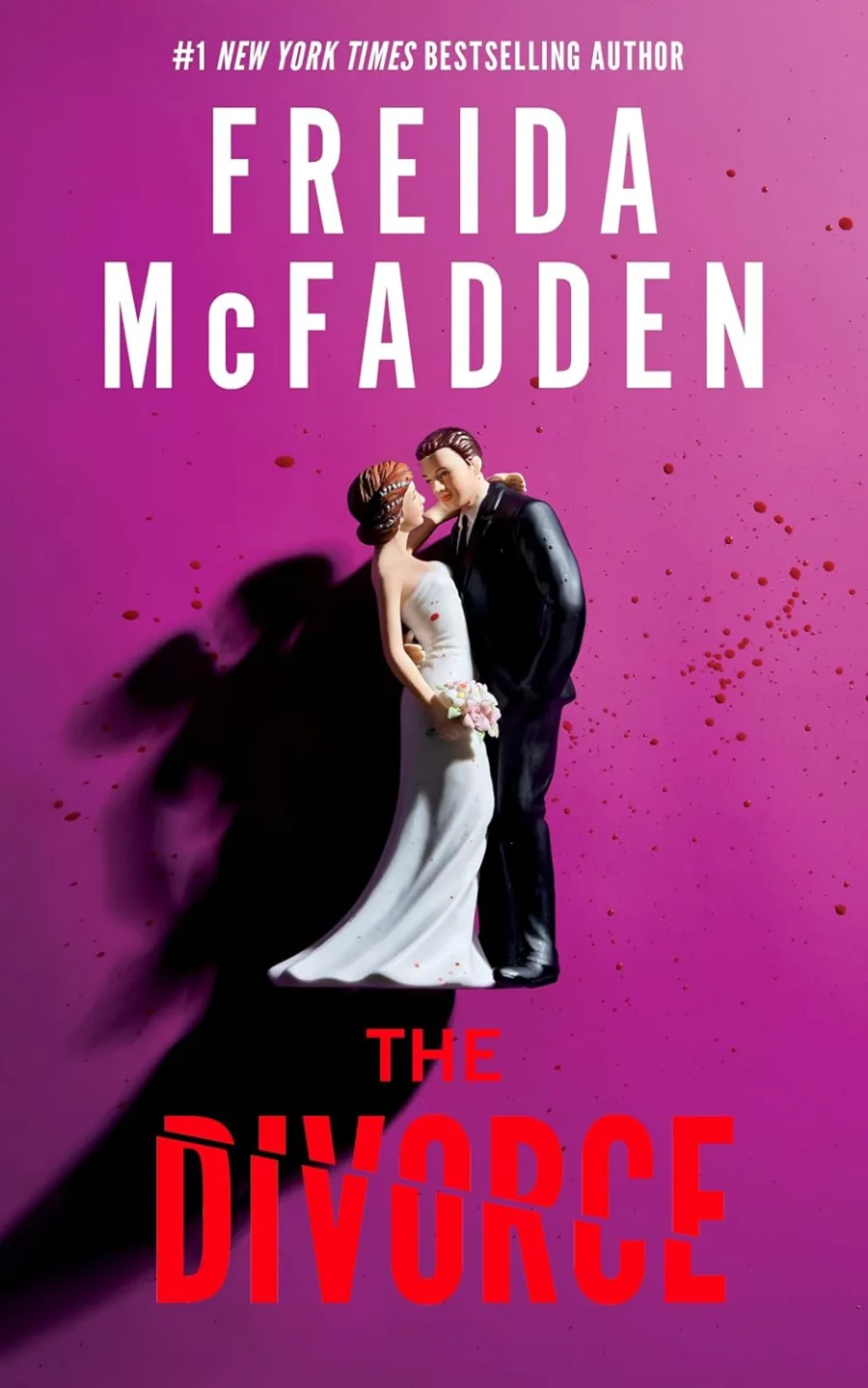
The Divorce
eBook
• 372 Pages
• USD 4.99
• English
No ratings yet
| Publisher | Hollywood Upstairs Press |
|---|---|
| ASIN/SKU | B0GKHGSV8S |
| Book Format | eBook |
| Language | English |
| Pages | 372 |
| List Price | USD 4.99 |
| Publishing Date | 26/05/2026 |
| Book Code | BD00066434 |
Buy this Book
Amazon Stores
Ebook Stores
Other Stores
Discover The Divorce by Freida McFadden. This book is published by Hollywood Upstairs Press in eBook format, ASIN B0GKHGSV8S, under Mystery, Thriller and Suspense, Domestic Thrillers, Psychological Thrillers.
Book Description
What is a happily ever after really worth?
Naomi was living the quintessential love story. Boy meets girl. They fall in love, get married, buy a dream house, start a family...
Then—he kicks her out, hires the city’s best divorce lawyers, drains their accounts, and takes up with a 20-something.
It’s a brutal end to the story. Naomi should accept defeat: move into a dingy apartment, get back into the workforce, and piece together the shattered remains of her life.
Except, why should she?
Instead, Naomi fixates on her husband’s new girlfriend. What begins as cynical curiosity soon twists into obsession—and then into something far darker. As Naomi uncovers secrets she never imagined, she realizes her own life may be in danger.
But if it keeps her perfect family intact, isn’t it worth it?
In The Divorce, #1 New York Times and internationally bestselling author Freida McFadden delivers a razor-sharp, subversive thriller where love curdles into vengeance, and survival becomes the most dangerous game of all.
Naomi was living the quintessential love story. Boy meets girl. They fall in love, get married, buy a dream house, start a family...
Then—he kicks her out, hires the city’s best divorce lawyers, drains their accounts, and takes up with a 20-something.
It’s a brutal end to the story. Naomi should accept defeat: move into a dingy apartment, get back into the workforce, and piece together the shattered remains of her life.
Except, why should she?
Instead, Naomi fixates on her husband’s new girlfriend. What begins as cynical curiosity soon twists into obsession—and then into something far darker. As Naomi uncovers secrets she never imagined, she realizes her own life may be in danger.
But if it keeps her perfect family intact, isn’t it worth it?
In The Divorce, #1 New York Times and internationally bestselling author Freida McFadden delivers a razor-sharp, subversive thriller where love curdles into vengeance, and survival becomes the most dangerous game of all.
Author Biography
#1 New York Times, Amazon Charts, USA Today, Washington Post, Wall Street Journal, Sunday Times, and Publisher's Weekly bestselling author Freida McFadden is a physician who has penned multiple bestselling psychological thrillers and medical humor novels. Freida is the winner of the International Thriller Writer Award for Best Paperback Original, the Goodreads Choice Award for Best Thriller, and was honored as one of TIME 100’s most influential people in the world for 2026. Her novels have been translated into more than 45 languages.
Freida lives with her family and cat in a centuries-old three-story home overlooking the ocean, with staircases that creak and moan with each step, and nobody could hear you if you scream. Unless you scream really loudly, maybe.
To hear Freida talk about herself more in the third person, check out her website freidamcfadden dot com.
Freida lives with her family and cat in a centuries-old three-story home overlooking the ocean, with staircases that creak and moan with each step, and nobody could hear you if you scream. Unless you scream really loudly, maybe.
To hear Freida talk about herself more in the third person, check out her website freidamcfadden dot com.
Editorial Reviews
Editorial Reviews will be added soon…
Book Summary
The Divorce by Freida McFadden is a fast-paced psychological thriller about marriage, betrayal, obsession, manipulation, motherhood, revenge, and the terrifying secrets that can exist beneath an apparently perfect family life. Published in 2026, the novel begins with what seems to be a familiar domestic crisis: a husband abruptly ends his marriage, leaves his wife financially and emotionally devastated, and starts seeing a much younger woman. But the deeper Naomi investigates, the more she discovers that the divorce is only the surface of a far more disturbing story.
The protagonist, Naomi Roth, appears to have everything she once wanted. She lives in an affluent Long Island community with her husband, Jeremy, a successful hedge-fund manager, and their young son, Teddy. From the outside, their marriage looks comfortable and secure. Naomi has devoted herself to raising Teddy, and she believes that she and Jeremy have created the kind of stable family life that people dream about.
That illusion collapses almost overnight.
One afternoon, Naomi returns home with Teddy and discovers that she cannot get inside her own house. The locks have been changed. Jeremy claims that he is arranging renovations, but Naomi quickly realizes that the explanation is a lie. Her belongings have been packed, and she is effectively being removed from the home she believed was hers.
Soon afterward, Jeremy tells her that he wants a divorce.
Naomi is stunned. She cannot understand how the marriage she believed was secure could suddenly be over. She tries to reason with Jeremy and suggests that they work through their problems, but he has already made his decision.
He has also prepared for the divorce far more thoroughly than Naomi realizes.
Jeremy hires powerful divorce lawyers and takes control of the family's finances, leaving Naomi at an enormous disadvantage. She is forced to move into a small apartment and confront the humiliating reality of rebuilding her life.
Then Naomi discovers that Jeremy has a girlfriend.
Her name is Veronica, a beautiful woman in her twenties who seems to have replaced Naomi almost effortlessly.
For Naomi, Veronica becomes the obvious symbol of everything she has lost. She cannot understand how Jeremy could discard their marriage and move on so quickly. Her anger gradually becomes focused on the younger woman.
At first, Naomi's interest in Veronica appears understandable. She wants to know who this woman is and why Jeremy chose her. But curiosity gradually becomes obsession.
Naomi begins investigating Veronica's life.
The more she discovers, the less she trusts her.
Veronica has a troubled past, including addiction and other suspicious circumstances. Naomi becomes convinced that Veronica is dangerous and that she may have deliberately manipulated Jeremy.
This is where the novel begins to move beyond an ordinary divorce story. The reader starts questioning whether Naomi is discovering genuine danger or becoming consumed by paranoia and jealousy.
McFadden deliberately creates uncertainty by showing the story through different perspectives. Naomi sees herself as a betrayed wife and devoted mother. Jeremy presents himself as a husband who has finally escaped an unhappy marriage. Veronica has her own history and motivations. As these perspectives collide, the reader is repeatedly forced to reconsider what is true.
Naomi's desperation becomes increasingly intense.
She is determined to preserve her family, particularly her relationship with Teddy. Her identity has become deeply connected to motherhood, and the possibility of losing her son terrifies her.
Meanwhile, Jeremy uses his wealth and influence strategically. He has access to lawyers and resources Naomi cannot easily match. Their divorce therefore becomes a struggle in which money itself becomes a weapon.
Naomi begins to suspect that Jeremy is deliberately trying to make her appear unstable.
Strange things happen around her.
Information seems to be manipulated.
Appointments and arrangements become confusing.
Evidence appears that makes Naomi look unreliable.
Her behavior, already becoming increasingly desperate, begins to reinforce the image that Jeremy is constructing.
This creates one of the novel's most disturbing themes: gaslighting.
Naomi increasingly doubts her own perception of events while simultaneously becoming convinced that someone is deliberately manipulating her. The reader is placed inside that uncertainty with her.
Is Naomi losing control?
Is Jeremy manipulating her?
Is Veronica responsible?
Or is there something even larger happening behind the scenes?
The novel continually shifts the reader's assumptions.
Naomi's fixation on Veronica eventually leads her to investigate the younger woman's past more deeply. What she discovers about Veronica's history seems to confirm her suspicions, but the information also raises an unexpected question: why is Veronica so interested in Teddy?
The answer leads to the novel's major revelation.
Veronica is not simply Jeremy's younger girlfriend.
She has a connection to Teddy that Naomi never expected.
Years earlier, Veronica had given birth to a baby boy named Dominic. Under traumatic circumstances, the infant disappeared.
That missing child is Teddy.
Naomi eventually realizes the horrifying truth: Teddy is Veronica's biological son.
Naomi had taken the baby years earlier and raised him as her own. She had constructed a false version of his identity and used forged documentation and manipulated paternity evidence to make the arrangement appear legitimate.
This revelation completely changes the reader's understanding of Naomi.
Until this point, she can appear to be a desperate mother fighting to keep her family together. Now the reader learns that her relationship with Teddy began through an act of kidnapping.
Her love for Teddy is genuine in an emotional sense, but it exists alongside an unforgivable act.
The novel therefore explores the disturbing boundary between love and possession.
Naomi believes she is Teddy's mother because she raised him. She has invested years of her life in him. She cannot imagine losing him.
But Veronica is his biological mother, and the child was taken from her.
The question becomes whether love can justify taking another person's child.
The answer is clearly no, yet McFadden complicates the issue by showing how Naomi has psychologically transformed her crime into a story of motherhood and family.
Her desperation to preserve the family she created eventually becomes more dangerous than the original deception.
Meanwhile, Jeremy's role becomes increasingly sinister.
He is not simply an indifferent husband who wants a divorce.
He has been manipulating Naomi and appears to understand far more about Teddy's origins than he has admitted.
The divorce itself begins to look less like a spontaneous decision and more like part of a larger plan.
Jeremy's behavior demonstrates another central theme of the novel: power can hide behind respectability.
He appears successful, controlled, wealthy, and rational.
Naomi appears increasingly emotional and unstable.
This contrast gives Jeremy an enormous advantage because institutions tend to find the composed person more credible than the desperate one.
The novel uses that contrast to examine how easily appearances can become a substitute for truth.
As the custody struggle intensifies, Naomi becomes increasingly desperate.
She believes Veronica is trying to take Teddy away from her.
She is willing to do almost anything to prevent that from happening.
Eventually, her obsession turns violent.
Naomi confronts Veronica and attacks her, eventually restraining her in the wine cellar. The confrontation becomes the point at which Naomi's determination to preserve her family crosses completely into criminal violence.
Her lawyer, Ezra Fletcher, becomes involved in the unfolding crisis.
The situation rapidly spirals beyond anyone's control.
Naomi's decisions have created a chain of consequences that cannot easily be reversed.
The story now moves toward the violent situation hinted at in its opening.
The wine cellar becomes the setting for the novel's climax.
Naomi attempts to create circumstances in which she can emerge as the person who saves Teddy. But her plan collapses into chaos when violence, fire, and desperate attempts at survival collide.
A fire breaks out.
Veronica manages to escape and reaches Teddy.
Naomi dies in the cellar fire, and Ezra also dies after being caught in the violent confrontation.
The apparent resolution, however, is not the real ending.
McFadden saves another major revelation for the epilogue.
Jeremy knew that Teddy was not biologically his.
In fact, he knew much more about Teddy's origins than he ever admitted.
The child's biological father, Clay, eventually tracked down the family. Jeremy arranged for Clay to be killed and made his death appear to be connected to a drug overdose.
This revelation completely changes the reader's understanding of Jeremy's character.
He was not merely trying to escape an unhappy marriage.
He had been manipulating the situation for his own purposes.
Jeremy had also been psychologically manipulating Naomi, creating circumstances that made her appear increasingly unstable. The divorce, therefore, was part of a much larger struggle over control.
His ultimate objective was connected to Teddy.
Jeremy wanted custody of the boy.
The final twist leaves Jeremy and Veronica connected through Teddy, while Naomi and Clay are dead.
The ending is deliberately unsettling because it refuses to provide a simple moral victory.
Veronica gets her child back, but the circumstances surrounding Teddy's life remain deeply disturbing.
Naomi loses everything because her obsessive desire to keep Teddy leads her into violence and ultimately destroys her.
Jeremy survives despite his own crimes.
This creates one of the novel's strongest themes: justice and truth do not always arrive together.
The person who appears most trustworthy may be the most dangerous.
The person who appears unstable may be hiding a terrible truth.
And the legal system, despite its purpose, can be manipulated by people with sufficient money, influence, and preparation.
Another major theme is maternal obsession.
Naomi genuinely loves Teddy. That fact makes her actions more disturbing rather than less. Her love gradually becomes possessiveness. She cannot separate loving her child from owning the right to keep him.
The novel asks how far someone might go when they believe that losing a loved one would destroy their identity.
Naomi's tragedy is that she does not recognize the point at which devotion becomes obsession.
Her desire to protect Teddy eventually places him in greater danger.
The novel also examines identity.
Teddy has been raised believing that Naomi is his mother. His biological history has been concealed from him. His identity therefore depends upon a carefully constructed lie.
This raises difficult questions about what makes someone a parent.
Is parenthood determined by biology?
By raising a child?
By emotional attachment?
By legal status?
The novel does not offer a simple answer, but it demonstrates how devastating the consequences can be when these different definitions of family conflict.
Veronica's journey provides an important contrast with Naomi's.
She lost her child and spent years living with the consequences. Her past makes her easy for Naomi to distrust, particularly because of her addiction history.
But the novel challenges the assumption that someone with a troubled past is incapable of being a loving parent.
Veronica's desire to reclaim her child becomes one of the story's strongest emotional forces.
The novel also explores wealth as power.
Jeremy's financial resources allow him to hire elite lawyers, control access to money, and shape the divorce process in ways Naomi cannot easily counter. His wealth becomes part of his ability to control the narrative.
This makes the divorce more than a private disagreement.
It becomes a battle between unequal forms of power.
Naomi's emotional desperation is repeatedly placed against Jeremy's financial and legal resources.
The story also examines the psychological effects of betrayal.
Naomi believes that Jeremy has betrayed their marriage.
Veronica believes that her child was taken from her.
Jeremy betrays the people around him while protecting his own interests.
Clay is betrayed.
Teddy's entire identity is built around a secret.
Almost every major character is connected to some form of deception.
The result is a world in which trust becomes extremely difficult.
This uncertainty is central to McFadden's storytelling style. The novel repeatedly encourages readers to form an opinion and then destabilizes it with another revelation.
The opening itself establishes this technique. The story begins with multiple bodies in a burning house, but the identities of the victims and the person responsible are initially concealed. The reader knows from the beginning that the story will end in violence, but not why or how.
This creates a sense of inevitability.
The question is not simply what will happen?
It is how did everyone get to this point?
As the story progresses, the answer becomes increasingly complicated.
The novel's domestic setting also contributes to its suspense. A comfortable suburban home, a child's school, family routines, divorce proceedings, and neighborhood relationships initially suggest safety and normality.
But beneath that surface are secrets involving kidnapping, manipulation, murder, and revenge.
The contrast between ordinary domestic life and extreme violence is characteristic of the psychological domestic thriller.
Ultimately, The Divorce is not really a story about a marriage ending.
The divorce is merely the event that exposes everything the marriage has been hiding.
It reveals Naomi's secret.
It reveals Jeremy's manipulation.
It reveals Veronica's connection to Teddy.
It exposes the unequal power created by wealth.
And it transforms an apparently ordinary custody dispute into a deadly struggle over identity, family, and control.
Naomi begins the story believing that her greatest problem is losing her husband.
She eventually discovers that her entire family history is built upon deception.
Jeremy begins as the apparently rational husband seeking freedom.
He ultimately emerges as one of the story's most dangerous figures.
Veronica begins as the seemingly threatening younger girlfriend.
She is ultimately revealed to have a far deeper connection to Teddy.
This constant reversal of appearances is what drives the novel's suspense.
At its heart, The Divorce asks a disturbing question: what is a happily ever after really worth if preserving it requires destroying the truth?
Naomi's answer is disastrous.
She tries to preserve her perfect family at any cost.
But the more desperately she tries to hold on, the more completely she destroys it.
The novel ultimately suggests that love can become dangerous when it turns into possession, and that a family built on lies cannot remain stable forever.
Freida McFadden's The Divorce is therefore a dark psychological thriller about marriage, betrayal, gaslighting, obsession, motherhood, stolen identity, revenge, wealth, and the frightening consequences of refusing to let go. Its fast-moving plot and successive revelations transform a familiar story of marital breakdown into something much more sinister.
The most unsettling lesson of the novel is that danger does not always look dangerous.
Sometimes it looks like a perfect husband.
Sometimes it looks like a desperate mother.
Sometimes it looks like a new girlfriend.
And sometimes the person everyone thinks they understand is the person they understand least.
In The Divorce, the collapse of a marriage becomes the doorway into a much darker truth: when love, fear, and the need for control become inseparable, the desire to keep a family together can become the very thing that destroys it.
The protagonist, Naomi Roth, appears to have everything she once wanted. She lives in an affluent Long Island community with her husband, Jeremy, a successful hedge-fund manager, and their young son, Teddy. From the outside, their marriage looks comfortable and secure. Naomi has devoted herself to raising Teddy, and she believes that she and Jeremy have created the kind of stable family life that people dream about.
That illusion collapses almost overnight.
One afternoon, Naomi returns home with Teddy and discovers that she cannot get inside her own house. The locks have been changed. Jeremy claims that he is arranging renovations, but Naomi quickly realizes that the explanation is a lie. Her belongings have been packed, and she is effectively being removed from the home she believed was hers.
Soon afterward, Jeremy tells her that he wants a divorce.
Naomi is stunned. She cannot understand how the marriage she believed was secure could suddenly be over. She tries to reason with Jeremy and suggests that they work through their problems, but he has already made his decision.
He has also prepared for the divorce far more thoroughly than Naomi realizes.
Jeremy hires powerful divorce lawyers and takes control of the family's finances, leaving Naomi at an enormous disadvantage. She is forced to move into a small apartment and confront the humiliating reality of rebuilding her life.
Then Naomi discovers that Jeremy has a girlfriend.
Her name is Veronica, a beautiful woman in her twenties who seems to have replaced Naomi almost effortlessly.
For Naomi, Veronica becomes the obvious symbol of everything she has lost. She cannot understand how Jeremy could discard their marriage and move on so quickly. Her anger gradually becomes focused on the younger woman.
At first, Naomi's interest in Veronica appears understandable. She wants to know who this woman is and why Jeremy chose her. But curiosity gradually becomes obsession.
Naomi begins investigating Veronica's life.
The more she discovers, the less she trusts her.
Veronica has a troubled past, including addiction and other suspicious circumstances. Naomi becomes convinced that Veronica is dangerous and that she may have deliberately manipulated Jeremy.
This is where the novel begins to move beyond an ordinary divorce story. The reader starts questioning whether Naomi is discovering genuine danger or becoming consumed by paranoia and jealousy.
McFadden deliberately creates uncertainty by showing the story through different perspectives. Naomi sees herself as a betrayed wife and devoted mother. Jeremy presents himself as a husband who has finally escaped an unhappy marriage. Veronica has her own history and motivations. As these perspectives collide, the reader is repeatedly forced to reconsider what is true.
Naomi's desperation becomes increasingly intense.
She is determined to preserve her family, particularly her relationship with Teddy. Her identity has become deeply connected to motherhood, and the possibility of losing her son terrifies her.
Meanwhile, Jeremy uses his wealth and influence strategically. He has access to lawyers and resources Naomi cannot easily match. Their divorce therefore becomes a struggle in which money itself becomes a weapon.
Naomi begins to suspect that Jeremy is deliberately trying to make her appear unstable.
Strange things happen around her.
Information seems to be manipulated.
Appointments and arrangements become confusing.
Evidence appears that makes Naomi look unreliable.
Her behavior, already becoming increasingly desperate, begins to reinforce the image that Jeremy is constructing.
This creates one of the novel's most disturbing themes: gaslighting.
Naomi increasingly doubts her own perception of events while simultaneously becoming convinced that someone is deliberately manipulating her. The reader is placed inside that uncertainty with her.
Is Naomi losing control?
Is Jeremy manipulating her?
Is Veronica responsible?
Or is there something even larger happening behind the scenes?
The novel continually shifts the reader's assumptions.
Naomi's fixation on Veronica eventually leads her to investigate the younger woman's past more deeply. What she discovers about Veronica's history seems to confirm her suspicions, but the information also raises an unexpected question: why is Veronica so interested in Teddy?
The answer leads to the novel's major revelation.
Veronica is not simply Jeremy's younger girlfriend.
She has a connection to Teddy that Naomi never expected.
Years earlier, Veronica had given birth to a baby boy named Dominic. Under traumatic circumstances, the infant disappeared.
That missing child is Teddy.
Naomi eventually realizes the horrifying truth: Teddy is Veronica's biological son.
Naomi had taken the baby years earlier and raised him as her own. She had constructed a false version of his identity and used forged documentation and manipulated paternity evidence to make the arrangement appear legitimate.
This revelation completely changes the reader's understanding of Naomi.
Until this point, she can appear to be a desperate mother fighting to keep her family together. Now the reader learns that her relationship with Teddy began through an act of kidnapping.
Her love for Teddy is genuine in an emotional sense, but it exists alongside an unforgivable act.
The novel therefore explores the disturbing boundary between love and possession.
Naomi believes she is Teddy's mother because she raised him. She has invested years of her life in him. She cannot imagine losing him.
But Veronica is his biological mother, and the child was taken from her.
The question becomes whether love can justify taking another person's child.
The answer is clearly no, yet McFadden complicates the issue by showing how Naomi has psychologically transformed her crime into a story of motherhood and family.
Her desperation to preserve the family she created eventually becomes more dangerous than the original deception.
Meanwhile, Jeremy's role becomes increasingly sinister.
He is not simply an indifferent husband who wants a divorce.
He has been manipulating Naomi and appears to understand far more about Teddy's origins than he has admitted.
The divorce itself begins to look less like a spontaneous decision and more like part of a larger plan.
Jeremy's behavior demonstrates another central theme of the novel: power can hide behind respectability.
He appears successful, controlled, wealthy, and rational.
Naomi appears increasingly emotional and unstable.
This contrast gives Jeremy an enormous advantage because institutions tend to find the composed person more credible than the desperate one.
The novel uses that contrast to examine how easily appearances can become a substitute for truth.
As the custody struggle intensifies, Naomi becomes increasingly desperate.
She believes Veronica is trying to take Teddy away from her.
She is willing to do almost anything to prevent that from happening.
Eventually, her obsession turns violent.
Naomi confronts Veronica and attacks her, eventually restraining her in the wine cellar. The confrontation becomes the point at which Naomi's determination to preserve her family crosses completely into criminal violence.
Her lawyer, Ezra Fletcher, becomes involved in the unfolding crisis.
The situation rapidly spirals beyond anyone's control.
Naomi's decisions have created a chain of consequences that cannot easily be reversed.
The story now moves toward the violent situation hinted at in its opening.
The wine cellar becomes the setting for the novel's climax.
Naomi attempts to create circumstances in which she can emerge as the person who saves Teddy. But her plan collapses into chaos when violence, fire, and desperate attempts at survival collide.
A fire breaks out.
Veronica manages to escape and reaches Teddy.
Naomi dies in the cellar fire, and Ezra also dies after being caught in the violent confrontation.
The apparent resolution, however, is not the real ending.
McFadden saves another major revelation for the epilogue.
Jeremy knew that Teddy was not biologically his.
In fact, he knew much more about Teddy's origins than he ever admitted.
The child's biological father, Clay, eventually tracked down the family. Jeremy arranged for Clay to be killed and made his death appear to be connected to a drug overdose.
This revelation completely changes the reader's understanding of Jeremy's character.
He was not merely trying to escape an unhappy marriage.
He had been manipulating the situation for his own purposes.
Jeremy had also been psychologically manipulating Naomi, creating circumstances that made her appear increasingly unstable. The divorce, therefore, was part of a much larger struggle over control.
His ultimate objective was connected to Teddy.
Jeremy wanted custody of the boy.
The final twist leaves Jeremy and Veronica connected through Teddy, while Naomi and Clay are dead.
The ending is deliberately unsettling because it refuses to provide a simple moral victory.
Veronica gets her child back, but the circumstances surrounding Teddy's life remain deeply disturbing.
Naomi loses everything because her obsessive desire to keep Teddy leads her into violence and ultimately destroys her.
Jeremy survives despite his own crimes.
This creates one of the novel's strongest themes: justice and truth do not always arrive together.
The person who appears most trustworthy may be the most dangerous.
The person who appears unstable may be hiding a terrible truth.
And the legal system, despite its purpose, can be manipulated by people with sufficient money, influence, and preparation.
Another major theme is maternal obsession.
Naomi genuinely loves Teddy. That fact makes her actions more disturbing rather than less. Her love gradually becomes possessiveness. She cannot separate loving her child from owning the right to keep him.
The novel asks how far someone might go when they believe that losing a loved one would destroy their identity.
Naomi's tragedy is that she does not recognize the point at which devotion becomes obsession.
Her desire to protect Teddy eventually places him in greater danger.
The novel also examines identity.
Teddy has been raised believing that Naomi is his mother. His biological history has been concealed from him. His identity therefore depends upon a carefully constructed lie.
This raises difficult questions about what makes someone a parent.
Is parenthood determined by biology?
By raising a child?
By emotional attachment?
By legal status?
The novel does not offer a simple answer, but it demonstrates how devastating the consequences can be when these different definitions of family conflict.
Veronica's journey provides an important contrast with Naomi's.
She lost her child and spent years living with the consequences. Her past makes her easy for Naomi to distrust, particularly because of her addiction history.
But the novel challenges the assumption that someone with a troubled past is incapable of being a loving parent.
Veronica's desire to reclaim her child becomes one of the story's strongest emotional forces.
The novel also explores wealth as power.
Jeremy's financial resources allow him to hire elite lawyers, control access to money, and shape the divorce process in ways Naomi cannot easily counter. His wealth becomes part of his ability to control the narrative.
This makes the divorce more than a private disagreement.
It becomes a battle between unequal forms of power.
Naomi's emotional desperation is repeatedly placed against Jeremy's financial and legal resources.
The story also examines the psychological effects of betrayal.
Naomi believes that Jeremy has betrayed their marriage.
Veronica believes that her child was taken from her.
Jeremy betrays the people around him while protecting his own interests.
Clay is betrayed.
Teddy's entire identity is built around a secret.
Almost every major character is connected to some form of deception.
The result is a world in which trust becomes extremely difficult.
This uncertainty is central to McFadden's storytelling style. The novel repeatedly encourages readers to form an opinion and then destabilizes it with another revelation.
The opening itself establishes this technique. The story begins with multiple bodies in a burning house, but the identities of the victims and the person responsible are initially concealed. The reader knows from the beginning that the story will end in violence, but not why or how.
This creates a sense of inevitability.
The question is not simply what will happen?
It is how did everyone get to this point?
As the story progresses, the answer becomes increasingly complicated.
The novel's domestic setting also contributes to its suspense. A comfortable suburban home, a child's school, family routines, divorce proceedings, and neighborhood relationships initially suggest safety and normality.
But beneath that surface are secrets involving kidnapping, manipulation, murder, and revenge.
The contrast between ordinary domestic life and extreme violence is characteristic of the psychological domestic thriller.
Ultimately, The Divorce is not really a story about a marriage ending.
The divorce is merely the event that exposes everything the marriage has been hiding.
It reveals Naomi's secret.
It reveals Jeremy's manipulation.
It reveals Veronica's connection to Teddy.
It exposes the unequal power created by wealth.
And it transforms an apparently ordinary custody dispute into a deadly struggle over identity, family, and control.
Naomi begins the story believing that her greatest problem is losing her husband.
She eventually discovers that her entire family history is built upon deception.
Jeremy begins as the apparently rational husband seeking freedom.
He ultimately emerges as one of the story's most dangerous figures.
Veronica begins as the seemingly threatening younger girlfriend.
She is ultimately revealed to have a far deeper connection to Teddy.
This constant reversal of appearances is what drives the novel's suspense.
At its heart, The Divorce asks a disturbing question: what is a happily ever after really worth if preserving it requires destroying the truth?
Naomi's answer is disastrous.
She tries to preserve her perfect family at any cost.
But the more desperately she tries to hold on, the more completely she destroys it.
The novel ultimately suggests that love can become dangerous when it turns into possession, and that a family built on lies cannot remain stable forever.
Freida McFadden's The Divorce is therefore a dark psychological thriller about marriage, betrayal, gaslighting, obsession, motherhood, stolen identity, revenge, wealth, and the frightening consequences of refusing to let go. Its fast-moving plot and successive revelations transform a familiar story of marital breakdown into something much more sinister.
The most unsettling lesson of the novel is that danger does not always look dangerous.
Sometimes it looks like a perfect husband.
Sometimes it looks like a desperate mother.
Sometimes it looks like a new girlfriend.
And sometimes the person everyone thinks they understand is the person they understand least.
In The Divorce, the collapse of a marriage becomes the doorway into a much darker truth: when love, fear, and the need for control become inseparable, the desire to keep a family together can become the very thing that destroys it.
Sample Chapters
Sample Chapters will be added soon…
Reader Reviews
No reviews yet.
The Divorce