
Stop, in the Name of God: Why Honoring the Sabbath Will Transform Your Life
Hardcover
• 292 Pages
• USD 29.99
• English
• 9798218777920
No ratings yet
| Publisher | Winning Team Publishing |
|---|---|
| ISBN13 | 9798218777920 |
| ASIN/SKU | B0FPPV48PB |
| Book Format | Hardcover |
| Language | English |
| Pages | 292 |
| List Price | USD 29.99 |
| Publishing Date | 09/12/2025 |
| Dimensions | 6.29 x 0.94 x 9.37 inches |
| Weight | 1.05 pounds |
| Book Code | BD00066615 |
Buy this Book
Amazon Stores
Ebook Stores
Other Stores
Discover Stop, in the Name of God: Why Honoring the Sabbath Will Transform Your Life by Charlie Kirk. This book is published by Winning Team Publishing in Hardcover format, ISBN 9798218777920, ASIN B0FPPV48PB, under Christian Books and Bibles, Religious Studies Education, Christian Commentaries.
Book Description
In a world that never slows down, where busyness is worn as a badge of honor and screens dictate our every move, Stop in the Name of God offers a radical yet profoundly simple invitation: pause, rest, and reconnect. Through the transformative practice of honoring the Sabbath, bestselling author Charlie Kirk guides readers to reclaim a sacred rhythm that restores balance, nurtures the soul, and strengthens relationships. This book is not about escaping modern life-it's about living it more fully, intentionally, and meaningfully.
Drawing on timeless spiritual wisdom and practical insights, Kirk demonstrates how observing the Sabbath can reduce anxiety, improve focus, and deepen one's connection with God, family, and self. He shows that true rest is not a luxury but a lifeline, a deliberate act of resistance against a culture obsessed with productivity and distraction. Through inspiring stories and actionable guidance, readers discover how a single day of dedicated pause can radically transform the week, the mind, and the heart.
Stop in the Name of God challenges conventional thinking about work, leisure, and purpose. It explores the profound psychological, emotional, and spiritual benefits of stepping away from the constant rush of life to embrace stillness, reflection, and worship. Kirk illuminates the power of presence, teaching that life's richest moments are found not in perpetual motion but in intentional pauses that honor God's design for rest, renewal, and restoration.
This book is a compelling call to action for anyone seeking peace in a noisy world, clarity amidst chaos, and deeper connection to what truly matters. By embracing the Sabbath as a sacred rhythm rather than a rigid rule, readers are empowered to reclaim time, strengthen relationships, and live with purpose, presence, and joy. Stop in the Name of God is more than a guide-it is a transformative journey toward a life of balance, meaning, and enduring spiritual fulfillment.
Drawing on timeless spiritual wisdom and practical insights, Kirk demonstrates how observing the Sabbath can reduce anxiety, improve focus, and deepen one's connection with God, family, and self. He shows that true rest is not a luxury but a lifeline, a deliberate act of resistance against a culture obsessed with productivity and distraction. Through inspiring stories and actionable guidance, readers discover how a single day of dedicated pause can radically transform the week, the mind, and the heart.
Stop in the Name of God challenges conventional thinking about work, leisure, and purpose. It explores the profound psychological, emotional, and spiritual benefits of stepping away from the constant rush of life to embrace stillness, reflection, and worship. Kirk illuminates the power of presence, teaching that life's richest moments are found not in perpetual motion but in intentional pauses that honor God's design for rest, renewal, and restoration.
This book is a compelling call to action for anyone seeking peace in a noisy world, clarity amidst chaos, and deeper connection to what truly matters. By embracing the Sabbath as a sacred rhythm rather than a rigid rule, readers are empowered to reclaim time, strengthen relationships, and live with purpose, presence, and joy. Stop in the Name of God is more than a guide-it is a transformative journey toward a life of balance, meaning, and enduring spiritual fulfillment.
Author Biography
Few authors are as in demand as Charlie Kirk. Kirk is the founder of Turning Point USA and Turning Point Action, the leading political youth organizations in the country. Kirk's social media reaches over 100 million people per month, and Axios has named Charlie Kirk as one of the "top 10 most engaged" handles in the world. The best-selling author of Right Wing Revolution, The College Scam, and The MAGA Doctrine, Kirk is also the host of The Charlie Kirk Show, which reaches millions of downloads monthly and regularly ranks among the top-10 shows on podcast news charts. As of 2025, Kirk's nationally syndicated "podcast to broadcast" show is aired on 250 radio stations, live Monday through Friday from 12-2 PM ET.
Editorial Reviews
Editorial Reviews will be added soon…
Book Summary
Stop, in the Name of God: Why Honoring the Sabbath Will Transform Your Life by Charlie Kirk is a Christian-oriented book about one of the most neglected spiritual practices in modern life: Sabbath rest. The book explores what happens when people deliberately stop working, producing, consuming, competing, and rushing in order to make space for God, family, reflection, worship, and genuine rest. Kirk's central argument is that modern culture has created an exhausting cycle in which people are expected to remain productive and connected almost all the time. In such an environment, stopping can feel irresponsible rather than holy. Stop, in the Name of God challenges that assumption by presenting Sabbath not as wasted time or an outdated religious custom, but as a biblical rhythm that can restore perspective, strengthen relationships, and reconnect people with God. For readers searching for a summary of Stop, in the Name of God, Charlie Kirk's views on Sabbath, the biblical meaning of Sabbath, Christian rest, or how observing the Sabbath can transform daily life, the book's message centers on recovering the discipline of intentionally stopping.
At the heart of the book is a simple but difficult command: stop. Modern people often live according to the belief that there is always something else to accomplish. There is another email to answer, another business problem to solve, another message to respond to, another task to complete, or another piece of entertainment to consume. Even when people physically stop working, their minds may remain busy. Kirk argues that this constant activity can become more than a lifestyle preference; it can become a form of dependence on productivity. People may begin measuring their worth by what they accomplish, how much money they earn, how efficiently they work, or how much they can fit into a day. Sabbath challenges this mindset by asking people to stop proving their value through constant activity and remember that human worth ultimately comes from God rather than productivity.
The biblical foundation of the book begins with the creation account in Genesis. God creates the world and then rests on the seventh day. Kirk treats this pattern as significant because Sabbath appears in Scripture before the modern pressures of careers, digital technology, social media, and consumer culture existed. The Sabbath is presented as part of God's design for human life rather than merely a ceremonial rule created for one historical period. The principle is that work and rest belong together. Work has meaning, but so does stopping. A healthy human life requires both purposeful effort and intentional recovery.
The book then connects Sabbath with the Fourth Commandment, in which Israel is instructed to remember the Sabbath and keep it holy. Kirk emphasizes that the command is unusual because it requires people to stop. Other commandments tell people what to do or avoid, while Sabbath deliberately interrupts ordinary productivity. This interruption creates a boundary around work and reminds people that they are not ultimately in control of everything. In this sense, Sabbath becomes an act of trust. When a person stops working for a period of time, they acknowledge that the world will continue even while they rest.
This idea of trusting God rather than productivity is one of the book's most important themes. Modern culture often rewards people for being constantly available. The expectation to respond immediately can make people feel that everything depends upon them. Sabbath challenges that anxiety. It says that there are moments when a person can put down the work, close the laptop, silence the phone, and trust that life does not collapse simply because they have stopped. For Christians, this becomes an expression of faith: God remains God even when human beings are not working.
Kirk also examines the relationship between Sabbath and freedom. In biblical history, Sabbath had particular significance because Israel's weekly rest stood in contrast to cultures in which labor could become relentless and oppressive. The command to rest meant that human beings were not merely instruments of production. Everyone within the community, including servants and others under authority, was included in the rhythm of rest. Sabbath therefore communicates a vision of human dignity. People are more than their economic usefulness, and life cannot be reduced to labor.
Another major theme is the relationship between Sabbath and family. When life becomes dominated by work and digital distraction, family relationships can become secondary. Parents may be physically present while mentally occupied by professional responsibilities. Children may compete with phones and other screens for attention. Kirk presents Sabbath as an opportunity to recover shared time and create a different family rhythm. Meals, conversations, worship, outdoor activities, reading, and simple time together can become meaningful because the usual pressure to accomplish something has temporarily been removed.
The book also speaks to the problem of technology and constant connectivity. Although the biblical Sabbath predates smartphones by thousands of years, its principles become especially relevant in a digital age. A phone can turn every moment of rest into another opportunity for work, news, entertainment, comparison, or argument. Even leisure can become exhausting when it involves endless scrolling. Kirk's emphasis on stopping therefore includes learning to disconnect from the technologies that keep people mentally attached to the demands of the outside world. The goal is not necessarily to reject technology completely but to prevent technology from colonizing every quiet moment.
A genuine Sabbath also requires distinguishing rest from entertainment. Modern culture often treats entertainment as the opposite of work, but constant consumption does not always produce genuine rest. Watching one more video, checking social media, shopping online, or consuming endless information may occupy time without restoring the mind or soul. Sabbath invites a deeper kind of rest—one that allows people to become attentive again. Reading Scripture, praying, walking, enjoying nature, sharing a meal, having an unhurried conversation, worshiping, or simply sitting quietly can sometimes restore a person more effectively than another hour of digital stimulation.
Kirk also presents Sabbath as a way of recovering perspective. When people work continuously, immediate concerns can become disproportionately important. Deadlines feel like emergencies, financial pressures dominate attention, and professional success can become an identity. Stopping creates distance from those pressures. A weekly pause allows people to step back and ask larger questions: What am I living for? What kind of person am I becoming? Am I giving sufficient attention to God and the people I love? Is my work serving my life, or has my life become organized entirely around work?
This makes Sabbath closely connected with worship. The biblical concept of Sabbath is not simply taking a day off. It is setting apart time for God. Kirk emphasizes that rest without spiritual renewal can miss the deeper purpose of Sabbath. Worship reorients the individual away from self and toward God. Prayer, Scripture, church, gratitude, and reflection remind believers that they are dependent upon something greater than themselves. The Sabbath therefore becomes both physical rest and spiritual recalibration.
The practice also confronts the illusion of control. Much of human anxiety comes from the belief that if we work harder, plan better, monitor everything, and remain constantly available, we can control outcomes. Sabbath exposes the limits of that belief. There will always be unfinished tasks. There will always be problems that cannot be solved immediately. There will always be uncertainty about tomorrow. Stopping teaches a person to accept those limits. From a Christian perspective, this is not defeat but dependence: the recognition that God is ultimately responsible for what human beings cannot control.
Another important message is that Sabbath should not become another source of legalism or anxiety. The purpose of rest is not to create a new checklist that makes people feel guilty when they fail to observe every rule perfectly. The deeper principle is intentionality. The individual must create genuine space to stop ordinary work and redirect attention toward God, relationships, gratitude, and renewal. Different people and families may structure that time differently, but the underlying purpose remains the same: interrupt the normal cycle of production and consumption.
Ultimately, the main message of Stop, in the Name of God is that stopping is not the opposite of a meaningful life; it is part of a meaningful life. Kirk argues that people need regular boundaries around work because without them, work can consume everything else. Sabbath reminds people that they are not machines, that their worth is not determined by output, and that God does not require them to be perpetually productive. Rest becomes an act of faith, gratitude, humility, and resistance to a culture that constantly demands more.
For readers searching for Charlie Kirk's Stop, in the Name of God summary, why Sabbath matters, how to observe the Sabbath, the biblical meaning of Sabbath rest, Christian books about rest, or how Sabbath can improve family and spiritual life, the book offers a direct and practical message. Its appeal lies in the fact that the problem it addresses is extraordinarily familiar: people are tired, distracted, overcommitted, and often unable to stop even when they desperately need rest. Kirk's answer is not simply to take a vacation or improve time management. It is to recover a sacred rhythm of stopping.
The deeper invitation of the book is therefore to reclaim rest as something valuable in itself. A person does not have to earn the right to rest by completing every task. There will always be more work. Sabbath creates a deliberate boundary that says life is larger than work and that God is more important than productivity. By stepping away from the demands of ordinary life, people can rediscover gratitude, deepen their relationships, strengthen their faith, and return to their responsibilities with renewed clarity. In that sense, the Sabbath is not merely a day of inactivity. It is a weekly reminder of who we are, what truly matters, and whom we ultimately trust.
At the heart of the book is a simple but difficult command: stop. Modern people often live according to the belief that there is always something else to accomplish. There is another email to answer, another business problem to solve, another message to respond to, another task to complete, or another piece of entertainment to consume. Even when people physically stop working, their minds may remain busy. Kirk argues that this constant activity can become more than a lifestyle preference; it can become a form of dependence on productivity. People may begin measuring their worth by what they accomplish, how much money they earn, how efficiently they work, or how much they can fit into a day. Sabbath challenges this mindset by asking people to stop proving their value through constant activity and remember that human worth ultimately comes from God rather than productivity.
The biblical foundation of the book begins with the creation account in Genesis. God creates the world and then rests on the seventh day. Kirk treats this pattern as significant because Sabbath appears in Scripture before the modern pressures of careers, digital technology, social media, and consumer culture existed. The Sabbath is presented as part of God's design for human life rather than merely a ceremonial rule created for one historical period. The principle is that work and rest belong together. Work has meaning, but so does stopping. A healthy human life requires both purposeful effort and intentional recovery.
The book then connects Sabbath with the Fourth Commandment, in which Israel is instructed to remember the Sabbath and keep it holy. Kirk emphasizes that the command is unusual because it requires people to stop. Other commandments tell people what to do or avoid, while Sabbath deliberately interrupts ordinary productivity. This interruption creates a boundary around work and reminds people that they are not ultimately in control of everything. In this sense, Sabbath becomes an act of trust. When a person stops working for a period of time, they acknowledge that the world will continue even while they rest.
This idea of trusting God rather than productivity is one of the book's most important themes. Modern culture often rewards people for being constantly available. The expectation to respond immediately can make people feel that everything depends upon them. Sabbath challenges that anxiety. It says that there are moments when a person can put down the work, close the laptop, silence the phone, and trust that life does not collapse simply because they have stopped. For Christians, this becomes an expression of faith: God remains God even when human beings are not working.
Kirk also examines the relationship between Sabbath and freedom. In biblical history, Sabbath had particular significance because Israel's weekly rest stood in contrast to cultures in which labor could become relentless and oppressive. The command to rest meant that human beings were not merely instruments of production. Everyone within the community, including servants and others under authority, was included in the rhythm of rest. Sabbath therefore communicates a vision of human dignity. People are more than their economic usefulness, and life cannot be reduced to labor.
Another major theme is the relationship between Sabbath and family. When life becomes dominated by work and digital distraction, family relationships can become secondary. Parents may be physically present while mentally occupied by professional responsibilities. Children may compete with phones and other screens for attention. Kirk presents Sabbath as an opportunity to recover shared time and create a different family rhythm. Meals, conversations, worship, outdoor activities, reading, and simple time together can become meaningful because the usual pressure to accomplish something has temporarily been removed.
The book also speaks to the problem of technology and constant connectivity. Although the biblical Sabbath predates smartphones by thousands of years, its principles become especially relevant in a digital age. A phone can turn every moment of rest into another opportunity for work, news, entertainment, comparison, or argument. Even leisure can become exhausting when it involves endless scrolling. Kirk's emphasis on stopping therefore includes learning to disconnect from the technologies that keep people mentally attached to the demands of the outside world. The goal is not necessarily to reject technology completely but to prevent technology from colonizing every quiet moment.
A genuine Sabbath also requires distinguishing rest from entertainment. Modern culture often treats entertainment as the opposite of work, but constant consumption does not always produce genuine rest. Watching one more video, checking social media, shopping online, or consuming endless information may occupy time without restoring the mind or soul. Sabbath invites a deeper kind of rest—one that allows people to become attentive again. Reading Scripture, praying, walking, enjoying nature, sharing a meal, having an unhurried conversation, worshiping, or simply sitting quietly can sometimes restore a person more effectively than another hour of digital stimulation.
Kirk also presents Sabbath as a way of recovering perspective. When people work continuously, immediate concerns can become disproportionately important. Deadlines feel like emergencies, financial pressures dominate attention, and professional success can become an identity. Stopping creates distance from those pressures. A weekly pause allows people to step back and ask larger questions: What am I living for? What kind of person am I becoming? Am I giving sufficient attention to God and the people I love? Is my work serving my life, or has my life become organized entirely around work?
This makes Sabbath closely connected with worship. The biblical concept of Sabbath is not simply taking a day off. It is setting apart time for God. Kirk emphasizes that rest without spiritual renewal can miss the deeper purpose of Sabbath. Worship reorients the individual away from self and toward God. Prayer, Scripture, church, gratitude, and reflection remind believers that they are dependent upon something greater than themselves. The Sabbath therefore becomes both physical rest and spiritual recalibration.
The practice also confronts the illusion of control. Much of human anxiety comes from the belief that if we work harder, plan better, monitor everything, and remain constantly available, we can control outcomes. Sabbath exposes the limits of that belief. There will always be unfinished tasks. There will always be problems that cannot be solved immediately. There will always be uncertainty about tomorrow. Stopping teaches a person to accept those limits. From a Christian perspective, this is not defeat but dependence: the recognition that God is ultimately responsible for what human beings cannot control.
Another important message is that Sabbath should not become another source of legalism or anxiety. The purpose of rest is not to create a new checklist that makes people feel guilty when they fail to observe every rule perfectly. The deeper principle is intentionality. The individual must create genuine space to stop ordinary work and redirect attention toward God, relationships, gratitude, and renewal. Different people and families may structure that time differently, but the underlying purpose remains the same: interrupt the normal cycle of production and consumption.
Ultimately, the main message of Stop, in the Name of God is that stopping is not the opposite of a meaningful life; it is part of a meaningful life. Kirk argues that people need regular boundaries around work because without them, work can consume everything else. Sabbath reminds people that they are not machines, that their worth is not determined by output, and that God does not require them to be perpetually productive. Rest becomes an act of faith, gratitude, humility, and resistance to a culture that constantly demands more.
For readers searching for Charlie Kirk's Stop, in the Name of God summary, why Sabbath matters, how to observe the Sabbath, the biblical meaning of Sabbath rest, Christian books about rest, or how Sabbath can improve family and spiritual life, the book offers a direct and practical message. Its appeal lies in the fact that the problem it addresses is extraordinarily familiar: people are tired, distracted, overcommitted, and often unable to stop even when they desperately need rest. Kirk's answer is not simply to take a vacation or improve time management. It is to recover a sacred rhythm of stopping.
The deeper invitation of the book is therefore to reclaim rest as something valuable in itself. A person does not have to earn the right to rest by completing every task. There will always be more work. Sabbath creates a deliberate boundary that says life is larger than work and that God is more important than productivity. By stepping away from the demands of ordinary life, people can rediscover gratitude, deepen their relationships, strengthen their faith, and return to their responsibilities with renewed clarity. In that sense, the Sabbath is not merely a day of inactivity. It is a weekly reminder of who we are, what truly matters, and whom we ultimately trust.
Sample Chapters
Sample Chapters will be added soon…
Reader Reviews
No reviews yet.
Stop, in the Name of God: Why Honoring the Sabbath Will Transform Your Life
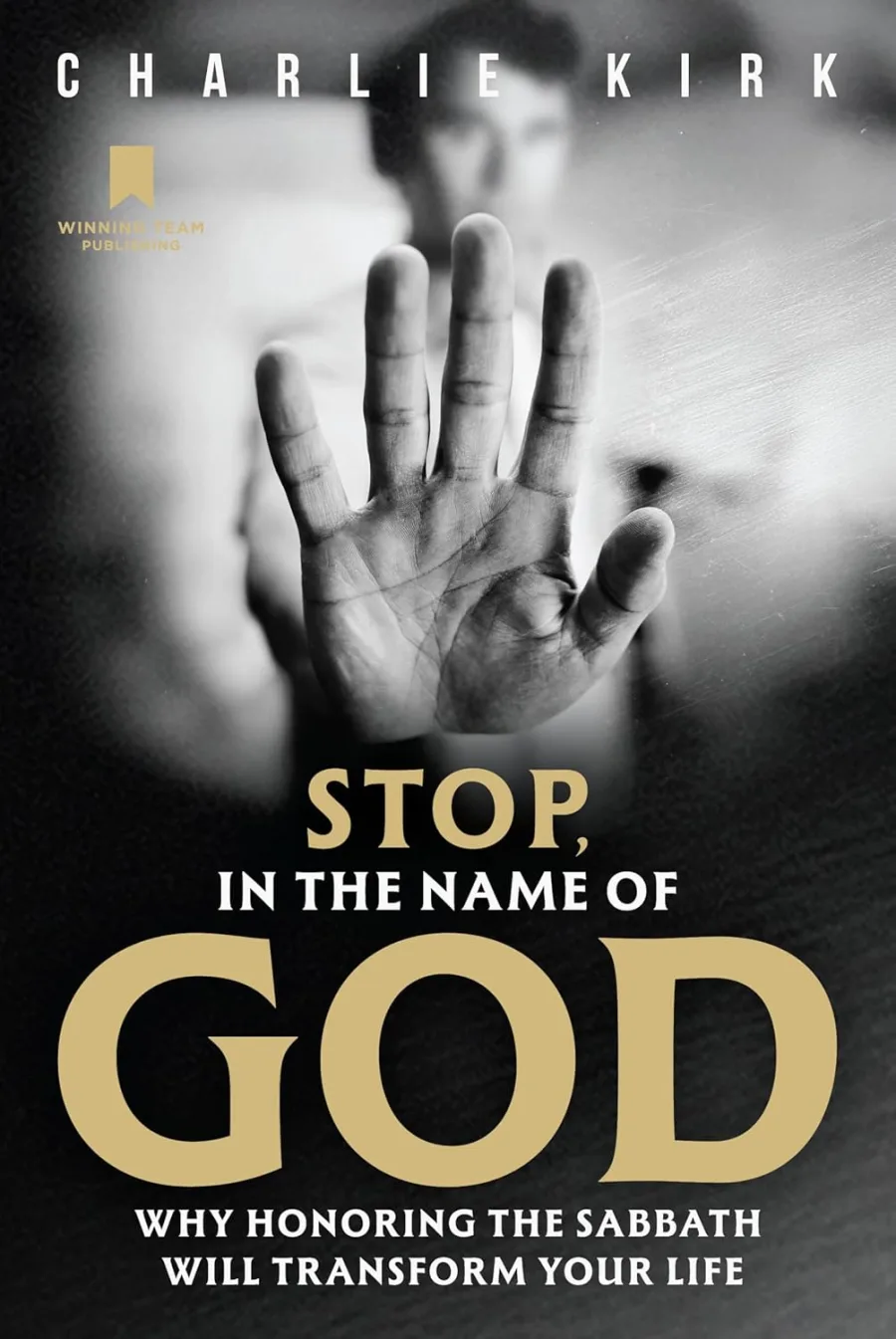
Download Cover Image
Do you want to download the full cover image for Stop, in the Name of God: Why Honoring the Sabbath Will Transform Your Life?