
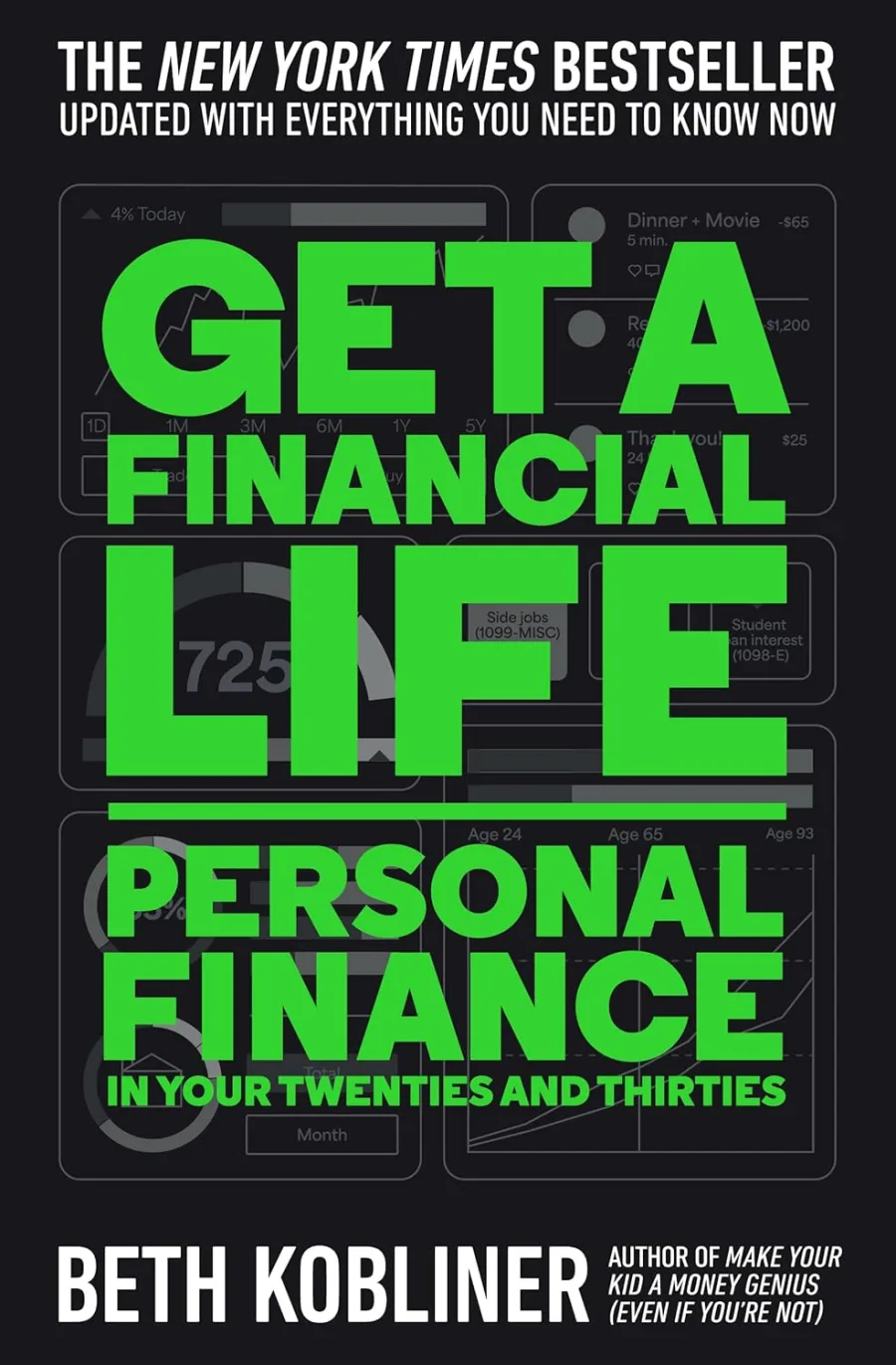
Get a Financial Life: Personal Finance in Your Twenties and Thirties
Paperback
• 336 Pages
• USD 20.00
• English
• 9781668095355
No ratings yet
| Publisher | Simon & Schuster |
|---|---|
| ISBN13 | 9781668095355 |
| ASIN/SKU | 1668095351 |
| Book Format | Paperback |
| Language | English |
| Pages | 336 |
| List Price | USD 20.00 |
| Publishing Date | 05/05/2026 |
| Dimensions | 5.5 x 0.84 x 8.38 inches |
| Weight | 10 ounces |
| Book Code | BD00066917 |
Buy this Book
Amazon Stores
Ebook Stores
Other Stores
Discover Get a Financial Life: Personal Finance in Your Twenties and Thirties by Beth Kobliner. This book is published by Simon and Schuster in Paperback format, ISBN 9781668095355, ASIN 1668095351, under Business and Money, Budgeting and Money Management, Introduction to Investing.
Book Description
The New York Times bestselling money guide, providing time-tested financial advice on topics like saving, managing debt, investing for the future, and selecting insurance, is now revised and updated with all that Gen Z and millennials need to know now.
With over half a million copies sold, this classic has helped generations of young adults through booms and busts, recessions, and even a pandemic, by delivering consistent money advice in down-to-earth, no-drama language—while keeping pace with an evolving financial landscape.
Gen Z and millennials are experiencing an unprecedented affordability crisis: rents are higher than they’ve been in years, and the concept of buying a home seems like a pipe dream; they are carrying more debt than previous generations; and they are confronting a tough and unpredictable job market. Even with a secure job and a 401(k), the uncertainty of the economy, surging home prices, and the volatility of the market would make anyone anxious about their money decisions, let alone young people who are only just beginning their financial journeys.
In this totally revised and updated edition, Kobliner teaches readers how to pay down debt, get a good return on savings, and plan for the future. Straight from the latest research, she shows how to choose the right bank, avoid excessive fees, and rein in spending. Kobliner also offers unbiased advice on the latest trends in personal finance—from neobanks and social media influencers to online fraud and cryptocurrency. And she answers frequently asked money questions such as: When is it smart to rent rather than buy (and vice versa)? How can I improve my credit score? When is the right time to invest in the stock market—and how? How do I save money on taxes?
Get a Financial Life has already helped over half a million readers get a handle on their finances and build smart money habits, no matter how much—or how little—they have. No wonder it has remained the go-to personal finance resource for young adults for more than thirty years.
With over half a million copies sold, this classic has helped generations of young adults through booms and busts, recessions, and even a pandemic, by delivering consistent money advice in down-to-earth, no-drama language—while keeping pace with an evolving financial landscape.
Gen Z and millennials are experiencing an unprecedented affordability crisis: rents are higher than they’ve been in years, and the concept of buying a home seems like a pipe dream; they are carrying more debt than previous generations; and they are confronting a tough and unpredictable job market. Even with a secure job and a 401(k), the uncertainty of the economy, surging home prices, and the volatility of the market would make anyone anxious about their money decisions, let alone young people who are only just beginning their financial journeys.
In this totally revised and updated edition, Kobliner teaches readers how to pay down debt, get a good return on savings, and plan for the future. Straight from the latest research, she shows how to choose the right bank, avoid excessive fees, and rein in spending. Kobliner also offers unbiased advice on the latest trends in personal finance—from neobanks and social media influencers to online fraud and cryptocurrency. And she answers frequently asked money questions such as: When is it smart to rent rather than buy (and vice versa)? How can I improve my credit score? When is the right time to invest in the stock market—and how? How do I save money on taxes?
Get a Financial Life has already helped over half a million readers get a handle on their finances and build smart money habits, no matter how much—or how little—they have. No wonder it has remained the go-to personal finance resource for young adults for more than thirty years.
Author Biography
Beth Kobliner is a personal finance author and journalist. She has written two New York Times bestselling books: Get a Financial Life: Personal Finance in Your Twenties and Thirties, which has helped young people navigate money matters for three decades; and Make Your Kid a Money Genius (Even If You're Not), a guide for parents that has been translated into nine languages.
Beth served on the President's Advisory Council on Financial Capability for Young Americans, dedicated to increasing the financial know-how of kids of all ages and economic backgrounds. A former staff writer for Money magazine, she has contributed to outlets such as The New York Times, The Wall Street Journal, MSNBC, CNN, and PBS NewsHour. Her favorite TV gig was partnering with Sesame Workshop and teaching Elmo how to spend, share, and save money.
Beth has partnered with the Heckscher Foundation for Children to create a financial literacy curriculum for New York City public high school students that is currently being taught in 50 New York high schools.
Beth served on the President's Advisory Council on Financial Capability for Young Americans, dedicated to increasing the financial know-how of kids of all ages and economic backgrounds. A former staff writer for Money magazine, she has contributed to outlets such as The New York Times, The Wall Street Journal, MSNBC, CNN, and PBS NewsHour. Her favorite TV gig was partnering with Sesame Workshop and teaching Elmo how to spend, share, and save money.
Beth has partnered with the Heckscher Foundation for Children to create a financial literacy curriculum for New York City public high school students that is currently being taught in 50 New York high schools.
Editorial Reviews
"Beth Kobliner is telling you it's time to smell the latte. In Get a Financial Life, Kobliner serves a rich, smooth brew of common sense on everything from paying off your student loan to saving for (gasp) your own kid's future. The advice is thoughtful, precise, and up-to-date. But the simple, step-by-step explanations make getting a financial life easier than steaming the perfect froth on a cappuccino." –The New York Times
"Stop worrying and start reading Beth Kobliner's Get a Financial Life, the best book to help you understand your money in the toughest financial market since the Great Depression." –Jim Cramer, CNBC's "Mad Money"
"Get A Financial Life gives you the essential information you need to get your finances in order as you're starting your career. The rest is up to you. Educate yourself, get motivated, and get your finances in shape now by reading this book." –Sharon Epperson, CNBC Personal Finance Correspondent and author of The Big Payoff
"A daring book.... A life's worth of smart financial advice." –Newsweek
"Kobliner's done it again! Get a Financial Life gives clear and straightforward advice on how to manage your money-even in a financial meltdown. A must-read for 20-and 30-somethings who want to be fiscally smart and financially secure." –Soledad O'Brien, TV news anchor and influencer
"One of the best guides to help young people get a handle on money matters." –Burton G. Malkiel, Chemical Bank Chairman's Professor of Economics, Princeton University; author, A Random Walk Down Wall Street
"Smart, thorough—a tremendously useful guide to all the essentials of sound personal finance." –Eric Gelman, Fortune
"With numerous insights, this fine book demonstrates that, through discipline and enterprise, anyone can win their financial independence." –Tom Gardner, co-founder of “The Motley Fool”
"Shaw said youth is wasted on the young. I suspect the Kobliner financial wisdoms will work out well at all our ages."—Paul A. Samuelson, Professor Emeritus, MIT; Nobel Laureate in Economics
“Laying a solid financial foundation is one of the most important and rewarding tasks facing young people today. In Get a Financial Life, Beth Kobliner has created a great guide that will make the job much easier and a lot more fun.” –Dean Shepherd, Former Anchor, CNBC, Bloomberg
“A highly readable and substantial guide… to guide novices through the thickets of apartment rentals, mortgage applications, taxes and more. Its strength is in explaining both the principles and the practicalities involved in each chunk of the landscape.” –Deborah Stead, The New York Times
“With all those new choices, personal financial decision making is getting more and more complicated, even for the computer generation. Beth Kobliner's book provides a much-needed and sensible guide.” –Paul A. Volcker, Former Chairman, Federal Reserve Board
“Get a Financial Life is an expert yet reassuringly simple guide to mastering your money, for people trying to keep afloat in the wake of the baby boomers.” –The New York Times
"Stop worrying and start reading Beth Kobliner's Get a Financial Life, the best book to help you understand your money in the toughest financial market since the Great Depression." –Jim Cramer, CNBC's "Mad Money"
"Get A Financial Life gives you the essential information you need to get your finances in order as you're starting your career. The rest is up to you. Educate yourself, get motivated, and get your finances in shape now by reading this book." –Sharon Epperson, CNBC Personal Finance Correspondent and author of The Big Payoff
"A daring book.... A life's worth of smart financial advice." –Newsweek
"Kobliner's done it again! Get a Financial Life gives clear and straightforward advice on how to manage your money-even in a financial meltdown. A must-read for 20-and 30-somethings who want to be fiscally smart and financially secure." –Soledad O'Brien, TV news anchor and influencer
"One of the best guides to help young people get a handle on money matters." –Burton G. Malkiel, Chemical Bank Chairman's Professor of Economics, Princeton University; author, A Random Walk Down Wall Street
"Smart, thorough—a tremendously useful guide to all the essentials of sound personal finance." –Eric Gelman, Fortune
"With numerous insights, this fine book demonstrates that, through discipline and enterprise, anyone can win their financial independence." –Tom Gardner, co-founder of “The Motley Fool”
"Shaw said youth is wasted on the young. I suspect the Kobliner financial wisdoms will work out well at all our ages."—Paul A. Samuelson, Professor Emeritus, MIT; Nobel Laureate in Economics
“Laying a solid financial foundation is one of the most important and rewarding tasks facing young people today. In Get a Financial Life, Beth Kobliner has created a great guide that will make the job much easier and a lot more fun.” –Dean Shepherd, Former Anchor, CNBC, Bloomberg
“A highly readable and substantial guide… to guide novices through the thickets of apartment rentals, mortgage applications, taxes and more. Its strength is in explaining both the principles and the practicalities involved in each chunk of the landscape.” –Deborah Stead, The New York Times
“With all those new choices, personal financial decision making is getting more and more complicated, even for the computer generation. Beth Kobliner's book provides a much-needed and sensible guide.” –Paul A. Volcker, Former Chairman, Federal Reserve Board
“Get a Financial Life is an expert yet reassuringly simple guide to mastering your money, for people trying to keep afloat in the wake of the baby boomers.” –The New York Times
Book Summary
Get a Financial Life: Personal Finance in Your Twenties and Thirties by Beth Kobliner is a practical guide for young adults who want to get control of their money without feeling overwhelmed by jargon or complicated investing language. The book is built around a simple idea: the earlier you understand basic money habits, the easier it becomes to avoid expensive mistakes and build long-term stability. Kobliner writes for people who are just starting their careers, dealing with student loans, renting apartments, opening credit cards, and trying to figure out how to save while still living their lives. Her tone is direct and realistic, and she focuses on everyday choices that can make a big difference over time.
A major theme of the book is that personal finance is less about being rich and more about making sensible, consistent decisions. Kobliner repeatedly emphasizes the importance of spending less than you earn, paying attention to where your money goes, and avoiding debt that drains future income. She explains that many young adults fall into financial trouble not because they make one huge mistake, but because they ignore small habits that slowly add up, such as paying only the minimum on credit cards, failing to keep track of bills, or spending impulsively because they assume their financial situation will improve later. The book pushes readers to be honest with themselves about their finances and to treat money management as a basic life skill rather than an intimidating specialty.
Credit cards and debt receive a great deal of attention. Kobliner warns against carrying balances on high-interest cards because the interest can quickly become a heavy burden. She explains how credit card companies make money and why young consumers need to read statements carefully, understand fees, and avoid the trap of using credit to fund a lifestyle they cannot afford. Student loans are also treated seriously, since many readers in this age group are likely to have them. She encourages readers to know exactly what they owe, understand repayment terms, and pay attention to whether loans are subsidized, unsubsidized, federal, or private. The overall message is that debt can sometimes be useful, but only if it is managed with full awareness and discipline.
Saving is another central part of the book. Kobliner argues that people often think they will start saving “later,” once they earn more money, but she shows why that delay can become expensive. Even small amounts set aside regularly can grow significantly over time, especially when saved consistently and invested wisely. She encourages readers to build an emergency fund so that unexpected expenses, such as car repairs or medical bills, do not force them into debt. The book also stresses the importance of automatic saving, since setting up regular transfers makes it easier to save without relying on willpower alone. Kobliner presents saving not as a sacrifice but as a way of creating freedom and reducing stress.
The book also explains the basics of investing in an accessible way. Kobliner does not assume readers know much about the stock market, retirement accounts, or asset allocation. Instead, she breaks down the importance of starting early, using tax-advantaged retirement accounts when available, and taking advantage of employer matching contributions. She explains that retirement may feel far away in your twenties and thirties, but time is one of the most valuable assets an investor has. The book encourages readers to learn enough to make informed decisions, but not to be paralyzed by fear or uncertainty. Her advice is to keep investing simple, diversified, and long-term rather than chasing quick gains or risky trends.
Another important section concerns lifestyle choices that affect finances more than many people realize. Kobliner discusses housing costs, transportation, insurance, and even everyday spending patterns. She points out that big fixed expenses can quietly shape a person’s financial life, so choosing an apartment, car, or insurance policy should be done carefully and with the full budget in mind. She also reminds readers not to ignore practical issues such as health insurance, disability insurance, and renters insurance, because protecting yourself against major losses is part of financial responsibility. The book treats these decisions as part of an overall financial system, not isolated purchases.
Kobliner’s advice is also shaped by the idea of planning ahead. She encourages readers to understand their financial goals, whether those are paying off debt, building savings, buying a home, starting a family, or simply gaining independence. Rather than offering one-size-fits-all rules, she frames money management as a series of thoughtful choices based on priorities and values. She wants readers to ask what kind of life they want and then use financial habits to support that life. This makes the book feel less like a lecture and more like a roadmap for adult independence.
What makes the book especially useful is its plainspoken style. Kobliner avoids making finance seem mysterious or elite. She translates complicated concepts into practical advice and often focuses on common sense, like reading the fine print, asking questions, and not assuming that everyone else knows more than you do. The book is designed to reduce anxiety and replace confusion with action. It does not promise easy wealth or magic solutions. Instead, it shows that financial security usually comes from steady habits, patience, and informed decisions.
Overall, Get a Financial Life is a straightforward and encouraging book about building a healthy relationship with money during the years when many habits are formed. Its core message is that young adults can take control of their finances by understanding debt, saving early, investing wisely, and making careful choices about everyday spending. The book is practical, realistic, and focused on long-term well-being rather than quick fixes. It is especially valuable for readers who want a clear introduction to managing money with confidence and common sense.
A major theme of the book is that personal finance is less about being rich and more about making sensible, consistent decisions. Kobliner repeatedly emphasizes the importance of spending less than you earn, paying attention to where your money goes, and avoiding debt that drains future income. She explains that many young adults fall into financial trouble not because they make one huge mistake, but because they ignore small habits that slowly add up, such as paying only the minimum on credit cards, failing to keep track of bills, or spending impulsively because they assume their financial situation will improve later. The book pushes readers to be honest with themselves about their finances and to treat money management as a basic life skill rather than an intimidating specialty.
Credit cards and debt receive a great deal of attention. Kobliner warns against carrying balances on high-interest cards because the interest can quickly become a heavy burden. She explains how credit card companies make money and why young consumers need to read statements carefully, understand fees, and avoid the trap of using credit to fund a lifestyle they cannot afford. Student loans are also treated seriously, since many readers in this age group are likely to have them. She encourages readers to know exactly what they owe, understand repayment terms, and pay attention to whether loans are subsidized, unsubsidized, federal, or private. The overall message is that debt can sometimes be useful, but only if it is managed with full awareness and discipline.
Saving is another central part of the book. Kobliner argues that people often think they will start saving “later,” once they earn more money, but she shows why that delay can become expensive. Even small amounts set aside regularly can grow significantly over time, especially when saved consistently and invested wisely. She encourages readers to build an emergency fund so that unexpected expenses, such as car repairs or medical bills, do not force them into debt. The book also stresses the importance of automatic saving, since setting up regular transfers makes it easier to save without relying on willpower alone. Kobliner presents saving not as a sacrifice but as a way of creating freedom and reducing stress.
The book also explains the basics of investing in an accessible way. Kobliner does not assume readers know much about the stock market, retirement accounts, or asset allocation. Instead, she breaks down the importance of starting early, using tax-advantaged retirement accounts when available, and taking advantage of employer matching contributions. She explains that retirement may feel far away in your twenties and thirties, but time is one of the most valuable assets an investor has. The book encourages readers to learn enough to make informed decisions, but not to be paralyzed by fear or uncertainty. Her advice is to keep investing simple, diversified, and long-term rather than chasing quick gains or risky trends.
Another important section concerns lifestyle choices that affect finances more than many people realize. Kobliner discusses housing costs, transportation, insurance, and even everyday spending patterns. She points out that big fixed expenses can quietly shape a person’s financial life, so choosing an apartment, car, or insurance policy should be done carefully and with the full budget in mind. She also reminds readers not to ignore practical issues such as health insurance, disability insurance, and renters insurance, because protecting yourself against major losses is part of financial responsibility. The book treats these decisions as part of an overall financial system, not isolated purchases.
Kobliner’s advice is also shaped by the idea of planning ahead. She encourages readers to understand their financial goals, whether those are paying off debt, building savings, buying a home, starting a family, or simply gaining independence. Rather than offering one-size-fits-all rules, she frames money management as a series of thoughtful choices based on priorities and values. She wants readers to ask what kind of life they want and then use financial habits to support that life. This makes the book feel less like a lecture and more like a roadmap for adult independence.
What makes the book especially useful is its plainspoken style. Kobliner avoids making finance seem mysterious or elite. She translates complicated concepts into practical advice and often focuses on common sense, like reading the fine print, asking questions, and not assuming that everyone else knows more than you do. The book is designed to reduce anxiety and replace confusion with action. It does not promise easy wealth or magic solutions. Instead, it shows that financial security usually comes from steady habits, patience, and informed decisions.
Overall, Get a Financial Life is a straightforward and encouraging book about building a healthy relationship with money during the years when many habits are formed. Its core message is that young adults can take control of their finances by understanding debt, saving early, investing wisely, and making careful choices about everyday spending. The book is practical, realistic, and focused on long-term well-being rather than quick fixes. It is especially valuable for readers who want a clear introduction to managing money with confidence and common sense.
Sample Chapters
Sample Chapters will be added soon…
Reader Reviews
No reviews yet.
Get a Financial Life: Personal Finance in Your Twenties and Thirties
Download Cover Image
Do you want to download the full cover image for Get a Financial Life: Personal Finance in Your Twenties and Thirties?