
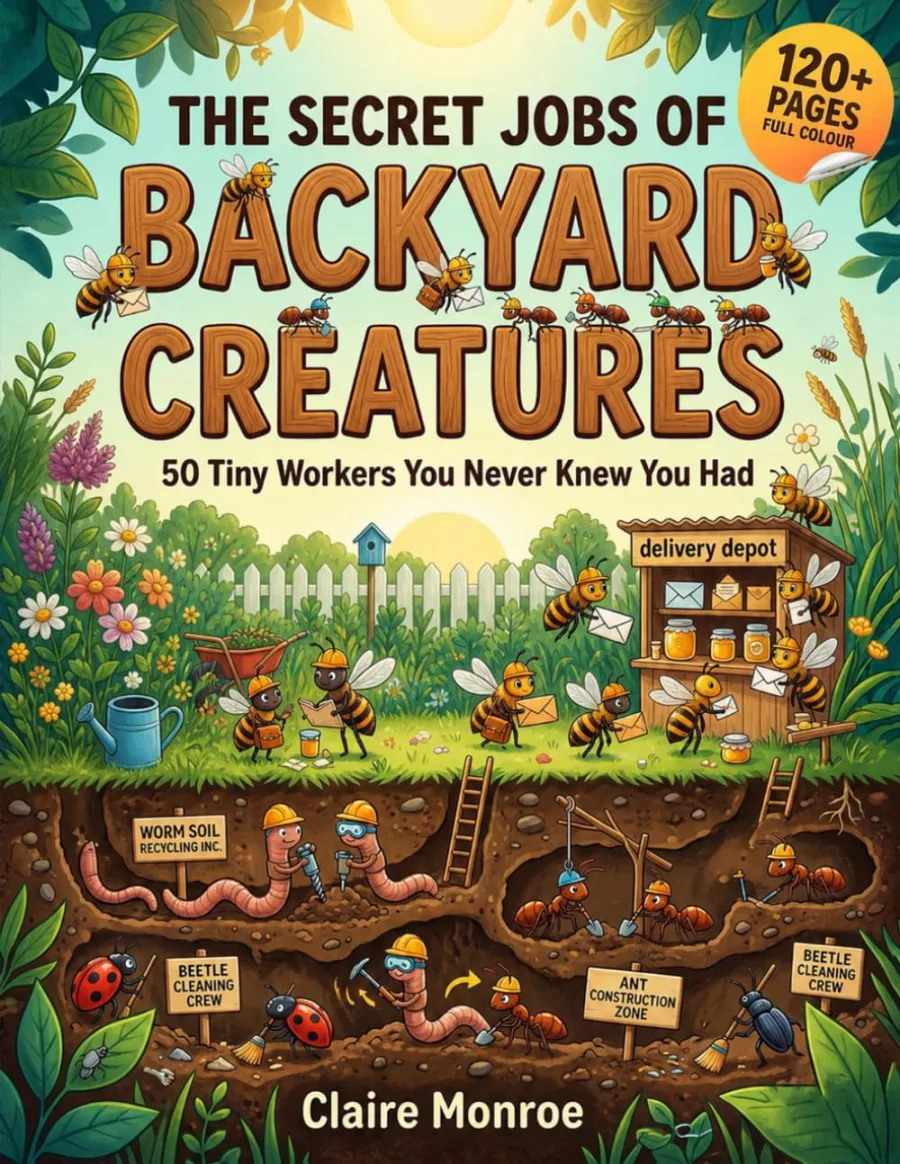
The Secret Jobs of Backyard Creatures For Kids Aged 6 to 10
Paperback
• 126 Pages
• USD 19.95
• English
• 9798195365752
No ratings yet
| Publisher | Independently Published |
|---|---|
| ISBN13 | 9798195365752 |
| ASIN/SKU | B0GZKRW8JH |
| Book Format | Paperback |
| Language | English |
| Pages | 126 |
| List Price | USD 19.95 |
| Publishing Date | 04/05/2026 |
| Dimensions | 8.5 x 0.29 x 11 inches |
| Weight | 11.3 ounces |
| Book Code | BD00066942 |
Buy this Book
Amazon Stores
Ebook Stores
Other Stores
Discover The Secret Jobs of Backyard Creatures For Kids Aged 6 to 10 by Claire Monroe. This book is published by Independently Published in Paperback format, ISBN 9798195365752, ASIN B0GZKRW8JH, under Children's Books, Children's Environment and Ecology Books, Children's Mystery and Wonders Books.
Book Description
Imagine handing your child a book that turns the backyard into the funniest, most fascinating place on earth — and watching them become genuinely curious about the natural world.
Large FULL-COLOR illustrated format packed with hidden objects, naturalist field notes, and jokes that make the whole family groan — in the best way.
Designed for ages 6–10. Adored by curious kids, nature lovers, and any adult who has ever wondered what a worm is really up to.
50 Garden Creatures, 50 Ridiculous Job Titles: From the Chief Soil Restructuring Officer tunnelling beneath your lawn to the Senior Overnight Surveillance Analyst blinking from the fence post — your backyard has never felt so official.
A Seek-and-Find Book Disguised as a Field Guide: Every double-page spread hides objects for sharp-eyed readers to track down, with magnified detail panels and naturalist callout bubbles to pour over.
Funny Enough to Read Aloud, Rich Enough to Revisit: Jokes and riddles on every page work for solo readers and family read-alouds alike. Kids come back to spot what they missed the first time.
Secretly Educational: Each creature's job title is a real nod to what it actually does in nature — so the laughs come with genuine learning built right in.
The Secret Jobs of Backyard Creatures transforms the garden path, the compost heap, and the dark patch under the porch into a fully staffed, hilariously documented workplace. Illustrated in warm, golden-age watercolour style, each creature is presented as a naturalist specimen — complete with official job title, field observations, and visual jokes hiding in every corner of the page. Kids pore over the illustrations. They hunt for hidden objects. They read the jokes out loud. And without noticing, they learn how the natural world actually works.
Why Kids, Parents, and Teachers Love It
Illustration-First Design — Every spread is a warm, detailed watercolour scene, packed with visual gags, hidden characters from other chapters, and a magnified detail panel that rewards close looking.
7 Workplace Departments — Creatures are organised across departments from Dawn Patrol to Midnight Operations, following a full day in the life of a very busy backyard.
Honest About How Nature Works — Job titles reflect what each creature genuinely does — decomposing, pollinating, aerating, hunting. The humour makes it memorable.
For the Whole Family — Jokes land for adults and kids. The seek-and-find works for ages 5 to 55. Read one creature at bedtime or get lost in a chapter on a rainy afternoon.
Designed to Be Dipped Into — 50 self-contained creatures mean there is no right order. Open anywhere. Every page delivers.
What's Inside
50 Fully Illustrated Creature Profiles — Each across a two-page spread, with job title, field notes, visual jokes, and callout observations.
Golden-Age Watercolour Illustration — Warm, semi-realistic artwork in a naturalist field guide style, designed to be pored over as much as read.
Hidden Seek-and-Find Objects on Every Page — Three objects per spread sourced from real scene details, plus cross-chapter creatures hiding in the background.
Riddles and Jokes Throughout — Short, punchy, and built for ages 6 to 10. Kid-tested. Parent-groan approved.
Specimen Cards for Every Creature — Common name, scientific name, and official job title, presented as a naturalist field tag.
Scroll up and add it to your cart — and give your child a book that makes the garden feel like the most interesting place in the world.
Large FULL-COLOR illustrated format packed with hidden objects, naturalist field notes, and jokes that make the whole family groan — in the best way.
Designed for ages 6–10. Adored by curious kids, nature lovers, and any adult who has ever wondered what a worm is really up to.
50 Garden Creatures, 50 Ridiculous Job Titles: From the Chief Soil Restructuring Officer tunnelling beneath your lawn to the Senior Overnight Surveillance Analyst blinking from the fence post — your backyard has never felt so official.
A Seek-and-Find Book Disguised as a Field Guide: Every double-page spread hides objects for sharp-eyed readers to track down, with magnified detail panels and naturalist callout bubbles to pour over.
Funny Enough to Read Aloud, Rich Enough to Revisit: Jokes and riddles on every page work for solo readers and family read-alouds alike. Kids come back to spot what they missed the first time.
Secretly Educational: Each creature's job title is a real nod to what it actually does in nature — so the laughs come with genuine learning built right in.
The Secret Jobs of Backyard Creatures transforms the garden path, the compost heap, and the dark patch under the porch into a fully staffed, hilariously documented workplace. Illustrated in warm, golden-age watercolour style, each creature is presented as a naturalist specimen — complete with official job title, field observations, and visual jokes hiding in every corner of the page. Kids pore over the illustrations. They hunt for hidden objects. They read the jokes out loud. And without noticing, they learn how the natural world actually works.
Why Kids, Parents, and Teachers Love It
Illustration-First Design — Every spread is a warm, detailed watercolour scene, packed with visual gags, hidden characters from other chapters, and a magnified detail panel that rewards close looking.
7 Workplace Departments — Creatures are organised across departments from Dawn Patrol to Midnight Operations, following a full day in the life of a very busy backyard.
Honest About How Nature Works — Job titles reflect what each creature genuinely does — decomposing, pollinating, aerating, hunting. The humour makes it memorable.
For the Whole Family — Jokes land for adults and kids. The seek-and-find works for ages 5 to 55. Read one creature at bedtime or get lost in a chapter on a rainy afternoon.
Designed to Be Dipped Into — 50 self-contained creatures mean there is no right order. Open anywhere. Every page delivers.
What's Inside
50 Fully Illustrated Creature Profiles — Each across a two-page spread, with job title, field notes, visual jokes, and callout observations.
Golden-Age Watercolour Illustration — Warm, semi-realistic artwork in a naturalist field guide style, designed to be pored over as much as read.
Hidden Seek-and-Find Objects on Every Page — Three objects per spread sourced from real scene details, plus cross-chapter creatures hiding in the background.
Riddles and Jokes Throughout — Short, punchy, and built for ages 6 to 10. Kid-tested. Parent-groan approved.
Specimen Cards for Every Creature — Common name, scientific name, and official job title, presented as a naturalist field tag.
Scroll up and add it to your cart — and give your child a book that makes the garden feel like the most interesting place in the world.
Author Biography
Mum of two homeschooled kids. Passionate about creating engaging books that encourage curiosity and joyful learning and inspire young readers to explore, learn, and grow with creativity and confidence.
Editorial Reviews
Editorial Reviews will be added soon…
Book Summary
The Secret Jobs of Backyard Creatures For Kids Aged 6 to 10 by Claire Monroe is a gentle, engaging exploration of the hidden work that small animals, insects, and other critters are doing all around us, usually without anyone noticing. Written especially for children, it invites young readers to step outside and look at their own yard, garden, park, or school playground with fresh eyes, as if they’ve been given a secret mission: to discover what each creature is busy doing and why it matters. Instead of presenting bugs and animals as scary, gross, or annoying, the book treats them like tiny workers with important jobs—gardeners, cleaners, recyclers, builders, and food providers—who are all helping nature stay healthy and balanced. The tone is friendly and curious, often talking directly to the reader and encouraging them to imagine themselves as detectives or scientists, piecing together clues about what’s going on under leaves, in the soil, and up in the branches. Monroe uses simple, clear language suited for ages 6 to 10, mixing short explanations with vivid descriptions and playful comparisons so children can understand complex ideas like ecosystems and food chains in a way that feels easy and fun.
Throughout the book, different common backyard creatures take center stage one by one, each introduced almost like a character with a special role to play. Ants, for example, are shown as tiny movers and cleaners who carry crumbs and bits of food back to their nests, helping to break down leftovers and keep the ground from piling up with waste. Children learn that ants are super strong for their size and that their tunnels help air and water move through the soil. Earthworms appear as underground gardeners, quietly wriggling through the dirt to mix it up and make it soft. Monroe explains that when earthworms eat dead leaves and plant bits, they turn them into rich, dark soil that helps new plants grow strong, so every worm is like a little compost machine working day and night. Beetles, pill bugs, and other small crawlers might be introduced as forest or backyard clean-up crew, chewing on dead wood and fallen leaves so that nothing goes to waste for long. Each example emphasizes the idea that even the smallest creatures are part of an invisible team, doing jobs that support plant life and make the backyard a better place for everyone, including humans.
Pollinators like bees and butterflies are given special attention, because their “job” is both beautiful and extremely important. The book explains that when bees and butterflies visit flowers to sip nectar, they accidentally carry pollen from one flower to another, which helps plants make seeds and fruits. Monroe describes this process in simple terms, perhaps comparing pollen to tiny dust that needs to travel around for plants to “have babies” in the form of seeds. Children are encouraged to imagine a bee wearing a fuzzy coat that collects pollen, turning it into a superhero of plant life. Butterflies are shown not just as pretty decorations in the garden, but as gentle helpers who spread pollen while fluttering from bloom to bloom. The book may also talk about how planting more flowers or leaving a little corner of the yard wild can give these pollinators more places to work and rest. In doing so, kids see that they can become part of the “job team” too, by creating habitats and being kind to the creatures that visit.
Spiders, often feared or disliked, are reintroduced in a more positive light, with their secret job explained as that of pest controllers or guardians of balance. Monroe likely explains that spiders weave webs not just because they look cool, but because webs are tools for catching flies, mosquitoes, and other insects that can become too numerous. By eating these insects, spiders help keep the numbers under control, making life more comfortable for other animals and even for humans. The book might encourage children to look closely at a web, notice its pattern, and imagine how carefully the spider had to work to build it. Instead of seeing a spider and feeling scared, young readers are nudged to think, “That spider is on duty, doing its job.” This change in perspective makes the backyard feel like a busy workplace where everyone is contributing, rather than a place full of “yucky” bugs.
Birds and small mammals can also appear in the story as helpers with jobs like seed-spreading and pest hunting. Birds are shown as messengers and gardeners who eat seeds and berries and then drop seeds in new places, helping plants grow in different spots. Some birds eat insects, keeping the number of certain pests lower. Squirrels might be described as forgetful gardeners who bury nuts and seeds to save for later but don’t always remember where they put them, allowing new trees and plants to sprout from those buried treasures. By presenting these animals as workers in a shared environment, Monroe helps children see that their backyard is a living system, not just a patch of grass. Everything is connected: the insects, the plants, the soil, the birds, and even the children who play there.
A key theme running through the book is respect and curiosity. At many points, the narrator probably reminds young readers that creatures should be watched gently rather than poked, stepped on, or captured for too long. Monroe encourages kids to kneel down and look at the ground, turn over a rock carefully and then put it back, listen for bird calls, and watch how insects move, then to ask themselves, “What job is this creature doing right now?” This practice turns everyday backyard time into a discovery adventure. Children begin to notice patterns: ants following trails, worms appearing after rain, bees visiting certain flowers again and again. These moments teach patience and observation, skills that are central to science but presented here as a fun, natural way of playing outdoors.
Because the book is aimed at 6- to 10-year-olds, it likely includes simple examples of how kids can help backyard workers with their jobs. They might be encouraged to plant native flowers, leave a small pile of leaves or sticks as a tiny habitat, avoid using harsh chemicals that can hurt bugs and plants, or create a shallow water dish with stones for bees and butterflies to drink from safely. These ideas are presented in a way that feels achievable and exciting, not like chores. The message is that children are not just spectators; they can become partners with nature, giving the creatures what they need to keep doing their secret work. This sense of agency is important: when kids realize they can protect and support backyard life, they feel proud and more connected to the world around them.
The book also gently introduces bigger ideas like ecosystems and food webs, but always in kid-friendly language. Monroe might describe the backyard as a tiny neighborhood or city where every creature has a job and a role, and if one role disappears, the whole place changes. For example, if there were no worms, the soil would be less healthy; if there were no bees, many flowers and fruits might not grow; if all spiders vanished, certain insects could become overwhelming. These “what if” scenarios help children understand why biodiversity—having many kinds of living things—is important. They learn that protecting one small insect or plant can affect many other parts of the backyard system.
Emotionally, the book aims to turn fear or disgust into fascination and care. Many children start out afraid of spiders, wasps, or beetles, or they may think worms and slugs are gross. By giving each such creature a clear, helpful job and describing that job in a positive, sometimes charming way, Monroe helps shift those feelings. Instead of shrinking away from a bug, a child might pause and think, “That’s a cleaner,” “That’s a gardener,” or “That’s a hunter keeping the balance.” This shift is powerful, because it lays the groundwork for empathy toward nature and a lifelong respect for living things.
By the end of The Secret Jobs of Backyard Creatures For Kids Aged 6 to 10, the backyard is no longer just a place to run around—it’s a secret workplace full of tiny jobs, quiet workers, and hidden stories. Children come away understanding that every ant, worm, bee, spider, bird, and small animal is part of a bigger picture, doing necessary tasks that help plants grow, keep things clean, control pests, and ensure that food and shelter are available for many species. The book leaves readers with the sense that when they step outside, they are stepping into a living, busy world, and that if they look closely and treat it kindly, they can discover endless wonders right under their feet and at the tips of the grass.
Throughout the book, different common backyard creatures take center stage one by one, each introduced almost like a character with a special role to play. Ants, for example, are shown as tiny movers and cleaners who carry crumbs and bits of food back to their nests, helping to break down leftovers and keep the ground from piling up with waste. Children learn that ants are super strong for their size and that their tunnels help air and water move through the soil. Earthworms appear as underground gardeners, quietly wriggling through the dirt to mix it up and make it soft. Monroe explains that when earthworms eat dead leaves and plant bits, they turn them into rich, dark soil that helps new plants grow strong, so every worm is like a little compost machine working day and night. Beetles, pill bugs, and other small crawlers might be introduced as forest or backyard clean-up crew, chewing on dead wood and fallen leaves so that nothing goes to waste for long. Each example emphasizes the idea that even the smallest creatures are part of an invisible team, doing jobs that support plant life and make the backyard a better place for everyone, including humans.
Pollinators like bees and butterflies are given special attention, because their “job” is both beautiful and extremely important. The book explains that when bees and butterflies visit flowers to sip nectar, they accidentally carry pollen from one flower to another, which helps plants make seeds and fruits. Monroe describes this process in simple terms, perhaps comparing pollen to tiny dust that needs to travel around for plants to “have babies” in the form of seeds. Children are encouraged to imagine a bee wearing a fuzzy coat that collects pollen, turning it into a superhero of plant life. Butterflies are shown not just as pretty decorations in the garden, but as gentle helpers who spread pollen while fluttering from bloom to bloom. The book may also talk about how planting more flowers or leaving a little corner of the yard wild can give these pollinators more places to work and rest. In doing so, kids see that they can become part of the “job team” too, by creating habitats and being kind to the creatures that visit.
Spiders, often feared or disliked, are reintroduced in a more positive light, with their secret job explained as that of pest controllers or guardians of balance. Monroe likely explains that spiders weave webs not just because they look cool, but because webs are tools for catching flies, mosquitoes, and other insects that can become too numerous. By eating these insects, spiders help keep the numbers under control, making life more comfortable for other animals and even for humans. The book might encourage children to look closely at a web, notice its pattern, and imagine how carefully the spider had to work to build it. Instead of seeing a spider and feeling scared, young readers are nudged to think, “That spider is on duty, doing its job.” This change in perspective makes the backyard feel like a busy workplace where everyone is contributing, rather than a place full of “yucky” bugs.
Birds and small mammals can also appear in the story as helpers with jobs like seed-spreading and pest hunting. Birds are shown as messengers and gardeners who eat seeds and berries and then drop seeds in new places, helping plants grow in different spots. Some birds eat insects, keeping the number of certain pests lower. Squirrels might be described as forgetful gardeners who bury nuts and seeds to save for later but don’t always remember where they put them, allowing new trees and plants to sprout from those buried treasures. By presenting these animals as workers in a shared environment, Monroe helps children see that their backyard is a living system, not just a patch of grass. Everything is connected: the insects, the plants, the soil, the birds, and even the children who play there.
A key theme running through the book is respect and curiosity. At many points, the narrator probably reminds young readers that creatures should be watched gently rather than poked, stepped on, or captured for too long. Monroe encourages kids to kneel down and look at the ground, turn over a rock carefully and then put it back, listen for bird calls, and watch how insects move, then to ask themselves, “What job is this creature doing right now?” This practice turns everyday backyard time into a discovery adventure. Children begin to notice patterns: ants following trails, worms appearing after rain, bees visiting certain flowers again and again. These moments teach patience and observation, skills that are central to science but presented here as a fun, natural way of playing outdoors.
Because the book is aimed at 6- to 10-year-olds, it likely includes simple examples of how kids can help backyard workers with their jobs. They might be encouraged to plant native flowers, leave a small pile of leaves or sticks as a tiny habitat, avoid using harsh chemicals that can hurt bugs and plants, or create a shallow water dish with stones for bees and butterflies to drink from safely. These ideas are presented in a way that feels achievable and exciting, not like chores. The message is that children are not just spectators; they can become partners with nature, giving the creatures what they need to keep doing their secret work. This sense of agency is important: when kids realize they can protect and support backyard life, they feel proud and more connected to the world around them.
The book also gently introduces bigger ideas like ecosystems and food webs, but always in kid-friendly language. Monroe might describe the backyard as a tiny neighborhood or city where every creature has a job and a role, and if one role disappears, the whole place changes. For example, if there were no worms, the soil would be less healthy; if there were no bees, many flowers and fruits might not grow; if all spiders vanished, certain insects could become overwhelming. These “what if” scenarios help children understand why biodiversity—having many kinds of living things—is important. They learn that protecting one small insect or plant can affect many other parts of the backyard system.
Emotionally, the book aims to turn fear or disgust into fascination and care. Many children start out afraid of spiders, wasps, or beetles, or they may think worms and slugs are gross. By giving each such creature a clear, helpful job and describing that job in a positive, sometimes charming way, Monroe helps shift those feelings. Instead of shrinking away from a bug, a child might pause and think, “That’s a cleaner,” “That’s a gardener,” or “That’s a hunter keeping the balance.” This shift is powerful, because it lays the groundwork for empathy toward nature and a lifelong respect for living things.
By the end of The Secret Jobs of Backyard Creatures For Kids Aged 6 to 10, the backyard is no longer just a place to run around—it’s a secret workplace full of tiny jobs, quiet workers, and hidden stories. Children come away understanding that every ant, worm, bee, spider, bird, and small animal is part of a bigger picture, doing necessary tasks that help plants grow, keep things clean, control pests, and ensure that food and shelter are available for many species. The book leaves readers with the sense that when they step outside, they are stepping into a living, busy world, and that if they look closely and treat it kindly, they can discover endless wonders right under their feet and at the tips of the grass.
Sample Chapters
Sample Chapters will be added soon…
Reader Reviews
No reviews yet.
The Secret Jobs of Backyard Creatures For Kids Aged 6 to 10
Download Cover Image
Do you want to download the full cover image for The Secret Jobs of Backyard Creatures For Kids Aged 6 to 10?