
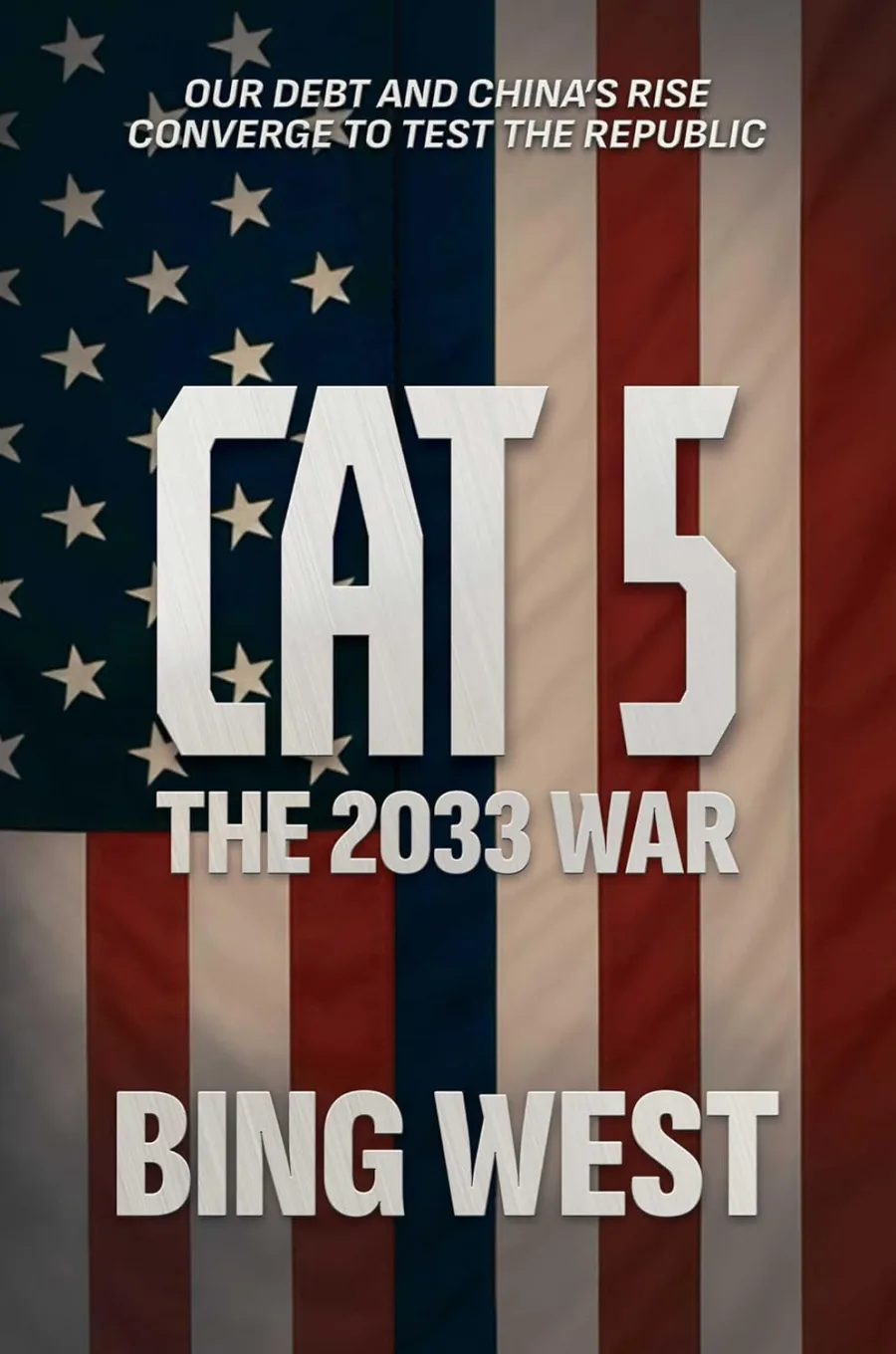
Cat 5: The 2033 War
Hardcover
• 216 Pages
• USD 28.99
• English
• 9798895656525
No ratings yet
| Publisher | Knox Press |
|---|---|
| ISBN13 | 9798895656525 |
| ASIN/SKU | B0G6MBP4L1 |
| Book Format | Hardcover |
| Language | English |
| Pages | 216 |
| List Price | USD 28.99 |
| Publishing Date | 07/07/2026 |
| Dimensions | 5.5 x 0.9 x 8.25 inches |
| Weight | 11.7 ounces |
| Book Code | BD00066955 |
Buy this Book
Amazon Stores
Ebook Stores
Other Stores
Discover Cat 5: The 2033 War by Bing West. This book is published by Knox Press in Hardcover format, ISBN 9798895656525, ASIN B0G6MBP4L1, under Biographies and Memoirs, Afghan War Biographies, Iraq War Biographies.
Book Description
Learn from losing three wars—or lose the next one in 2033.
Bing West is the only historian to serve on the front lines in Vietnam, Iraq, and Afghanistan—and at the highest levels of government. He fought in the battles he writes about, and he explains with firsthand insight why our grunts won the fights, but our presidents lost the wars. The cause, he argues, was hubris. Presidents and policymakers believed the nation was too powerful to fail. That same conceit now threatens America itself. Our elected leaders have hollowed out the military while expanding entitlements to buy votes. The result is a weakened defense and a debt approaching collapse.
By 2033, two forces—our unsustainable debt and China’s ambition—will collide in a Category 5 storm. Drawing on six decades of combat and policy experience, West shows how America arrived at this perilous moment and how to deal with a disaster of our own making. Cat 5: The 2033 War is a soldier’s warning and a historian’s verdict—an unflinching account of national pride, political failure, and the storm closing in. For the first time in our history, we face economic convulsion and confrontation with a mortal adversary—before a single shot is fired.
Bing West is the only historian to serve on the front lines in Vietnam, Iraq, and Afghanistan—and at the highest levels of government. He fought in the battles he writes about, and he explains with firsthand insight why our grunts won the fights, but our presidents lost the wars. The cause, he argues, was hubris. Presidents and policymakers believed the nation was too powerful to fail. That same conceit now threatens America itself. Our elected leaders have hollowed out the military while expanding entitlements to buy votes. The result is a weakened defense and a debt approaching collapse.
By 2033, two forces—our unsustainable debt and China’s ambition—will collide in a Category 5 storm. Drawing on six decades of combat and policy experience, West shows how America arrived at this perilous moment and how to deal with a disaster of our own making. Cat 5: The 2033 War is a soldier’s warning and a historian’s verdict—an unflinching account of national pride, political failure, and the storm closing in. For the first time in our history, we face economic convulsion and confrontation with a mortal adversary—before a single shot is fired.
Author Biography
Bing West's novel, The Last Platoon, is the story of duty in savage, unwinnable combat. West served in Marine infantry in Vietnam. A graduate of Georgetown and Princeton Universities, he has served as both Special Assistant to Secretary of Defense and as Assistant Secretary of Defense for International Security. Based on his own combat and dozens of embeds over the decades, he has written a dozen books about the wars in Vietnam, Iraq and Afghanistan. He is the co-author of General Jim Mattis's memoir, Call Sign Chaos: Learning to Lead, that is on the Commandant's Required Reading List. He has twice been awarded the Department of Defense Distinguished Civilian Service medal, as well as numerous awards for his reporting on combat.
Editorial Reviews
Editorial Reviews will be added soon…
Book Summary
In his provocative and urgent book, Cat 5: The 2033 War, renowned military historian and combat veteran Bing West delivers a stark warning about the immediate future of the United States. Published in the summer of 2026, the book acts as both a sobering historical critique and an alarming forecast of the decade ahead. West paints a picture of a nation hurtling toward an unavoidable crisis, which he vividly describes as a Category 5 geopolitical storm. Unlike traditional military thrillers or abstract academic treatises, this work is grounded in harsh reality, drawing directly from the author's extraordinary six-decade career. West's central thesis is that America has spent the last half-century winning battles but losing wars, and that the same fundamental flaws in leadership that caused those strategic failures are now setting the stage for a catastrophic confrontation by the year 2033.
To truly understand the weight of the arguments presented in this book, one must first appreciate the unique vantage point of its author. Francis J. Bing West is perhaps the only historian of his generation to have served on the front lines of combat in Vietnam, Iraq, and Afghanistan, while also operating at the highest echelons of government as an Assistant Secretary of Defense. He has spent his life alongside the infantrymen in the dirt, experiencing the visceral reality of warfare firsthand. Yet, he has also sat in the pristine rooms of the Pentagon, watching how the struggles of soldiers are translated into abstract political strategies. This rare dual perspective allows West to bridge the gap between tactical realities and strategic decision-making. He does not write from a place of detached academic theory; his insights are forged in the crucible of actual combat, making his critique of American military history incredibly potent.
The foundation of West's warning lies in a brutal examination of America's last three major conflicts. He addresses a painful paradox that has defined the United States military: the glaring disconnect between tactical victory and strategic defeat. As West meticulously points out, American troops on the ground in Vietnam, Iraq, and Afghanistan fought heroically and almost never suffered tactical defeats. In firefight after firefight, the grunts consistently overwhelmed their adversaries through superior firepower and courage. However, despite these battlefield successes, the United States ultimately failed to achieve its overarching goals in all three theaters. West argues that these wars were not lost by the soldiers who waged them; they were lost by the presidents and policymakers who ordered them into action. The political leadership repeatedly sent the military into complex environments without a clear definition of victory, turning tactical dominance into agonizing strategic failure.
The root cause of these recurring disasters, according to West, is a profound sense of hubris among America's ruling class. He diagnoses the political establishment with what he calls a "Jupiter complex"—a deeply ingrained belief that the United States is so overwhelmingly powerful and financially inexhaustible that it can accomplish anything without suffering meaningful consequences. This conceit blinded successive administrations to the harsh realities of geopolitics. Because presidents believed the nation was essentially too powerful to fail, they routinely committed military forces to vaguely defined nation-building exercises. They lacked the discipline to establish clear end-state objectives before the shooting started. Instead of asking what the ultimate goal was and how it could realistically be achieved, leaders assumed that American might would simply figure it out. West views this arrogant assumption of invulnerability as the fatal flaw that undermined decades of sacrifice.
Tragically, West argues that this same hubris has now infected America's domestic policy, threatening the survival of the nation itself. While the Jupiter complex previously led to disastrous misadventures overseas, it is currently hollowing out the country from within. The author points a damning finger at elected officials across the political spectrum, accusing them of prioritizing short-term political survival over long-term national security. In a desperate bid to buy votes and maintain power, politicians have dramatically expanded entitlement programs, funneling wealth into immediate consumer satisfaction rather than investing in the republic's foundational strength. Consequently, the military has been starved of the resources and modernization required to deter modern threats. The American public, lulled into a false sense of security, has become deeply complacent. West views this combination of political self-interest and societal complacency as a toxic brew, leaving the United States acutely vulnerable.
This internal decay sets the stage for the book's core premise: the looming, inevitable crisis that West dubs the Cat 5 storm. He warns that the United States is currently on a collision course with two massive forces that will converge with devastating impact. The first force is the nation's entirely unsustainable national debt. By borrowing trillions of dollars annually, the government has built a financial house of cards rapidly approaching mathematical collapse. The second force is the relentless rise of China's global ambition. While America has been distracted by endless wars and paralyzed by political division, China has methodically built its economic leverage and military capabilities. West explains that these two forces are intrinsically linked, as a nation drowning in debt cannot afford to sustain the military deterrence necessary to hold off a peer adversary.
The timeline West provides is specific and deeply alarming. He does not speak of a vague threat in the hazy future; he circles the years 2031 through 2033 on the calendar. By 2033, he calculates that the sheer weight of the national debt will force an economic convulsion within the United States. The cost of servicing this astronomical debt will severely limit the government's ability to fund essential services, let alone maintain a globally dominant military force. Simultaneously, this window represents the period when China’s military modernization and strategic confidence will likely reach their peak. West foresees a scenario where the ultimate confrontation between these superpowers might not initially look like a traditional war of bullets and bombs. Instead, it will be a war of economic coercion, culminating in a situation where America is forced to concede its global influence simply because it can no longer afford to fight.
Faced with this grim prognosis, West dedicates a significant portion of his work to outlining how the impending disaster might be managed. He directs his most urgent advice to the occupants of the Oval Office, insisting that the next president cannot afford the luxury of denial. The era of kicking the can down the road is over. The very first action a newly elected leader must take, West argues, is to gather their advisors and ask the simple, vital question that was ignored in previous conflicts: what is the final objective? The United States must radically restructure its national priorities, forcing a painful but necessary return to fiscal responsibility. The nation must rebuild its military deterrence not as a tool for endless foreign intervention, but as a rigid shield against existential threats, requiring political courage that has been sorely lacking in recent decades.
Ultimately, Cat 5: The 2033 War serves as both a soldier's desperate warning and a historian's unyielding verdict. Bing West has watched generations of young Americans fight in wars betrayed by political arrogance, and he is terrified that the ultimate price for this institutional incompetence is about to be paid on American soil. His book is an impassioned plea for national renewal, urging the country to shake off its complacency and recognize the storm clouds gathering on the horizon. If the United States refuses to learn the bitter lessons of its last three strategic defeats, it will inevitably succumb to the next one. By laying bare the dangerous intersection of runaway debt, hollowed-out defenses, and rising adversaries, West has provided a crucial roadmap for survival. It is a stark reminder that national greatness is never guaranteed, and that the bill for decades of hubris is finally coming due.
To truly understand the weight of the arguments presented in this book, one must first appreciate the unique vantage point of its author. Francis J. Bing West is perhaps the only historian of his generation to have served on the front lines of combat in Vietnam, Iraq, and Afghanistan, while also operating at the highest echelons of government as an Assistant Secretary of Defense. He has spent his life alongside the infantrymen in the dirt, experiencing the visceral reality of warfare firsthand. Yet, he has also sat in the pristine rooms of the Pentagon, watching how the struggles of soldiers are translated into abstract political strategies. This rare dual perspective allows West to bridge the gap between tactical realities and strategic decision-making. He does not write from a place of detached academic theory; his insights are forged in the crucible of actual combat, making his critique of American military history incredibly potent.
The foundation of West's warning lies in a brutal examination of America's last three major conflicts. He addresses a painful paradox that has defined the United States military: the glaring disconnect between tactical victory and strategic defeat. As West meticulously points out, American troops on the ground in Vietnam, Iraq, and Afghanistan fought heroically and almost never suffered tactical defeats. In firefight after firefight, the grunts consistently overwhelmed their adversaries through superior firepower and courage. However, despite these battlefield successes, the United States ultimately failed to achieve its overarching goals in all three theaters. West argues that these wars were not lost by the soldiers who waged them; they were lost by the presidents and policymakers who ordered them into action. The political leadership repeatedly sent the military into complex environments without a clear definition of victory, turning tactical dominance into agonizing strategic failure.
The root cause of these recurring disasters, according to West, is a profound sense of hubris among America's ruling class. He diagnoses the political establishment with what he calls a "Jupiter complex"—a deeply ingrained belief that the United States is so overwhelmingly powerful and financially inexhaustible that it can accomplish anything without suffering meaningful consequences. This conceit blinded successive administrations to the harsh realities of geopolitics. Because presidents believed the nation was essentially too powerful to fail, they routinely committed military forces to vaguely defined nation-building exercises. They lacked the discipline to establish clear end-state objectives before the shooting started. Instead of asking what the ultimate goal was and how it could realistically be achieved, leaders assumed that American might would simply figure it out. West views this arrogant assumption of invulnerability as the fatal flaw that undermined decades of sacrifice.
Tragically, West argues that this same hubris has now infected America's domestic policy, threatening the survival of the nation itself. While the Jupiter complex previously led to disastrous misadventures overseas, it is currently hollowing out the country from within. The author points a damning finger at elected officials across the political spectrum, accusing them of prioritizing short-term political survival over long-term national security. In a desperate bid to buy votes and maintain power, politicians have dramatically expanded entitlement programs, funneling wealth into immediate consumer satisfaction rather than investing in the republic's foundational strength. Consequently, the military has been starved of the resources and modernization required to deter modern threats. The American public, lulled into a false sense of security, has become deeply complacent. West views this combination of political self-interest and societal complacency as a toxic brew, leaving the United States acutely vulnerable.
This internal decay sets the stage for the book's core premise: the looming, inevitable crisis that West dubs the Cat 5 storm. He warns that the United States is currently on a collision course with two massive forces that will converge with devastating impact. The first force is the nation's entirely unsustainable national debt. By borrowing trillions of dollars annually, the government has built a financial house of cards rapidly approaching mathematical collapse. The second force is the relentless rise of China's global ambition. While America has been distracted by endless wars and paralyzed by political division, China has methodically built its economic leverage and military capabilities. West explains that these two forces are intrinsically linked, as a nation drowning in debt cannot afford to sustain the military deterrence necessary to hold off a peer adversary.
The timeline West provides is specific and deeply alarming. He does not speak of a vague threat in the hazy future; he circles the years 2031 through 2033 on the calendar. By 2033, he calculates that the sheer weight of the national debt will force an economic convulsion within the United States. The cost of servicing this astronomical debt will severely limit the government's ability to fund essential services, let alone maintain a globally dominant military force. Simultaneously, this window represents the period when China’s military modernization and strategic confidence will likely reach their peak. West foresees a scenario where the ultimate confrontation between these superpowers might not initially look like a traditional war of bullets and bombs. Instead, it will be a war of economic coercion, culminating in a situation where America is forced to concede its global influence simply because it can no longer afford to fight.
Faced with this grim prognosis, West dedicates a significant portion of his work to outlining how the impending disaster might be managed. He directs his most urgent advice to the occupants of the Oval Office, insisting that the next president cannot afford the luxury of denial. The era of kicking the can down the road is over. The very first action a newly elected leader must take, West argues, is to gather their advisors and ask the simple, vital question that was ignored in previous conflicts: what is the final objective? The United States must radically restructure its national priorities, forcing a painful but necessary return to fiscal responsibility. The nation must rebuild its military deterrence not as a tool for endless foreign intervention, but as a rigid shield against existential threats, requiring political courage that has been sorely lacking in recent decades.
Ultimately, Cat 5: The 2033 War serves as both a soldier's desperate warning and a historian's unyielding verdict. Bing West has watched generations of young Americans fight in wars betrayed by political arrogance, and he is terrified that the ultimate price for this institutional incompetence is about to be paid on American soil. His book is an impassioned plea for national renewal, urging the country to shake off its complacency and recognize the storm clouds gathering on the horizon. If the United States refuses to learn the bitter lessons of its last three strategic defeats, it will inevitably succumb to the next one. By laying bare the dangerous intersection of runaway debt, hollowed-out defenses, and rising adversaries, West has provided a crucial roadmap for survival. It is a stark reminder that national greatness is never guaranteed, and that the bill for decades of hubris is finally coming due.
Sample Chapters
Sample Chapters will be added soon…
Reader Reviews
No reviews yet.
Cat 5: The 2033 War
Download Cover Image
Do you want to download the full cover image for Cat 5: The 2033 War?