
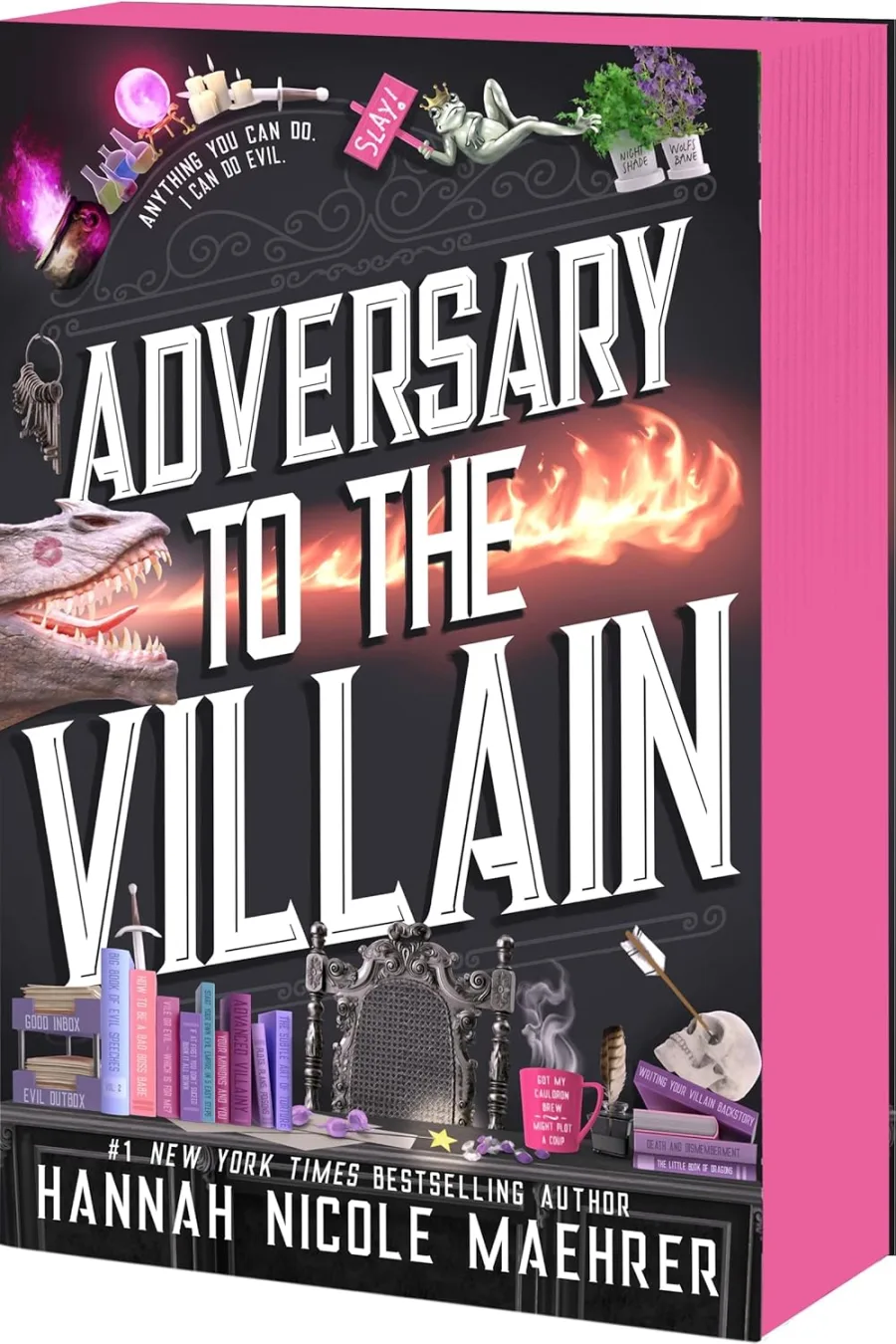
Adversary to the Villain
Paperback
• 352 Pages
• USD 19.99
• English
• 9781682816721
No ratings yet
| Publisher | Entangled: Red Tower Books |
|---|---|
| ISBN13 | 9781682816721 |
| ASIN/SKU | 1682816729 |
| Book Format | Paperback |
| Language | English |
| Pages | 352 |
| List Price | USD 19.99 |
| Series Title | Assistant and the Villain |
| Publishing Date | 04/08/2026 |
| Dimensions | 5.95 x 0.85 x 8.95 inches |
| Weight | 13.6 ounces |
| Book Code | BD00066959 |
Buy this Book
Amazon Stores
Ebook Stores
Other Stores
Discover Adversary to the Villain by Hannah Nicole Maehrer. This book is published by Entangled: Red Tower Books in Paperback format, ISBN 9781682816721, ASIN 1682816729, under Science Fiction and Fantasy, Cozy Fantasy Fiction, Humorous Fantasy.
Book Description
HR Update: The position of “adversary to the villain” has been filled. Evie Sage does not recall applying.
Evie has always tried to be helpful, loyal, and only mildly involved in treason. But with a dangerous prophecy threatening the very magic of Rennedawn―not to mention the race to claim its necessary artifacts before King Benedict does―things are starting to feel…less like a career path and more like a serious problem.
The prophecy won’t stop pointing in Evie’s direction. The Villain’s magic keeps choosing her. And honestly, if you’re going to be accused of evil anyway, you might as well commit.
Unfortunately, the more Evie leans into her alleged villain era, the more her boss starts acting like the hero of a completely different story. Trystan is getting closer―closer than is wise, advisable, or even remotely professional―and looking at her like she’s already chosen a side. His.
Which is deeply inconvenient, because if Evie can’t save the kingdom’s magic, she might just become its greatest threat.
The hilarious fantasy romance series doesn't end at Adversary to the Villain! The thrilling conclusion to the series is coming soon!
The Assistant and the Villain series is best enjoyed in order.
Reading Order:
Book #1 Assistant to the Villain
Book #2 Apprentice to the Villain
Book #3 Accomplice to the Villain
Book #4 Adversary to the Villain
Evie has always tried to be helpful, loyal, and only mildly involved in treason. But with a dangerous prophecy threatening the very magic of Rennedawn―not to mention the race to claim its necessary artifacts before King Benedict does―things are starting to feel…less like a career path and more like a serious problem.
The prophecy won’t stop pointing in Evie’s direction. The Villain’s magic keeps choosing her. And honestly, if you’re going to be accused of evil anyway, you might as well commit.
Unfortunately, the more Evie leans into her alleged villain era, the more her boss starts acting like the hero of a completely different story. Trystan is getting closer―closer than is wise, advisable, or even remotely professional―and looking at her like she’s already chosen a side. His.
Which is deeply inconvenient, because if Evie can’t save the kingdom’s magic, she might just become its greatest threat.
The hilarious fantasy romance series doesn't end at Adversary to the Villain! The thrilling conclusion to the series is coming soon!
The Assistant and the Villain series is best enjoyed in order.
Reading Order:
Book #1 Assistant to the Villain
Book #2 Apprentice to the Villain
Book #3 Accomplice to the Villain
Book #4 Adversary to the Villain
Author Biography
Hannah Nicole Maehrer—or as TikTok Knows her, @hannahnicolemae—is a fantasy romance author and BookToker with a propensity for villains. When she’s not creating bookish comedy skits about Villains and Assistants, she’s writing to Taylor Swift songs. Her biggest passions in life include romance, magic, laughter, and finding ways to include them all in everything she creates. Most days you can find her with her head in the clouds and a pen in her hand.
Editorial Reviews
Editorial Reviews will be added soon…
Book Summary
Hannah Nicole Maehrer’s Adversary to the Villain is the fourth installment in the Assistant and the Villain series, a cozy fantasy romantic comedy that combines magical adventure, workplace humor, slow-burn romance, found family, mystery, and a playful reversal of traditional fantasy roles. Published in August 2026, the 352-page novel continues the story of Evie Sage and Trystan Maverine in the magical kingdom of Rennedawn, but it dramatically raises the stakes. What began as the charmingly absurd story of an ordinary young woman working for a feared villain now develops into a much larger struggle involving prophecy, magical artifacts, political power, betrayal, and the possibility that Evie herself could become the greatest threat to the kingdom.
At the center of Adversary to the Villain is Evie Sage, whose cheerful personality, helpful nature, and practical approach to life have always made her an amusing contrast to the dark world surrounding her. Evie originally entered the employ of Trystan, the notorious Villain, expecting something that resembles a normal job—at least as normal as employment in a villain’s lair can be. Instead, she became part of a strange found family filled with dangerous criminals, magical creatures, eccentric personalities, and people who care for one another far more deeply than their intimidating appearances suggest. The fourth book takes everything Evie has learned about herself and turns it upside down. The title itself captures the transformation: the position of “adversary to the villain” has somehow been filled, and Evie has no memory of applying for it.
The story begins from the major revelation established at the end of Accomplice to the Villain. Evie is no longer simply the sunny assistant standing beside a morally complicated villain. A dangerous prophecy now points directly toward her, suggesting that she has a much more important role in the magical fate of Rennedawn than anyone previously understood. This creates the central conflict of the novel. Evie has spent much of the series trying to understand whether she belongs among the so-called good people or the villains. Now the question becomes much more frightening: what if she is genuinely connected to the destruction of the kingdom? The possibility forces Evie to confront an identity she never wanted and never expected.
The prophecy is not merely a mysterious prediction hanging over the characters. It becomes an active force shaping the plot. The very magic of Rennedawn is threatened, and Evie finds herself at the center of a race to recover powerful artifacts before King Benedict can claim them. The conflict therefore expands beyond the personal relationship between Evie and Trystan. The kingdom itself is at stake. King Benedict represents the conventional fantasy idea of royal authority, but Maehrer continues to complicate the traditional division between heroes and villains. The supposedly villainous Trystan may not be the greatest danger, while the supposedly legitimate ruler may have motives and methods that are considerably more questionable.
This reversal of fantasy conventions is one of the defining pleasures of the novel. In a traditional fairy tale, the villain is easy to identify, the hero is easy to recognize, and the moral boundaries are clearly drawn. Maehrer deliberately refuses that simplicity. Trystan may have earned his reputation as the Villain, but his relationship with Evie has revealed a more vulnerable and protective side. Evie, meanwhile, is kind, optimistic, and fundamentally compassionate, yet she is increasingly associated with dangerous magic and a prophecy that could make her the kingdom’s greatest threat. The novel therefore asks whether someone's reputation, appearance, or assigned role really tells us who that person is.
Evie’s relationship with Trystan becomes even more important in this installment. Their romance has always been built around contrast: her warmth against his darkness, her optimism against his guarded nature, and her ordinary approach to problems against his experience with violence and political intrigue. In Adversary to the Villain, however, the relationship moves into more emotionally complicated territory. Trystan is becoming increasingly open about his feelings, while Evie has to deal with the frightening possibility that the person she trusts most may be unable to protect her from the destiny now surrounding her. The publisher describes Trystan as becoming increasingly close to Evie and looking at her as though she has already chosen his side.
Their romance is therefore not simply a matter of whether the Villain and his assistant will finally become a couple. Their relationship is tested by questions of loyalty, identity, danger, and trust. Trystan must decide whether he can allow Evie to make her own choices even when those choices might place her in terrible danger. Evie must determine whether she can accept Trystan's protection without surrendering her independence. Their attraction remains playful and romantic, but the stakes are considerably higher than in the earlier books. What once felt like workplace flirting now carries the possibility of genuine loss.
The most interesting development in Evie’s character is her growing willingness to confront the darker possibilities surrounding her. For much of the series, her natural response to chaos has been to help. She organizes things, looks after people, solves practical problems, and brings warmth into an environment that should be terrifying. But the prophecy forces her to question whether kindness alone will be enough. If everyone believes she is destined to become dangerous, does she have to reject that identity—or can she use the assumptions against her? The novel plays humorously with this idea as Evie begins leaning into her supposed “villain era.”
That transformation is not simply a turn toward evil. Instead, it becomes an exploration of agency. Evie has spent much of her life being defined by other people's expectations. Now she must decide what kind of person she wants to be regardless of prophecy. The story suggests that being associated with darkness does not automatically make someone evil, just as possessing authority or claiming to represent goodness does not automatically make someone virtuous. What matters are the choices a person makes when given power.
The magical artifacts add an adventure component to the novel. Evie, Trystan, and their allies are caught in a race against King Benedict to secure objects necessary to protect the magic of Rennedawn. This quest takes the series beyond the familiar setting of the Villain’s lair and gives the story a broader fantasy scope. The characters are no longer simply dealing with workplace mishaps, romantic tension, and localized threats. Their actions now have consequences for the entire kingdom.
At the same time, the book retains the cozy qualities that distinguish the series from darker fantasy romances. Maehrer continues to place humor inside situations that would normally be played completely seriously. The villainous workplace remains an important source of comedy, with the characters behaving like an eccentric office team despite the fact that their workplace happens to involve assassinations, magical threats, weapons, and treason. This contrast is central to the appeal of the series. The story can move from high-stakes fantasy danger to an absurdly ordinary interaction without losing its personality.
The found-family element is equally important. Evie’s relationship with the people in Trystan’s lair has gradually become as meaningful as her romantic relationship with Trystan. They are an unlikely group of individuals who have been brought together by circumstances rather than conventional family ties. Their loyalty to one another gives the story emotional warmth beneath its jokes. As the prophecy becomes more dangerous, this family is placed under greater pressure. The threat facing Evie is consequently not only about her own survival; it threatens everyone she has come to love.
One of the novel's more intriguing developments is the mystery surrounding betrayal. Reviews of the finished book describe an expanded ensemble cast and a mystery involving a traitor within the manor, suspicious clues, shifting identities, and a shapeshifter. The story reportedly uses multiple perspectives to broaden the investigation and make different characters possible suspects. This gives Adversary to the Villain a stronger mystery element than the series' basic romantic-comedy premise might suggest.
The use of multiple narrators also expands the world beyond Evie’s perspective. Earlier books are heavily shaped by Evie’s interpretation of events, which is part of what makes the humor work: she often sees bizarre or dangerous circumstances through the practical lens of an employee trying to get through the day. By widening the point of view, Maehrer allows readers to see the characters and conflicts from angles Evie cannot access. This makes the fourth installment feel larger and more ambitious while still retaining the series' signature voice.
Another important thread involves Trystan’s relationship with magic and his own identity. The developing revelations force both characters to reconsider assumptions they have made about themselves. In particular, the contrast between Evie’s apparent connection to dangerous magic and Trystan’s increasingly heroic behavior creates one of the novel's most effective role reversals. The Villain begins behaving like the hero of a story in which Evie may be the danger. The woman who once assisted the Villain may now be the person everyone fears. This inversion gives the romance additional emotional depth because the characters must love one another without fully understanding what either of them may become.
The book also continues Maehrer’s use of humor to make serious themes more accessible. The jokes are not merely decorative. They allow the story to explore anxiety about identity, destiny, power, and mortality without becoming relentlessly dark. Even when the stakes become enormous, Evie’s instinctive optimism and the bizarre personalities around her provide emotional relief. Reviews have particularly noted the series’ unusual comedic touches, including memorable frog-related humor, demonstrating how willing Maehrer is to undercut traditional fantasy seriousness with absurdity.
For readers searching for a cozy fantasy romance, romantic comedy with villains, enemies-to-lovers fantasy, slow-burn romantasy, found-family fantasy, or a funny fantasy series with magical adventure, Adversary to the Villain offers a distinctive combination. It is especially suited to readers who enjoy stories that reverse the usual hero-versus-villain formula and place an ordinary, cheerful heroine inside a world of dark magic and dangerous politics. The official classification describes the book as a cozy fantasy romantic comedy, while major booksellers categorize it under fantasy, romance, humor, and fiction.
Because Adversary to the Villain is the fourth book in the series, its emotional impact depends heavily on the relationships established earlier. The recommended reading order is Assistant to the Villain, Apprentice to the Villain, Accomplice to the Villain, and then Adversary to the Villain. The publisher specifically advises reading the series in order. Readers looking for a standalone fantasy romance may therefore find the fourth book less accessible than readers already invested in Evie, Trystan, and the rest of the cast.
Ultimately, Adversary to the Villain is a story about what happens when the person who has always seemed least likely to become dangerous is suddenly told that she may be the source of the kingdom’s greatest threat. Evie’s journey is not simply about defeating a prophecy. It is about deciding whether destiny has the authority to define her. Trystan’s journey is similarly about discovering that being called a villain does not prevent someone from loving, protecting, sacrificing, and choosing to do what is right.
The novel's central tension comes from this collision between identity and expectation. Evie has spent years proving that kindness can exist in dark places. Now she must discover whether kindness can survive when darkness begins to exist inside her. Trystan, meanwhile, must confront the possibility that the person he loves could become his greatest adversary. Their romance consequently becomes inseparable from the larger fantasy conflict: loving someone means trusting them even when you cannot predict what they will become.
In the end, Adversary to the Villain expands the series from a charming workplace fantasy romance into a larger story about prophecy, power, identity, loyalty, and the meaning of good and evil. Its appeal lies in the combination of high-stakes magical adventure and low-stakes absurdity, with dangerous quests and kingdom-threatening prophecies existing alongside workplace banter, eccentric friendships, romantic tension, and found-family warmth. The result is a playful but increasingly ambitious romantasy that asks an unexpectedly serious question beneath all the comedy: if the world tells you that you are destined to become a villain, do you accept that identity—or do you choose your own story?
For fans of Hannah Nicole Maehrer’s Assistant and the Villain series, Adversary to the Villain represents a major escalation in Evie and Trystan’s story. The prophecy places Evie at the center of the kingdom's fate, the race for magical artifacts raises the stakes, betrayal threatens the found family, and the relationship between Evie and Trystan moves closer to its emotional breaking point. Most importantly, the novel continues Maehrer’s signature belief that heroes and villains are rarely as simple as their titles suggest. In Rennedawn, the person called the Villain may be capable of extraordinary love, while the cheerful assistant may hold the power to change everything. That reversal is ultimately what makes Adversary to the Villain such an entertaining and compelling entry in contemporary cozy romantasy.
At the center of Adversary to the Villain is Evie Sage, whose cheerful personality, helpful nature, and practical approach to life have always made her an amusing contrast to the dark world surrounding her. Evie originally entered the employ of Trystan, the notorious Villain, expecting something that resembles a normal job—at least as normal as employment in a villain’s lair can be. Instead, she became part of a strange found family filled with dangerous criminals, magical creatures, eccentric personalities, and people who care for one another far more deeply than their intimidating appearances suggest. The fourth book takes everything Evie has learned about herself and turns it upside down. The title itself captures the transformation: the position of “adversary to the villain” has somehow been filled, and Evie has no memory of applying for it.
The story begins from the major revelation established at the end of Accomplice to the Villain. Evie is no longer simply the sunny assistant standing beside a morally complicated villain. A dangerous prophecy now points directly toward her, suggesting that she has a much more important role in the magical fate of Rennedawn than anyone previously understood. This creates the central conflict of the novel. Evie has spent much of the series trying to understand whether she belongs among the so-called good people or the villains. Now the question becomes much more frightening: what if she is genuinely connected to the destruction of the kingdom? The possibility forces Evie to confront an identity she never wanted and never expected.
The prophecy is not merely a mysterious prediction hanging over the characters. It becomes an active force shaping the plot. The very magic of Rennedawn is threatened, and Evie finds herself at the center of a race to recover powerful artifacts before King Benedict can claim them. The conflict therefore expands beyond the personal relationship between Evie and Trystan. The kingdom itself is at stake. King Benedict represents the conventional fantasy idea of royal authority, but Maehrer continues to complicate the traditional division between heroes and villains. The supposedly villainous Trystan may not be the greatest danger, while the supposedly legitimate ruler may have motives and methods that are considerably more questionable.
This reversal of fantasy conventions is one of the defining pleasures of the novel. In a traditional fairy tale, the villain is easy to identify, the hero is easy to recognize, and the moral boundaries are clearly drawn. Maehrer deliberately refuses that simplicity. Trystan may have earned his reputation as the Villain, but his relationship with Evie has revealed a more vulnerable and protective side. Evie, meanwhile, is kind, optimistic, and fundamentally compassionate, yet she is increasingly associated with dangerous magic and a prophecy that could make her the kingdom’s greatest threat. The novel therefore asks whether someone's reputation, appearance, or assigned role really tells us who that person is.
Evie’s relationship with Trystan becomes even more important in this installment. Their romance has always been built around contrast: her warmth against his darkness, her optimism against his guarded nature, and her ordinary approach to problems against his experience with violence and political intrigue. In Adversary to the Villain, however, the relationship moves into more emotionally complicated territory. Trystan is becoming increasingly open about his feelings, while Evie has to deal with the frightening possibility that the person she trusts most may be unable to protect her from the destiny now surrounding her. The publisher describes Trystan as becoming increasingly close to Evie and looking at her as though she has already chosen his side.
Their romance is therefore not simply a matter of whether the Villain and his assistant will finally become a couple. Their relationship is tested by questions of loyalty, identity, danger, and trust. Trystan must decide whether he can allow Evie to make her own choices even when those choices might place her in terrible danger. Evie must determine whether she can accept Trystan's protection without surrendering her independence. Their attraction remains playful and romantic, but the stakes are considerably higher than in the earlier books. What once felt like workplace flirting now carries the possibility of genuine loss.
The most interesting development in Evie’s character is her growing willingness to confront the darker possibilities surrounding her. For much of the series, her natural response to chaos has been to help. She organizes things, looks after people, solves practical problems, and brings warmth into an environment that should be terrifying. But the prophecy forces her to question whether kindness alone will be enough. If everyone believes she is destined to become dangerous, does she have to reject that identity—or can she use the assumptions against her? The novel plays humorously with this idea as Evie begins leaning into her supposed “villain era.”
That transformation is not simply a turn toward evil. Instead, it becomes an exploration of agency. Evie has spent much of her life being defined by other people's expectations. Now she must decide what kind of person she wants to be regardless of prophecy. The story suggests that being associated with darkness does not automatically make someone evil, just as possessing authority or claiming to represent goodness does not automatically make someone virtuous. What matters are the choices a person makes when given power.
The magical artifacts add an adventure component to the novel. Evie, Trystan, and their allies are caught in a race against King Benedict to secure objects necessary to protect the magic of Rennedawn. This quest takes the series beyond the familiar setting of the Villain’s lair and gives the story a broader fantasy scope. The characters are no longer simply dealing with workplace mishaps, romantic tension, and localized threats. Their actions now have consequences for the entire kingdom.
At the same time, the book retains the cozy qualities that distinguish the series from darker fantasy romances. Maehrer continues to place humor inside situations that would normally be played completely seriously. The villainous workplace remains an important source of comedy, with the characters behaving like an eccentric office team despite the fact that their workplace happens to involve assassinations, magical threats, weapons, and treason. This contrast is central to the appeal of the series. The story can move from high-stakes fantasy danger to an absurdly ordinary interaction without losing its personality.
The found-family element is equally important. Evie’s relationship with the people in Trystan’s lair has gradually become as meaningful as her romantic relationship with Trystan. They are an unlikely group of individuals who have been brought together by circumstances rather than conventional family ties. Their loyalty to one another gives the story emotional warmth beneath its jokes. As the prophecy becomes more dangerous, this family is placed under greater pressure. The threat facing Evie is consequently not only about her own survival; it threatens everyone she has come to love.
One of the novel's more intriguing developments is the mystery surrounding betrayal. Reviews of the finished book describe an expanded ensemble cast and a mystery involving a traitor within the manor, suspicious clues, shifting identities, and a shapeshifter. The story reportedly uses multiple perspectives to broaden the investigation and make different characters possible suspects. This gives Adversary to the Villain a stronger mystery element than the series' basic romantic-comedy premise might suggest.
The use of multiple narrators also expands the world beyond Evie’s perspective. Earlier books are heavily shaped by Evie’s interpretation of events, which is part of what makes the humor work: she often sees bizarre or dangerous circumstances through the practical lens of an employee trying to get through the day. By widening the point of view, Maehrer allows readers to see the characters and conflicts from angles Evie cannot access. This makes the fourth installment feel larger and more ambitious while still retaining the series' signature voice.
Another important thread involves Trystan’s relationship with magic and his own identity. The developing revelations force both characters to reconsider assumptions they have made about themselves. In particular, the contrast between Evie’s apparent connection to dangerous magic and Trystan’s increasingly heroic behavior creates one of the novel's most effective role reversals. The Villain begins behaving like the hero of a story in which Evie may be the danger. The woman who once assisted the Villain may now be the person everyone fears. This inversion gives the romance additional emotional depth because the characters must love one another without fully understanding what either of them may become.
The book also continues Maehrer’s use of humor to make serious themes more accessible. The jokes are not merely decorative. They allow the story to explore anxiety about identity, destiny, power, and mortality without becoming relentlessly dark. Even when the stakes become enormous, Evie’s instinctive optimism and the bizarre personalities around her provide emotional relief. Reviews have particularly noted the series’ unusual comedic touches, including memorable frog-related humor, demonstrating how willing Maehrer is to undercut traditional fantasy seriousness with absurdity.
For readers searching for a cozy fantasy romance, romantic comedy with villains, enemies-to-lovers fantasy, slow-burn romantasy, found-family fantasy, or a funny fantasy series with magical adventure, Adversary to the Villain offers a distinctive combination. It is especially suited to readers who enjoy stories that reverse the usual hero-versus-villain formula and place an ordinary, cheerful heroine inside a world of dark magic and dangerous politics. The official classification describes the book as a cozy fantasy romantic comedy, while major booksellers categorize it under fantasy, romance, humor, and fiction.
Because Adversary to the Villain is the fourth book in the series, its emotional impact depends heavily on the relationships established earlier. The recommended reading order is Assistant to the Villain, Apprentice to the Villain, Accomplice to the Villain, and then Adversary to the Villain. The publisher specifically advises reading the series in order. Readers looking for a standalone fantasy romance may therefore find the fourth book less accessible than readers already invested in Evie, Trystan, and the rest of the cast.
Ultimately, Adversary to the Villain is a story about what happens when the person who has always seemed least likely to become dangerous is suddenly told that she may be the source of the kingdom’s greatest threat. Evie’s journey is not simply about defeating a prophecy. It is about deciding whether destiny has the authority to define her. Trystan’s journey is similarly about discovering that being called a villain does not prevent someone from loving, protecting, sacrificing, and choosing to do what is right.
The novel's central tension comes from this collision between identity and expectation. Evie has spent years proving that kindness can exist in dark places. Now she must discover whether kindness can survive when darkness begins to exist inside her. Trystan, meanwhile, must confront the possibility that the person he loves could become his greatest adversary. Their romance consequently becomes inseparable from the larger fantasy conflict: loving someone means trusting them even when you cannot predict what they will become.
In the end, Adversary to the Villain expands the series from a charming workplace fantasy romance into a larger story about prophecy, power, identity, loyalty, and the meaning of good and evil. Its appeal lies in the combination of high-stakes magical adventure and low-stakes absurdity, with dangerous quests and kingdom-threatening prophecies existing alongside workplace banter, eccentric friendships, romantic tension, and found-family warmth. The result is a playful but increasingly ambitious romantasy that asks an unexpectedly serious question beneath all the comedy: if the world tells you that you are destined to become a villain, do you accept that identity—or do you choose your own story?
For fans of Hannah Nicole Maehrer’s Assistant and the Villain series, Adversary to the Villain represents a major escalation in Evie and Trystan’s story. The prophecy places Evie at the center of the kingdom's fate, the race for magical artifacts raises the stakes, betrayal threatens the found family, and the relationship between Evie and Trystan moves closer to its emotional breaking point. Most importantly, the novel continues Maehrer’s signature belief that heroes and villains are rarely as simple as their titles suggest. In Rennedawn, the person called the Villain may be capable of extraordinary love, while the cheerful assistant may hold the power to change everything. That reversal is ultimately what makes Adversary to the Villain such an entertaining and compelling entry in contemporary cozy romantasy.
Sample Chapters
Sample Chapters will be added soon…
Reader Reviews
No reviews yet.
Adversary to the Villain
Download Cover Image
Do you want to download the full cover image for Adversary to the Villain?