
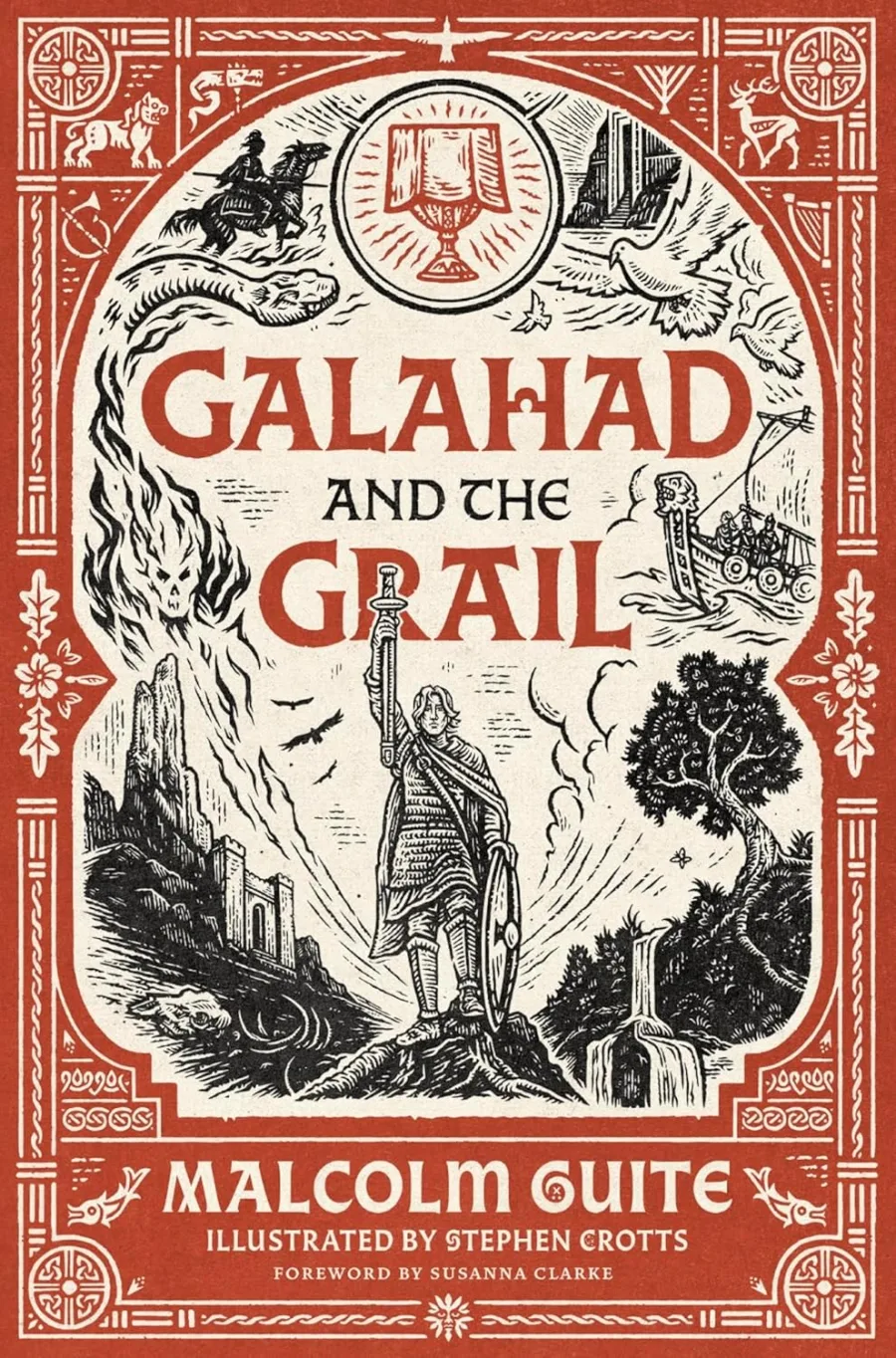
Galahad and the Grail (Merlin's Isle: An Arthuriad), 1
Malcolm Guite, Stephen Crotts (Illustrator)
Hardcover
• 372 Pages
• USD 34.00
• English
• 9781951872700
No ratings yet
| Publisher | Rabbit Room Press |
|---|---|
| ISBN13 | 9781951872700 |
| ASIN/SKU | 1951872703 |
| Book Format | Hardcover |
| Language | English |
| Pages | 372 |
| List Price | USD 34.00 |
| Publishing Date | 20/04/2026 |
| Weight | 1.68 pounds |
| Book Code | BD00066961 |
Buy this Book
Amazon Stores
Ebook Stores
Other Stores
Discover Galahad and the Grail (Merlin's Isle: An Arthuriad), 1 by Malcolm Guite. This book is published by Rabbit Room Press in Hardcover format, ISBN 9781951872700, ASIN 1951872703, under Literature and Fiction, Religious Poetry, British and Irish Poetry.
Book Description
"An astonishing achievement. . ." -- Susanna Clarke, author of Jonathan Strange & Mr Norrell and Piranesi
"Vigorous and fresh. . . whets the appetite for much more." -- Rowan Williams, former Archbishop of Canterbury
"A rare glimpse at a magnum opus in the making." Daniel Nayeri, author of Everything Sad Is Untrue
In this first volume of Merlin's Isle, join the prophesied youth, Sir Galahad, and the other knights of the quest as they set out from Camelot to achieve the Holy Grail. The accomplishment of their goal will not only heal the wounded Fisher-King, but will bring about the long hoped-for healing of the land itself.
Acclaimed poet Malcolm Guite's masterwork, a lifetime in the making
Illustrated by award-winning artist Stephen Crotts
Foreword by Hugo Award-winning author Susanna Clarke
More than 25 full-page illustrations
Color interior with unique illuminated capitals
Clothbound hardcover with dust jacket
Accessible for all ages
A true, new epic of English Literature
Here at the height of his poetic power, Malcolm Guite delivers a tale of adventure in ballad form that plumbs the depths of the human soul, carries readers through the Wasteland, and sets them upon the numinous shores of Faerie in all its mystery and meaning.
Guite follows in the epic footsteps of Spenser, Milton, Dante, and Tennyson, yet this is not poetry destined solely for the halls of academia--it's a story to be enjoyed by young and old alike, a story to be read aloud among friends and family, a story to be cherished for generations to come.
Merlin's Isle: An Arthuriad is an epic ballad cycle in four volumes:
Galahad and the Grail (Spring 2026)
The Coming of Arthur (Fall 2026)
Days of the Round Table (Fall 2027)
The Passing of Arthur (Spring 2028)
"Vigorous and fresh. . . whets the appetite for much more." -- Rowan Williams, former Archbishop of Canterbury
"A rare glimpse at a magnum opus in the making." Daniel Nayeri, author of Everything Sad Is Untrue
In this first volume of Merlin's Isle, join the prophesied youth, Sir Galahad, and the other knights of the quest as they set out from Camelot to achieve the Holy Grail. The accomplishment of their goal will not only heal the wounded Fisher-King, but will bring about the long hoped-for healing of the land itself.
Acclaimed poet Malcolm Guite's masterwork, a lifetime in the making
Illustrated by award-winning artist Stephen Crotts
Foreword by Hugo Award-winning author Susanna Clarke
More than 25 full-page illustrations
Color interior with unique illuminated capitals
Clothbound hardcover with dust jacket
Accessible for all ages
A true, new epic of English Literature
Here at the height of his poetic power, Malcolm Guite delivers a tale of adventure in ballad form that plumbs the depths of the human soul, carries readers through the Wasteland, and sets them upon the numinous shores of Faerie in all its mystery and meaning.
Guite follows in the epic footsteps of Spenser, Milton, Dante, and Tennyson, yet this is not poetry destined solely for the halls of academia--it's a story to be enjoyed by young and old alike, a story to be read aloud among friends and family, a story to be cherished for generations to come.
Merlin's Isle: An Arthuriad is an epic ballad cycle in four volumes:
Galahad and the Grail (Spring 2026)
The Coming of Arthur (Fall 2026)
Days of the Round Table (Fall 2027)
The Passing of Arthur (Spring 2028)
Author Biography
Malcolm Guite is a poet, scholar, and Life Fellow of Girton College, Cambridge. He has published five collections of poetry and many other books including Mariner: A Voyage with Samuel Taylor Coleridge (Hodder, 2017).
Editorial Reviews
Editorial Reviews will be added soon…
Book Summary
Galahad and the Grail by Malcolm Guite, with illustrations by Stephen Crotts, is a gentle, imaginative retelling of the story of Sir Galahad and his quest for the Holy Grail, written in a way that is accessible to younger readers while still rich enough to speak to adults. At its heart, the book follows Galahad, the pure knight of Arthurian legend, whose whole life is shaped by a deep inner calling rather than ambition, glory, or fear. He grows up somewhat apart from the noisy struggles for power that fill the world of Camelot, and instead learns to listen to the quiet voice of goodness and truth. Guite presents Galahad not as a flawless hero in a distant myth, but as a young person learning to pay attention to the hints and whispers of grace in his life. From an early age, Galahad senses that he is meant for a special purpose, yet he does not fully understand it. That uncertainty, and the way he bears it, becomes one of the book’s most important themes: a kind of faithful waiting and readiness.
As the story unfolds, Galahad is drawn from the margins of Arthur’s world into its very center. Camelot itself is portrayed with a familiar mix of nobility and brokenness: great knights, brave deeds and high ideals, but also pride, rivalry and moral failure. The Round Table, once a symbol of unity and justice, is shown to be in decline, haunted by past mistakes and divided loyalties. Into this weary, half-fallen world comes the strange and wondrous sign of the Holy Grail—the mysterious cup associated with Christ’s Last Supper and His sacrifice. The Grail appears only fleetingly, and not in a way that can be grasped or controlled. Its coming is more like a vision or a visitation, a reminder that there is a deeper story of mercy and redemption running beneath all the human struggles for power. Many knights burn with the desire to seek the Grail, but few understand what that longing truly asks of them.
Galahad, unlike many of the other knights, is not driven by a desire to prove himself or to gain honor. Instead, his quest for the Grail arises out of love and an almost childlike trust. Guite emphasizes Galahad’s purity, but not as a cold, moral perfection. His purity is more like a clear window: because his heart is not cluttered with selfish ambition and bitterness, he can see what others cannot. This sets him apart from figures like Lancelot, whose genuine greatness is shadowed by guilt and divided love, or Gawain, whose courage is sometimes distorted by anger and stubbornness. Galahad’s strength is inward; he is brave, but his bravery flows from a quiet confidence in something beyond himself. The book shows him facing the temptations and dangers that come with the quest—not only outward threats, but also inner ones—yet remaining steady because he is guided by the light he has learned to trust.
The journey to the Grail takes Galahad through wild landscapes, lonely paths, and encounters that test both character and faith. Along the way, he meets signs and symbols that echo Christian themes: moments of sacrifice, forgiveness, and grace. Guite weaves these elements in naturally, without heavy preaching, allowing the story itself to suggest meanings rather than forcing them. The Grail, in this telling, is not a magical object that grants power, but a holy mystery that reveals the presence of God’s love in the midst of human weakness. Seeking it means being willing to leave comfort, face one’s own limitations, and let go of pride. Many knights fall away from the quest because they cannot bear that kind of self-emptying. Galahad, however, accepts that the journey is not about personal triumph but about being drawn closer to a reality greater than himself.
As Galahad moves closer to the Grail, the narrative slows and grows more contemplative. The outward adventure continues, but the reader is invited to notice what is happening inside the young knight’s heart. He learns that seeing the Grail clearly requires more than courage; it requires compassion, humility, and a readiness to be changed. The book suggests that true vision is given, not taken. The Grail is shown to those who are able to receive it, and receiving it means becoming more open to love. In this way, Galahad’s success is quietly contrasted with the struggles of other knights, whose past wounds and unresolved conflicts cloud their sight. The tragedy of their failure is not mocked or condemned; instead, it underscores how hard it is for any person to let go of self and entrust themselves fully to grace.
When Galahad finally beholds the Grail, the moment is described less as a spectacle and more as a revelation. It is a turning point not only for him, but for the larger story of Arthur’s world. Here, the book invites readers to see the quest as something that touches every human life: the search for meaning, for a love that does not disappoint, for a light that does not go out. Galahad’s encounter with the Grail is transformative. It fulfills his calling but also leads him beyond the ordinary limits of the world he has known. The ending has a gentle, bittersweet quality. There is a sense of completion and peace for Galahad himself, but also an awareness that Camelot remains wounded and imperfect. The Grail does not erase history or magically repair all wrongs; instead, it offers a glimpse of a deeper hope that can sustain people even in a broken world.
Throughout the book, Malcolm Guite’s prose remains simple and lyrical, making the story approachable for readers who might be encountering the Grail legend for the first time. At the same time, his background as a poet and Christian thinker shines through in the way he handles symbol and meaning. Stephen Crotts’ illustrations accompany the text, adding visual richness and helping to anchor the tale in vivid scenes—knights riding through forests, quiet moments of prayer or reflection, and the luminous presence of the Grail itself. Together, words and images create a story that feels both ancient and fresh: a classic legend retold with tenderness, inviting readers to see in Galahad’s journey a mirror of their own longing for truth, goodness, and a love that calls them beyond themselves.
As the story unfolds, Galahad is drawn from the margins of Arthur’s world into its very center. Camelot itself is portrayed with a familiar mix of nobility and brokenness: great knights, brave deeds and high ideals, but also pride, rivalry and moral failure. The Round Table, once a symbol of unity and justice, is shown to be in decline, haunted by past mistakes and divided loyalties. Into this weary, half-fallen world comes the strange and wondrous sign of the Holy Grail—the mysterious cup associated with Christ’s Last Supper and His sacrifice. The Grail appears only fleetingly, and not in a way that can be grasped or controlled. Its coming is more like a vision or a visitation, a reminder that there is a deeper story of mercy and redemption running beneath all the human struggles for power. Many knights burn with the desire to seek the Grail, but few understand what that longing truly asks of them.
Galahad, unlike many of the other knights, is not driven by a desire to prove himself or to gain honor. Instead, his quest for the Grail arises out of love and an almost childlike trust. Guite emphasizes Galahad’s purity, but not as a cold, moral perfection. His purity is more like a clear window: because his heart is not cluttered with selfish ambition and bitterness, he can see what others cannot. This sets him apart from figures like Lancelot, whose genuine greatness is shadowed by guilt and divided love, or Gawain, whose courage is sometimes distorted by anger and stubbornness. Galahad’s strength is inward; he is brave, but his bravery flows from a quiet confidence in something beyond himself. The book shows him facing the temptations and dangers that come with the quest—not only outward threats, but also inner ones—yet remaining steady because he is guided by the light he has learned to trust.
The journey to the Grail takes Galahad through wild landscapes, lonely paths, and encounters that test both character and faith. Along the way, he meets signs and symbols that echo Christian themes: moments of sacrifice, forgiveness, and grace. Guite weaves these elements in naturally, without heavy preaching, allowing the story itself to suggest meanings rather than forcing them. The Grail, in this telling, is not a magical object that grants power, but a holy mystery that reveals the presence of God’s love in the midst of human weakness. Seeking it means being willing to leave comfort, face one’s own limitations, and let go of pride. Many knights fall away from the quest because they cannot bear that kind of self-emptying. Galahad, however, accepts that the journey is not about personal triumph but about being drawn closer to a reality greater than himself.
As Galahad moves closer to the Grail, the narrative slows and grows more contemplative. The outward adventure continues, but the reader is invited to notice what is happening inside the young knight’s heart. He learns that seeing the Grail clearly requires more than courage; it requires compassion, humility, and a readiness to be changed. The book suggests that true vision is given, not taken. The Grail is shown to those who are able to receive it, and receiving it means becoming more open to love. In this way, Galahad’s success is quietly contrasted with the struggles of other knights, whose past wounds and unresolved conflicts cloud their sight. The tragedy of their failure is not mocked or condemned; instead, it underscores how hard it is for any person to let go of self and entrust themselves fully to grace.
When Galahad finally beholds the Grail, the moment is described less as a spectacle and more as a revelation. It is a turning point not only for him, but for the larger story of Arthur’s world. Here, the book invites readers to see the quest as something that touches every human life: the search for meaning, for a love that does not disappoint, for a light that does not go out. Galahad’s encounter with the Grail is transformative. It fulfills his calling but also leads him beyond the ordinary limits of the world he has known. The ending has a gentle, bittersweet quality. There is a sense of completion and peace for Galahad himself, but also an awareness that Camelot remains wounded and imperfect. The Grail does not erase history or magically repair all wrongs; instead, it offers a glimpse of a deeper hope that can sustain people even in a broken world.
Throughout the book, Malcolm Guite’s prose remains simple and lyrical, making the story approachable for readers who might be encountering the Grail legend for the first time. At the same time, his background as a poet and Christian thinker shines through in the way he handles symbol and meaning. Stephen Crotts’ illustrations accompany the text, adding visual richness and helping to anchor the tale in vivid scenes—knights riding through forests, quiet moments of prayer or reflection, and the luminous presence of the Grail itself. Together, words and images create a story that feels both ancient and fresh: a classic legend retold with tenderness, inviting readers to see in Galahad’s journey a mirror of their own longing for truth, goodness, and a love that calls them beyond themselves.
Sample Chapters
Sample Chapters will be added soon…
Reader Reviews
No reviews yet.
Galahad and the Grail (Merlin's Isle: An Arthuriad), 1
Download Cover Image
Do you want to download the full cover image for Galahad and the Grail (Merlin's Isle: An Arthuriad), 1?