
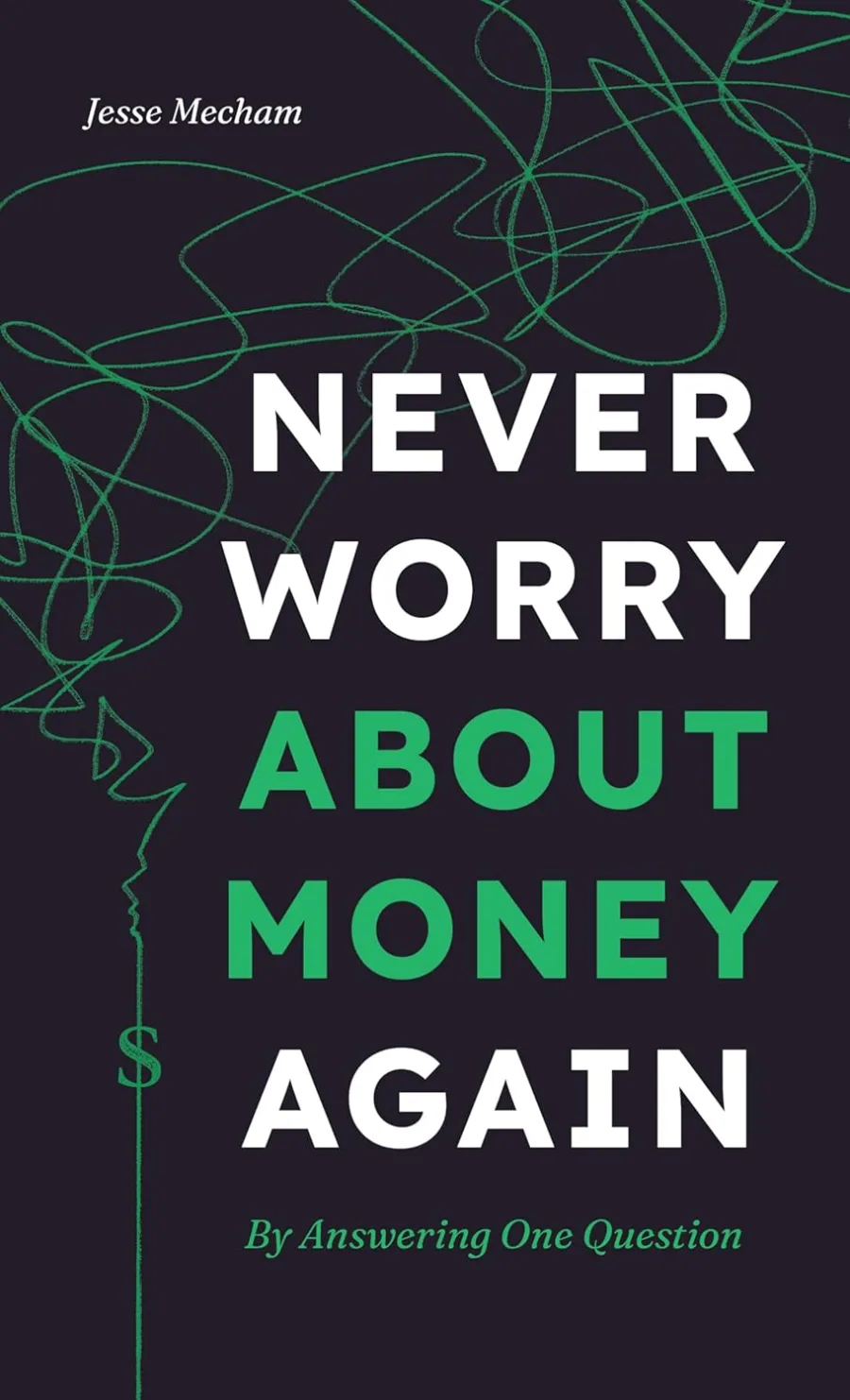
Never Worry About Money Again: By Answering One Question
Hardcover
• 112 Pages
• USD 22.00
• English
• 9798992872903
No ratings yet
| Publisher | Wish Farm Press |
|---|---|
| ISBN13 | 9798992872903 |
| ASIN/SKU | B0H2C4F39W |
| Book Format | Hardcover |
| Language | English |
| Pages | 112 |
| List Price | USD 22.00 |
| Publishing Date | 11/08/2022 |
| Dimensions | 8.5 x 5.5 x 0.49 inches |
| Weight | 9.9 ounces |
| Book Code | BD00066966 |
Buy this Book
Amazon Stores
Ebook Stores
Other Stores
Discover Never Worry About Money Again: By Answering One Question by Jesse Mecham. This book is published by Wish Farm Press in Hardcover format, ISBN 9798992872903, ASIN B0H2C4F39W, under Self-Help, Personal Finance, Success Self-Help.
Book Description
From the founder of YNAB, an app beloved by millions, comes a proven guide to stop worrying about money, for good.
There's only one thing you can do with your money: spend it. Most of us are taught that getting good at money means earning more and spending less. But that well-intentioned advice overlooks the purpose of money and it keeps us stuck worrying about it. Money is for spending. So if you want to get good at money, you need to get good at spending it.
But nobody is born knowing how to spend well. Most of us live with a constant gap between how we think we should be spending our money and how we actually want to be spending it. You'll never stop worrying about money until you close that gap. Jesse Mecham shows you how. His approach is simple, but the shift is profound. Two changes make all the difference:
Change how you see money. Each dollar represents real time, energy, and effort. Your money is an extension of you, and is therefore meant to be spent as an expression of you.
Change how you spend money. Ask one question — What's it for? — to take control of your money, spend with confidence, and stop worrying.
This practice has helped millions of people silence the low-grade hum of money worry. The mental math at dinner. The hesitation at the grocery store. The sleepless nights running numbers that never seem to add up. You don't have to live like that. You can get good at money, and never worry about it again.
There's only one thing you can do with your money: spend it. Most of us are taught that getting good at money means earning more and spending less. But that well-intentioned advice overlooks the purpose of money and it keeps us stuck worrying about it. Money is for spending. So if you want to get good at money, you need to get good at spending it.
But nobody is born knowing how to spend well. Most of us live with a constant gap between how we think we should be spending our money and how we actually want to be spending it. You'll never stop worrying about money until you close that gap. Jesse Mecham shows you how. His approach is simple, but the shift is profound. Two changes make all the difference:
Change how you see money. Each dollar represents real time, energy, and effort. Your money is an extension of you, and is therefore meant to be spent as an expression of you.
Change how you spend money. Ask one question — What's it for? — to take control of your money, spend with confidence, and stop worrying.
This practice has helped millions of people silence the low-grade hum of money worry. The mental math at dinner. The hesitation at the grocery store. The sleepless nights running numbers that never seem to add up. You don't have to live like that. You can get good at money, and never worry about it again.
Author Biography
Jesse Mecham is the founder of the award-winning money app YNAB, bestselling author, and host of the top-rated podcast The Jesse Mecham Show. In 2004, YNAB began as a humble spreadsheet to keep Jesse’s young marriage financially afloat and has since grown into a movement — one that's helped millions of people get good at money and never worry about money again.
Today, Jesse is a leading personal finance expert trusted by WIRED, Fortune, and The New York Times for his unique ability to transform how people relate to their money. He lives in Utah with his wife Julie and their children where he practices what he preaches — embracing a life full of purpose, woodworking, and the occasional donut.
Today, Jesse is a leading personal finance expert trusted by WIRED, Fortune, and The New York Times for his unique ability to transform how people relate to their money. He lives in Utah with his wife Julie and their children where he practices what he preaches — embracing a life full of purpose, woodworking, and the occasional donut.
Editorial Reviews
"Most people think making more money would cure their financial anxiety-Jesse Mecham knows the truth. Peace comes from having a plan. Never Worry About Money Again offers a simple, refreshingly human solution that works for every stage of life and income level." -Farnoosh Torabi, best selling author and host of the So Money podcast.
Book Summary
Jesse Mecham’s Never Worry About Money Again: By Answering One Question presents a simple but powerful way to think about personal finance: instead of constantly asking whether you have enough money, ask yourself what your money needs to do for you before you receive more of it. The book grows out of Mecham’s broader philosophy of intentional money management, which emphasizes clarity, flexibility, and living according to present priorities rather than allowing financial anxiety to control everyday life. Its central message is not that money problems can disappear through a clever trick, nor that everyone can become wealthy overnight. Rather, Mecham argues that much of the emotional stress surrounding money comes from uncertainty. When people know what their money is supposed to accomplish, they can make financial decisions with greater calm and confidence.
At the heart of the book is one deceptively simple question: “What does my money need to do before I get paid again?” This question changes the way a person looks at a bank balance. A balance of ₹50,000, $5,000, or any other amount does not automatically tell us whether we are financially secure. The same amount can represent freedom for one person and serious financial pressure for another, depending on upcoming bills, obligations, savings goals, and priorities. Mecham encourages readers to stop treating money as an abstract number and instead give every available amount a clear purpose.
This idea is important because traditional personal-finance advice often focuses on broad goals such as spending less, saving more, avoiding debt, or building wealth. Those principles can be useful, but they do not always answer the immediate question that creates financial anxiety: “Can I afford this right now?” Mecham’s approach begins much closer to everyday life. Instead of looking at money only through monthly budgets or long-term projections, he asks people to consider the obligations and priorities that exist between now and the next time money arrives.
Imagine someone has ₹40,000 in the bank. At first glance, that may seem like a comfortable amount. But if rent of ₹20,000 is due soon, groceries will cost ₹8,000, school expenses require ₹5,000, and several other bills are approaching, the person does not really have ₹40,000 available to spend. Much of that money already has a job. Once those responsibilities are acknowledged, the remaining amount becomes easier to understand. This distinction between money that is technically present and money that is actually available is one of the book’s most useful insights.
Mecham’s philosophy therefore encourages people to assign money to priorities before spending it. This does not mean creating a rigid financial prison in which every rupee or dollar must be controlled perfectly. In fact, flexibility is an important part of the approach. Life changes. Emergencies happen. Income varies. A planned expense can become more urgent, while another expense may suddenly become less important. Good money management should therefore adapt to reality rather than forcing reality to obey an old plan.
This is where the book’s approach differs from a simplistic budget. A traditional budget can sometimes feel like a prediction: “I will spend this much on food, this much on entertainment, and this much on transportation.” But real life rarely follows a perfect script. Mecham encourages a more dynamic relationship with money. You make a plan based on what you know now, observe what happens, and adjust when circumstances change. The goal is not to achieve mathematical perfection. The goal is to remain aware and intentional.
The emotional dimension of money is equally important. Financial anxiety is often caused not simply by having too little money but by not knowing what will happen next. A person may repeatedly check a bank account, worry about upcoming bills, postpone necessary purchases, or feel guilty about spending even when the money is available. This constant uncertainty can make money feel like an enemy.
Mecham’s method attempts to replace that uncertainty with clarity. When money has been assigned to specific responsibilities, a person can spend what remains with greater confidence. If money has already been reserved for rent, it is not mentally available for an impulsive purchase. Conversely, if an amount has been deliberately set aside for dining out, hobbies, books, travel, or entertainment, spending it does not have to produce guilt. The important thing is that the spending reflects a conscious decision.
This leads to another major theme of the book: money should serve life rather than become the purpose of life. Personal finance can easily become an endless exercise in optimization. People may spend years trying to reduce expenses by tiny amounts, maximize savings, increase investments, and accumulate larger balances without asking what all that financial discipline is ultimately meant to achieve. Mecham brings the focus back to the human being behind the numbers.
Money is useful because it gives people choices. It can provide shelter, food, education, experiences, security, generosity, and freedom. It can help someone leave an unhealthy job, support a family member, start a business, take a meaningful trip, or simply sleep more peacefully at night. Financial management becomes meaningful when it helps create those possibilities.
The book also challenges the idea that financial security comes only from earning more. Higher income can certainly make financial problems easier to solve, but earning more does not automatically eliminate anxiety. If spending rises at the same speed as income, the underlying uncertainty may remain. Someone earning twice as much can still feel financially trapped if every additional dollar immediately acquires another obligation.
This is why Mecham emphasizes intentional allocation rather than simply increasing income. The important question is not only “How much do I earn?” but also “What does this money need to accomplish?” By answering that question repeatedly, people become more conscious of their priorities. They begin to see patterns in their spending and discover which expenses genuinely matter to them and which are simply habits.
The philosophy also creates a healthier relationship with future expenses. Many financial difficulties occur because people think only about today. Annual insurance payments, school fees, medical expenses, repairs, festivals, vacations, taxes, and other irregular costs can feel like emergencies when they arrive unexpectedly. Yet many of these expenses are not actually unpredictable. They are simply infrequent.
Mecham’s approach encourages people to acknowledge these future obligations in advance. If an expense is known to be coming, money can gradually be prepared for it. This transforms a large future payment from a frightening surprise into an expected responsibility. The emotional difference can be substantial.
Another important lesson is that financial organization does not need to be complicated. People sometimes believe they need elaborate spreadsheets, sophisticated investment strategies, or extensive financial knowledge before they can manage money effectively. Mecham’s philosophy suggests that the first improvement can be much simpler: become aware of what your money is already committed to doing.
That awareness can produce surprisingly powerful results. A person who knows that the next paycheck must cover rent, groceries, transportation, debt payments, and savings has a clearer picture of reality than someone who merely knows their current bank balance. The numbers become meaningful because they are connected to actual life.
The book also encourages readers to distinguish between genuine financial problems and temporary discomfort. Sometimes the numbers simply do not work. If income is insufficient to cover essential expenses, no budgeting technique can magically solve the underlying problem. The answer may require increasing income, reducing expenses, restructuring debt, selling assets, or making other significant changes. Mecham’s method is not intended to deny these realities. Instead, it helps reveal them clearly.
This honesty is valuable because financial peace does not come from pretending everything is fine. It comes from knowing what is true and deciding what to do next. If the plan shows that there is not enough money, that information is useful. It turns vague anxiety into a concrete problem that can be addressed.
Over time, the practice of assigning money to priorities can also change a person's relationship with spending. Instead of asking, “Can I technically buy this?” the person begins asking, “Is this what I want my money to do?” The first question is about purchasing power. The second is about values.
That distinction is subtle but profound. Someone may technically be able to afford a new phone but decide that the money would be better used for an upcoming trip. Another person may choose the phone because having it genuinely matters to them. Neither decision is automatically right or wrong. The important point is that the spending becomes intentional rather than automatic.
This makes Mecham’s philosophy less about deprivation and more about choice. It does not demand that everyone live minimally or eliminate pleasurable spending. Instead, it asks people to become honest about what they value. Financial discipline then becomes a way of protecting those values rather than constantly saying no to oneself.
The method can also reduce the shame that often surrounds money. People frequently compare themselves with friends, relatives, colleagues, or images presented on social media. They may feel unsuccessful because someone else appears to own a bigger house, drive a better car, travel more frequently, or accumulate wealth faster. Mecham’s framework shifts attention away from comparison and toward personal priorities. Your money has a job within your life, not someone else’s.
Ultimately, Never Worry About Money Again presents financial peace as an ongoing practice rather than a final destination. There may always be unexpected expenses, changing priorities, uncertain income, and new financial decisions. The objective is not to reach a point where nothing ever goes wrong. It is to develop a system that allows you to respond intelligently when things do go wrong.
The book’s central question remains remarkably powerful because it is both practical and personal: What does my money need to do before I get paid again? Asking it forces attention onto the immediate future without losing sight of larger goals. It turns a vague pile of money into a collection of purposeful resources. It also creates a natural bridge between today’s responsibilities and tomorrow’s ambitions.
In the end, Mecham’s message is fundamentally about peace of mind. Money becomes less frightening when it is understood. A bank balance becomes more useful when it is connected to real obligations. Spending becomes more satisfying when it reflects genuine priorities. Saving becomes more meaningful when it protects something important. And financial planning becomes less about controlling every detail of life and more about giving yourself the freedom to respond to life as it actually unfolds.
The deepest lesson of the book is therefore not simply how to budget. It is how to stop allowing uncertainty about money to occupy so much mental space. By giving every available amount a purpose, revisiting those decisions as circumstances change, and continually asking what the money needs to accomplish next, a person can build a calmer and more deliberate financial life. The goal is not to worship money, fear money, or endlessly chase more of it. The goal is to make money useful—to make it serve the life you are actually trying to live.
At the heart of the book is one deceptively simple question: “What does my money need to do before I get paid again?” This question changes the way a person looks at a bank balance. A balance of ₹50,000, $5,000, or any other amount does not automatically tell us whether we are financially secure. The same amount can represent freedom for one person and serious financial pressure for another, depending on upcoming bills, obligations, savings goals, and priorities. Mecham encourages readers to stop treating money as an abstract number and instead give every available amount a clear purpose.
This idea is important because traditional personal-finance advice often focuses on broad goals such as spending less, saving more, avoiding debt, or building wealth. Those principles can be useful, but they do not always answer the immediate question that creates financial anxiety: “Can I afford this right now?” Mecham’s approach begins much closer to everyday life. Instead of looking at money only through monthly budgets or long-term projections, he asks people to consider the obligations and priorities that exist between now and the next time money arrives.
Imagine someone has ₹40,000 in the bank. At first glance, that may seem like a comfortable amount. But if rent of ₹20,000 is due soon, groceries will cost ₹8,000, school expenses require ₹5,000, and several other bills are approaching, the person does not really have ₹40,000 available to spend. Much of that money already has a job. Once those responsibilities are acknowledged, the remaining amount becomes easier to understand. This distinction between money that is technically present and money that is actually available is one of the book’s most useful insights.
Mecham’s philosophy therefore encourages people to assign money to priorities before spending it. This does not mean creating a rigid financial prison in which every rupee or dollar must be controlled perfectly. In fact, flexibility is an important part of the approach. Life changes. Emergencies happen. Income varies. A planned expense can become more urgent, while another expense may suddenly become less important. Good money management should therefore adapt to reality rather than forcing reality to obey an old plan.
This is where the book’s approach differs from a simplistic budget. A traditional budget can sometimes feel like a prediction: “I will spend this much on food, this much on entertainment, and this much on transportation.” But real life rarely follows a perfect script. Mecham encourages a more dynamic relationship with money. You make a plan based on what you know now, observe what happens, and adjust when circumstances change. The goal is not to achieve mathematical perfection. The goal is to remain aware and intentional.
The emotional dimension of money is equally important. Financial anxiety is often caused not simply by having too little money but by not knowing what will happen next. A person may repeatedly check a bank account, worry about upcoming bills, postpone necessary purchases, or feel guilty about spending even when the money is available. This constant uncertainty can make money feel like an enemy.
Mecham’s method attempts to replace that uncertainty with clarity. When money has been assigned to specific responsibilities, a person can spend what remains with greater confidence. If money has already been reserved for rent, it is not mentally available for an impulsive purchase. Conversely, if an amount has been deliberately set aside for dining out, hobbies, books, travel, or entertainment, spending it does not have to produce guilt. The important thing is that the spending reflects a conscious decision.
This leads to another major theme of the book: money should serve life rather than become the purpose of life. Personal finance can easily become an endless exercise in optimization. People may spend years trying to reduce expenses by tiny amounts, maximize savings, increase investments, and accumulate larger balances without asking what all that financial discipline is ultimately meant to achieve. Mecham brings the focus back to the human being behind the numbers.
Money is useful because it gives people choices. It can provide shelter, food, education, experiences, security, generosity, and freedom. It can help someone leave an unhealthy job, support a family member, start a business, take a meaningful trip, or simply sleep more peacefully at night. Financial management becomes meaningful when it helps create those possibilities.
The book also challenges the idea that financial security comes only from earning more. Higher income can certainly make financial problems easier to solve, but earning more does not automatically eliminate anxiety. If spending rises at the same speed as income, the underlying uncertainty may remain. Someone earning twice as much can still feel financially trapped if every additional dollar immediately acquires another obligation.
This is why Mecham emphasizes intentional allocation rather than simply increasing income. The important question is not only “How much do I earn?” but also “What does this money need to accomplish?” By answering that question repeatedly, people become more conscious of their priorities. They begin to see patterns in their spending and discover which expenses genuinely matter to them and which are simply habits.
The philosophy also creates a healthier relationship with future expenses. Many financial difficulties occur because people think only about today. Annual insurance payments, school fees, medical expenses, repairs, festivals, vacations, taxes, and other irregular costs can feel like emergencies when they arrive unexpectedly. Yet many of these expenses are not actually unpredictable. They are simply infrequent.
Mecham’s approach encourages people to acknowledge these future obligations in advance. If an expense is known to be coming, money can gradually be prepared for it. This transforms a large future payment from a frightening surprise into an expected responsibility. The emotional difference can be substantial.
Another important lesson is that financial organization does not need to be complicated. People sometimes believe they need elaborate spreadsheets, sophisticated investment strategies, or extensive financial knowledge before they can manage money effectively. Mecham’s philosophy suggests that the first improvement can be much simpler: become aware of what your money is already committed to doing.
That awareness can produce surprisingly powerful results. A person who knows that the next paycheck must cover rent, groceries, transportation, debt payments, and savings has a clearer picture of reality than someone who merely knows their current bank balance. The numbers become meaningful because they are connected to actual life.
The book also encourages readers to distinguish between genuine financial problems and temporary discomfort. Sometimes the numbers simply do not work. If income is insufficient to cover essential expenses, no budgeting technique can magically solve the underlying problem. The answer may require increasing income, reducing expenses, restructuring debt, selling assets, or making other significant changes. Mecham’s method is not intended to deny these realities. Instead, it helps reveal them clearly.
This honesty is valuable because financial peace does not come from pretending everything is fine. It comes from knowing what is true and deciding what to do next. If the plan shows that there is not enough money, that information is useful. It turns vague anxiety into a concrete problem that can be addressed.
Over time, the practice of assigning money to priorities can also change a person's relationship with spending. Instead of asking, “Can I technically buy this?” the person begins asking, “Is this what I want my money to do?” The first question is about purchasing power. The second is about values.
That distinction is subtle but profound. Someone may technically be able to afford a new phone but decide that the money would be better used for an upcoming trip. Another person may choose the phone because having it genuinely matters to them. Neither decision is automatically right or wrong. The important point is that the spending becomes intentional rather than automatic.
This makes Mecham’s philosophy less about deprivation and more about choice. It does not demand that everyone live minimally or eliminate pleasurable spending. Instead, it asks people to become honest about what they value. Financial discipline then becomes a way of protecting those values rather than constantly saying no to oneself.
The method can also reduce the shame that often surrounds money. People frequently compare themselves with friends, relatives, colleagues, or images presented on social media. They may feel unsuccessful because someone else appears to own a bigger house, drive a better car, travel more frequently, or accumulate wealth faster. Mecham’s framework shifts attention away from comparison and toward personal priorities. Your money has a job within your life, not someone else’s.
Ultimately, Never Worry About Money Again presents financial peace as an ongoing practice rather than a final destination. There may always be unexpected expenses, changing priorities, uncertain income, and new financial decisions. The objective is not to reach a point where nothing ever goes wrong. It is to develop a system that allows you to respond intelligently when things do go wrong.
The book’s central question remains remarkably powerful because it is both practical and personal: What does my money need to do before I get paid again? Asking it forces attention onto the immediate future without losing sight of larger goals. It turns a vague pile of money into a collection of purposeful resources. It also creates a natural bridge between today’s responsibilities and tomorrow’s ambitions.
In the end, Mecham’s message is fundamentally about peace of mind. Money becomes less frightening when it is understood. A bank balance becomes more useful when it is connected to real obligations. Spending becomes more satisfying when it reflects genuine priorities. Saving becomes more meaningful when it protects something important. And financial planning becomes less about controlling every detail of life and more about giving yourself the freedom to respond to life as it actually unfolds.
The deepest lesson of the book is therefore not simply how to budget. It is how to stop allowing uncertainty about money to occupy so much mental space. By giving every available amount a purpose, revisiting those decisions as circumstances change, and continually asking what the money needs to accomplish next, a person can build a calmer and more deliberate financial life. The goal is not to worship money, fear money, or endlessly chase more of it. The goal is to make money useful—to make it serve the life you are actually trying to live.
Sample Chapters
Sample Chapters will be added soon…
Reader Reviews
No reviews yet.
Never Worry About Money Again: By Answering One Question
Download Cover Image
Do you want to download the full cover image for Never Worry About Money Again: By Answering One Question?