
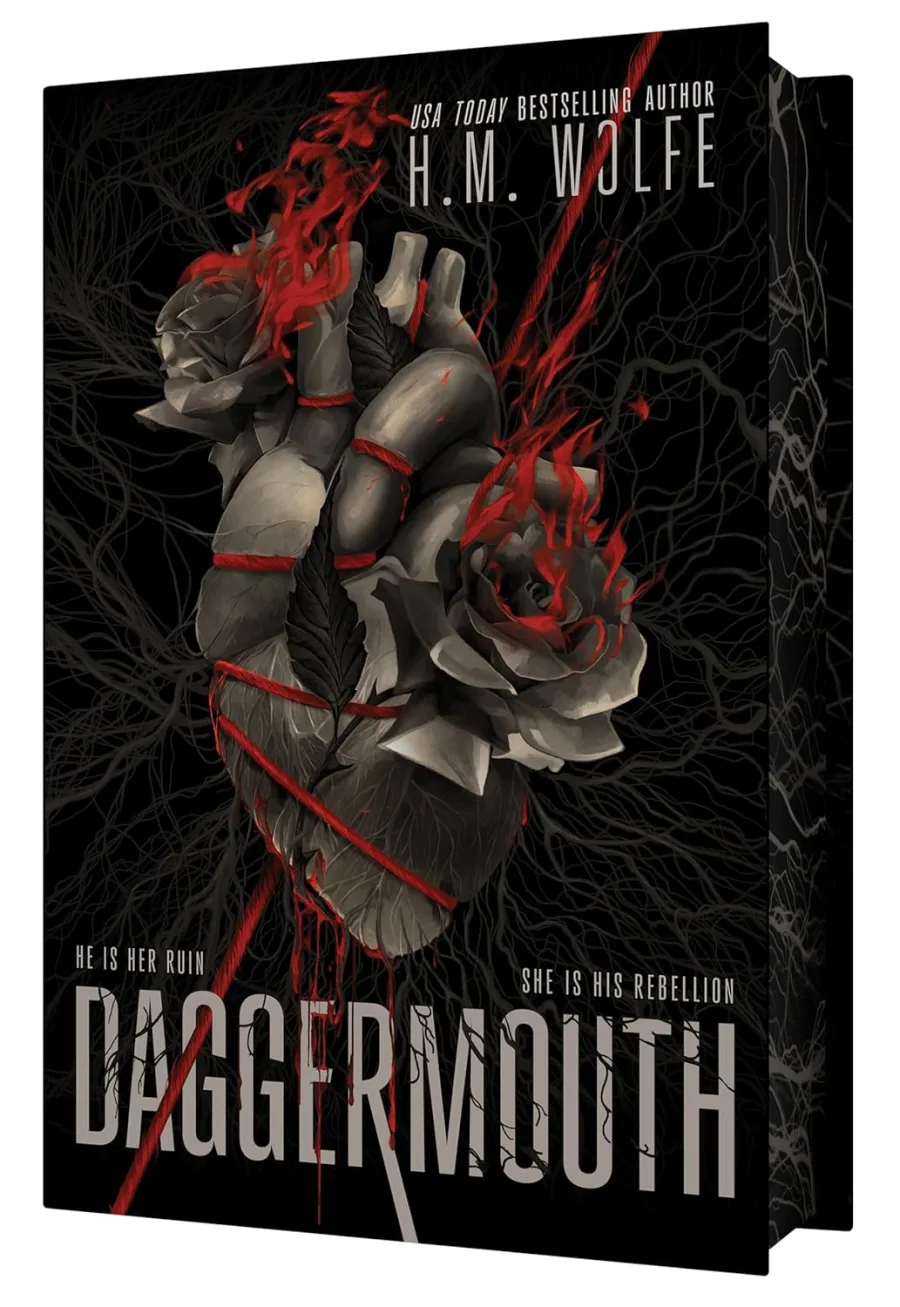
Daggermouth (The Heart Duology)
Hardcover
• 544 Pages
• USD 34.00
• English
• 9798347122363
No ratings yet
| Publisher | Scarlett Press |
|---|---|
| ISBN13 | 9798347122363 |
| ASIN/SKU | B0GN38SNGB |
| Book Format | Hardcover |
| Language | English |
| Pages | 544 |
| List Price | USD 34.00 |
| Publishing Date | 28/07/2026 |
| Dimensions | 6 x 1.6 x 9 inches |
| Weight | 1.88 pounds |
| Book Code | BD00066969 |
Buy this Book
Amazon Stores
Ebook Stores
Other Stores
Discover Daggermouth (The Heart Duology) by H. M. Wolfe. This book is published by Scarlett Press in Hardcover format, ISBN 9798347122363, ASIN B0GN38SNGB, under Romance, Science Fiction Romance, Enemies to Lovers Romance.
Book Description
This deluxe hardcover edition features gorgeous sprayed stenciled edges while supplies last, stunning endpaper art of the Heart and the Boundary, and a never-before-seen bonus story from Callum and Lira’s POVs!
Set in a corrupt surveillance state ruled by the masked elite, this true enemies-to-lovers dystopian romance that’s Conform meets V for Vendetta follows a mercenary who botches the assassination of the president’s son and ends up forced to marry him.
The first thing you’ll learn in New Found Haven is that mercy doesn’t exist. The second thing is that, from the highest glass atrium in the Heart to the windowless slums of the Boundary, the Veyra are always watching.
The last lesson is the hardest, but you must remember it: Love outside of your ring is a death sentence.
The city is carved into rings of privilege and poverty, ruled by the masked elite who will do whatever it takes to hold onto power. Obedience is demanded. Rebellion is crushed.
Greyson Serel has spent his life caught between two worlds. Publicly, he’s the flawless heir to the presidency. Privately, he’s entangled in secrets that could topple the regime. But when he’s forced into a political marriage meant to bind him tighter to the government’s brutal laws, he finds himself shackled to a bride as lethal as she is unwilling.
Shadera Kael is a mercenary raised to kill, not to wed. Yet when her bullet misses its mark, survival leaves her tied to the very man she was sent to eliminate. Trapped inside the corrupt heart of the city, she becomes both prisoner and wife, her every step watched, her every move tested.
Their union is no love story—it’s a battlefield. As secrets come to light and betrayals fester within the walls of power, Greyson and Shadera must decide between annihilating each other or burning the city to the ground together.
In a world where passion has consequences and loyalty is paid for in blood, their forced bond may be the spark that ignites a revolution. Or the fire that consumes them both.
Set in a corrupt surveillance state ruled by the masked elite, this true enemies-to-lovers dystopian romance that’s Conform meets V for Vendetta follows a mercenary who botches the assassination of the president’s son and ends up forced to marry him.
The first thing you’ll learn in New Found Haven is that mercy doesn’t exist. The second thing is that, from the highest glass atrium in the Heart to the windowless slums of the Boundary, the Veyra are always watching.
The last lesson is the hardest, but you must remember it: Love outside of your ring is a death sentence.
The city is carved into rings of privilege and poverty, ruled by the masked elite who will do whatever it takes to hold onto power. Obedience is demanded. Rebellion is crushed.
Greyson Serel has spent his life caught between two worlds. Publicly, he’s the flawless heir to the presidency. Privately, he’s entangled in secrets that could topple the regime. But when he’s forced into a political marriage meant to bind him tighter to the government’s brutal laws, he finds himself shackled to a bride as lethal as she is unwilling.
Shadera Kael is a mercenary raised to kill, not to wed. Yet when her bullet misses its mark, survival leaves her tied to the very man she was sent to eliminate. Trapped inside the corrupt heart of the city, she becomes both prisoner and wife, her every step watched, her every move tested.
Their union is no love story—it’s a battlefield. As secrets come to light and betrayals fester within the walls of power, Greyson and Shadera must decide between annihilating each other or burning the city to the ground together.
In a world where passion has consequences and loyalty is paid for in blood, their forced bond may be the spark that ignites a revolution. Or the fire that consumes them both.
Author Biography
H. M. Wolfe writes with her heart wide open, chasing the thrill of chaos and the sting of heartbreak on every page. Based in Central Florida, she shares her days with her husband and three loyal dogs—her writing partners and adventure crew through every twist of her literary journey.
Wolfe crafts stories where romance tangles with fantasy and unforgettable characters drive the action, inviting readers to disappear into worlds brimming with magic and meaning. She’s fiercely passionate about mental health advocacy and the messy, powerful work of self-discovery, believing deeply that everyone deserves to see themselves represented in the stories they love.
As you turn the final page of her books, Wolfe hopes you’ll find a new kind of strength—ready to take on the world and own your story like the warrior she knows you are.
Wolfe crafts stories where romance tangles with fantasy and unforgettable characters drive the action, inviting readers to disappear into worlds brimming with magic and meaning. She’s fiercely passionate about mental health advocacy and the messy, powerful work of self-discovery, believing deeply that everyone deserves to see themselves represented in the stories they love.
As you turn the final page of her books, Wolfe hopes you’ll find a new kind of strength—ready to take on the world and own your story like the warrior she knows you are.
Editorial Reviews
Daggermouth had me in a chokehold! Shadera Kael is bound to be your next favorite morally grey heroine. Impossible stakes, sizzling writing and plot twists you’ll never see coming . . . this book has everything you want in a dark dystopian.
-- Sable Sorensen, USA Today bestselling author of Dire Bound
-- Sable Sorensen, USA Today bestselling author of Dire Bound
Book Summary
H. M. Wolfe’s Daggermouth is a dark dystopian romance set in New Found Haven, a brutally controlled society divided into rigid social rings. The city is governed by a masked elite who maintain their authority through surveillance, violence, fear, and carefully constructed social rules. Mercy is treated as weakness, obedience is demanded, and even love can become a crime when it crosses the boundaries imposed by the ruling order. At the center of the novel are Greyson Serel, the privileged son of the President, and Shadera Kael, a mercenary and assassin from the oppressed Boundary. They begin as enemies, but circumstances force them into an intimate alliance that gradually transforms both their understanding of each other and their relationship with the society they inhabit.
New Found Haven is not merely a backdrop for the romance. It is one of the novel’s most important characters because nearly every decision the protagonists make is shaped by its structure. The city is divided into rings representing different levels of privilege and deprivation. At the center is the Heart, where the ruling elite live behind wealth, technology, masks, and layers of security. At the opposite end is the Boundary, where people live with far fewer resources and far less protection. The Veyra, the regime’s surveillance apparatus, watches the population constantly, making privacy almost impossible. The result is a society in which people learn to monitor not only their actions but also their words, relationships, emotions, and loyalties.
The government’s most powerful weapon is not simply physical force. It is the creation of a culture in which people begin policing themselves. Citizens know that rebellion can bring severe punishment, and they understand that even compassion may attract suspicion. Public violence becomes a form of political theatre, reminding everyone that the authorities have the power to decide who lives and who dies. This atmosphere gives the story its oppressive tone and explains why characters who might otherwise resist the government often find themselves compromising, hiding, or remaining silent.
Greyson Serel is one of the novel’s central contradictions. He is the President’s son and publicly represents everything the regime wants its citizens to admire: privilege, authority, discipline, and loyalty. He is also the city’s Executioner, a position that makes him a direct instrument of state power. His role requires him to participate in the violence that keeps New Found Haven obedient. Yet Greyson is not emotionally comfortable with the identity the government has created for him. Beneath the mask of the perfect heir is a man who has developed a private resistance to the system surrounding him.
Greyson’s conflict becomes especially clear when he is ordered to carry out executions. The act of killing is supposed to be routine, almost ceremonial, but moments of hesitation reveal that the regime has not succeeded in completely destroying his conscience. His position is therefore deeply paradoxical. He has power over others, but he himself is controlled by his father and by the expectations attached to his family name. His privilege protects him from many forms of suffering, yet it also makes him a prisoner of the political system he represents.
His father, Maximus Serel, embodies the authoritarian structure of New Found Haven. Maximus does not simply rule through laws; he manipulates the people closest to him and uses family relationships as another instrument of control. Greyson’s value to him is connected to what Greyson can represent publicly. The President expects obedience and treats weakness as something that must be eliminated. Through Maximus, Wolfe shows how political tyranny can become intensely personal. The authoritarian state does not stop at public institutions. It can enter the family, turning love, loyalty, and fear into tools of domination.
On the other side of the city stands Shadera Kael. Unlike Greyson, Shadera has been shaped by deprivation rather than privilege. She is a Daggermouth mercenary, a dangerous figure whose reputation has been built on violence, precision, and survival. Her history is closely connected to the cruelty of the Heart, and the loss of her parents gives her a deeply personal reason to hate the ruling elite. Violence is not simply her profession; it has become part of the language she learned in order to survive.
Shadera is therefore not introduced as a conventional romantic heroine. She is capable of killing, suspicious of authority, and unwilling to surrender control of her life. Her identity has been shaped by grief and necessity. The regime sees people like her as threats, while those in the Boundary may also see violence as one of the few tools available to them. Her moral world is consequently complicated. She understands that survival sometimes requires choices that would be unacceptable in a peaceful society.
The two characters are brought together when Shadera accepts a contract to assassinate Greyson. She enters the mission with a clear objective: kill the President’s son. Greyson, meanwhile, has every reason to regard her as an enemy. Their first relationship is therefore built on suspicion and danger rather than attraction or trust.
The assassination attempt fails, however, and the consequences change both of their lives. Instead of simply becoming another victim of the regime, Shadera becomes entangled in the Heart itself. Greyson and Shadera are publicly exposed and placed in a situation neither of them chose. Their punishment and political usefulness lead to a forced marriage under the brutal rules of the regime. The marriage is intended to control them, not to unite them emotionally. Yet the authorities make an important mistake: by forcing two people from radically different worlds into close proximity, they give them the opportunity to understand the system from the other side.
Their relationship develops through hostility, suspicion, and reluctant cooperation. Shadera initially sees Greyson as a representative of everything she hates: the Heart, the Serel family, privilege, and state violence. Greyson, meanwhile, has been taught to see people from the Boundary as dangerous and uncontrollable. Neither character initially knows how much the other has suffered.
As they spend more time together, those assumptions begin to break down. Shadera discovers that Greyson is not simply the obedient heir she imagined. He has secrets and has already taken steps against the system from within. Greyson discovers that Shadera is more than the assassin whose name frightens people in the Heart. Her violence is inseparable from her history, her losses, and the brutal world that created her.
This transformation is one of the novel’s central ideas: identity can be imposed by a political system, but it does not have to remain permanent. Greyson has been defined as an executioner and heir. Shadera has been defined as a killer. Both identities contain truth, but neither completely describes the people underneath them.
Their forced marriage also creates an unusual form of political intimacy. They cannot easily escape one another, and every interaction carries consequences. Their personal relationship gradually becomes connected to the larger conflict between the Heart and the Boundary. What begins as a battle between two individuals becomes part of a much larger struggle over who has the right to control the city.
As the story progresses, secrets within the ruling system begin to surface. Greyson’s hidden actions reveal that resistance already exists inside the Heart. Other characters are also working against the regime in different ways. Callum Thane, an information broker and Greyson’s close confidant, operates between worlds and uses his position to assist the resistance. Lira Serel, Greyson’s sister, understands the power of information and propaganda and eventually becomes an important force in challenging the regime. Elara Serel, Greyson’s mother, represents another kind of resistance: the quiet endurance of someone who has survived years of domination while waiting for an opportunity to act.
These supporting characters broaden the novel’s understanding of rebellion. Resistance does not always look like open warfare. Sometimes it is information passed secretly from one person to another. Sometimes it is a hidden act of mercy. Sometimes it is surviving long enough to expose the truth. And sometimes it is refusing to participate in the rituals that allow oppression to appear normal.
The novel also explores the relationship between information and political power. The government’s surveillance system gives it extraordinary control because knowledge about citizens becomes a weapon. At the same time, the resistance can challenge the regime by revealing information the authorities want to keep hidden. Lira’s role is particularly significant because she understands that controlling the story people hear can be almost as powerful as controlling the weapons they fear. The struggle therefore takes place not only in streets and prisons but also in the realm of narrative and visibility.
One of the most important developments is the exposure of the regime’s larger plans, including the Culling. What initially appears to be an oppressive society built simply to maintain an unequal social order is revealed to be capable of even more devastating violence. The threat forces characters to reconsider what survival means. Remaining alive within the system may no longer be enough if the system intends to destroy entire groups of people.
The story’s treatment of women and social control is particularly important. Women in the Heart are expected to exist within strict rules governing their behavior, appearance, and relationships. Masks become a literal and symbolic representation of this control. They hide individual identity while reinforcing conformity. The eventual decision by women to remove their masks becomes a powerful collective rejection of imposed silence. Rather than remaining anonymous symbols of the regime, they make themselves visible.
For Shadera, this question of identity is especially personal. She has spent much of her life being valued primarily for what she can do—fight, kill, survive, and obey the needs of those who employ her. Her relationship with Greyson forces her to consider whether she can become something other than the weapon she was trained to be. Her journey is therefore not simply about falling in love. It is about reclaiming agency.
Greyson’s journey runs in the opposite direction. He begins with enormous institutional power but little personal freedom. His challenge is to understand that privilege does not excuse complicity. He has benefited from the system while simultaneously resisting parts of it. His moral struggle involves confronting the violence attached to his position and deciding what he is willing to sacrifice when obedience and conscience can no longer coexist.
The romance between Greyson and Shadera consequently becomes inseparable from the novel’s political conflict. Their attraction does not magically erase their differences. Instead, it forces them to confront them. They have to decide whether they can trust someone who was once their enemy and whether their individual survival is worth more than the possibility of changing the society around them.
This is what makes Daggermouth more than a conventional enemies-to-lovers story. The relationship functions as a lens through which the novel examines power, class, trauma, identity, and rebellion. The two protagonists represent different sides of the same broken society, and their eventual understanding of one another demonstrates how difficult it can be to see the human being behind a political label.
The novel’s darker themes also make its idea of hope more complicated. Wolfe does not present rebellion as clean or painless. Violence produces consequences, and characters carry emotional wounds from the choices they make. The story includes disturbing material involving abuse, sexual violence, child death, physical violence, and emotional trauma, so its darker atmosphere is an essential part of the reading experience rather than a minor background element.
By the later stages of the story, the personal and political conflicts have become almost impossible to separate. Greyson and Shadera must decide whether they will continue trying to survive inside a system designed to control them or risk everything by challenging it. The rebellion grows through individual acts, hidden alliances, exposure of secrets, and collective refusal. The forced marriage that was supposed to make them easier for the regime to control instead becomes one of the circumstances that helps bring two opposing worlds together.
Ultimately, Daggermouth is a story about people attempting to recover their humanity inside a society that has made humanity dangerous. Greyson has to discover that being powerful does not mean being free. Shadera has to discover that being capable of violence does not mean violence is all she is. Their relationship gives both characters an opportunity to question identities imposed upon them by family, class, grief, and political power.
The novel’s deepest idea is that oppressive systems depend not only on weapons but on people believing that the system cannot be changed. New Found Haven survives because its citizens are taught to accept surveillance, inequality, violence, and silence as unavoidable facts of life. Rebellion begins when those assumptions are challenged.
In that sense, the title Daggermouth captures the spirit of the novel: words can cut, secrets can become weapons, and the people who have been forced into silence can eventually find ways to speak. Shadera and Greyson begin on opposite sides of a violent divide, but their journey gradually reveals that neither side possesses the whole truth. Their forced connection becomes a confrontation with everything the city has taught them to fear.
By the conclusion, the conflict has expanded far beyond whether two enemies can fall in love. The real question is whether individuals can reclaim their identities from a society determined to define them. Love becomes one form of rebellion, truth becomes another, and visibility becomes an act of resistance. Daggermouth ultimately presents revolution not as a single heroic moment but as a collection of choices—choices to question, to remember, to refuse, to protect, and finally to stand together against a system built on fear.
New Found Haven is not merely a backdrop for the romance. It is one of the novel’s most important characters because nearly every decision the protagonists make is shaped by its structure. The city is divided into rings representing different levels of privilege and deprivation. At the center is the Heart, where the ruling elite live behind wealth, technology, masks, and layers of security. At the opposite end is the Boundary, where people live with far fewer resources and far less protection. The Veyra, the regime’s surveillance apparatus, watches the population constantly, making privacy almost impossible. The result is a society in which people learn to monitor not only their actions but also their words, relationships, emotions, and loyalties.
The government’s most powerful weapon is not simply physical force. It is the creation of a culture in which people begin policing themselves. Citizens know that rebellion can bring severe punishment, and they understand that even compassion may attract suspicion. Public violence becomes a form of political theatre, reminding everyone that the authorities have the power to decide who lives and who dies. This atmosphere gives the story its oppressive tone and explains why characters who might otherwise resist the government often find themselves compromising, hiding, or remaining silent.
Greyson Serel is one of the novel’s central contradictions. He is the President’s son and publicly represents everything the regime wants its citizens to admire: privilege, authority, discipline, and loyalty. He is also the city’s Executioner, a position that makes him a direct instrument of state power. His role requires him to participate in the violence that keeps New Found Haven obedient. Yet Greyson is not emotionally comfortable with the identity the government has created for him. Beneath the mask of the perfect heir is a man who has developed a private resistance to the system surrounding him.
Greyson’s conflict becomes especially clear when he is ordered to carry out executions. The act of killing is supposed to be routine, almost ceremonial, but moments of hesitation reveal that the regime has not succeeded in completely destroying his conscience. His position is therefore deeply paradoxical. He has power over others, but he himself is controlled by his father and by the expectations attached to his family name. His privilege protects him from many forms of suffering, yet it also makes him a prisoner of the political system he represents.
His father, Maximus Serel, embodies the authoritarian structure of New Found Haven. Maximus does not simply rule through laws; he manipulates the people closest to him and uses family relationships as another instrument of control. Greyson’s value to him is connected to what Greyson can represent publicly. The President expects obedience and treats weakness as something that must be eliminated. Through Maximus, Wolfe shows how political tyranny can become intensely personal. The authoritarian state does not stop at public institutions. It can enter the family, turning love, loyalty, and fear into tools of domination.
On the other side of the city stands Shadera Kael. Unlike Greyson, Shadera has been shaped by deprivation rather than privilege. She is a Daggermouth mercenary, a dangerous figure whose reputation has been built on violence, precision, and survival. Her history is closely connected to the cruelty of the Heart, and the loss of her parents gives her a deeply personal reason to hate the ruling elite. Violence is not simply her profession; it has become part of the language she learned in order to survive.
Shadera is therefore not introduced as a conventional romantic heroine. She is capable of killing, suspicious of authority, and unwilling to surrender control of her life. Her identity has been shaped by grief and necessity. The regime sees people like her as threats, while those in the Boundary may also see violence as one of the few tools available to them. Her moral world is consequently complicated. She understands that survival sometimes requires choices that would be unacceptable in a peaceful society.
The two characters are brought together when Shadera accepts a contract to assassinate Greyson. She enters the mission with a clear objective: kill the President’s son. Greyson, meanwhile, has every reason to regard her as an enemy. Their first relationship is therefore built on suspicion and danger rather than attraction or trust.
The assassination attempt fails, however, and the consequences change both of their lives. Instead of simply becoming another victim of the regime, Shadera becomes entangled in the Heart itself. Greyson and Shadera are publicly exposed and placed in a situation neither of them chose. Their punishment and political usefulness lead to a forced marriage under the brutal rules of the regime. The marriage is intended to control them, not to unite them emotionally. Yet the authorities make an important mistake: by forcing two people from radically different worlds into close proximity, they give them the opportunity to understand the system from the other side.
Their relationship develops through hostility, suspicion, and reluctant cooperation. Shadera initially sees Greyson as a representative of everything she hates: the Heart, the Serel family, privilege, and state violence. Greyson, meanwhile, has been taught to see people from the Boundary as dangerous and uncontrollable. Neither character initially knows how much the other has suffered.
As they spend more time together, those assumptions begin to break down. Shadera discovers that Greyson is not simply the obedient heir she imagined. He has secrets and has already taken steps against the system from within. Greyson discovers that Shadera is more than the assassin whose name frightens people in the Heart. Her violence is inseparable from her history, her losses, and the brutal world that created her.
This transformation is one of the novel’s central ideas: identity can be imposed by a political system, but it does not have to remain permanent. Greyson has been defined as an executioner and heir. Shadera has been defined as a killer. Both identities contain truth, but neither completely describes the people underneath them.
Their forced marriage also creates an unusual form of political intimacy. They cannot easily escape one another, and every interaction carries consequences. Their personal relationship gradually becomes connected to the larger conflict between the Heart and the Boundary. What begins as a battle between two individuals becomes part of a much larger struggle over who has the right to control the city.
As the story progresses, secrets within the ruling system begin to surface. Greyson’s hidden actions reveal that resistance already exists inside the Heart. Other characters are also working against the regime in different ways. Callum Thane, an information broker and Greyson’s close confidant, operates between worlds and uses his position to assist the resistance. Lira Serel, Greyson’s sister, understands the power of information and propaganda and eventually becomes an important force in challenging the regime. Elara Serel, Greyson’s mother, represents another kind of resistance: the quiet endurance of someone who has survived years of domination while waiting for an opportunity to act.
These supporting characters broaden the novel’s understanding of rebellion. Resistance does not always look like open warfare. Sometimes it is information passed secretly from one person to another. Sometimes it is a hidden act of mercy. Sometimes it is surviving long enough to expose the truth. And sometimes it is refusing to participate in the rituals that allow oppression to appear normal.
The novel also explores the relationship between information and political power. The government’s surveillance system gives it extraordinary control because knowledge about citizens becomes a weapon. At the same time, the resistance can challenge the regime by revealing information the authorities want to keep hidden. Lira’s role is particularly significant because she understands that controlling the story people hear can be almost as powerful as controlling the weapons they fear. The struggle therefore takes place not only in streets and prisons but also in the realm of narrative and visibility.
One of the most important developments is the exposure of the regime’s larger plans, including the Culling. What initially appears to be an oppressive society built simply to maintain an unequal social order is revealed to be capable of even more devastating violence. The threat forces characters to reconsider what survival means. Remaining alive within the system may no longer be enough if the system intends to destroy entire groups of people.
The story’s treatment of women and social control is particularly important. Women in the Heart are expected to exist within strict rules governing their behavior, appearance, and relationships. Masks become a literal and symbolic representation of this control. They hide individual identity while reinforcing conformity. The eventual decision by women to remove their masks becomes a powerful collective rejection of imposed silence. Rather than remaining anonymous symbols of the regime, they make themselves visible.
For Shadera, this question of identity is especially personal. She has spent much of her life being valued primarily for what she can do—fight, kill, survive, and obey the needs of those who employ her. Her relationship with Greyson forces her to consider whether she can become something other than the weapon she was trained to be. Her journey is therefore not simply about falling in love. It is about reclaiming agency.
Greyson’s journey runs in the opposite direction. He begins with enormous institutional power but little personal freedom. His challenge is to understand that privilege does not excuse complicity. He has benefited from the system while simultaneously resisting parts of it. His moral struggle involves confronting the violence attached to his position and deciding what he is willing to sacrifice when obedience and conscience can no longer coexist.
The romance between Greyson and Shadera consequently becomes inseparable from the novel’s political conflict. Their attraction does not magically erase their differences. Instead, it forces them to confront them. They have to decide whether they can trust someone who was once their enemy and whether their individual survival is worth more than the possibility of changing the society around them.
This is what makes Daggermouth more than a conventional enemies-to-lovers story. The relationship functions as a lens through which the novel examines power, class, trauma, identity, and rebellion. The two protagonists represent different sides of the same broken society, and their eventual understanding of one another demonstrates how difficult it can be to see the human being behind a political label.
The novel’s darker themes also make its idea of hope more complicated. Wolfe does not present rebellion as clean or painless. Violence produces consequences, and characters carry emotional wounds from the choices they make. The story includes disturbing material involving abuse, sexual violence, child death, physical violence, and emotional trauma, so its darker atmosphere is an essential part of the reading experience rather than a minor background element.
By the later stages of the story, the personal and political conflicts have become almost impossible to separate. Greyson and Shadera must decide whether they will continue trying to survive inside a system designed to control them or risk everything by challenging it. The rebellion grows through individual acts, hidden alliances, exposure of secrets, and collective refusal. The forced marriage that was supposed to make them easier for the regime to control instead becomes one of the circumstances that helps bring two opposing worlds together.
Ultimately, Daggermouth is a story about people attempting to recover their humanity inside a society that has made humanity dangerous. Greyson has to discover that being powerful does not mean being free. Shadera has to discover that being capable of violence does not mean violence is all she is. Their relationship gives both characters an opportunity to question identities imposed upon them by family, class, grief, and political power.
The novel’s deepest idea is that oppressive systems depend not only on weapons but on people believing that the system cannot be changed. New Found Haven survives because its citizens are taught to accept surveillance, inequality, violence, and silence as unavoidable facts of life. Rebellion begins when those assumptions are challenged.
In that sense, the title Daggermouth captures the spirit of the novel: words can cut, secrets can become weapons, and the people who have been forced into silence can eventually find ways to speak. Shadera and Greyson begin on opposite sides of a violent divide, but their journey gradually reveals that neither side possesses the whole truth. Their forced connection becomes a confrontation with everything the city has taught them to fear.
By the conclusion, the conflict has expanded far beyond whether two enemies can fall in love. The real question is whether individuals can reclaim their identities from a society determined to define them. Love becomes one form of rebellion, truth becomes another, and visibility becomes an act of resistance. Daggermouth ultimately presents revolution not as a single heroic moment but as a collection of choices—choices to question, to remember, to refuse, to protect, and finally to stand together against a system built on fear.
Sample Chapters
Sample Chapters will be added soon…
Reader Reviews
No reviews yet.
Daggermouth (The Heart Duology)
Download Cover Image
Do you want to download the full cover image for Daggermouth (The Heart Duology)?