
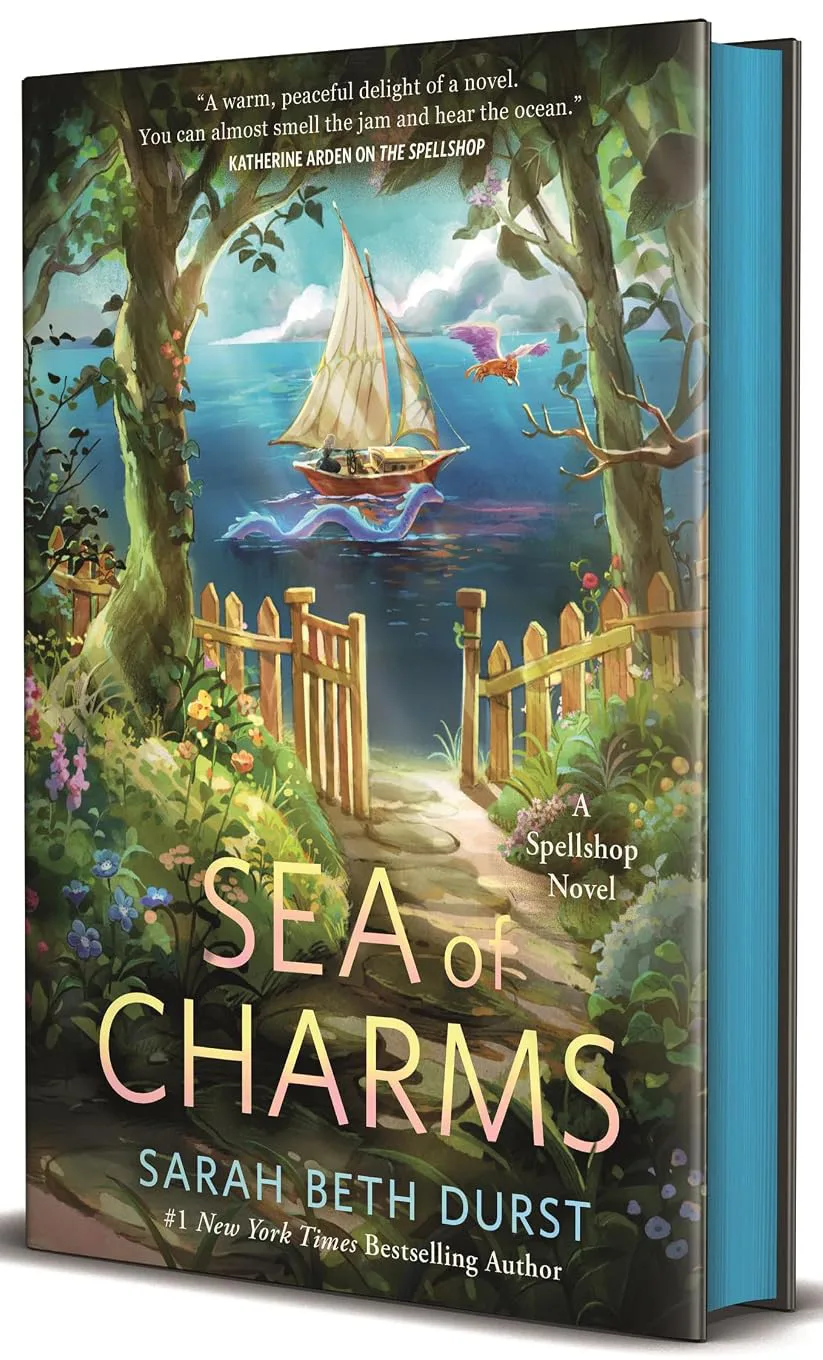
Sea of Charms: A Spellshop Novel (The Spellshop)
Hardcover
• 384 Pages
• USD 29.99
• English
• 9781250400673
No ratings yet
| Publisher | Bramble |
|---|---|
| ISBN13 | 9781250400673 |
| ASIN/SKU | 1250400678 |
| Book Format | Hardcover |
| Language | English |
| Pages | 384 |
| List Price | USD 29.99 |
| Publishing Date | 28/07/2026 |
| Dimensions | 5.85 x 1.2 x 8.6 inches |
| Weight | 1 pounds |
| Book Code | BD00066983 |
Buy this Book
Amazon Stores
Ebook Stores
Other Stores
Discover Sea of Charms: A Spellshop Novel (The Spellshop) by Sarah Beth Durst. This book is published by Bramble in Hardcover format, ISBN 9781250400673, ASIN 1250400678, under Romance, Romantic Comedy, Romantasy.
Book Description
DELUXE EDITION―a gorgeous hardcover edition featuring beautiful cerulean blue sprayed edges!
A LibraryReads pick! An Indie Next pick!
Most anticipated from BookBub, Apple Books and BookPage. Featured in: The New York Times and ScreenRant.
#1 New York Times bestselling author Sarah Beth Durst brings cozy fantasy romance to the high seas in Sea of Charms, the third magical adventure in the Spellshop series!
Marin has always belonged on the great blue sea.
Betrayed by love, Marin lives and works as a supply runner, sailing from island to island, delivering an array of goods with Perri the sea serpent and Ree the sailor shrub as her crew.
On one of her routine trips to the capital, Alyssium, Marin finds a revolution underway―and her friend Dax in the line of fire.
What starts as a rescue evolves into a deal: Marin will keep Dax on as a member of her crew if he pretends to be her boyfriend at the End-of-Harvest Festival back home.
But against her better judgment, Marin finds herself intrigued by his stubbornness, his passion for stories, his charming smile―and realizes that perhaps she isn’t saving him. Maybe it’s the other way around.
Sea of Charms is a cozy fantasy romance about finding your crew, your family, and moreover, finding yourself.
Read in whatever order your heart desires, but don’t miss The Spellshop and The Enchanted Greenhouse.
“I, for one, couldn’t ask for more.” ―Sangu Mandanna on The Spellshop
Expect:
Standalone romance
Friends to lovers
Magical creatures
Swimming lessons
Bramble books by Sarah Beth Durst
The Spellshop series
The Spellshop
The Enchanted Greenhouse
Sea of Charms
The Magical Cheese Emporium
A LibraryReads pick! An Indie Next pick!
Most anticipated from BookBub, Apple Books and BookPage. Featured in: The New York Times and ScreenRant.
#1 New York Times bestselling author Sarah Beth Durst brings cozy fantasy romance to the high seas in Sea of Charms, the third magical adventure in the Spellshop series!
Marin has always belonged on the great blue sea.
Betrayed by love, Marin lives and works as a supply runner, sailing from island to island, delivering an array of goods with Perri the sea serpent and Ree the sailor shrub as her crew.
On one of her routine trips to the capital, Alyssium, Marin finds a revolution underway―and her friend Dax in the line of fire.
What starts as a rescue evolves into a deal: Marin will keep Dax on as a member of her crew if he pretends to be her boyfriend at the End-of-Harvest Festival back home.
But against her better judgment, Marin finds herself intrigued by his stubbornness, his passion for stories, his charming smile―and realizes that perhaps she isn’t saving him. Maybe it’s the other way around.
Sea of Charms is a cozy fantasy romance about finding your crew, your family, and moreover, finding yourself.
Read in whatever order your heart desires, but don’t miss The Spellshop and The Enchanted Greenhouse.
“I, for one, couldn’t ask for more.” ―Sangu Mandanna on The Spellshop
Expect:
Standalone romance
Friends to lovers
Magical creatures
Swimming lessons
Bramble books by Sarah Beth Durst
The Spellshop series
The Spellshop
The Enchanted Greenhouse
Sea of Charms
The Magical Cheese Emporium
Author Biography
Sarah Beth Durst is the New York Times bestselling author of over twenty-five books for adults, teens, and kids, including cozy fantasy THE SPELLSHOP. She's been awarded an American Library Association Alex Award, as well as a Mythopoeic Fantasy Award. Several of her books have been optioned for film/television, including DRINK SLAY LOVE, which was made into a TV movie and was a question on Jeopardy! She lives in Stony Brook, New York, with her husband, her children, and her ill-mannered cat.
Editorial Reviews
Featured in The New York Times's "The Novels Everyone Will Be Talking About in 2026"!
"Oh, is Sarah Beth Durst good at writing imaginative magical worlds! A really beautiful book that made my heart melt." ―Stephanie Burgis, author of Wooing the Witch Queen
"Readers will find it a warmhearted and thoroughly entertaining escape." ―Publishers Weekly
Praise for The Enchanted Greenhouse
A New York TImes, USA Today, and indie bestseller!
“A beautiful, profoundly hopeful love letter to the magic of community.” ―Sangu Mandanna, bestselling author of The Very Secret Society of Irregular Witches
“The perfect comfort-read to sink into! ―Stephanie Burgis, author of Wooing the Witch Queen
“This magical novel offers the reader a respite from cold reality, a balm of beauty and fragrance, and a spell of priceless enchantment.” ―Jennifer K. Lambert, USA TODAY bestselling author of Never the Roses
“Kind, comforting, and utterly delightful – reading this book feels like coming home.” ―Julie Leong, bestselling author of The Teller of Small Fortunes
"A charming ensemble of characters, delightful mythical beings, and a sprinkle of wondrous magic make this world one you'll want to linger in well past the final page." ―M. Stevenson, author of Behooved
Praise for The Spellshop
A New York TImes, USA Today, and indie bestseller!
"If the words 'cottagecore fantasy romance' sound appealing, this is the fall book for you. Durst’s cheerful, unapologetically low-stakes novel is an exemplar of the literary subgenre." ―The New York Times
“Expect slow days in a sleepy coastal village, baked goods, winged kittens, a sentient spider plant, and a hot man who builds bookshelves for our heroine. I, for one, couldn’t ask for more.” ―Sangu Mandanna, bestselling author of The Very Secret Society of Irregular Witches
"Those who come for the cheery aesthetic and celebration of everyday successes... will find this utterly delightful."―Publisher's Weekly
"A story full of love, magic, plants, books, and mutual aid, for those who love to see heroes fight for a gentle life and a cozy corner of the world to call their own." ―Booklist
"Kindness is king in this soft and breezy low-stakes cottagecore fantasy."―Kirkus
"As comforting as homemade jam on a fresh baked muffin!" ―Rebecca Thorne, author of Can't Spell Treason Without Tea
"Thoroughly enchanting!" ―Heather Webber, USA Today bestselling author
“The Spellshop is about believing in the kindness of people, even when you’ve seen nothing but cruelty.” ―J.R. Dawson, author of The First Bright Thing
"Reading this book was like sitting in the sun, watching bees in the foxgloves; I finished the book smiling." ―Katherine Arden, New York Times bestselling author of The Bear and the Nightingale
"Oh, is Sarah Beth Durst good at writing imaginative magical worlds! A really beautiful book that made my heart melt." ―Stephanie Burgis, author of Wooing the Witch Queen
"Readers will find it a warmhearted and thoroughly entertaining escape." ―Publishers Weekly
Praise for The Enchanted Greenhouse
A New York TImes, USA Today, and indie bestseller!
“A beautiful, profoundly hopeful love letter to the magic of community.” ―Sangu Mandanna, bestselling author of The Very Secret Society of Irregular Witches
“The perfect comfort-read to sink into! ―Stephanie Burgis, author of Wooing the Witch Queen
“This magical novel offers the reader a respite from cold reality, a balm of beauty and fragrance, and a spell of priceless enchantment.” ―Jennifer K. Lambert, USA TODAY bestselling author of Never the Roses
“Kind, comforting, and utterly delightful – reading this book feels like coming home.” ―Julie Leong, bestselling author of The Teller of Small Fortunes
"A charming ensemble of characters, delightful mythical beings, and a sprinkle of wondrous magic make this world one you'll want to linger in well past the final page." ―M. Stevenson, author of Behooved
Praise for The Spellshop
A New York TImes, USA Today, and indie bestseller!
"If the words 'cottagecore fantasy romance' sound appealing, this is the fall book for you. Durst’s cheerful, unapologetically low-stakes novel is an exemplar of the literary subgenre." ―The New York Times
“Expect slow days in a sleepy coastal village, baked goods, winged kittens, a sentient spider plant, and a hot man who builds bookshelves for our heroine. I, for one, couldn’t ask for more.” ―Sangu Mandanna, bestselling author of The Very Secret Society of Irregular Witches
"Those who come for the cheery aesthetic and celebration of everyday successes... will find this utterly delightful."―Publisher's Weekly
"A story full of love, magic, plants, books, and mutual aid, for those who love to see heroes fight for a gentle life and a cozy corner of the world to call their own." ―Booklist
"Kindness is king in this soft and breezy low-stakes cottagecore fantasy."―Kirkus
"As comforting as homemade jam on a fresh baked muffin!" ―Rebecca Thorne, author of Can't Spell Treason Without Tea
"Thoroughly enchanting!" ―Heather Webber, USA Today bestselling author
“The Spellshop is about believing in the kindness of people, even when you’ve seen nothing but cruelty.” ―J.R. Dawson, author of The First Bright Thing
"Reading this book was like sitting in the sun, watching bees in the foxgloves; I finished the book smiling." ―Katherine Arden, New York Times bestselling author of The Bear and the Nightingale
Book Summary
Sarah Beth Durst’s Sea of Charms is a warm, whimsical, and deeply comforting cozy fantasy romance that takes the magical world of The Spellshop out onto the open sea. The third novel set in the Crescent Islands Empire, Sea of Charms follows Marin, a fiercely independent supply runner who has built a new life for herself aboard her enchanted boat after a devastating betrayal by the man she once believed she would marry. With a sea serpent, a talking sailor shrub, a talented composer, and an increasingly eccentric crew around her, Marin finds herself caught in the middle of a revolution, a family crisis, a pretend romance, and a journey that gradually teaches her something she has spent years refusing to believe: independence and love do not have to be opposites. Durst's official description calls the book a cozy fantasy romance about “finding your crew, your family, and moreover, finding yourself,” and that idea provides the emotional heart of the entire novel.
At the beginning of the story, Marin has deliberately chosen the sea because the sea feels safer than people. She owns her own boat and works as a supply runner, traveling between the islands of the Crescent Islands Empire to deliver whatever people need. Her cargo can include practical necessities such as flour, but also letters, stories, magical objects, and other unusual deliveries. The work is demanding, sometimes lonely, and occasionally dangerous, but Marin prefers it because it gives her something she has not been able to find in relationships: control over her own life. She can decide where to go, whom to trust, and when to leave. On the water, nobody can tell her what she should be.
The reason Marin has become so protective of her independence is rooted in a painful betrayal. Two years before the main events of the novel, she was engaged to a man named Iovar, whom she believed loved her. Instead, she discovered that he had been scheming to ruin her parents' supply-running business. The betrayal did more than end her engagement. It damaged Marin's ability to trust people and left her feeling that emotional dependence was dangerous. She responded by escaping to the sea and building a life in which she could rely primarily on herself. Reviews of the novel emphasize that Marin's emotional wound is closely connected to the way she repeatedly tries to carry every burden alone.
Marin is not completely alone, however. Her closest companion is Perri, a sea serpent whom Marin rescued after finding her trapped in a fisherfolk's net. What begins as an act of kindness develops into one of the book's most charming friendships. Perri becomes part of Marin's crew and family, demonstrating one of the novel's recurring ideas: sometimes the deepest bonds in life are not created by blood or conventional expectations but by acts of kindness. Marin also has Ree, a talking sailor shrub, as part of her unusual crew. Together, the three create the cozy emotional atmosphere that makes the novel feel so distinctive. Their boat is not merely a workplace or a means of transportation; it gradually becomes a home.
The story changes dramatically when Marin sails to Alyssium, the capital of the Crescent Islands Empire. What should have been another routine delivery becomes a dangerous rescue mission when Marin discovers that the city is on fire and a revolution is underway. The political upheaval forms the larger backdrop of the novel, but Durst deliberately keeps the story focused on ordinary people rather than turning it into an epic political fantasy. The revolution is important because it changes the world around Marin, but the emotional stakes remain personal: where people will live, how they will survive, whom they can trust, and what they are willing to do for the people they love.
During the chaos in Alyssium, Marin encounters Dax, a composer and musician who is determined not to leave the city without his instruments. His attachment to his music initially strikes Marin as ridiculous. The city is collapsing around them, yet Dax is worrying about transporting his instruments. From Marin's practical perspective, survival should obviously come first. But this disagreement introduces an important difference between them. Marin has learned to survive by stripping life down to necessities. Dax, by contrast, insists that the things that make life beautiful are worth saving too. His music, stories, and artistic passion are not luxuries to him. They are part of what makes survival meaningful.
Marin agrees to help Dax escape. What begins as a rescue gradually develops into a more complicated arrangement. Dax becomes a temporary member of Marin's crew, and Marin asks him to pretend to be her boyfriend at the End-of-Harvest Festival back home. The arrangement appears practical and harmless. Marin has no intention of falling in love again, and Dax is supposedly only playing a role. Yet the fake relationship creates exactly the kind of emotional proximity Marin has spent years avoiding. The more time she spends with Dax, the more difficult it becomes to separate the pretend romance from genuine affection.
Dax is an especially effective romantic counterpart for Marin because he does not attempt to “fix” her. He challenges her assumptions instead. Where Marin sees self-reliance as protection, Dax sees companionship as a source of strength. Where Marin distrusts dependence, Dax embraces connection. His passion for music also gives him a quality that Marin has lost: the ability to be openly enthusiastic about something simply because it brings joy. Their relationship consequently develops through small moments of curiosity, humor, irritation, and mutual respect rather than through instant attraction.
The pretend-boyfriend arrangement also allows Marin to experiment with a version of herself she normally suppresses. She can flirt without admitting that she is vulnerable. She can spend time with Dax while telling herself that none of it is real. She can experience companionship without immediately having to decide whether she trusts him. Yet the emotional boundaries gradually become harder to maintain. Marin starts to realize that Dax's presence on the boat changes the atmosphere of her life. The ship feels less lonely. Her problems are shared rather than carried entirely by herself. And perhaps most frighteningly for Marin, she begins to want him there.
Meanwhile, the family's financial crisis brings another layer of urgency to the story. After Iovar's betrayal, Marin's parents are still dealing with the consequences. The loan they took out for Marin's boat becomes a major problem when Iovar gains control of it and demands repayment after the winter solstice. If Marin cannot find enough money, her parents risk losing their home. This gives the novel a wonderfully grounded set of stakes. The characters are living in a magical world with sea serpents, enchanted objects, magical islands, and political revolutions, but Marin's immediate problem is still something painfully recognizable: how to keep her family from losing the home they worked to build.
This financial problem becomes the reason Marin and her expanding crew embark on a series of adventures across the Crescent Islands. Instead of following a single straightforward quest, the novel takes the form of a journey from island to island. Each location has its own magical character, unusual inhabitants, challenges, and surprises. The high-seas setting allows Durst to expand the world established in The Spellshop and The Enchanted Greenhouse. Readers get a much broader sense of the Crescent Islands, their communities, and the strange forms of magic that exist throughout them.
The adventure element includes magical storms, shipwrecks, dragons, financial enemies, refugees, and other unexpected complications. Yet these events never overwhelm the cozy character of the book. Durst's version of fantasy is less interested in enormous battles than in the everyday lives of people living in a magical world. Even when Marin encounters danger, the emotional center remains the crew's relationships and their determination to help one another. This is one of the defining features of the Spellshop books: high stakes can exist without requiring the story to become relentlessly grim.
The revolution in Alyssium is therefore an interesting background element. The empire is collapsing, but Marin is not trying to become a revolutionary leader or save the entire kingdom. She is trying to get people safely from one place to another, help her family, earn enough money, and figure out how to live with the people who have entered her life. This smaller perspective makes the political upheaval feel more human. Revolutions are experienced not only through grand speeches and battles but through frightened people needing transportation, shelter, food, and somewhere safe to begin again. Marin's work as a supply runner becomes unexpectedly important because she connects people and places at precisely the moment when the old systems are breaking apart.
The book also explores the meaning of home. Marin initially believes that home is something she must avoid because home means vulnerability. She escaped to the sea partly because it gave her a place where nobody could hurt her in the same way again. But as her crew grows, she begins to discover that home may not be a fixed location. It can be a boat shared with people who understand you. It can be a family that accepts you without demanding that you become someone else. It can even be a relationship that does not take away your independence. This transformation is at the heart of Marin's emotional journey.
Her relationship with her parents further complicates that idea. Marin loves them deeply and works tirelessly to protect them, but her devotion also becomes a burden. She has convinced herself that she must solve every problem for everyone around her. Some readers have found this aspect of her character frustrating because Marin repeatedly refuses help and assumes responsibility for burdens that others could share. Yet that behavior is precisely what the novel wants to examine. Her independence has become so deeply tied to her identity that accepting help feels dangerously close to surrendering control.
Dax gradually helps Marin understand that accepting help is not the same as becoming helpless. This is perhaps the most important lesson in their romance. Marin has spent years believing that the safest way to avoid betrayal is to need nobody. But that strategy also prevents her from experiencing the joy, comfort, and belonging that come from trusting others. Dax's presence gives her the opportunity to discover another form of strength: the ability to say, “I cannot do this alone,” and allow someone else to stand beside her.
The found-family theme becomes increasingly powerful as the crew expands. Perri, Ree, Dax, Marin's family, and the people they encounter throughout their travels create a network of relationships that slowly replaces the loneliness Marin once considered a virtue. Their loyalty is not based on obligation. It grows through shared experiences, mutual assistance, humor, and affection. This makes Sea of Charms especially appealing to readers who enjoy cozy fantasy books about found family, magical companions, community, and healing.
The novel also benefits from its connections to the earlier books. Although Sea of Charms can be read as a standalone, it shares the same world as The Spellshop and The Enchanted Greenhouse, and characters and events from those books appear throughout the story. The timeline overlaps with events from the earlier novels, allowing readers to see familiar developments from Marin's perspective. This makes the book especially rewarding for longtime fans because it expands the Crescent Islands rather than simply repeating the previous stories.
At the same time, readers do not need to know the earlier books to understand Marin's central story. Her emotional wound, her relationship with the sea, her family crisis, her friendship with Perri, and her developing romance with Dax all stand on their own. For readers searching for a standalone cozy fantasy romance, a high-seas romantasy, a magical adventure with sea serpents, or a sweet fake-dating romance, Sea of Charms offers a particularly accessible entry point into Durst's world.
Perhaps the most beautiful idea in the novel is that healing does not require Marin to become less independent. The story does not ask her to abandon the sea or give up the life she created. Instead, it asks her to reconsider what independence means. She can captain her own boat and still allow someone else to help navigate. She can make her own decisions and still trust another person. She can love someone without surrendering her identity. In this sense, Dax does not represent the end of Marin's freedom. He represents the possibility of sharing freedom with another person.
Ultimately, Sea of Charms is a story about rebuilding a life after betrayal. Marin begins the novel believing that the safest life is one in which she depends only on herself. She has replaced romantic vulnerability with work, companionship with solitude, and uncertainty with routine. The magical sea gives her freedom, but it also gives her a place to hide. Her journey with Dax and the rest of her crew slowly teaches her that hiding and healing are not the same thing.
The book's greatest emotional achievement is therefore its gentle treatment of trust. Marin is not suddenly cured of her fear because she meets a charming musician. Trust develops slowly through actions. Dax proves himself through his loyalty, humor, creativity, and willingness to stand beside her. Perri proves that companionship can grow from compassion. Ree demonstrates that even the strangest friendships can become meaningful. And Marin's family reminds her that love can be imperfect without being false.
For readers looking for cozy fantasy romance books with magical creatures, high-seas fantasy romance, found-family fantasy, fake dating romance, slow-burn romance, magical adventure, or stories about healing after betrayal, Sea of Charms brings these elements together in a particularly warm package. It is whimsical without being empty, romantic without becoming overly dramatic, and adventurous without losing its comforting atmosphere. Publishers Weekly similarly describes it as a warmhearted, entertaining cozy romantasy focused on adventure, love, and family.
In the end, Sea of Charms is less about finding a perfect destination than about discovering who belongs on the journey with you. Marin begins with a boat, a sea serpent, and a determination never to need anyone again. She ends up with something much more valuable: a crew, a family, a renewed sense of trust, and the possibility of love that does not demand that she give up herself. The sea that once represented escape becomes the setting in which she finally learns how to connect.
Sarah Beth Durst's greatest strength in the novel is her ability to make enormous emotional ideas feel gentle and accessible. Betrayal, financial insecurity, political upheaval, loneliness, and fear are real problems in Marin's world, but they are balanced by friendship, magical creatures, music, food, humor, adventure, and affection. The result is a fantasy novel that offers exactly what many readers seek from cozy romantasy: a world that feels magical enough to escape into and emotionally honest enough to feel like home.
At its core, Sea of Charms asks Marin to reconsider one of the beliefs that has governed her life: that being alone is the same as being safe. Her answer gradually becomes clear. True safety is not the absence of vulnerability. Sometimes it is knowing that if the storm arrives, someone will stay beside you. And sometimes the greatest adventure is not crossing another magical sea or discovering another enchanted island, but allowing yourself to trust the people who have quietly become your crew.
At the beginning of the story, Marin has deliberately chosen the sea because the sea feels safer than people. She owns her own boat and works as a supply runner, traveling between the islands of the Crescent Islands Empire to deliver whatever people need. Her cargo can include practical necessities such as flour, but also letters, stories, magical objects, and other unusual deliveries. The work is demanding, sometimes lonely, and occasionally dangerous, but Marin prefers it because it gives her something she has not been able to find in relationships: control over her own life. She can decide where to go, whom to trust, and when to leave. On the water, nobody can tell her what she should be.
The reason Marin has become so protective of her independence is rooted in a painful betrayal. Two years before the main events of the novel, she was engaged to a man named Iovar, whom she believed loved her. Instead, she discovered that he had been scheming to ruin her parents' supply-running business. The betrayal did more than end her engagement. It damaged Marin's ability to trust people and left her feeling that emotional dependence was dangerous. She responded by escaping to the sea and building a life in which she could rely primarily on herself. Reviews of the novel emphasize that Marin's emotional wound is closely connected to the way she repeatedly tries to carry every burden alone.
Marin is not completely alone, however. Her closest companion is Perri, a sea serpent whom Marin rescued after finding her trapped in a fisherfolk's net. What begins as an act of kindness develops into one of the book's most charming friendships. Perri becomes part of Marin's crew and family, demonstrating one of the novel's recurring ideas: sometimes the deepest bonds in life are not created by blood or conventional expectations but by acts of kindness. Marin also has Ree, a talking sailor shrub, as part of her unusual crew. Together, the three create the cozy emotional atmosphere that makes the novel feel so distinctive. Their boat is not merely a workplace or a means of transportation; it gradually becomes a home.
The story changes dramatically when Marin sails to Alyssium, the capital of the Crescent Islands Empire. What should have been another routine delivery becomes a dangerous rescue mission when Marin discovers that the city is on fire and a revolution is underway. The political upheaval forms the larger backdrop of the novel, but Durst deliberately keeps the story focused on ordinary people rather than turning it into an epic political fantasy. The revolution is important because it changes the world around Marin, but the emotional stakes remain personal: where people will live, how they will survive, whom they can trust, and what they are willing to do for the people they love.
During the chaos in Alyssium, Marin encounters Dax, a composer and musician who is determined not to leave the city without his instruments. His attachment to his music initially strikes Marin as ridiculous. The city is collapsing around them, yet Dax is worrying about transporting his instruments. From Marin's practical perspective, survival should obviously come first. But this disagreement introduces an important difference between them. Marin has learned to survive by stripping life down to necessities. Dax, by contrast, insists that the things that make life beautiful are worth saving too. His music, stories, and artistic passion are not luxuries to him. They are part of what makes survival meaningful.
Marin agrees to help Dax escape. What begins as a rescue gradually develops into a more complicated arrangement. Dax becomes a temporary member of Marin's crew, and Marin asks him to pretend to be her boyfriend at the End-of-Harvest Festival back home. The arrangement appears practical and harmless. Marin has no intention of falling in love again, and Dax is supposedly only playing a role. Yet the fake relationship creates exactly the kind of emotional proximity Marin has spent years avoiding. The more time she spends with Dax, the more difficult it becomes to separate the pretend romance from genuine affection.
Dax is an especially effective romantic counterpart for Marin because he does not attempt to “fix” her. He challenges her assumptions instead. Where Marin sees self-reliance as protection, Dax sees companionship as a source of strength. Where Marin distrusts dependence, Dax embraces connection. His passion for music also gives him a quality that Marin has lost: the ability to be openly enthusiastic about something simply because it brings joy. Their relationship consequently develops through small moments of curiosity, humor, irritation, and mutual respect rather than through instant attraction.
The pretend-boyfriend arrangement also allows Marin to experiment with a version of herself she normally suppresses. She can flirt without admitting that she is vulnerable. She can spend time with Dax while telling herself that none of it is real. She can experience companionship without immediately having to decide whether she trusts him. Yet the emotional boundaries gradually become harder to maintain. Marin starts to realize that Dax's presence on the boat changes the atmosphere of her life. The ship feels less lonely. Her problems are shared rather than carried entirely by herself. And perhaps most frighteningly for Marin, she begins to want him there.
Meanwhile, the family's financial crisis brings another layer of urgency to the story. After Iovar's betrayal, Marin's parents are still dealing with the consequences. The loan they took out for Marin's boat becomes a major problem when Iovar gains control of it and demands repayment after the winter solstice. If Marin cannot find enough money, her parents risk losing their home. This gives the novel a wonderfully grounded set of stakes. The characters are living in a magical world with sea serpents, enchanted objects, magical islands, and political revolutions, but Marin's immediate problem is still something painfully recognizable: how to keep her family from losing the home they worked to build.
This financial problem becomes the reason Marin and her expanding crew embark on a series of adventures across the Crescent Islands. Instead of following a single straightforward quest, the novel takes the form of a journey from island to island. Each location has its own magical character, unusual inhabitants, challenges, and surprises. The high-seas setting allows Durst to expand the world established in The Spellshop and The Enchanted Greenhouse. Readers get a much broader sense of the Crescent Islands, their communities, and the strange forms of magic that exist throughout them.
The adventure element includes magical storms, shipwrecks, dragons, financial enemies, refugees, and other unexpected complications. Yet these events never overwhelm the cozy character of the book. Durst's version of fantasy is less interested in enormous battles than in the everyday lives of people living in a magical world. Even when Marin encounters danger, the emotional center remains the crew's relationships and their determination to help one another. This is one of the defining features of the Spellshop books: high stakes can exist without requiring the story to become relentlessly grim.
The revolution in Alyssium is therefore an interesting background element. The empire is collapsing, but Marin is not trying to become a revolutionary leader or save the entire kingdom. She is trying to get people safely from one place to another, help her family, earn enough money, and figure out how to live with the people who have entered her life. This smaller perspective makes the political upheaval feel more human. Revolutions are experienced not only through grand speeches and battles but through frightened people needing transportation, shelter, food, and somewhere safe to begin again. Marin's work as a supply runner becomes unexpectedly important because she connects people and places at precisely the moment when the old systems are breaking apart.
The book also explores the meaning of home. Marin initially believes that home is something she must avoid because home means vulnerability. She escaped to the sea partly because it gave her a place where nobody could hurt her in the same way again. But as her crew grows, she begins to discover that home may not be a fixed location. It can be a boat shared with people who understand you. It can be a family that accepts you without demanding that you become someone else. It can even be a relationship that does not take away your independence. This transformation is at the heart of Marin's emotional journey.
Her relationship with her parents further complicates that idea. Marin loves them deeply and works tirelessly to protect them, but her devotion also becomes a burden. She has convinced herself that she must solve every problem for everyone around her. Some readers have found this aspect of her character frustrating because Marin repeatedly refuses help and assumes responsibility for burdens that others could share. Yet that behavior is precisely what the novel wants to examine. Her independence has become so deeply tied to her identity that accepting help feels dangerously close to surrendering control.
Dax gradually helps Marin understand that accepting help is not the same as becoming helpless. This is perhaps the most important lesson in their romance. Marin has spent years believing that the safest way to avoid betrayal is to need nobody. But that strategy also prevents her from experiencing the joy, comfort, and belonging that come from trusting others. Dax's presence gives her the opportunity to discover another form of strength: the ability to say, “I cannot do this alone,” and allow someone else to stand beside her.
The found-family theme becomes increasingly powerful as the crew expands. Perri, Ree, Dax, Marin's family, and the people they encounter throughout their travels create a network of relationships that slowly replaces the loneliness Marin once considered a virtue. Their loyalty is not based on obligation. It grows through shared experiences, mutual assistance, humor, and affection. This makes Sea of Charms especially appealing to readers who enjoy cozy fantasy books about found family, magical companions, community, and healing.
The novel also benefits from its connections to the earlier books. Although Sea of Charms can be read as a standalone, it shares the same world as The Spellshop and The Enchanted Greenhouse, and characters and events from those books appear throughout the story. The timeline overlaps with events from the earlier novels, allowing readers to see familiar developments from Marin's perspective. This makes the book especially rewarding for longtime fans because it expands the Crescent Islands rather than simply repeating the previous stories.
At the same time, readers do not need to know the earlier books to understand Marin's central story. Her emotional wound, her relationship with the sea, her family crisis, her friendship with Perri, and her developing romance with Dax all stand on their own. For readers searching for a standalone cozy fantasy romance, a high-seas romantasy, a magical adventure with sea serpents, or a sweet fake-dating romance, Sea of Charms offers a particularly accessible entry point into Durst's world.
Perhaps the most beautiful idea in the novel is that healing does not require Marin to become less independent. The story does not ask her to abandon the sea or give up the life she created. Instead, it asks her to reconsider what independence means. She can captain her own boat and still allow someone else to help navigate. She can make her own decisions and still trust another person. She can love someone without surrendering her identity. In this sense, Dax does not represent the end of Marin's freedom. He represents the possibility of sharing freedom with another person.
Ultimately, Sea of Charms is a story about rebuilding a life after betrayal. Marin begins the novel believing that the safest life is one in which she depends only on herself. She has replaced romantic vulnerability with work, companionship with solitude, and uncertainty with routine. The magical sea gives her freedom, but it also gives her a place to hide. Her journey with Dax and the rest of her crew slowly teaches her that hiding and healing are not the same thing.
The book's greatest emotional achievement is therefore its gentle treatment of trust. Marin is not suddenly cured of her fear because she meets a charming musician. Trust develops slowly through actions. Dax proves himself through his loyalty, humor, creativity, and willingness to stand beside her. Perri proves that companionship can grow from compassion. Ree demonstrates that even the strangest friendships can become meaningful. And Marin's family reminds her that love can be imperfect without being false.
For readers looking for cozy fantasy romance books with magical creatures, high-seas fantasy romance, found-family fantasy, fake dating romance, slow-burn romance, magical adventure, or stories about healing after betrayal, Sea of Charms brings these elements together in a particularly warm package. It is whimsical without being empty, romantic without becoming overly dramatic, and adventurous without losing its comforting atmosphere. Publishers Weekly similarly describes it as a warmhearted, entertaining cozy romantasy focused on adventure, love, and family.
In the end, Sea of Charms is less about finding a perfect destination than about discovering who belongs on the journey with you. Marin begins with a boat, a sea serpent, and a determination never to need anyone again. She ends up with something much more valuable: a crew, a family, a renewed sense of trust, and the possibility of love that does not demand that she give up herself. The sea that once represented escape becomes the setting in which she finally learns how to connect.
Sarah Beth Durst's greatest strength in the novel is her ability to make enormous emotional ideas feel gentle and accessible. Betrayal, financial insecurity, political upheaval, loneliness, and fear are real problems in Marin's world, but they are balanced by friendship, magical creatures, music, food, humor, adventure, and affection. The result is a fantasy novel that offers exactly what many readers seek from cozy romantasy: a world that feels magical enough to escape into and emotionally honest enough to feel like home.
At its core, Sea of Charms asks Marin to reconsider one of the beliefs that has governed her life: that being alone is the same as being safe. Her answer gradually becomes clear. True safety is not the absence of vulnerability. Sometimes it is knowing that if the storm arrives, someone will stay beside you. And sometimes the greatest adventure is not crossing another magical sea or discovering another enchanted island, but allowing yourself to trust the people who have quietly become your crew.
Sample Chapters
Sample Chapters will be added soon…
Reader Reviews
No reviews yet.
Sea of Charms: A Spellshop Novel (The Spellshop)
Download Cover Image
Do you want to download the full cover image for Sea of Charms: A Spellshop Novel (The Spellshop)?