
The Altar of Pergamon: The Mystery of the Dark Angel and the Future of the World
Hardcover
• 352 Pages
• USD 29.99
• English
• 9781636416151
No ratings yet
| Publisher | Frontline |
|---|---|
| ISBN13 | 9781636416151 |
| ASIN/SKU | 1636416152 |
| Book Format | Hardcover |
| Language | English |
| Pages | 352 |
| List Price | USD 29.99 |
| Publishing Date | 01/09/2026 |
| Dimensions | 9.29 x 0.04 x 6.18 inches |
| Weight | 1.43 pounds |
| Book Code | BD00066984 |
Buy this Book
Amazon Stores
Ebook Stores
Other Stores
Discover The Altar of Pergamon: The Mystery of the Dark Angel and the Future of the World by Jonathan Cahn. This book is published by Frontline in Hardcover format, ISBN 9781636416151, ASIN 1636416152, under Mystery, Thriller and Suspense, Christian Mystery and Suspense, Suspense Thrillers.
Book Description
IS IT POSSIBLE…
That there exists an ancient mystery that lies behind the events of the modern world?
An ancient object created over 2000 years ago and yet is altering the course of world history?
The secret behind the events of our age, the past, present, and the future?
Could it lie behind the greatest calamities of the modern world . . .
· The rise of Adolf Hitler and the Third Reich
· World War I
· The Holocaust
· World War II
· The spread of Marxism
· The rise of the Soviet Union
· Nuclear war
· The near end of the world
· What is yet to come, even a new world order
· And much, much more . . .
And where is it bringing the world?
Who is the dark angel?
And what are the unseen forces at work and moving behind the events of the modern world?
In what may be his most stunning and monumental book yet, The Altar of Pergamon: The Mystery of the Dark Angel and the Future of the World, #1 New York Times Bestselling Author Jonathan Cahn opens up the ancient mystery that has affected and is affecting everyone on earth . . . even you!
For the first time in years, Cahn reveals the mystery through a story, the spellbinding account of Ariel Herzog, a skeptic known for dismantling the claims of the supernatural, but who receives a cryptic page of a secret book. The page opens up an ancient mystery.
The mystery will lead Herzog and an unlikely ally, Lara Winter, to undertake a journey that will span the globe to unlock the mystery, page by page, revelation by revelation. The journey will take them from New York City to Istanbul, to Berlin, to Eastern Europe, to Moscow, New Mexico, Havana, Jerusalem, and beyond. In each place, they will encounter a mysterious agent connected to the mystery holding the keys to unlock the next secret and piece of the puzzle.
But they are not alone. They will find themselves watched, tracked, and pursued by the members of a dark organization who have guarded the mystery from ancient times. And those who draw too close to unlocking its secret do so at the risk or cost of their lives.
The Altar of Pergamon will reveal the Visitor, the Man in the Bazaar, the Dark Kingdom, the Monster’s Birth, the Guardians of the Throne, the Wizard, the Hall of Mirrors, the Stranger on the Train, the Dark Priesthood, the Ancient Matrix, the Black Gate, the Winged Creature, the Unholy of Holies, the Lightning of the Gods, the Woman and the Beast, What Was and Is to Come, the End of All Things, and much, much more.
It may sound like a thriller… a fantasy… something out of an Indiana Jones adventure… Lord of the Rings… or the DaVinci Code . . .
But The Altar of Pergamon is different from all of these …
Because the mystery it reveals is not fiction
It’s real…
It will change the way you see the world.
It has already altered the course of world history… and maybe even your life.
It is the mystery on which the future of the world hangs in the balance.
And your future may depend on it.
The Altar of Pergamon – The Mystery of the Dark Angel and the Future of the World – the book you can’t afford not to read!
That there exists an ancient mystery that lies behind the events of the modern world?
An ancient object created over 2000 years ago and yet is altering the course of world history?
The secret behind the events of our age, the past, present, and the future?
Could it lie behind the greatest calamities of the modern world . . .
· The rise of Adolf Hitler and the Third Reich
· World War I
· The Holocaust
· World War II
· The spread of Marxism
· The rise of the Soviet Union
· Nuclear war
· The near end of the world
· What is yet to come, even a new world order
· And much, much more . . .
And where is it bringing the world?
Who is the dark angel?
And what are the unseen forces at work and moving behind the events of the modern world?
In what may be his most stunning and monumental book yet, The Altar of Pergamon: The Mystery of the Dark Angel and the Future of the World, #1 New York Times Bestselling Author Jonathan Cahn opens up the ancient mystery that has affected and is affecting everyone on earth . . . even you!
For the first time in years, Cahn reveals the mystery through a story, the spellbinding account of Ariel Herzog, a skeptic known for dismantling the claims of the supernatural, but who receives a cryptic page of a secret book. The page opens up an ancient mystery.
The mystery will lead Herzog and an unlikely ally, Lara Winter, to undertake a journey that will span the globe to unlock the mystery, page by page, revelation by revelation. The journey will take them from New York City to Istanbul, to Berlin, to Eastern Europe, to Moscow, New Mexico, Havana, Jerusalem, and beyond. In each place, they will encounter a mysterious agent connected to the mystery holding the keys to unlock the next secret and piece of the puzzle.
But they are not alone. They will find themselves watched, tracked, and pursued by the members of a dark organization who have guarded the mystery from ancient times. And those who draw too close to unlocking its secret do so at the risk or cost of their lives.
The Altar of Pergamon will reveal the Visitor, the Man in the Bazaar, the Dark Kingdom, the Monster’s Birth, the Guardians of the Throne, the Wizard, the Hall of Mirrors, the Stranger on the Train, the Dark Priesthood, the Ancient Matrix, the Black Gate, the Winged Creature, the Unholy of Holies, the Lightning of the Gods, the Woman and the Beast, What Was and Is to Come, the End of All Things, and much, much more.
It may sound like a thriller… a fantasy… something out of an Indiana Jones adventure… Lord of the Rings… or the DaVinci Code . . .
But The Altar of Pergamon is different from all of these …
Because the mystery it reveals is not fiction
It’s real…
It will change the way you see the world.
It has already altered the course of world history… and maybe even your life.
It is the mystery on which the future of the world hangs in the balance.
And your future may depend on it.
The Altar of Pergamon – The Mystery of the Dark Angel and the Future of the World – the book you can’t afford not to read!
Author Biography
Jonathan Cahn caused a worldwide stir with the release of his explosive first book, The Harbinger, which became an instant New York Times best seller and brought him to national and international prominence. Every one of his books since then have become a New York Times best seller, including The Mystery of the Shemitah, The Book of Mysteries, The Paradigm, The Oracle, The Harbinger II, The Return of the Gods, The Josiah Manifesto, The Dragon's Prophecy, and The Avatar. Each one opens up deep or long-hidden mysteries that are unfolding and manifesting in our time. He has spoken at the United Nations, on Capitol Hill, to Members of Congress, and to millions around the world. His teachings and prophetic messages on Youtube have received over 100 Million views. He leads Beth Israel at the Jerusalem Center in Wayne, New Jersey - and Hope of the World ministry, a world outreach of God’s word and compassion to the world’s most needy.
Editorial Reviews
Editorial Reviews will be added soon…
Book Summary
Jonathan Cahn’s The Altar of Pergamon: The Mystery of the Dark Angel and the Future of the World is a historical mystery, supernatural thriller, and prophetic Christian narrative that attempts to connect an ancient archaeological monument with some of the darkest and most consequential events of modern history. Published in September 2026, the book follows a fictional investigation led by Ariel Herzog, a skeptical scholar, and Lara Winter, as they uncover a secret that Cahn presents as stretching from ancient Pergamon into the modern age and possibly toward the future of humanity. The book asks an unsettling question: what if the wars, ideological movements, dictatorships, and near-catastrophes of modern history are connected by something deeper than politics, economics, and human ambition? Cahn's answer is built around the mysterious Altar of Pergamon and the biblical reference to Pergamon as the place “where Satan's throne is.”
The story begins with Ariel Herzog, a highly skeptical intellectual who has made a reputation for exposing or dismissing claims of supernatural phenomena. His worldview is essentially rationalistic: mysteries have explanations, legends have human origins, and supernatural interpretations should be treated with suspicion. That position begins to collapse when Ariel receives a cryptic page from a mysterious source. The person connected to the message is subsequently killed, making it clear that the information Ariel has received is not merely an academic curiosity. Someone wants the secret to remain hidden, and those who get too close to it may face deadly consequences. Ariel is drawn into a mystery he does not initially believe exists, creating one of the book's central tensions: the skeptic is forced to investigate a possibility that challenges the foundations of his own worldview.
Ariel's investigation brings him together with Lara Winter, an unlikely companion whose own understanding of faith and spirituality differs from his. Together, they begin following clues hidden within the mysterious manuscript. Their journey becomes international, taking them from New York City to Istanbul, Berlin, Eastern Europe, Moscow, New Mexico, Havana, Jerusalem, and other locations. Each destination reveals another piece of the puzzle. Rather than presenting the mystery through a conventional historical essay, Cahn turns the investigation into a globe-spanning thriller in which clues, strangers, secret knowledge, hidden organizations, and historical events continually overlap.
The ancient Altar of Pergamon is the central symbol around which everything revolves. The actual altar was constructed in the ancient city of Pergamon, in what is now Turkey, and was later excavated and transported to Berlin. Cahn's narrative gives the monument a far greater significance than that of an archaeological artifact. He connects it to the biblical Book of Revelation, particularly the passage describing Pergamon as the place where Satan's throne is. From this starting point, the book develops the idea that the altar represents a nexus between spiritual darkness and earthly power. The altar becomes a symbol of worship, authority, empire, and the unseen forces that may influence human history.
One of the most striking ideas in The Altar of Pergamon is Cahn's interpretation of the movement of the altar through modern history. He argues that its story is somehow intertwined with the rise and transformation of political power, particularly in Europe. The narrative moves toward Germany, where the altar's modern history becomes especially significant. Cahn connects the rise of modern Germany with the transformation of the European balance of power and then follows the consequences through World War I, the rise of Nazism, Adolf Hitler, World War II, and the Holocaust. The book therefore treats history not simply as a collection of unrelated political events but as part of a larger pattern in which power moves from one center to another.
The book's treatment of Nazi Germany is particularly important to its larger argument. Cahn explores the relationship between the altar, Germany, Hitler, and the ideology that eventually produced catastrophic violence. His argument is not simply that Hitler encountered an ancient monument or that the Nazis were historically interested in German and classical symbolism. Instead, he presents these developments as part of a deeper spiritual pattern. In Cahn's interpretation, political movements can become vessels through which destructive spiritual forces operate. The “Dark Angel” of the title therefore represents more than a conventional villain. It becomes a symbolic and spiritual explanation for the darkness that appears behind certain historical transformations.
The narrative then expands beyond Nazism into the twentieth century's other great ideological conflict: Marxism and the rise of the Soviet Union. Cahn connects the spread of Marxist ideology, the emergence of Soviet power, and the Cold War to the same underlying mystery. World War II does not represent the end of the story; instead, the destruction of Nazi Germany gives way to another confrontation between competing systems of power. The Soviet Union, nuclear weapons, and the possibility of global annihilation become new stages in the book's unfolding pattern. The result is a sweeping interpretation of the twentieth century in which fascism, communism, world wars, and nuclear confrontation are connected by a spiritual dimension that Cahn believes conventional historical explanations cannot fully capture.
This is also where the book's concept of the “Dark Kingdom” becomes important. Cahn portrays evil not merely as individual wrongdoing but as something capable of influencing institutions, ideologies, governments, and civilizations. The book repeatedly asks what happens when political power becomes connected to destructive spiritual allegiance. An altar represents worship, while a throne represents authority. By combining those two images, Cahn creates the central metaphor of the book: spiritual allegiance and political power can become dangerously intertwined. This helps explain why the Altar of Pergamon is presented as much more than an archaeological curiosity. It represents the possibility that civilizations are shaped not only by what they believe politically but also by what they ultimately worship.
A major strength of the narrative structure is the contrast between Ariel's skepticism and the increasingly impossible evidence confronting him. At the beginning, he approaches the mystery like an investigator who expects a rational solution. As the clues accumulate, however, the distinction between history and spiritual mystery becomes increasingly difficult for him to maintain. Cahn uses this transformation to invite readers into the same question: can the visible events of history be understood without considering the invisible forces described in biblical theology? The book's answer is emphatically no.
The story also introduces a shadowy organization that has allegedly guarded the secret across generations. Ariel and Lara discover that they are being watched and pursued as they move from one clue to another. Figures such as the mysterious Visitor, the Man in the Bazaar, the Stranger on the Train, the Wizard, and members of the Dark Priesthood contribute to the atmosphere of conspiracy and supernatural suspense. The chapter structure itself reinforces the escalating mystery, with titles such as “The Dark Kingdom,” “The Ancient Matrix,” “The Black Gate,” “The Winged Creature,” “The Unholy of Holies,” “The Woman and the Beast,” and “What Was and Is to Come.”
Ultimately, The Altar of Pergamon is not simply a book about the past. Its most important question concerns the future. Cahn argues that the historical pattern he believes he has uncovered has not ended. The same spiritual struggle that appeared behind ancient power structures and twentieth-century conflicts may continue into the present and future. This gives the book its prophetic dimension. The mystery is connected not only to Hitler, the Holocaust, Marxism, the Soviet Union, the Cold War, and the threat of nuclear destruction but also to what Cahn sees as future world developments, including a possible new world order and end-times events.
The deeper message of the book is therefore a warning about spiritual discernment. Cahn wants readers to look beyond headlines and political explanations and consider the spiritual choices underlying human civilization. Evil, in his framework, does not ultimately possess unlimited power; it operates within a world still governed by God. The real danger is humanity's willingness to compromise, surrender moral responsibility, and attach ultimate loyalty to political systems, ideologies, leaders, or cultural powers. The book's prophetic urgency comes from the possibility that the same pattern could repeat itself in another form.
In the end, The Altar of Pergamon combines thriller storytelling with biblical interpretation, historical events, archaeology, spiritual warfare, and apocalyptic speculation. Its central mystery begins with an ancient altar but expands into a much larger question: who or what stands behind the great movements of history? Ariel Herzog's journey from skepticism toward confrontation with the supernatural mirrors the reader's own journey through Cahn's argument. Whether readers accept Cahn's interpretation as spiritual truth, approach it as speculative theology, or simply enjoy it as a historical mystery, the book is designed to make familiar events look different. Its ultimate warning is that history may contain patterns that are easy to miss—and that understanding those patterns, according to Cahn, may be essential to understanding where the world is heading next.
The story begins with Ariel Herzog, a highly skeptical intellectual who has made a reputation for exposing or dismissing claims of supernatural phenomena. His worldview is essentially rationalistic: mysteries have explanations, legends have human origins, and supernatural interpretations should be treated with suspicion. That position begins to collapse when Ariel receives a cryptic page from a mysterious source. The person connected to the message is subsequently killed, making it clear that the information Ariel has received is not merely an academic curiosity. Someone wants the secret to remain hidden, and those who get too close to it may face deadly consequences. Ariel is drawn into a mystery he does not initially believe exists, creating one of the book's central tensions: the skeptic is forced to investigate a possibility that challenges the foundations of his own worldview.
Ariel's investigation brings him together with Lara Winter, an unlikely companion whose own understanding of faith and spirituality differs from his. Together, they begin following clues hidden within the mysterious manuscript. Their journey becomes international, taking them from New York City to Istanbul, Berlin, Eastern Europe, Moscow, New Mexico, Havana, Jerusalem, and other locations. Each destination reveals another piece of the puzzle. Rather than presenting the mystery through a conventional historical essay, Cahn turns the investigation into a globe-spanning thriller in which clues, strangers, secret knowledge, hidden organizations, and historical events continually overlap.
The ancient Altar of Pergamon is the central symbol around which everything revolves. The actual altar was constructed in the ancient city of Pergamon, in what is now Turkey, and was later excavated and transported to Berlin. Cahn's narrative gives the monument a far greater significance than that of an archaeological artifact. He connects it to the biblical Book of Revelation, particularly the passage describing Pergamon as the place where Satan's throne is. From this starting point, the book develops the idea that the altar represents a nexus between spiritual darkness and earthly power. The altar becomes a symbol of worship, authority, empire, and the unseen forces that may influence human history.
One of the most striking ideas in The Altar of Pergamon is Cahn's interpretation of the movement of the altar through modern history. He argues that its story is somehow intertwined with the rise and transformation of political power, particularly in Europe. The narrative moves toward Germany, where the altar's modern history becomes especially significant. Cahn connects the rise of modern Germany with the transformation of the European balance of power and then follows the consequences through World War I, the rise of Nazism, Adolf Hitler, World War II, and the Holocaust. The book therefore treats history not simply as a collection of unrelated political events but as part of a larger pattern in which power moves from one center to another.
The book's treatment of Nazi Germany is particularly important to its larger argument. Cahn explores the relationship between the altar, Germany, Hitler, and the ideology that eventually produced catastrophic violence. His argument is not simply that Hitler encountered an ancient monument or that the Nazis were historically interested in German and classical symbolism. Instead, he presents these developments as part of a deeper spiritual pattern. In Cahn's interpretation, political movements can become vessels through which destructive spiritual forces operate. The “Dark Angel” of the title therefore represents more than a conventional villain. It becomes a symbolic and spiritual explanation for the darkness that appears behind certain historical transformations.
The narrative then expands beyond Nazism into the twentieth century's other great ideological conflict: Marxism and the rise of the Soviet Union. Cahn connects the spread of Marxist ideology, the emergence of Soviet power, and the Cold War to the same underlying mystery. World War II does not represent the end of the story; instead, the destruction of Nazi Germany gives way to another confrontation between competing systems of power. The Soviet Union, nuclear weapons, and the possibility of global annihilation become new stages in the book's unfolding pattern. The result is a sweeping interpretation of the twentieth century in which fascism, communism, world wars, and nuclear confrontation are connected by a spiritual dimension that Cahn believes conventional historical explanations cannot fully capture.
This is also where the book's concept of the “Dark Kingdom” becomes important. Cahn portrays evil not merely as individual wrongdoing but as something capable of influencing institutions, ideologies, governments, and civilizations. The book repeatedly asks what happens when political power becomes connected to destructive spiritual allegiance. An altar represents worship, while a throne represents authority. By combining those two images, Cahn creates the central metaphor of the book: spiritual allegiance and political power can become dangerously intertwined. This helps explain why the Altar of Pergamon is presented as much more than an archaeological curiosity. It represents the possibility that civilizations are shaped not only by what they believe politically but also by what they ultimately worship.
A major strength of the narrative structure is the contrast between Ariel's skepticism and the increasingly impossible evidence confronting him. At the beginning, he approaches the mystery like an investigator who expects a rational solution. As the clues accumulate, however, the distinction between history and spiritual mystery becomes increasingly difficult for him to maintain. Cahn uses this transformation to invite readers into the same question: can the visible events of history be understood without considering the invisible forces described in biblical theology? The book's answer is emphatically no.
The story also introduces a shadowy organization that has allegedly guarded the secret across generations. Ariel and Lara discover that they are being watched and pursued as they move from one clue to another. Figures such as the mysterious Visitor, the Man in the Bazaar, the Stranger on the Train, the Wizard, and members of the Dark Priesthood contribute to the atmosphere of conspiracy and supernatural suspense. The chapter structure itself reinforces the escalating mystery, with titles such as “The Dark Kingdom,” “The Ancient Matrix,” “The Black Gate,” “The Winged Creature,” “The Unholy of Holies,” “The Woman and the Beast,” and “What Was and Is to Come.”
Ultimately, The Altar of Pergamon is not simply a book about the past. Its most important question concerns the future. Cahn argues that the historical pattern he believes he has uncovered has not ended. The same spiritual struggle that appeared behind ancient power structures and twentieth-century conflicts may continue into the present and future. This gives the book its prophetic dimension. The mystery is connected not only to Hitler, the Holocaust, Marxism, the Soviet Union, the Cold War, and the threat of nuclear destruction but also to what Cahn sees as future world developments, including a possible new world order and end-times events.
The deeper message of the book is therefore a warning about spiritual discernment. Cahn wants readers to look beyond headlines and political explanations and consider the spiritual choices underlying human civilization. Evil, in his framework, does not ultimately possess unlimited power; it operates within a world still governed by God. The real danger is humanity's willingness to compromise, surrender moral responsibility, and attach ultimate loyalty to political systems, ideologies, leaders, or cultural powers. The book's prophetic urgency comes from the possibility that the same pattern could repeat itself in another form.
In the end, The Altar of Pergamon combines thriller storytelling with biblical interpretation, historical events, archaeology, spiritual warfare, and apocalyptic speculation. Its central mystery begins with an ancient altar but expands into a much larger question: who or what stands behind the great movements of history? Ariel Herzog's journey from skepticism toward confrontation with the supernatural mirrors the reader's own journey through Cahn's argument. Whether readers accept Cahn's interpretation as spiritual truth, approach it as speculative theology, or simply enjoy it as a historical mystery, the book is designed to make familiar events look different. Its ultimate warning is that history may contain patterns that are easy to miss—and that understanding those patterns, according to Cahn, may be essential to understanding where the world is heading next.
Sample Chapters
Sample Chapters will be added soon…
Reader Reviews
No reviews yet.
The Altar of Pergamon: The Mystery of the Dark Angel and the Future of the World
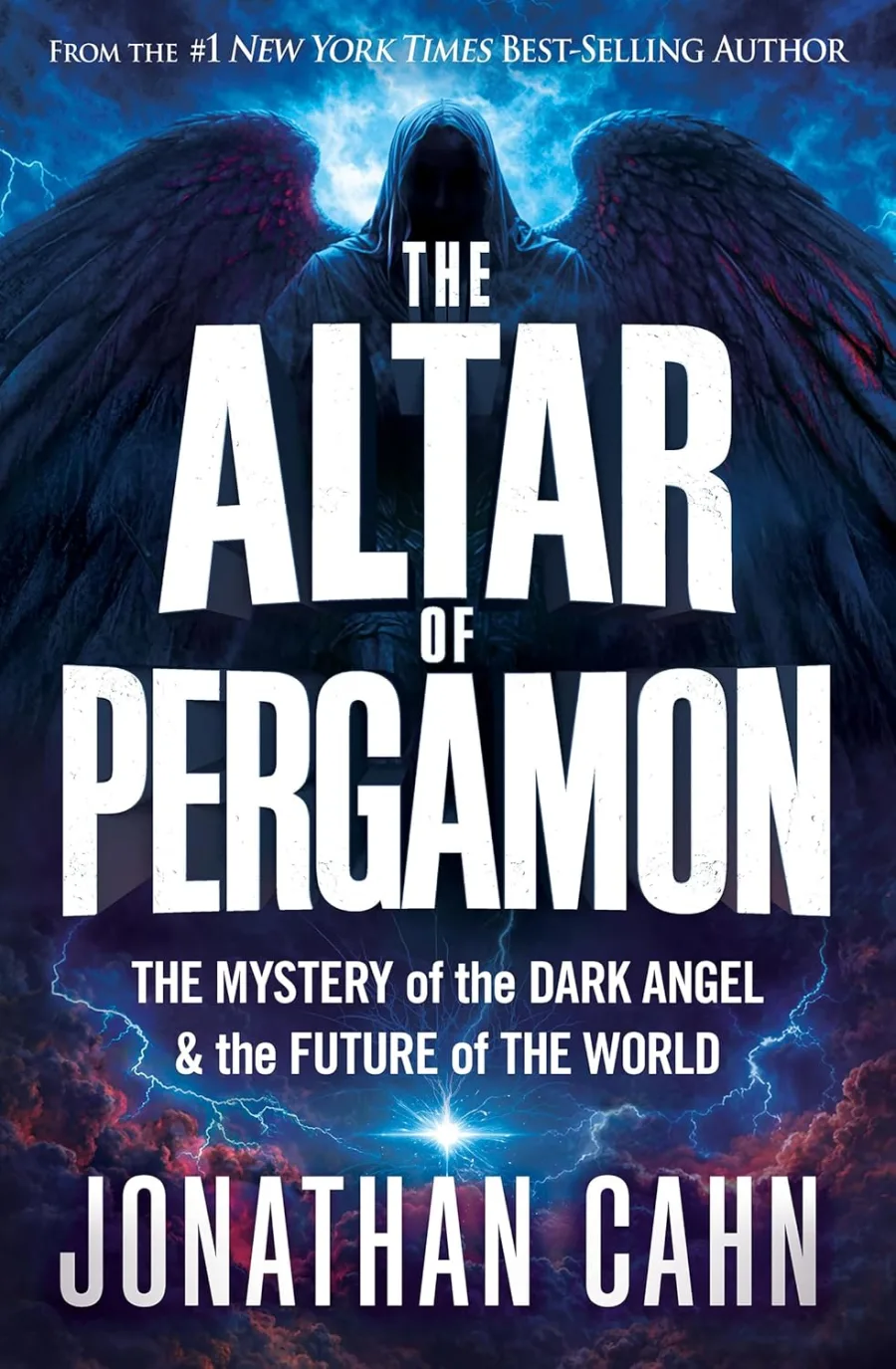
Download Cover Image
Do you want to download the full cover image for The Altar of Pergamon: The Mystery of the Dark Angel and the Future of the World?