
What to Cook When You Don’t Feel Like Cooking: Make It Fast
Hardcover
• 272 Pages
• USD 35.00
• English
• 9781454963264
No ratings yet
| Publisher | Union Square & Co. |
|---|---|
| ISBN13 | 9781454963264 |
| ASIN/SKU | 1454963263 |
| Book Format | Hardcover |
| Language | English |
| Pages | 272 |
| List Price | USD 35.00 |
| Publishing Date | 11/08/2026 |
| Dimensions | 8.25 x 0.93 x 10.25 inches |
| Weight | 2.69 pounds |
| Book Code | BD00066991 |
Buy this Book
Amazon Stores
Ebook Stores
Other Stores
Discover What to Cook When You Don’t Feel Like Cooking: Make It Fast by Caroline Chambers. This book is published by Union Square and Co. in Hardcover format, ISBN 9781454963264, ASIN 1454963263, under Cookbooks, Food and Wine, Quick and Easy Cooking.
Book Description
Following the breakout success of the New York Times bestselling What to Cook When You Don't Feel Like Cooking, Substack star Caroline Chambers returns with a new cookbook offering 100 more recipes for busy people who love good food—and these can be made even faster!
Caroline Chambers famously doesn’t feel like cooking—and she’s built a whole brand on that premise. Her superpowers are eliminating unnecessary steps; minimizing dirty dishes; and making dinnertime as simple, stress-free, and fun as possible. While plenty of obstacles stand between you and a delicious meal, being short on time is probably the biggest one.
This exciting follow-up cookbook is once again organized into three time-based chapters. You’ll find recipes for 100 dinners, all of which are complete meals and can be made with no more than 30 minutes hands-on time in the kitchen—and yes, that includes chopping, marinating, and all other prep! Delicious meals include:
Flank Steak with Elote Salsa
Fish and Veggie Curry
Rotisserie-ish Chicken with Schmaltzy Lemon Dressing
Smoky Black Beans
Fried Rice
Every quick and easy recipe features Caro’s signature swaps, riffs, tips, and shortcuts to empower you to make these recipes work for you—not the other way around! You’ll also find special treasures throughout the book, including anchor recipes you can spin into five different dishes so you can DIY your favorites.
Plus, helpful back-of-book indexes allow you to search by both ingredient—useful when, say, you’ve got ground meat in the freezer—and occasion or mood—like when you cannot be bothered to chop a single thing. Even on the nights when you think there’s no way, no how, What to Cook When You Don’t Feel Like Cooking: Make It Fast will help you get a full, flavorful meal on the table in basically no time.
Caroline Chambers famously doesn’t feel like cooking—and she’s built a whole brand on that premise. Her superpowers are eliminating unnecessary steps; minimizing dirty dishes; and making dinnertime as simple, stress-free, and fun as possible. While plenty of obstacles stand between you and a delicious meal, being short on time is probably the biggest one.
This exciting follow-up cookbook is once again organized into three time-based chapters. You’ll find recipes for 100 dinners, all of which are complete meals and can be made with no more than 30 minutes hands-on time in the kitchen—and yes, that includes chopping, marinating, and all other prep! Delicious meals include:
Flank Steak with Elote Salsa
Fish and Veggie Curry
Rotisserie-ish Chicken with Schmaltzy Lemon Dressing
Smoky Black Beans
Fried Rice
Every quick and easy recipe features Caro’s signature swaps, riffs, tips, and shortcuts to empower you to make these recipes work for you—not the other way around! You’ll also find special treasures throughout the book, including anchor recipes you can spin into five different dishes so you can DIY your favorites.
Plus, helpful back-of-book indexes allow you to search by both ingredient—useful when, say, you’ve got ground meat in the freezer—and occasion or mood—like when you cannot be bothered to chop a single thing. Even on the nights when you think there’s no way, no how, What to Cook When You Don’t Feel Like Cooking: Make It Fast will help you get a full, flavorful meal on the table in basically no time.
Author Biography
Caroline Chambers grew up in the kitchen on her mom’s hip, learning how to cook in their Winston-Salem, North Carolina, home. Her professional food career began in her early twenties when she worked as a chef and caterer. After a stint in a professional test kitchen, Caro struck out on her own as a freelancer, developing recipes for a host of publications as well as brands such as Boursin Cheese and Kim Crawford Wine, and in 2018, she published her first cookbook, Just Married. In 2020—at the height of the COVID-19 pandemic—Caro began sharing her recipes and connecting with home cooks on Instagram (@carochambers), and launched her newsletter, What to Cook When You Don’t Feel Like Cooking, which flew to the top of the Substack charts; her podcast, So Into That, followed in 2023. Caro's latest cookbook, What To Cook When You Don't Feel Like Cooking, was released in August 2024. Caro lives in Carmel Valley, California, with her husband, George, and their three young sons, Mattis, Calum, and Cashel—one of whom can almost always be found in the kitchen on her hip.
Editorial Reviews
"Chambers embodies the ethos of her best-selling What to Cook When You Don't Feel Like Cooking (2024) and then some with this follow-up…The enthusiastic What to Cook community is sure to only grow with this encouraging hug of a cookbook.”
―Booklist, Starred Review
―Booklist, Starred Review
Book Summary
What to Cook When You Don’t Feel Like Cooking: Make It Fast by Caroline Chambers is a cookbook built around one of the most familiar problems in modern home cooking: you want a genuinely good dinner, but you have very little time, energy, or patience left to make it happen. Published by Union Square & Co. in August 2026, this 272-page follow-up to Chambers’s bestselling What to Cook When You Don’t Feel Like Cooking contains 100 complete-meal recipes designed for busy people who still want flavorful homemade food. The defining promise is simple but powerful: no recipe requires more than 30 minutes of hands-on kitchen time, including preparation such as chopping and marinating.
The book's appeal begins with its understanding of the emotional reality behind weeknight cooking. Many quick-dinner cookbooks assume that the main obstacle is time. Chambers recognizes that time is only part of the problem. Sometimes the real obstacle is decision fatigue. Sometimes it is the prospect of washing a mountain of dishes. Sometimes you are hungry, tired, distracted, or responsible for feeding several other people who all want something different. The genius of Make It Fast is that it does not simply provide fast recipes; it tries to remove the mental burden surrounding dinner. Chambers's cooking philosophy is based on eliminating unnecessary steps, reducing dirty dishes, using smart shortcuts, and giving readers enough flexibility to adapt recipes instead of treating them as rigid instructions.
The central concept is therefore complete meals rather than isolated recipes. A typical cookbook might give you a recipe for chicken and leave you wondering what vegetable, grain, salad, or sauce should accompany it. Chambers approaches dinner differently. Her recipes are designed as finished meals, meaning that the protein, vegetables, starch, and other components are considered together. This idea carries forward the philosophy of her earlier cookbook, but Make It Fast pushes the concept further by focusing specifically on speed. Instead of asking the exhausted home cook to plan dinner from several separate recipes, the book offers a single path from “I don't feel like cooking” to “Dinner is ready.”
The book is organized into three time-based chapters: 15 minutes, 30 minutes, and “Walk Away.” This structure is one of its most practical features because it lets the reader choose a recipe according to the amount of energy and time available that day. The 15-minute chapter is for genuinely frantic evenings when dinner needs to happen almost immediately. The 30-minute chapter allows a little more breathing room for meals with additional preparation or cooking. The “Walk Away” chapter takes a different approach: these recipes require 30 minutes or less of active work but then spend at least an hour cooking without demanding constant attention.
That final category is especially clever because it recognizes an important distinction between total cooking time and active cooking time. A dish that roasts or simmers for an hour does not necessarily consume an hour of your evening. If most of that time is passive, you can fold laundry, help children with homework, answer emails, take a shower, or simply sit down. Chambers turns the oven or stovetop into a temporary assistant. This makes the book useful not only for people who need dinner quickly but also for people who need dinner to fit around an unpredictable schedule.
Among the recipes highlighted by the publisher are Flank Steak with Elote Salsa, Fish and Veggie Curry, Rotisserie-ish Chicken with Schmaltzy Lemon Dressing, Smoky Black Beans, and Fried Rice. These examples reveal the range of the cookbook. Chambers is not suggesting that fast food has to mean repetitive food. The recipes draw on different flavor traditions and cooking techniques while keeping the underlying process practical. A quick dinner can have the smoky, creamy, spicy, tangy, or deeply savory qualities people normally associate with more elaborate cooking.
The 15-minute recipes embody the book's most aggressive approach to efficiency. Publisher's Weekly notes, for example, that the barbecue chicken and peach chopped salad uses shortcuts such as pre-diced cooked chicken and frozen or canned corn. This is important because Chambers does not treat convenience ingredients as something home cooks should feel guilty about. If a prepared ingredient saves time without sacrificing the overall meal, she is willing to use it. The philosophy is refreshingly practical: the goal is not to prove how much work you can do yourself; the goal is to make a delicious dinner.
This attitude is also visible in recipes such as Skillet Un-stuffed Peppers, which captures the flavor and character of stuffed peppers without requiring the labor-intensive stuffing process. Another example is Spanakopita-style Eggs, a clever shortcut that evokes the flavors of spanakopita while removing the need to work with phyllo dough. Publisher's Weekly describes the dish as a meeting point between shakshuka, spinach dip, and spanakopita. These recipes demonstrate one of Chambers's most useful skills: she identifies the part of a traditional dish that people actually crave and then removes the steps that contribute more effort than pleasure.
The 30-minute chapter expands the possibilities while retaining the same philosophy. Here, Chambers can introduce recipes with more layers of flavor and more substantial preparation without turning dinner into a project. Examples include steak and potato bites with chipotle almond sauce and sheet-pan salmon with pesto and panko. These recipes suggest another important lesson in the book: speed does not have to mean blandness. Strong sauces, toppings, contrasting textures, herbs, spices, and condiments can make a relatively simple meal feel much more elaborate than it actually is.
The “Walk Away” chapter is perhaps where the cookbook becomes most useful for people who associate cooking with constant supervision. Chambers includes dishes such as a simplified beef bourguignon stew and a slow-baked skillet lasagna. The idea is to front-load the work, put the meal into its cooking phase, and then leave it alone. This turns dinner preparation into something compatible with real life. Instead of standing over a pan for an hour, the cook can complete the essential steps and then let time and heat do the rest.
Another defining feature of Make It Fast is Chambers's extensive collection of swaps, riffs, shortcuts, tips, and alterations. These additions prevent the book from becoming a rigid collection of recipes that only work when every ingredient is available. If you do not have one vegetable, there may be another that works. If you have a different protein, the basic flavor structure may still be adaptable. If you have more time and energy than expected, the book offers “extra extra” suggestions for taking a recipe further.
This flexibility is more than a convenience. It teaches readers how to cook by principles rather than memorization. A rigid recipe says, “Do exactly this.” Chambers's approach increasingly says, “Here is the basic idea; now make it work for your kitchen.” That is an important distinction for beginner cooks. Someone who learns to substitute vegetables, change proteins, reuse sauces, or repurpose leftovers is becoming more independent in the kitchen. The cookbook therefore functions partly as a collection of recipes and partly as a guide to improvisational cooking.
The book's anchor recipes take this idea even further. Chambers includes recipes that can be transformed into multiple different dishes. One example is Smoky Black Beans, which can serve as the foundation for five different meals. This approach addresses another common problem in home cooking: the ingredients you buy for one meal often become leftovers that sit unused in the refrigerator. An adaptable base allows the cook to deliberately create leftovers that have a second life.
The same philosophy appears in the book's formula sidebars, including the concept represented by “Fried Rice Is Always Nice (and Other Grains, Too).” Instead of giving readers one perfect fried-rice recipe and stopping there, Chambers provides a framework that can be applied to whatever ingredients are available. This is a valuable skill because it transforms cooking from following instructions into assembling a meal from components.
The back-of-book indexes by ingredient, occasion, and mood are another thoughtful feature. If you have ground meat in the freezer, you can search accordingly. If you are exhausted and cannot bear to chop anything, you can find recipes suited to that specific state of mind. This is particularly well aligned with the book's title. Chambers understands that the question home cooks ask is not always “What recipe should I make?” It may be “What can I make when I have chicken?” or “What can I make when I absolutely do not want to dirty another pan?” or simply “What can I make when I have no energy?”
The humane quality of the book comes from this recognition of everyday limitations. Chambers does not present cooking as a moral obligation or imply that a good home cook must make everything from scratch. Her message is essentially that homemade food should fit into your life, not require your life to revolve around it. That makes the cookbook especially relevant to working professionals, parents, caregivers, students, and anyone navigating busy weeknights.
Caroline Chambers's own background reinforces this practical approach. She grew up cooking with her mother in Winston-Salem, North Carolina, and later worked as a chef, caterer, and freelance recipe developer before publishing her first cookbook, Just Married, in 2018. Her What to Cook platform grew out of her experience creating realistic meals while managing a demanding family and professional life. Her recipes therefore emerge from the pressures of actual home cooking rather than an idealized version of it.
Ultimately, What to Cook When You Don't Feel Like Cooking: Make It Fast is not simply a cookbook about speed. It is a cookbook about reducing friction. It recognizes that dinner becomes difficult when too many small obstacles accumulate: deciding what to make, shopping for unusual ingredients, chopping endlessly, dirtying several pans, monitoring multiple dishes, and worrying about whether everything will come together at the same time. Chambers systematically attacks those obstacles. Her answer is not to demand more discipline from the cook but to redesign the cooking process so that it requires less effort.
For readers searching for quick and easy dinner recipes, 15-minute meals, 30-minute dinners, easy weeknight meals, low-effort family dinners, one-pan recipes, beginner-friendly recipes, meals with minimal cleanup, or what to cook when you are too tired to cook, this book offers a highly targeted solution. Its recipes are flavorful enough to feel like real meals rather than emergency food, while its organization makes it easy to choose something according to the time, ingredients, and energy available.
The deepest lesson of Caroline Chambers's Make It Fast is that cooking does not have to be an all-or-nothing activity. You do not have to choose between an elaborate homemade dinner and giving up entirely. There is a middle ground where smart shortcuts, flexible recipes, pantry ingredients, prepared foods, efficient techniques, and a little planning can produce food that is genuinely satisfying. By making that middle ground the center of the cookbook, Chambers offers something more valuable than another collection of recipes: she offers permission to make cooking easier.
In the end, What to Cook When You Don't Feel Like Cooking: Make It Fast is a celebration of practical home cooking. Its 100 complete meals, three time-based chapters, adaptable recipes, anchor dishes, ingredient and mood indexes, and emphasis on shortcuts all serve one purpose: getting a flavorful dinner onto the table without making the cook miserable. The book understands that some nights call for ambition, while other nights call for survival—and both kinds of nights deserve good food. For anyone who loves eating well but does not always love cooking, Caroline Chambers's central message is reassuring and realistic: you can make dinner fast, you can make it delicious, and you do not have to make it harder than it needs to be.
The book's appeal begins with its understanding of the emotional reality behind weeknight cooking. Many quick-dinner cookbooks assume that the main obstacle is time. Chambers recognizes that time is only part of the problem. Sometimes the real obstacle is decision fatigue. Sometimes it is the prospect of washing a mountain of dishes. Sometimes you are hungry, tired, distracted, or responsible for feeding several other people who all want something different. The genius of Make It Fast is that it does not simply provide fast recipes; it tries to remove the mental burden surrounding dinner. Chambers's cooking philosophy is based on eliminating unnecessary steps, reducing dirty dishes, using smart shortcuts, and giving readers enough flexibility to adapt recipes instead of treating them as rigid instructions.
The central concept is therefore complete meals rather than isolated recipes. A typical cookbook might give you a recipe for chicken and leave you wondering what vegetable, grain, salad, or sauce should accompany it. Chambers approaches dinner differently. Her recipes are designed as finished meals, meaning that the protein, vegetables, starch, and other components are considered together. This idea carries forward the philosophy of her earlier cookbook, but Make It Fast pushes the concept further by focusing specifically on speed. Instead of asking the exhausted home cook to plan dinner from several separate recipes, the book offers a single path from “I don't feel like cooking” to “Dinner is ready.”
The book is organized into three time-based chapters: 15 minutes, 30 minutes, and “Walk Away.” This structure is one of its most practical features because it lets the reader choose a recipe according to the amount of energy and time available that day. The 15-minute chapter is for genuinely frantic evenings when dinner needs to happen almost immediately. The 30-minute chapter allows a little more breathing room for meals with additional preparation or cooking. The “Walk Away” chapter takes a different approach: these recipes require 30 minutes or less of active work but then spend at least an hour cooking without demanding constant attention.
That final category is especially clever because it recognizes an important distinction between total cooking time and active cooking time. A dish that roasts or simmers for an hour does not necessarily consume an hour of your evening. If most of that time is passive, you can fold laundry, help children with homework, answer emails, take a shower, or simply sit down. Chambers turns the oven or stovetop into a temporary assistant. This makes the book useful not only for people who need dinner quickly but also for people who need dinner to fit around an unpredictable schedule.
Among the recipes highlighted by the publisher are Flank Steak with Elote Salsa, Fish and Veggie Curry, Rotisserie-ish Chicken with Schmaltzy Lemon Dressing, Smoky Black Beans, and Fried Rice. These examples reveal the range of the cookbook. Chambers is not suggesting that fast food has to mean repetitive food. The recipes draw on different flavor traditions and cooking techniques while keeping the underlying process practical. A quick dinner can have the smoky, creamy, spicy, tangy, or deeply savory qualities people normally associate with more elaborate cooking.
The 15-minute recipes embody the book's most aggressive approach to efficiency. Publisher's Weekly notes, for example, that the barbecue chicken and peach chopped salad uses shortcuts such as pre-diced cooked chicken and frozen or canned corn. This is important because Chambers does not treat convenience ingredients as something home cooks should feel guilty about. If a prepared ingredient saves time without sacrificing the overall meal, she is willing to use it. The philosophy is refreshingly practical: the goal is not to prove how much work you can do yourself; the goal is to make a delicious dinner.
This attitude is also visible in recipes such as Skillet Un-stuffed Peppers, which captures the flavor and character of stuffed peppers without requiring the labor-intensive stuffing process. Another example is Spanakopita-style Eggs, a clever shortcut that evokes the flavors of spanakopita while removing the need to work with phyllo dough. Publisher's Weekly describes the dish as a meeting point between shakshuka, spinach dip, and spanakopita. These recipes demonstrate one of Chambers's most useful skills: she identifies the part of a traditional dish that people actually crave and then removes the steps that contribute more effort than pleasure.
The 30-minute chapter expands the possibilities while retaining the same philosophy. Here, Chambers can introduce recipes with more layers of flavor and more substantial preparation without turning dinner into a project. Examples include steak and potato bites with chipotle almond sauce and sheet-pan salmon with pesto and panko. These recipes suggest another important lesson in the book: speed does not have to mean blandness. Strong sauces, toppings, contrasting textures, herbs, spices, and condiments can make a relatively simple meal feel much more elaborate than it actually is.
The “Walk Away” chapter is perhaps where the cookbook becomes most useful for people who associate cooking with constant supervision. Chambers includes dishes such as a simplified beef bourguignon stew and a slow-baked skillet lasagna. The idea is to front-load the work, put the meal into its cooking phase, and then leave it alone. This turns dinner preparation into something compatible with real life. Instead of standing over a pan for an hour, the cook can complete the essential steps and then let time and heat do the rest.
Another defining feature of Make It Fast is Chambers's extensive collection of swaps, riffs, shortcuts, tips, and alterations. These additions prevent the book from becoming a rigid collection of recipes that only work when every ingredient is available. If you do not have one vegetable, there may be another that works. If you have a different protein, the basic flavor structure may still be adaptable. If you have more time and energy than expected, the book offers “extra extra” suggestions for taking a recipe further.
This flexibility is more than a convenience. It teaches readers how to cook by principles rather than memorization. A rigid recipe says, “Do exactly this.” Chambers's approach increasingly says, “Here is the basic idea; now make it work for your kitchen.” That is an important distinction for beginner cooks. Someone who learns to substitute vegetables, change proteins, reuse sauces, or repurpose leftovers is becoming more independent in the kitchen. The cookbook therefore functions partly as a collection of recipes and partly as a guide to improvisational cooking.
The book's anchor recipes take this idea even further. Chambers includes recipes that can be transformed into multiple different dishes. One example is Smoky Black Beans, which can serve as the foundation for five different meals. This approach addresses another common problem in home cooking: the ingredients you buy for one meal often become leftovers that sit unused in the refrigerator. An adaptable base allows the cook to deliberately create leftovers that have a second life.
The same philosophy appears in the book's formula sidebars, including the concept represented by “Fried Rice Is Always Nice (and Other Grains, Too).” Instead of giving readers one perfect fried-rice recipe and stopping there, Chambers provides a framework that can be applied to whatever ingredients are available. This is a valuable skill because it transforms cooking from following instructions into assembling a meal from components.
The back-of-book indexes by ingredient, occasion, and mood are another thoughtful feature. If you have ground meat in the freezer, you can search accordingly. If you are exhausted and cannot bear to chop anything, you can find recipes suited to that specific state of mind. This is particularly well aligned with the book's title. Chambers understands that the question home cooks ask is not always “What recipe should I make?” It may be “What can I make when I have chicken?” or “What can I make when I absolutely do not want to dirty another pan?” or simply “What can I make when I have no energy?”
The humane quality of the book comes from this recognition of everyday limitations. Chambers does not present cooking as a moral obligation or imply that a good home cook must make everything from scratch. Her message is essentially that homemade food should fit into your life, not require your life to revolve around it. That makes the cookbook especially relevant to working professionals, parents, caregivers, students, and anyone navigating busy weeknights.
Caroline Chambers's own background reinforces this practical approach. She grew up cooking with her mother in Winston-Salem, North Carolina, and later worked as a chef, caterer, and freelance recipe developer before publishing her first cookbook, Just Married, in 2018. Her What to Cook platform grew out of her experience creating realistic meals while managing a demanding family and professional life. Her recipes therefore emerge from the pressures of actual home cooking rather than an idealized version of it.
Ultimately, What to Cook When You Don't Feel Like Cooking: Make It Fast is not simply a cookbook about speed. It is a cookbook about reducing friction. It recognizes that dinner becomes difficult when too many small obstacles accumulate: deciding what to make, shopping for unusual ingredients, chopping endlessly, dirtying several pans, monitoring multiple dishes, and worrying about whether everything will come together at the same time. Chambers systematically attacks those obstacles. Her answer is not to demand more discipline from the cook but to redesign the cooking process so that it requires less effort.
For readers searching for quick and easy dinner recipes, 15-minute meals, 30-minute dinners, easy weeknight meals, low-effort family dinners, one-pan recipes, beginner-friendly recipes, meals with minimal cleanup, or what to cook when you are too tired to cook, this book offers a highly targeted solution. Its recipes are flavorful enough to feel like real meals rather than emergency food, while its organization makes it easy to choose something according to the time, ingredients, and energy available.
The deepest lesson of Caroline Chambers's Make It Fast is that cooking does not have to be an all-or-nothing activity. You do not have to choose between an elaborate homemade dinner and giving up entirely. There is a middle ground where smart shortcuts, flexible recipes, pantry ingredients, prepared foods, efficient techniques, and a little planning can produce food that is genuinely satisfying. By making that middle ground the center of the cookbook, Chambers offers something more valuable than another collection of recipes: she offers permission to make cooking easier.
In the end, What to Cook When You Don't Feel Like Cooking: Make It Fast is a celebration of practical home cooking. Its 100 complete meals, three time-based chapters, adaptable recipes, anchor dishes, ingredient and mood indexes, and emphasis on shortcuts all serve one purpose: getting a flavorful dinner onto the table without making the cook miserable. The book understands that some nights call for ambition, while other nights call for survival—and both kinds of nights deserve good food. For anyone who loves eating well but does not always love cooking, Caroline Chambers's central message is reassuring and realistic: you can make dinner fast, you can make it delicious, and you do not have to make it harder than it needs to be.
Sample Chapters
Sample Chapters will be added soon…
Reader Reviews
No reviews yet.
What to Cook When You Don’t Feel Like Cooking: Make It Fast
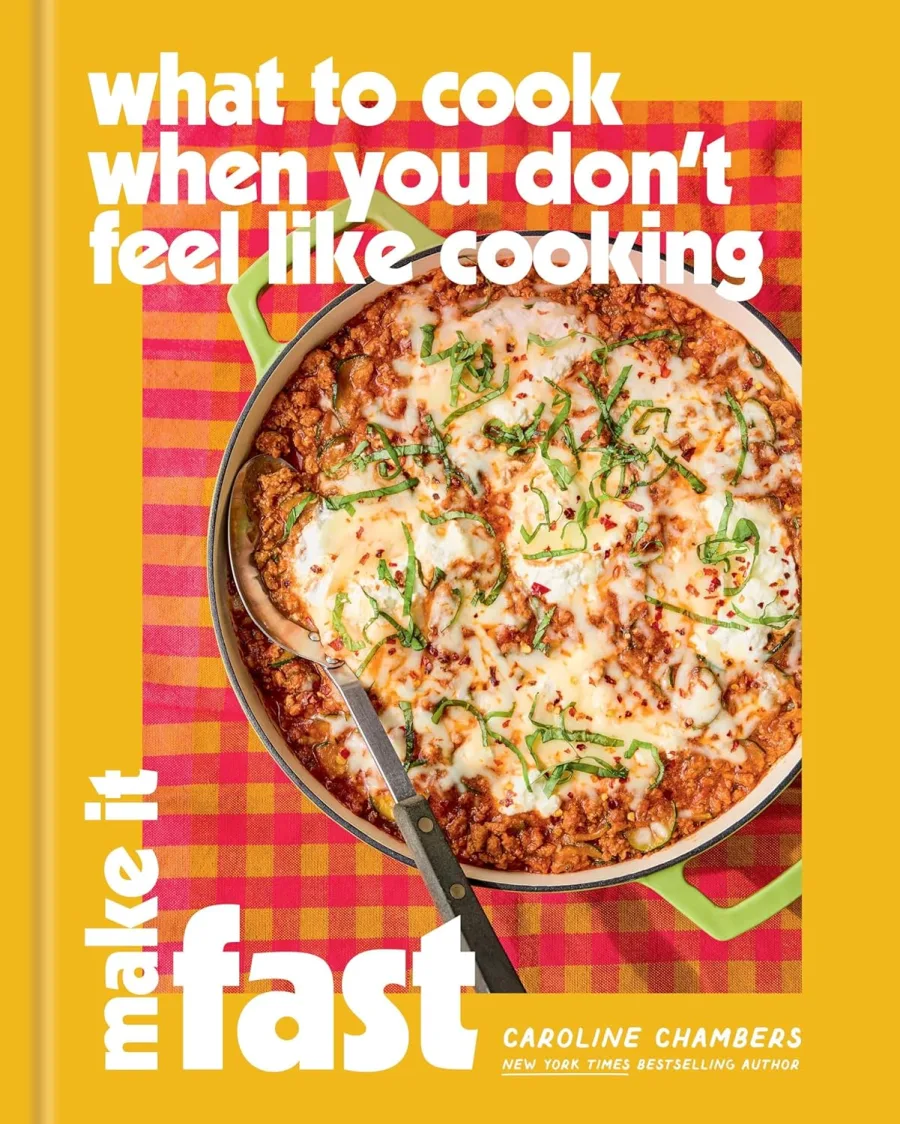
Download Cover Image
Do you want to download the full cover image for What to Cook When You Don’t Feel Like Cooking: Make It Fast?