
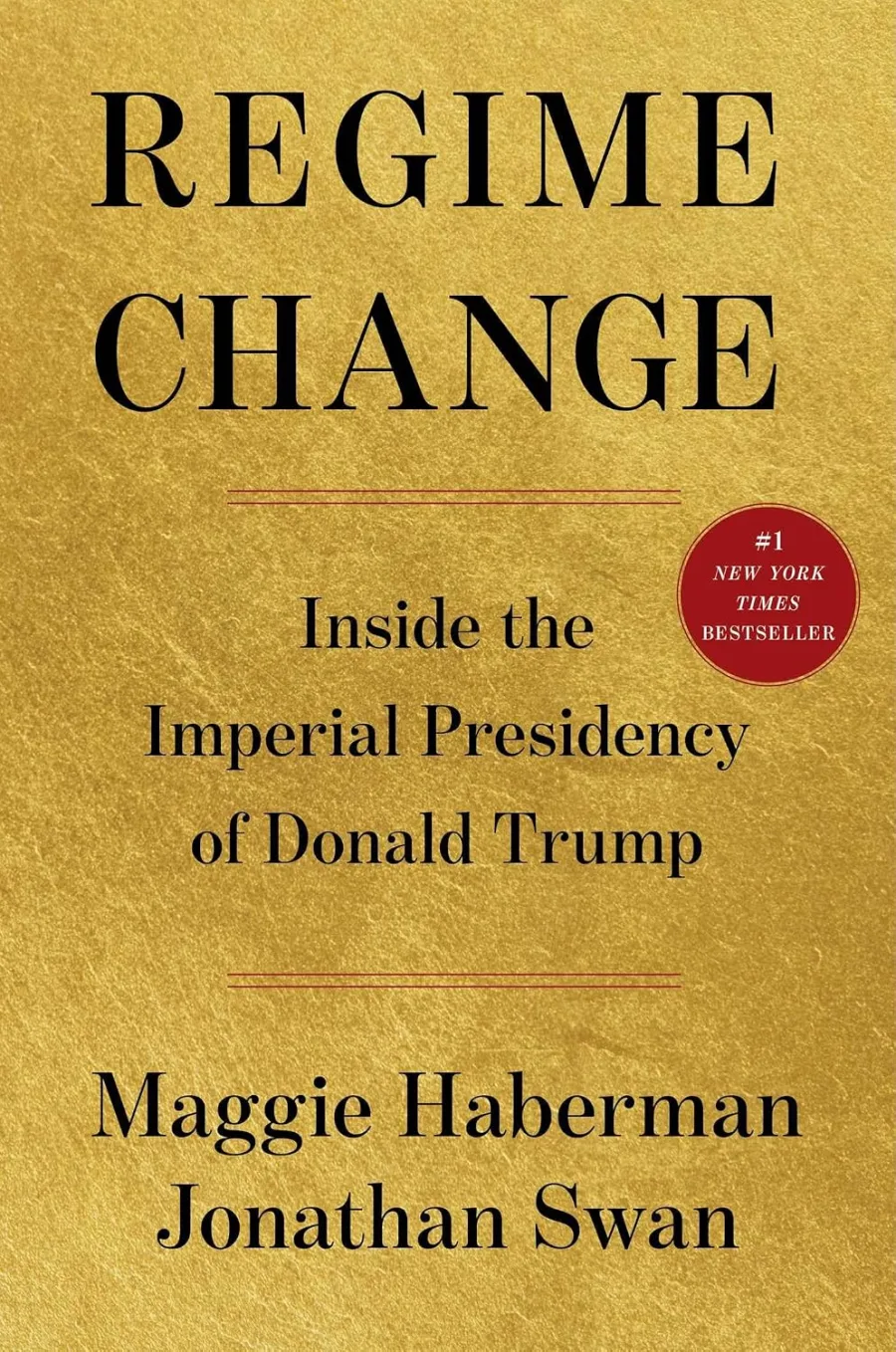
Regime Change: Inside the Imperial Presidency of Donald Trump
Maggie Haberman, Jonathan Swan
eBook
• 496 Pages
• USD 34.00
• English
• 9781668067260
No ratings yet
| Publisher | Simon & Schuster |
|---|---|
| ISBN13 | 9781668067260 |
| ASIN/SKU | B0FH2K4T1C |
| Book Format | eBook |
| Language | English |
| Pages | 496 |
| List Price | USD 34.00 |
| Publishing Date | 23/06/2026 |
| Book Code | BD00067154 |
Buy this Book
Amazon Stores
Ebook Stores
Other Stores
Discover Regime Change: Inside the Imperial Presidency of Donald Trump by Maggie Haberman. This book is published by Simon and Schuster in eBook format, ISBN 9781668067260, ASIN B0FH2K4T1C, under Politics and Social Sciences, Campaigns and Elections, United States Executive Government.
Book Description
“Regime Change is exceptional. It transcends its genre...the book is packed with news that will stay news...This is reporting of consequence.” —David Remnick, The New Yorker
“A flabbergasting feat of political reporting.” —Tina Brown
“Riveting and richly textured...What the authors add is the vivid detail that makes these events feel actual. They wrest reality itself back from the distorted world of entertainment, illusion, fantasy and denial that Trump has generated around himself. It is this flood of provocation, atrocity, self-dealing and fabrication that makes Haberman and Swan’s counternarrative so vital.” —Fintan O’Toole, The New York Times
A riveting, intimate, and revelatory account of the most radical and consequential presidency of our time.
From the two reporters who have covered him more closely than perhaps anyone else over the past decade comes this definitive portrait of Donald Trump in the White House. Regime Change covers the first year of Trump’s second presidency—a term liberated from every constraint that defined his first. The generals who once told him “no” are gone, and the lawyers who remain have learned to pick their battles. His administration has flouted court orders and he has claimed powers that Congress once checked. What remains is a President willing to take enormous risks that have upended global markets and toppled heads of state; an imperial President operating almost entirely on instinct alone.
Based on hundreds of interviews and unprecedented reporting from deep within the administration’s most closely guarded rooms, Regime Change takes the reader inside the Situation Room and into the secret Oval Office deliberations that have launched a new war in the Middle East and seen Trump seal the border, surge National Guard troops into cities, and send immigration agents into deadly clashes with protestors. Maggie Haberman and Jonathan Swan bring us behind the scenes of a presidency that has transformed the culture, turned the Justice Department into an agent of retribution against the President’s enemies and the office itself into a brazen vehicle for profit. They reveal a second term propelled by a historical irony that Trump himself has come to understand: that the indictments, the convictions, the assassination attempts, and four years of exile made him not weaker but far more powerful, more vengeful, and more willing to gamble than any President in modern history.
This is the story of how Trump has used that power, who has tried to stop him, and why nearly all of them have failed. It is also the story of something American journalists are more accustomed to chronicling in distant capitals than in their own: a President who has fundamentally altered the nature of the office he holds—and, with it, how the rest of the world understands American power. It is an account of Regime Change right here in America—a landmark real-time history of a modern presidency like no other.
“A flabbergasting feat of political reporting.” —Tina Brown
“Riveting and richly textured...What the authors add is the vivid detail that makes these events feel actual. They wrest reality itself back from the distorted world of entertainment, illusion, fantasy and denial that Trump has generated around himself. It is this flood of provocation, atrocity, self-dealing and fabrication that makes Haberman and Swan’s counternarrative so vital.” —Fintan O’Toole, The New York Times
A riveting, intimate, and revelatory account of the most radical and consequential presidency of our time.
From the two reporters who have covered him more closely than perhaps anyone else over the past decade comes this definitive portrait of Donald Trump in the White House. Regime Change covers the first year of Trump’s second presidency—a term liberated from every constraint that defined his first. The generals who once told him “no” are gone, and the lawyers who remain have learned to pick their battles. His administration has flouted court orders and he has claimed powers that Congress once checked. What remains is a President willing to take enormous risks that have upended global markets and toppled heads of state; an imperial President operating almost entirely on instinct alone.
Based on hundreds of interviews and unprecedented reporting from deep within the administration’s most closely guarded rooms, Regime Change takes the reader inside the Situation Room and into the secret Oval Office deliberations that have launched a new war in the Middle East and seen Trump seal the border, surge National Guard troops into cities, and send immigration agents into deadly clashes with protestors. Maggie Haberman and Jonathan Swan bring us behind the scenes of a presidency that has transformed the culture, turned the Justice Department into an agent of retribution against the President’s enemies and the office itself into a brazen vehicle for profit. They reveal a second term propelled by a historical irony that Trump himself has come to understand: that the indictments, the convictions, the assassination attempts, and four years of exile made him not weaker but far more powerful, more vengeful, and more willing to gamble than any President in modern history.
This is the story of how Trump has used that power, who has tried to stop him, and why nearly all of them have failed. It is also the story of something American journalists are more accustomed to chronicling in distant capitals than in their own: a President who has fundamentally altered the nature of the office he holds—and, with it, how the rest of the world understands American power. It is an account of Regime Change right here in America—a landmark real-time history of a modern presidency like no other.
Author Biography
Maggie Haberman is a White House correspondent for The New York Times. A New York City native, Haberman worked at the New York Post, New York Daily News, and Politico, before joining the Times in 2015. She has covered six US presidential elections and several gubernatorial and New York City mayoral races. She was part of a team that won a Pulitzer Prize in 2018 for reporting on President Trump’s advisers and their connections to Russia. In 2021, she was part of a team that was a Pulitzer finalist for coverage of President Trump’s handling of the coronavirus. She has received the White House Correspondents’ Association’s Aldo Beckman Award, as well as the Newswomen’s Club of New York’s Front Page Award for Journalist of the Year. She is the author of Confidence Man: The Making of Donald Trump and the Breaking of America. She lives in New York City with her husband and their three children.
Editorial Reviews
“Please get this book.”
—Jon Stewart, The Daily Show
"Regime Change paints a vivid and deeply unsettling tableau of a chaotic period during which Trump has governed with awesome power and unprecedented impunity."
—Vanity Fair
“There are no words to describe the dramatic impact it’s having on this country.”
—Mika Brzezinski, Morning Joe
“Revelations we’ve never heard before.”
—Gayle King, CBS Mornings
“Such an incredibly fascinating read…really extraordinary.”
—Anderson Cooper
"A blockbuster new book."
—Guardian
“When you talk about jaw-dropping, jaw dropping…I could not catch my breath.”
—Whoopi Goldberg, The View
"Illuminating and disturbing reportage."
—Financial Times
“The Trump White House has been rocked by stunning new reporting.”
—Lawrence O'Donnell, The Last Word
"One of the best books ever written about Donald Trump."
—Sydney Morning Herald
—Jon Stewart, The Daily Show
"Regime Change paints a vivid and deeply unsettling tableau of a chaotic period during which Trump has governed with awesome power and unprecedented impunity."
—Vanity Fair
“There are no words to describe the dramatic impact it’s having on this country.”
—Mika Brzezinski, Morning Joe
“Revelations we’ve never heard before.”
—Gayle King, CBS Mornings
“Such an incredibly fascinating read…really extraordinary.”
—Anderson Cooper
"A blockbuster new book."
—Guardian
“When you talk about jaw-dropping, jaw dropping…I could not catch my breath.”
—Whoopi Goldberg, The View
"Illuminating and disturbing reportage."
—Financial Times
“The Trump White House has been rocked by stunning new reporting.”
—Lawrence O'Donnell, The Last Word
"One of the best books ever written about Donald Trump."
—Sydney Morning Herald
Book Summary
Maggie Haberman and Jonathan Swan’s meticulously reported book, Regime Change: Inside the Imperial Presidency of Donald Trump, offers a stark, deeply detailed account of the first year of Donald Trump’s second term in the White House. Published in June 2026, the non-fiction narrative draws on hundreds of interviews to bring readers inside the most closely guarded rooms of the administration. Rather than simply chronicling day-to-day political events, the journalists paint a definitive portrait of a radically transformed presidency, one that has been completely liberated from the traditional constraints that defined Trump’s initial four years in office. The authors argue that this second term represents an unprecedented shift in American governance, essentially amounting to a domestic regime change that has fundamentally altered the nature of the executive branch and how the rest of the world understands American power.
A central theme of the book is the stark contrast between Trump’s first and second terms, specifically focusing on the personnel who surround the Oval Office. During his first term, Trump appointed traditional establishment figures, such as James Mattis and John Kelly, who often pushed back against his more impulsive directives and tried to serve as guardrails against his worldview. In this second term, however, those generals and institutionalists are entirely gone. They have been replaced by a small, insulated, and intensely loyal inner circle. Even the White House legal personnel have shifted; the lawyers who remain have learned to pick their battles carefully, rarely advising against the president’s core directives. This absence of internal friction has given rise to a personalized style of governance where the president operates almost entirely on instinct, taking enormous risks with sweeping domestic and international consequences.
The authors explore the profound historical irony that fueled this transformation: the very forces meant to hold Trump accountable actually forged him into a more formidable and unrestrained executive. Haberman and Swan detail how years of legal challenges, indictments, convictions, and assassination attempts during his political exile did not weaken him. Instead, these events convinced him that his legal troubles were purely partisan attacks, allowing him to cast his 2020 election loss as illegitimate. Consequently, he returned to the presidency far more powerful, vengeful, and willing to gamble than any modern American leader. Empowered by a sense of survival and grievance, Trump's second administration is characterized by a willingness to flout court orders and bypass the traditional checks once imposed by Congress.
This unrestrained approach to power is vividly illustrated in the book’s behind-the-scenes reporting on major policy decisions and national crises. The authors take readers inside secret Oval Office and Situation Room deliberations that have upended global stability. They recount discussions surrounding the launch of a new war in the Middle East, a massive geopolitical gamble executed with little regard for institutional caution. Domestically, the administration's actions are just as radical. The book details the aggressive closing of the United States border and the controversial deployment of National Guard troops into American cities. This hardline approach has sparked intense domestic unrest, leading to documented violence between protesters and immigration agents. Through these events, Haberman and Swan showcase an imperial president who acts decisively and unilaterally, often blindsiding both allies and adversaries on the world stage.
Beyond policy, Regime Change delves into the institutional decay and the politicization of federal agencies under Trump's renewed authority. A major focus of the book is the transformation of the Justice Department. The authors present claims and evidence that the department has been directed to target the president's political opponents, effectively acting as an agent of retribution. Furthermore, the book scrutinizes the ethical boundaries of the administration, highlighting widespread criticisms that the presidency is increasingly being utilized as a brazen vehicle for profit, blurring the lines between public service and private enterprise. The reporting even touches on startling internal revelations, such as high-level Situation Room meetings pertaining to the notorious Epstein files, underscoring the chaotic and highly irregular priorities of the administration.
Ultimately, Haberman and Swan conclude that this era cannot be viewed through the traditional lens of American politics. The title Regime Change serves as a sobering thesis: the structural and cultural shifts brought about by Trump’s second term resemble the kind of authoritarian consolidation that American journalists usually cover in distant, unstable capitals, rather than in Washington, D.C.. By capturing the world-class bluster alongside the deeply concerning realities of this governance style, the authors document a republic under profound strain. The book stands as a landmark, real-time history of a presidency that has stripped away the illusion of institutional invulnerability, revealing an American executive branch permanently reshaped by grievance, absolute loyalty, and the unyielding will of a singular, imperial leader.
A central theme of the book is the stark contrast between Trump’s first and second terms, specifically focusing on the personnel who surround the Oval Office. During his first term, Trump appointed traditional establishment figures, such as James Mattis and John Kelly, who often pushed back against his more impulsive directives and tried to serve as guardrails against his worldview. In this second term, however, those generals and institutionalists are entirely gone. They have been replaced by a small, insulated, and intensely loyal inner circle. Even the White House legal personnel have shifted; the lawyers who remain have learned to pick their battles carefully, rarely advising against the president’s core directives. This absence of internal friction has given rise to a personalized style of governance where the president operates almost entirely on instinct, taking enormous risks with sweeping domestic and international consequences.
The authors explore the profound historical irony that fueled this transformation: the very forces meant to hold Trump accountable actually forged him into a more formidable and unrestrained executive. Haberman and Swan detail how years of legal challenges, indictments, convictions, and assassination attempts during his political exile did not weaken him. Instead, these events convinced him that his legal troubles were purely partisan attacks, allowing him to cast his 2020 election loss as illegitimate. Consequently, he returned to the presidency far more powerful, vengeful, and willing to gamble than any modern American leader. Empowered by a sense of survival and grievance, Trump's second administration is characterized by a willingness to flout court orders and bypass the traditional checks once imposed by Congress.
This unrestrained approach to power is vividly illustrated in the book’s behind-the-scenes reporting on major policy decisions and national crises. The authors take readers inside secret Oval Office and Situation Room deliberations that have upended global stability. They recount discussions surrounding the launch of a new war in the Middle East, a massive geopolitical gamble executed with little regard for institutional caution. Domestically, the administration's actions are just as radical. The book details the aggressive closing of the United States border and the controversial deployment of National Guard troops into American cities. This hardline approach has sparked intense domestic unrest, leading to documented violence between protesters and immigration agents. Through these events, Haberman and Swan showcase an imperial president who acts decisively and unilaterally, often blindsiding both allies and adversaries on the world stage.
Beyond policy, Regime Change delves into the institutional decay and the politicization of federal agencies under Trump's renewed authority. A major focus of the book is the transformation of the Justice Department. The authors present claims and evidence that the department has been directed to target the president's political opponents, effectively acting as an agent of retribution. Furthermore, the book scrutinizes the ethical boundaries of the administration, highlighting widespread criticisms that the presidency is increasingly being utilized as a brazen vehicle for profit, blurring the lines between public service and private enterprise. The reporting even touches on startling internal revelations, such as high-level Situation Room meetings pertaining to the notorious Epstein files, underscoring the chaotic and highly irregular priorities of the administration.
Ultimately, Haberman and Swan conclude that this era cannot be viewed through the traditional lens of American politics. The title Regime Change serves as a sobering thesis: the structural and cultural shifts brought about by Trump’s second term resemble the kind of authoritarian consolidation that American journalists usually cover in distant, unstable capitals, rather than in Washington, D.C.. By capturing the world-class bluster alongside the deeply concerning realities of this governance style, the authors document a republic under profound strain. The book stands as a landmark, real-time history of a presidency that has stripped away the illusion of institutional invulnerability, revealing an American executive branch permanently reshaped by grievance, absolute loyalty, and the unyielding will of a singular, imperial leader.
Sample Chapters
Sample Chapters will be added soon…
Reader Reviews
No reviews yet.
Regime Change: Inside the Imperial Presidency of Donald Trump
Download Cover Image
Do you want to download the full cover image for Regime Change: Inside the Imperial Presidency of Donald Trump?