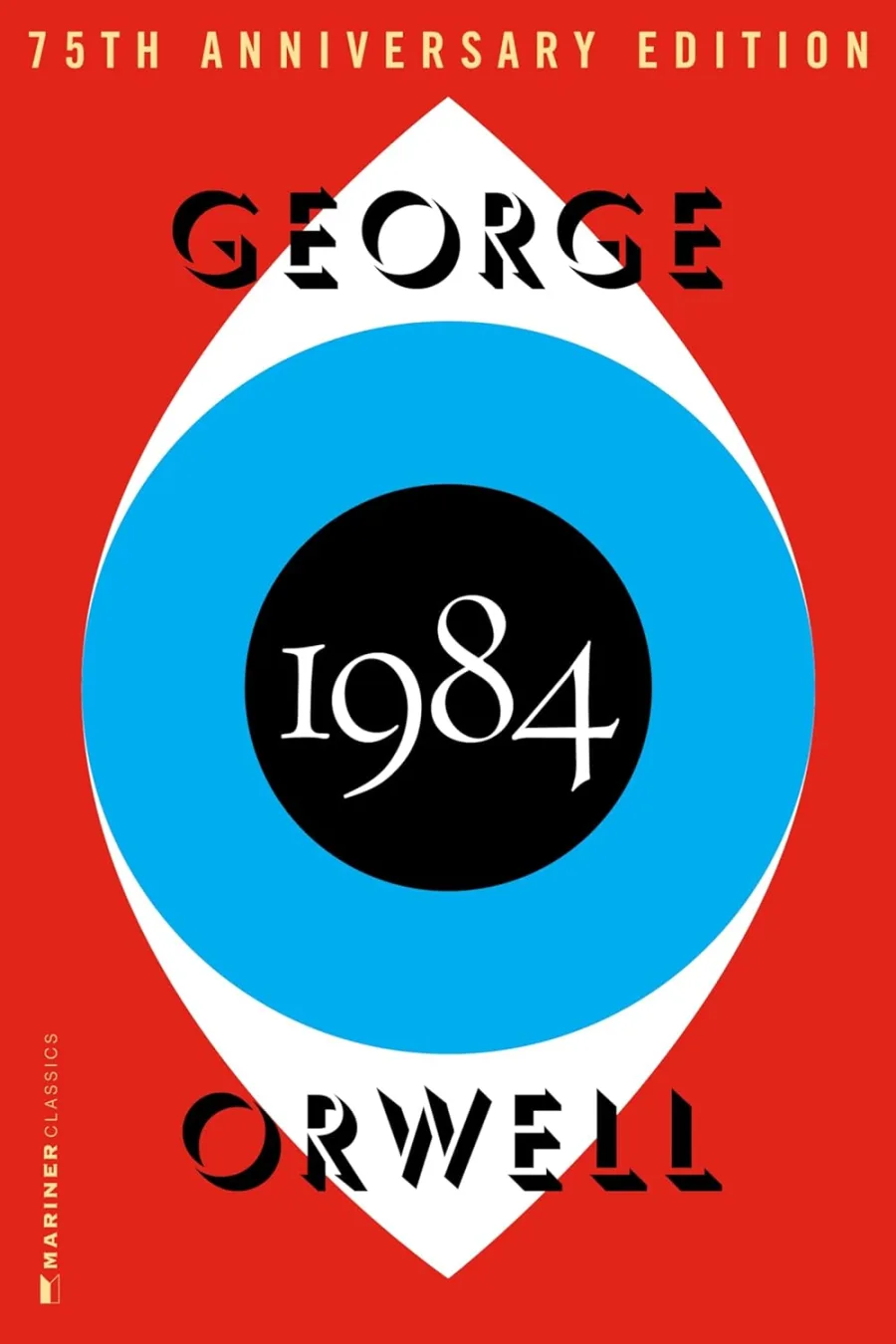
1984
Hardcover
• 304 Pages
• USD 10.97
• English
• 9781328869333
No ratings yet
| Publisher | Mariner Books Classics |
|---|---|
| ISBN13 | 9781328869333 |
| ASIN/SKU | 1328869334 |
| Book Format | Hardcover |
| Language | English |
| Pages | 304 |
| List Price | USD 10.97 |
| Publishing Date | 04/04/2017 |
| Dimensions | 5.5 x 1 x 8.25 inches |
| Weight | 2.31 pounds |
| Book Code | BD00067187 |
Buy this Book
Amazon Stores
Ebook Stores
Other Stores
Discover 1984 by George Orwell. This book is published by Mariner Books Classics in Hardcover format, ISBN 9781328869333, ASIN 1328869334, under Literature and Fiction, Political Fiction, British and Irish Humor and Satire.
Book Description
75th ANNIVERSARY EDITION
“Orwell saw, to his credit, that the act of falsifying reality is only secondarily a way of changing perceptions. It is, above all, a way of asserting power.”—The New Yorker
In 1984, London is a grim city in the totalitarian state of Oceania where Big Brother is always watching you and the Thought Police can practically read your mind. Winston Smith is a man in grave danger for the simple reason that his memory still functions. Drawn into a forbidden love affair, Winston finds the courage to join a secret revolutionary organization called The Brotherhood, dedicated to the destruction of the Party. Together with his beloved Julia, he hazards his life in a deadly match against the powers that be.
Lionel Trilling said of Orwell’s masterpiece “1984 is a profound, terrifying, and wholly fascinating book. It is a fantasy of the political future, and like any such fantasy, serves its author as a magnifying device for an examination of the present.” Though the year 1984 now exists in the past, Orwell’s dystopian classic remains an urgent call for the individual willing to speak truth to power.
“Orwell saw, to his credit, that the act of falsifying reality is only secondarily a way of changing perceptions. It is, above all, a way of asserting power.”—The New Yorker
In 1984, London is a grim city in the totalitarian state of Oceania where Big Brother is always watching you and the Thought Police can practically read your mind. Winston Smith is a man in grave danger for the simple reason that his memory still functions. Drawn into a forbidden love affair, Winston finds the courage to join a secret revolutionary organization called The Brotherhood, dedicated to the destruction of the Party. Together with his beloved Julia, he hazards his life in a deadly match against the powers that be.
Lionel Trilling said of Orwell’s masterpiece “1984 is a profound, terrifying, and wholly fascinating book. It is a fantasy of the political future, and like any such fantasy, serves its author as a magnifying device for an examination of the present.” Though the year 1984 now exists in the past, Orwell’s dystopian classic remains an urgent call for the individual willing to speak truth to power.
Author Biography
George Orwell is one of England's most famous writers and social commentators. Among his works are the classic political satire Animal Farm and the dystopian nightmare vision Nineteen Eighty-Four. Orwell was also a prolific essayist, and it is for these works that he was perhaps best known during his lifetime. They include Why I Write and Politics and the English Language. His writing is at once insightful, poignant and entertaining, and continues to be read widely all over the world.
Eric Arthur Blair (George Orwell) was born in 1903 in India, where his father worked for the Civil Service. The family moved to England in 1907 and in 1917 Orwell entered Eton, where he contributed regularly to the various college magazines. From 1922 to 1927 he served with the Indian Imperial Police in Burma, an experience that inspired his first novel, Burmese Days (1934). Several years of poverty followed. He lived in Paris for two years before returning to England, where he worked successively as a private tutor, schoolteacher and bookshop assistant, and contributed reviews and articles to a number of periodicals. Down and Out in Paris and London was published in 1933. In 1936 he was commissioned by Victor Gollancz to visit areas of mass unemployment in Lancashire and Yorkshire, and The Road to Wigan Pier (1937) is a powerful description of the poverty he saw there.
At the end of 1936 Orwell went to Spain to fight for the Republicans and was wounded. Homage to Catalonia is his account of the civil war. He was admitted to a sanatorium in 1938 and from then on was never fully fit. He spent six months in Morocco and there wrote Coming Up for Air. During the Second World War he served in the Home Guard and worked for the BBC Eastern Service from 1941 to 1943. As literary editor of the Tribune he contributed a regular page of political and literary commentary, and he also wrote for the Observer and later for the Manchester Evening News. His unique political allegory, Animal Farm was published in 1945, and it was this novel, together with Nineteen Eighty-Four (1949), which brought him world-wide fame.
It was around this time that Orwell's unique political allegory Animal Farm (1945) was published. The novel is recognised as a classic of modern political satire and is simultaneously an engaging story and convincing allegory. It was this novel, together with Nineteen Eighty-Four (1949), which finally brought him world-wide fame. Nineteen Eighty-Four's ominous depiction of a repressive, totalitarian regime shocked contemporary readers, but ensures that the book remains perhaps the preeminent dystopian novel of modern literature.
Orwell's fiercely moral writing has consistently struck a chord with each passing generation. The intense honesty and insight of his essays and non-fiction made Orwell one of the foremost social commentators of his age. Added to this, his ability to construct elaborately imaginative fictional worlds, which he imbued with this acute sense of morality, has undoubtedly assured his contemporary and future relevance.
George Orwell died in London in January 1950.
Eric Arthur Blair (George Orwell) was born in 1903 in India, where his father worked for the Civil Service. The family moved to England in 1907 and in 1917 Orwell entered Eton, where he contributed regularly to the various college magazines. From 1922 to 1927 he served with the Indian Imperial Police in Burma, an experience that inspired his first novel, Burmese Days (1934). Several years of poverty followed. He lived in Paris for two years before returning to England, where he worked successively as a private tutor, schoolteacher and bookshop assistant, and contributed reviews and articles to a number of periodicals. Down and Out in Paris and London was published in 1933. In 1936 he was commissioned by Victor Gollancz to visit areas of mass unemployment in Lancashire and Yorkshire, and The Road to Wigan Pier (1937) is a powerful description of the poverty he saw there.
At the end of 1936 Orwell went to Spain to fight for the Republicans and was wounded. Homage to Catalonia is his account of the civil war. He was admitted to a sanatorium in 1938 and from then on was never fully fit. He spent six months in Morocco and there wrote Coming Up for Air. During the Second World War he served in the Home Guard and worked for the BBC Eastern Service from 1941 to 1943. As literary editor of the Tribune he contributed a regular page of political and literary commentary, and he also wrote for the Observer and later for the Manchester Evening News. His unique political allegory, Animal Farm was published in 1945, and it was this novel, together with Nineteen Eighty-Four (1949), which brought him world-wide fame.
It was around this time that Orwell's unique political allegory Animal Farm (1945) was published. The novel is recognised as a classic of modern political satire and is simultaneously an engaging story and convincing allegory. It was this novel, together with Nineteen Eighty-Four (1949), which finally brought him world-wide fame. Nineteen Eighty-Four's ominous depiction of a repressive, totalitarian regime shocked contemporary readers, but ensures that the book remains perhaps the preeminent dystopian novel of modern literature.
Orwell's fiercely moral writing has consistently struck a chord with each passing generation. The intense honesty and insight of his essays and non-fiction made Orwell one of the foremost social commentators of his age. Added to this, his ability to construct elaborately imaginative fictional worlds, which he imbued with this acute sense of morality, has undoubtedly assured his contemporary and future relevance.
George Orwell died in London in January 1950.
Editorial Reviews
One of the BBC's 100 Novels that Shaped the World “Orwell saw, to his credit, that the act of falsifying reality is only secondarily a way of changing perceptions. It is, above all, a way of asserting power.”—The New Yorker “1984 is a profound, terrifying, and wholly fascinating book. It is a fantasy of the political future, and like any such fantasy, serves its author as a magnifying device for an examination of the present.”—Lionel Trilling
Book Summary
George Orwell’s 1984 drops us into a deeply unsettling vision of the future, set in the grim and decaying totalitarian superstate of Oceania. The society is ruled with an iron fist by the Party, a political entity symbolized by the ever-present face of Big Brother, a mythical leader whose posters blanket the city of London, now known as Airstrip One. In this world, privacy does not exist. Citizens are constantly monitored by two-way telescreens, hidden microphones, and an organization known as the Thought Police, who brutally eliminate anyone suspected of disloyalty. The Party exerts such extreme control over human life that even holding an unauthorized or rebellious thought is punishable by death, an offense terrifyingly termed "thoughtcrime."
The story follows Winston Smith, an outwardly compliant but secretly disillusioned mid-level worker at the Ministry of Truth. Winston’s daily job involves continuously altering historical records, news articles, and photographs so they match the Party’s ever-shifting official narrative. If the Party changes its alliances in its perpetual global war, Winston retroactively rewrites the archives to make it look like the current alliance has existed forever. Through this relentless manipulation of facts, alongside the enforcement of "Newspeak"—a severely limited language designed to make rebellious thoughts literally impossible to articulate—the Party maintains a monopoly on reality itself. Despite participating in this system, Winston despises the Party. His silent rebellion begins when he illegally purchases a beautiful, blank diary from a dusty antique shop in a working-class neighborhood. Knowing that writing in it guarantees his eventual arrest and execution, he nevertheless begins to document his subversive thoughts, driven by a desperate need to hold on to his memory and objective truth.
Winston’s isolation begins to crack when he meets Julia, a vibrant young woman who works on the novel-writing machines in his department. Initially, Winston is terrified of her, convinced she is a spy aiming to turn him in. His fears are shattered when she covertly slips him a small piece of paper that simply reads, "I love you." The two embark on a highly illegal and dangerous love affair, meeting in hidden groves in the countryside and eventually renting a secluded room above the same antique shop where Winston bought his diary. Their relationship becomes a private oasis of humanity and affection in an otherwise cold, mechanical world. However, their motivations differ wildly. While Winston’s rebellion is deeply philosophical and rooted in a desperate desire to overthrow the system, Julia’s resistance is practical and personal; she hates the Party simply because it prevents her from having fun, enjoying sex, and living life on her own terms.
United by their mutual hatred for the regime, Winston and Julia take a massive risk by reaching out to O’Brien, a powerful Inner Party member whom Winston instinctively believes is part of a legendary underground resistance known as the Brotherhood. O’Brien invites them to his luxurious apartment, confirms their suspicions, and provides Winston with a copy of the ultimate forbidden text: a book authored by Emmanuel Goldstein, the Party’s greatest enemy. The book thoroughly explains the mechanics of the Party’s control and its reliance on "doublethink," the practice of holding two contradictory beliefs in one's mind simultaneously and genuinely accepting both. Winston reads it with a profound sense of validation, but his comfort is short-lived.
Their sanctuary is abruptly destroyed when the Thought Police raid their rented room. To Winston’s horror, the kindly antique shop owner, Mr. Charrington, is revealed to be an undercover agent. For months, a telescreen hidden behind a painting in their room had been recording their every whisper and embrace. Winston and Julia are forcefully separated and taken to the dreaded Ministry of Love, a windowless fortress designed to crush political dissidents.
Inside the Ministry, Winston discovers the most devastating truth of all: O’Brien was never a rebel. He is a loyal agent of the Party who has been meticulously watching and entrapping Winston for years. O’Brien personally oversees Winston’s torture, initiating a grueling, agonizing campaign to break him both physically and mentally. The Party does not just want to kill its enemies; it demands absolute obedience and insists on reshaping their minds entirely before executing them. Through unimaginable pain, O’Brien forces Winston to abandon all logic and accept the Party’s reality, convincing him that if the Party dictates two plus two equals five, it genuinely does.
The final, fatal blow comes in Room 101, an interrogation chamber where prisoners face their deepest, darkest phobias. For Winston, this means rats. When O’Brien straps a cage of starving rats to Winston’s face, Winston’s spirit completely shatters. In a blind panic, he begs for the torture to be inflicted on Julia instead, definitively betraying the only person he loved. Having lost his final shred of humanity and loyalty, Winston is released back into society as a broken, empty shell. The novel ends with Winston sitting alone in a cafe, tears welling in his eyes as he looks up at a poster of Big Brother, finally realizing that the struggle is over. He has won the victory over himself; he truly loves Big Brother.
The story follows Winston Smith, an outwardly compliant but secretly disillusioned mid-level worker at the Ministry of Truth. Winston’s daily job involves continuously altering historical records, news articles, and photographs so they match the Party’s ever-shifting official narrative. If the Party changes its alliances in its perpetual global war, Winston retroactively rewrites the archives to make it look like the current alliance has existed forever. Through this relentless manipulation of facts, alongside the enforcement of "Newspeak"—a severely limited language designed to make rebellious thoughts literally impossible to articulate—the Party maintains a monopoly on reality itself. Despite participating in this system, Winston despises the Party. His silent rebellion begins when he illegally purchases a beautiful, blank diary from a dusty antique shop in a working-class neighborhood. Knowing that writing in it guarantees his eventual arrest and execution, he nevertheless begins to document his subversive thoughts, driven by a desperate need to hold on to his memory and objective truth.
Winston’s isolation begins to crack when he meets Julia, a vibrant young woman who works on the novel-writing machines in his department. Initially, Winston is terrified of her, convinced she is a spy aiming to turn him in. His fears are shattered when she covertly slips him a small piece of paper that simply reads, "I love you." The two embark on a highly illegal and dangerous love affair, meeting in hidden groves in the countryside and eventually renting a secluded room above the same antique shop where Winston bought his diary. Their relationship becomes a private oasis of humanity and affection in an otherwise cold, mechanical world. However, their motivations differ wildly. While Winston’s rebellion is deeply philosophical and rooted in a desperate desire to overthrow the system, Julia’s resistance is practical and personal; she hates the Party simply because it prevents her from having fun, enjoying sex, and living life on her own terms.
United by their mutual hatred for the regime, Winston and Julia take a massive risk by reaching out to O’Brien, a powerful Inner Party member whom Winston instinctively believes is part of a legendary underground resistance known as the Brotherhood. O’Brien invites them to his luxurious apartment, confirms their suspicions, and provides Winston with a copy of the ultimate forbidden text: a book authored by Emmanuel Goldstein, the Party’s greatest enemy. The book thoroughly explains the mechanics of the Party’s control and its reliance on "doublethink," the practice of holding two contradictory beliefs in one's mind simultaneously and genuinely accepting both. Winston reads it with a profound sense of validation, but his comfort is short-lived.
Their sanctuary is abruptly destroyed when the Thought Police raid their rented room. To Winston’s horror, the kindly antique shop owner, Mr. Charrington, is revealed to be an undercover agent. For months, a telescreen hidden behind a painting in their room had been recording their every whisper and embrace. Winston and Julia are forcefully separated and taken to the dreaded Ministry of Love, a windowless fortress designed to crush political dissidents.
Inside the Ministry, Winston discovers the most devastating truth of all: O’Brien was never a rebel. He is a loyal agent of the Party who has been meticulously watching and entrapping Winston for years. O’Brien personally oversees Winston’s torture, initiating a grueling, agonizing campaign to break him both physically and mentally. The Party does not just want to kill its enemies; it demands absolute obedience and insists on reshaping their minds entirely before executing them. Through unimaginable pain, O’Brien forces Winston to abandon all logic and accept the Party’s reality, convincing him that if the Party dictates two plus two equals five, it genuinely does.
The final, fatal blow comes in Room 101, an interrogation chamber where prisoners face their deepest, darkest phobias. For Winston, this means rats. When O’Brien straps a cage of starving rats to Winston’s face, Winston’s spirit completely shatters. In a blind panic, he begs for the torture to be inflicted on Julia instead, definitively betraying the only person he loved. Having lost his final shred of humanity and loyalty, Winston is released back into society as a broken, empty shell. The novel ends with Winston sitting alone in a cafe, tears welling in his eyes as he looks up at a poster of Big Brother, finally realizing that the struggle is over. He has won the victory over himself; he truly loves Big Brother.
Sample Chapters
Sample Chapters will be added soon…
Reader Reviews
No reviews yet.
1984