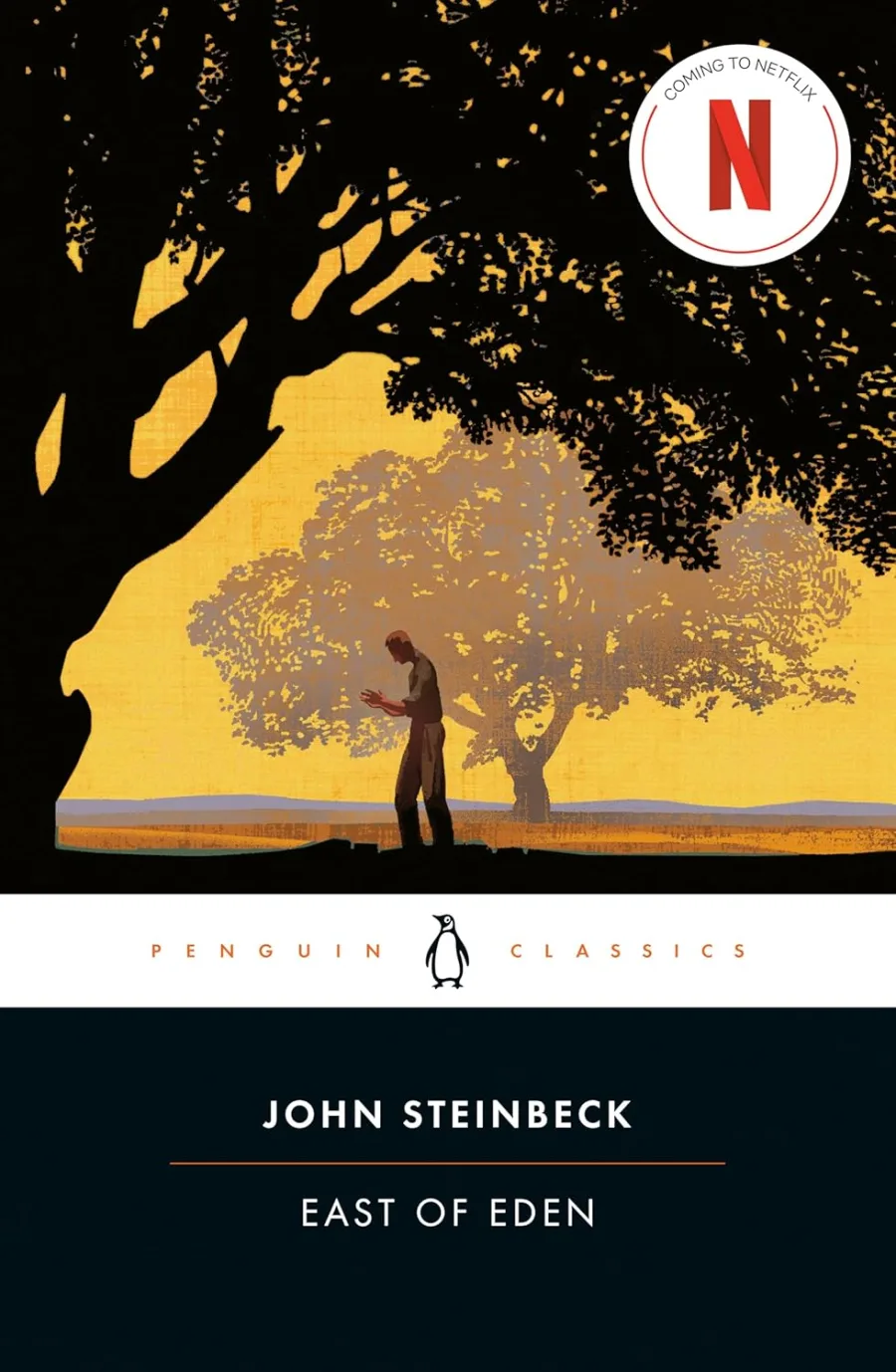
East of Eden
Paperback
• 640 Pages
• USD 20.00
• English
• 9780140186390
No ratings yet
| Publisher | Penguin Classics |
|---|---|
| ISBN13 | 9780140186390 |
| ASIN/SKU | 0140186395 |
| Book Format | Paperback |
| Language | English |
| Pages | 640 |
| List Price | USD 20.00 |
| Publishing Date | 01/01/1952 |
| Dimensions | 7.7 x 5 x 1.2 inches |
| Weight | 14.4 ounces |
| Book Code | BD00067188 |
Buy this Book
Amazon Stores
Ebook Stores
Other Stores
Discover East of Eden by John Steinbeck. This book is published by Penguin Classics in Paperback format, ISBN 9780140186390, ASIN 0140186395, under Literature and Fiction, Family Saga Fiction, Contemporary Literature and Fiction.
Book Description
Soon to be a Netflix series starring Florence Pugh
The masterpiece of Steinbeck’s later years—at once a family saga and a modern retelling of the Book of Genesis
A Penguin Classic
In his journal, Nobel Prize winner John Steinbeck called East of Eden “the first book,” and indeed it has the primordial power and simplicity of myth. Set in the rich farmland of California’s Salinas Valley, this sprawling and often brutal novel follows the intertwined destinies of two families—the Trasks and the Hamiltons—whose generations helplessly reenact the fall of Adam and Eve and the poisonous rivalry of Cain and Abel. Here is a work in which Steinbeck created his most mesmerizing characters and explored his most enduring themes: the mystery of identity, the inexplicability of love, and the murderous consequences of love’s absence. Adapted for the 1955 film directed by Elia Kazan introducing James Dean and read by thousands as the book that brought Oprah’s Book Club back, East of Eden has remained a touchstone of American literature for over half a century.
This edition includes selections from Journal of a Novel: The “East of Eden” Letters by John Steinbeck to his longtime Viking editor Pascal Covici, and recommended resources, adaptations, and parallel texts for readers to explore and discuss.
Penguin Classics is the leading publisher of classic literature in the English-speaking world, representing a global bookshelf of the best works throughout history and across genres and disciplines. Readers trust the series to provide authoritative texts enhanced by introductions and notes by distinguished scholars and contemporary authors, as well as up-to-date translations by award-winning translators.
The masterpiece of Steinbeck’s later years—at once a family saga and a modern retelling of the Book of Genesis
A Penguin Classic
In his journal, Nobel Prize winner John Steinbeck called East of Eden “the first book,” and indeed it has the primordial power and simplicity of myth. Set in the rich farmland of California’s Salinas Valley, this sprawling and often brutal novel follows the intertwined destinies of two families—the Trasks and the Hamiltons—whose generations helplessly reenact the fall of Adam and Eve and the poisonous rivalry of Cain and Abel. Here is a work in which Steinbeck created his most mesmerizing characters and explored his most enduring themes: the mystery of identity, the inexplicability of love, and the murderous consequences of love’s absence. Adapted for the 1955 film directed by Elia Kazan introducing James Dean and read by thousands as the book that brought Oprah’s Book Club back, East of Eden has remained a touchstone of American literature for over half a century.
This edition includes selections from Journal of a Novel: The “East of Eden” Letters by John Steinbeck to his longtime Viking editor Pascal Covici, and recommended resources, adaptations, and parallel texts for readers to explore and discuss.
Penguin Classics is the leading publisher of classic literature in the English-speaking world, representing a global bookshelf of the best works throughout history and across genres and disciplines. Readers trust the series to provide authoritative texts enhanced by introductions and notes by distinguished scholars and contemporary authors, as well as up-to-date translations by award-winning translators.
Author Biography
John Steinbeck (1902–1968) born in Salinas, California, grew up in a fertile agricultural valley, about twenty-five miles from the Pacific Coast. Both the valley and the coast would serve as settings for some of his best fiction. In 1919 he went to Stanford University, where he intermittently enrolled in literature and writing courses until he left in 1925 without taking a degree. During the next five years he supported himself as a laborer and journalist in New York City, all the time working on his first novel, Cup of Gold (1929).
After marriage and a move to Pacific Grove, he published two California books, The Pastures of Heaven (1932) and To a God Unknown (1933), and worked on short stories later collected in The Long Valley (1938). Popular success and financial security came only with Tortilla Flat (1935), stories about Monterey’s paisanos. A ceaseless experimenter throughout his career, Steinbeck changed courses regularly. Three powerful novels of the late 1930s focused on the California laboring class: In Dubious Battle (1936), Of Mice and Men (1937), and the book considered by many his finest, The Grapes of Wrath (1939). The Grapes of Wrath won both the National Book Award and the Pulitzer Prize in 1939.
Early in the 1940s, Steinbeck became a filmmaker with The Forgotten Village (1941) and a serious student of marine biology with Sea of Cortez (1941). He devoted his services to the war, writing Bombs Away (1942) and the controversial play-novelette The Moon is Down (1942). Cannery Row (1945), The Wayward Bus (1948), another experimental drama, Burning Bright (1950), and The Log from the Sea of Cortez (1951) preceded publication of the monumental East of Eden (1952), an ambitious saga of the Salinas Valley and his own family’s history.
The last decades of his life were spent in New York City and Sag Harbor with his third wife, with whom he traveled widely. Later books include Sweet Thursday (1954), The Short Reign of Pippin IV: A Fabrication (1957), Once There Was a War (1958), The Winter of Our Discontent (1961),Travels with Charley in Search of America (1962), America and Americans (1966), and the posthumously published Journal of a Novel: The East of Eden Letters (1969), Viva Zapata! (1975), The Acts of King Arthur and His Noble Knights (1976), and Working Days: The Journals of The Grapes of Wrath (1989).
Steinbeck received the Nobel Prize in Literature in 1962, and, in 1964, he was presented with the United States Medal of Freedom by President Lyndon B. Johnson. Steinbeck died in New York in 1968. Today, more than thirty years after his death, he remains one of America's greatest writers and cultural figures.
After marriage and a move to Pacific Grove, he published two California books, The Pastures of Heaven (1932) and To a God Unknown (1933), and worked on short stories later collected in The Long Valley (1938). Popular success and financial security came only with Tortilla Flat (1935), stories about Monterey’s paisanos. A ceaseless experimenter throughout his career, Steinbeck changed courses regularly. Three powerful novels of the late 1930s focused on the California laboring class: In Dubious Battle (1936), Of Mice and Men (1937), and the book considered by many his finest, The Grapes of Wrath (1939). The Grapes of Wrath won both the National Book Award and the Pulitzer Prize in 1939.
Early in the 1940s, Steinbeck became a filmmaker with The Forgotten Village (1941) and a serious student of marine biology with Sea of Cortez (1941). He devoted his services to the war, writing Bombs Away (1942) and the controversial play-novelette The Moon is Down (1942). Cannery Row (1945), The Wayward Bus (1948), another experimental drama, Burning Bright (1950), and The Log from the Sea of Cortez (1951) preceded publication of the monumental East of Eden (1952), an ambitious saga of the Salinas Valley and his own family’s history.
The last decades of his life were spent in New York City and Sag Harbor with his third wife, with whom he traveled widely. Later books include Sweet Thursday (1954), The Short Reign of Pippin IV: A Fabrication (1957), Once There Was a War (1958), The Winter of Our Discontent (1961),Travels with Charley in Search of America (1962), America and Americans (1966), and the posthumously published Journal of a Novel: The East of Eden Letters (1969), Viva Zapata! (1975), The Acts of King Arthur and His Noble Knights (1976), and Working Days: The Journals of The Grapes of Wrath (1989).
Steinbeck received the Nobel Prize in Literature in 1962, and, in 1964, he was presented with the United States Medal of Freedom by President Lyndon B. Johnson. Steinbeck died in New York in 1968. Today, more than thirty years after his death, he remains one of America's greatest writers and cultural figures.
Editorial Reviews
By the Winner of the Nobel Prize in Literature
“A novel planned on the grandest possible scale . . . One of those occasions when a writer has aimed high and then summoned every ounce of energy, talent, seriousness, and passion of which he was capable. . . . It is an entirely interesting and impressive book.” —The New York Herald Tribune
“A fantasia and myth . . . A strange and original work of art.” —The New York Times Book Review
“A moving, crying pageant with wilderness strengths.” —Carl Sandburg
“When the book club ended a year ago, I said I would bring it back when I found the book that was moving . . . and this is a great one. I read it for myself for the first time and then I had some friends read it. And we think it might be the best novel we've ever read!” —Oprah Winfrey
“A novel planned on the grandest possible scale . . . One of those occasions when a writer has aimed high and then summoned every ounce of energy, talent, seriousness, and passion of which he was capable. . . . It is an entirely interesting and impressive book.” —The New York Herald Tribune
“A fantasia and myth . . . A strange and original work of art.” —The New York Times Book Review
“A moving, crying pageant with wilderness strengths.” —Carl Sandburg
“When the book club ended a year ago, I said I would bring it back when I found the book that was moving . . . and this is a great one. I read it for myself for the first time and then I had some friends read it. And we think it might be the best novel we've ever read!” —Oprah Winfrey
Book Summary
John Steinbeck’s East of Eden is an expansive, deeply philosophical epic that explores the enduring struggle between good and evil, the weight of inherited trauma, and the fundamental human capacity for free will. Set primarily in the sprawling, fertile Salinas Valley of California, the novel weaves together the intertwined destinies of two distinct families: the Hamiltons and the Trasks. Through these families, Steinbeck reimagines the biblical story of Cain and Abel, tracing the cyclical nature of jealousy, rejection, and sin across multiple generations. While the Hamiltons, based on Steinbeck’s own maternal ancestors, are rich in spirit, ingenuity, and warmth despite their financial poverty, the Trasks are wealthy but haunted by dark secrets, emotional isolation, and psychological violence.
The story’s foundations are laid in Connecticut with the first generation of Trask brothers, Adam and Charles. Adam is gentle, trusting, and deeply good, while his half-brother Charles is brooding, violently jealous, and desperately craves the affection of their domineering father, Cyrus. When Cyrus clearly favors Adam’s modest birthday gift over Charles’s expensive one, Charles beats Adam nearly to death, cementing the Cain and Abel dynamic. Into this fractured household steps Cathy Ames, a sociopathic, masterfully manipulative woman fleeing a fiery past in which she murdered her own parents. Beaten and scarred from a previous violent encounter, she is found on the Trasks' doorstep. While Charles sees through her deceptive innocence, Adam falls blindly in love with her. He marries Cathy and moves her to the Salinas Valley, determined to build a flourishing, Eden-like paradise for his new bride.
However, Adam’s paradise is immediately poisoned. Cathy has no desire to be a mother or a traditional wife. Shortly after giving birth to twin boys, she shoots Adam in the shoulder, abandons the family, and moves to the nearby town of Salinas to work at—and eventually take over—a sadistic brothel, renaming herself Kate. Adam is left physically shattered and emotionally paralyzed. For over a decade, he walks through life as a ghost, completely ignoring his nameless sons. The household is kept afloat only by the profound wisdom and quiet strength of Lee, a brilliantly educated Chinese-American servant who masks his intellect behind a stereotypical dialect to survive in a prejudiced society.
Eventually, Lee and the warm-hearted, inventive patriarch of the Hamilton family, Samuel, force Adam to wake from his stupor. They finally name the growing boys Caleb and Aaron, deliberately maintaining the "C" and "A" initials of the biblical brothers. During these profound philosophical conversations, Lee introduces the central thematic anchor of the novel: the concept of timshel. After extensively studying the Hebrew text of the Cain and Abel story with a group of elderly scholars, Lee discovers that a crucial word in God’s message to Cain translates not as a promise ("thou shalt") or a command (do thou), but as a choice: thou mayest. Timshel means that humanity is not doomed by original sin or predestined to commit evil. Instead, every individual possesses the free will to overcome their dark impulses and choose goodness.
As the twins grow into teenagers, the cyclical pattern of their father and uncle repeats. Aron is golden-haired, angelic, universally beloved, and rigidly idealistic. Cal is dark, secretive, and keenly aware of the malice inside himself, constantly fearing he has inherited his mother’s poisoned blood. Unlike Aron, who believes their mother is an angel in heaven, Cal discovers the devastating truth about Kate’s brothel but chooses to protect his brother’s fragile innocence. Cal genuinely wants to be good, but he struggles with intense jealousy over Adam’s clear preference for the effortless, shining Aron.
The climax of the novel hinges on a tragic repetition of rejection. Adam loses his fortune in a failed venture to ship refrigerated lettuce across the country. Desperate to win his father’s love, Cal partners with a businessman and makes a massive profit exploiting the surging price of beans during World War I. He presents the money to Adam as a loving gift to restore his lost fortune. However, an idealistic Adam is horrified by the war profiteering. He violently rejects the money, telling Cal he would rather have him be good and pure like Aron, who has recently started college.
Crushed by this profound rejection, Cal is consumed by a vicious, vengeful jealousy. In a deliberate act of cruelty meant to destroy Aron’s perfect worldview, Cal drags his brother to the brothel and forces him to see their mother in all her degraded reality. The shock completely shatters Aron’s mind. Unable to cope with the ugliness of the world, a devastated Aron drops out of school, enlists in the army, and is quickly killed in the trenches of France. When Adam receives the telegram announcing Aron's death, the sheer grief triggers a severe stroke, leaving him paralyzed and near death.
In the novel's final, heart-wrenching moments, Cal is drowning in guilt, believing he has murdered his brother and fulfilled the doomed destiny of Cain. A desperate Lee brings Cal to the dying Adam's bedside, pleading with Adam to forgive his son. Lee explains that Cal’s terrible mistake was born only from a desperate need for his father's love, and he begs Adam to bless Cal and free him from the crushing weight of inherited sin. With his final breath, Adam summons the last of his strength, raises his hand, and whispers a single word: Timshel. With this final act, Adam grants Cal forgiveness and the ultimate realization that he is not bound by his past, leaving the young man with the beautiful, terrifying freedom to choose his own path.
The story’s foundations are laid in Connecticut with the first generation of Trask brothers, Adam and Charles. Adam is gentle, trusting, and deeply good, while his half-brother Charles is brooding, violently jealous, and desperately craves the affection of their domineering father, Cyrus. When Cyrus clearly favors Adam’s modest birthday gift over Charles’s expensive one, Charles beats Adam nearly to death, cementing the Cain and Abel dynamic. Into this fractured household steps Cathy Ames, a sociopathic, masterfully manipulative woman fleeing a fiery past in which she murdered her own parents. Beaten and scarred from a previous violent encounter, she is found on the Trasks' doorstep. While Charles sees through her deceptive innocence, Adam falls blindly in love with her. He marries Cathy and moves her to the Salinas Valley, determined to build a flourishing, Eden-like paradise for his new bride.
However, Adam’s paradise is immediately poisoned. Cathy has no desire to be a mother or a traditional wife. Shortly after giving birth to twin boys, she shoots Adam in the shoulder, abandons the family, and moves to the nearby town of Salinas to work at—and eventually take over—a sadistic brothel, renaming herself Kate. Adam is left physically shattered and emotionally paralyzed. For over a decade, he walks through life as a ghost, completely ignoring his nameless sons. The household is kept afloat only by the profound wisdom and quiet strength of Lee, a brilliantly educated Chinese-American servant who masks his intellect behind a stereotypical dialect to survive in a prejudiced society.
Eventually, Lee and the warm-hearted, inventive patriarch of the Hamilton family, Samuel, force Adam to wake from his stupor. They finally name the growing boys Caleb and Aaron, deliberately maintaining the "C" and "A" initials of the biblical brothers. During these profound philosophical conversations, Lee introduces the central thematic anchor of the novel: the concept of timshel. After extensively studying the Hebrew text of the Cain and Abel story with a group of elderly scholars, Lee discovers that a crucial word in God’s message to Cain translates not as a promise ("thou shalt") or a command (do thou), but as a choice: thou mayest. Timshel means that humanity is not doomed by original sin or predestined to commit evil. Instead, every individual possesses the free will to overcome their dark impulses and choose goodness.
As the twins grow into teenagers, the cyclical pattern of their father and uncle repeats. Aron is golden-haired, angelic, universally beloved, and rigidly idealistic. Cal is dark, secretive, and keenly aware of the malice inside himself, constantly fearing he has inherited his mother’s poisoned blood. Unlike Aron, who believes their mother is an angel in heaven, Cal discovers the devastating truth about Kate’s brothel but chooses to protect his brother’s fragile innocence. Cal genuinely wants to be good, but he struggles with intense jealousy over Adam’s clear preference for the effortless, shining Aron.
The climax of the novel hinges on a tragic repetition of rejection. Adam loses his fortune in a failed venture to ship refrigerated lettuce across the country. Desperate to win his father’s love, Cal partners with a businessman and makes a massive profit exploiting the surging price of beans during World War I. He presents the money to Adam as a loving gift to restore his lost fortune. However, an idealistic Adam is horrified by the war profiteering. He violently rejects the money, telling Cal he would rather have him be good and pure like Aron, who has recently started college.
Crushed by this profound rejection, Cal is consumed by a vicious, vengeful jealousy. In a deliberate act of cruelty meant to destroy Aron’s perfect worldview, Cal drags his brother to the brothel and forces him to see their mother in all her degraded reality. The shock completely shatters Aron’s mind. Unable to cope with the ugliness of the world, a devastated Aron drops out of school, enlists in the army, and is quickly killed in the trenches of France. When Adam receives the telegram announcing Aron's death, the sheer grief triggers a severe stroke, leaving him paralyzed and near death.
In the novel's final, heart-wrenching moments, Cal is drowning in guilt, believing he has murdered his brother and fulfilled the doomed destiny of Cain. A desperate Lee brings Cal to the dying Adam's bedside, pleading with Adam to forgive his son. Lee explains that Cal’s terrible mistake was born only from a desperate need for his father's love, and he begs Adam to bless Cal and free him from the crushing weight of inherited sin. With his final breath, Adam summons the last of his strength, raises his hand, and whispers a single word: Timshel. With this final act, Adam grants Cal forgiveness and the ultimate realization that he is not bound by his past, leaving the young man with the beautiful, terrifying freedom to choose his own path.
Sample Chapters
Sample Chapters will be added soon…
Reader Reviews
No reviews yet.
East of Eden