
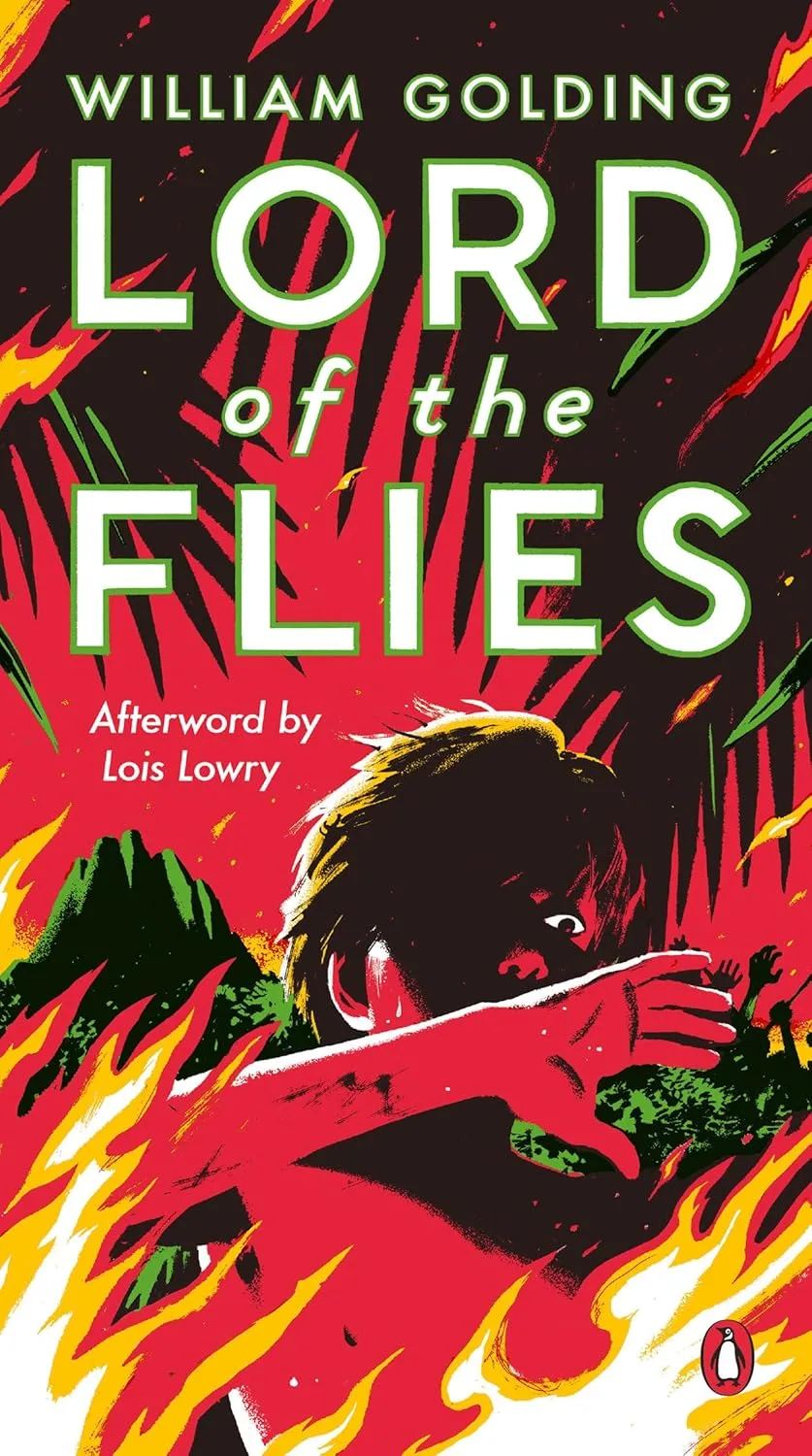
Lord of the Flies
Mass Market Paperback
• 224 Pages
• USD 13.00
• English
• 9780399501487
No ratings yet
| Publisher | Penguin Books |
|---|---|
| ISBN13 | 9780399501487 |
| ASIN/SKU | 0399501487 |
| Book Format | Mass Market Paperback |
| Language | English |
| Pages | 224 |
| List Price | USD 13.00 |
| Publishing Date | 16/12/2003 |
| Dimensions | 4.17 x 0.59 x 7.52 inches |
| Weight | 4.2 ounces |
| Book Code | BD00067196 |
Buy this Book
Amazon Stores
Ebook Stores
Other Stores
Discover Lord of the Flies by William Golding. This book is published by Penguin Books in Mass Market Paperback format, ISBN 9780399501487, ASIN 0399501487, under Literature and Fiction, Censorship and Politics, Teen and Young Adult Classic Literature.
Book Description
NOW A NETFLIX SERIES
William Golding’s profound tale of stranded youth, survival, and the shadowy depths of human nature, with an afterword by Lois Lowry
“Lord of the Flies is one of my favorite books. I still read it every couple of years.”—Suzanne Collins, author of The Hunger Games trilogy
At the dawn of the next World War, a plane crash strands a group of schoolboys on a remote island. There are no grownups. No rules. Freedom is celebrated. But when strange, distant noises and visions of a beast begin to haunt the boys, their fragile order unravels, and all hopes of rescue fade.
Since 1954, William Golding’s Lord of the Flies has shaped our understanding of human nature—the latent darkness within, and the destructive or creative capacity of collective will. This edition also includes Suggestions for Further Exploration by Jennifer Buehler to contextualize Golding’s classic as one of the most timeless and socially relevant texts in the last century of literature.
William Golding’s profound tale of stranded youth, survival, and the shadowy depths of human nature, with an afterword by Lois Lowry
“Lord of the Flies is one of my favorite books. I still read it every couple of years.”—Suzanne Collins, author of The Hunger Games trilogy
At the dawn of the next World War, a plane crash strands a group of schoolboys on a remote island. There are no grownups. No rules. Freedom is celebrated. But when strange, distant noises and visions of a beast begin to haunt the boys, their fragile order unravels, and all hopes of rescue fade.
Since 1954, William Golding’s Lord of the Flies has shaped our understanding of human nature—the latent darkness within, and the destructive or creative capacity of collective will. This edition also includes Suggestions for Further Exploration by Jennifer Buehler to contextualize Golding’s classic as one of the most timeless and socially relevant texts in the last century of literature.
Author Biography
Born in Cornwall, England, William Golding started writing at the age of seven. Though he studied natural sciences at Oxford to please his parents, he also studied English and published his first book, a collection of poems, before finishing college. He served in the Royal Navy during World War II, participating in the Normandy invasion. Golding's other novels include Lord of the Flies, The Inheritors, The Free Fall, Pincher Martin, The Double Tongue, and Rites of Passage, which won the Booker Prize.
Photo by See page for author [CC BY-SA 3.0 nl (http://creativecommons.org/licenses/by-sa/3.0/nl/deed.en)], via Wikimedia Commons.
Photo by See page for author [CC BY-SA 3.0 nl (http://creativecommons.org/licenses/by-sa/3.0/nl/deed.en)], via Wikimedia Commons.
Editorial Reviews
“One of the most complex studies of human nature and the tendencies of societal forces ever written.”
—Jason Mott, National Book Award-winning author of Hell of a Book and People Like Us.
"Lord of the Flies is one of my favorite books. I still read it every couple of years."
—Suzanne Collins, author of The Hunger Games trilogy
"I finished the last half of Lord of the Flies in a single afternoon, my eyes wide, my heart pounding, not thinking, just inhaling....My rule of thumb as a writer and reader—largely formed by Lord of the Flies—is feel it first, think about it later."
—Stephen King
"This brilliant work is a frightening parody on man's return [in a few weeks] to that state of darkness from which it took him thousands of years to emerge. Fully to succeed, a fantasy must approach very close to reality. Lord of the Flies does. It must also be superbly written. It is."
—The New York Times Book Review
—Jason Mott, National Book Award-winning author of Hell of a Book and People Like Us.
"Lord of the Flies is one of my favorite books. I still read it every couple of years."
—Suzanne Collins, author of The Hunger Games trilogy
"I finished the last half of Lord of the Flies in a single afternoon, my eyes wide, my heart pounding, not thinking, just inhaling....My rule of thumb as a writer and reader—largely formed by Lord of the Flies—is feel it first, think about it later."
—Stephen King
"This brilliant work is a frightening parody on man's return [in a few weeks] to that state of darkness from which it took him thousands of years to emerge. Fully to succeed, a fantasy must approach very close to reality. Lord of the Flies does. It must also be superbly written. It is."
—The New York Times Book Review
Book Summary
William Golding’s Lord of the Flies opens with a plane evacuating a group of British schoolboys during a fictional wartime conflict. The plane is shot down, crashing onto a deserted, idyllic tropical island. With all the adults dead, the boys are completely alone. At first, the situation feels like a grand adventure. Two boys, an athletic natural leader named Ralph and a brilliant but overweight and asthmatic boy nicknamed Piggy, discover a large conch shell on the beach. Ralph blows into it, using the booming sound to gather the rest of the scattered survivors.
Once everyone is assembled, the boys recognize the need for order and hold an impromptu election. Ralph is chosen as the chief, largely due to his composed demeanor and the authority of the conch. Jack, the aggressive and proud leader of a choirboy group, is deeply jealous. To keep the peace, Ralph puts Jack in charge of the choirboys, who become the designated hunters. Ralph and Piggy try to establish a civilized society based on democratic rules. Their primary objective is to maintain a signal fire on the mountain using Piggy’s thick eyeglasses to focus the sunlight, hoping the smoke will attract a passing ship.
The illusion of a cooperative society breaks down almost immediately. Most of the boys would rather swim and play than build shelters or tend to the fire. Ralph becomes increasingly frustrated by the lack of discipline, while Jack becomes dangerously obsessed with the thrill of hunting pigs. The growing rift between the two boys turns permanent when Jack pulls his hunters away from the signal fire to help him corner and kill a wild pig. While the fire is completely abandoned and extinguished, a ship passes by the island, destroying their chance at rescue.
As the days turn into weeks, a deep, irrational fear begins to grip the younger boys, known as the littluns. They suffer from nightmares and speak of a terrifying "beast" lurking in the jungle. Ralph and Piggy try to rationally explain that such a monster cannot exist, but the fear infects the entire group. One night, a dead fighter pilot drops from a chaotic aerial battle high above the island. His parachute becomes tangled in the trees at the top of the mountain, causing his lifeless body to nod and sway in the wind. When the boys catch sight of this shadowy figure in the dark, they are entirely convinced that the beast is real.
This supposed confirmation of the monster gives Jack the perfect opportunity to seize power. He mocks Ralph for being a coward and a weak leader, eventually breaking away to form his own tribe. Jack sets up camp on a rocky peninsula called Castle Rock, promising the boys a life of absolute freedom, feasts of meat, and protection from the beast. Intoxicated by the idea of living without rules, the vast majority of the boys abandon Ralph and Piggy, painting their faces and fully embracing Jack's primitive, violent new society.
To appease the dreaded monster, Jack’s savage tribe slaughters a mother pig, cuts off her head, and mounts it on a sharpened stick in the middle of the jungle. Simon, a quiet and deeply intuitive boy prone to fainting spells, stumbles upon the rotting, bloodied offering. Swarming with flies, the grotesque severed head seems to speak to him in a hallucinated trance. This "Lord of the Flies" reveals the horrifying truth to Simon: the beast is not a physical animal that can be hunted or killed. Instead, the beast is the inherent evil and savagery that resides naturally within the hearts of all mankind.
Armed with this profound realization, Simon climbs the mountain and discovers the rotting corpse of the paratrooper. Wanting to free the boys from their paralyzing fear, he rushes down to the beach to deliver the truth. However, he arrives during a violent, thunderous storm just as Jack’s tribe is whipped into a frenzy by a tribal dance. Blinded by the darkness, the rain, and their own mob mentality, the boys mistake the crawling Simon for the beast itself. They descend upon him in a vicious pack, tearing him apart with their bare hands and teeth, crossing a horrific line from which they cannot return.
Following Simon’s murder, the island descends into total anarchy. Jack’s tribe raids Ralph’s fragile camp in the dead of night, brutally beating Ralph and stealing Piggy’s glasses to control the power of fire. Desperate and clinging to the last shred of civilization, Ralph and Piggy travel to Castle Rock to confront Jack. Piggy holds up the white conch shell, passionately pleading for a return to reason, rules, and rescue. In response, Roger, a boy who has fully surrendered to his darkest sadistic urges, levers a massive boulder off the cliff. The rock strikes Piggy, shattering the conch into dust and knocking Piggy to his death on the jagged rocks below.
With Piggy dead and the symbol of order destroyed, Jack’s tribe declares an all-out manhunt for Ralph. The next morning, the painted savages sweep across the island in a coordinated line, intending to hunt their former chief like an animal and mount his head on a stick. When Ralph proves too difficult to catch in the dense jungle undergrowth, Jack blindly orders his followers to set the forest on fire, willing to burn down the entire island just to smoke out one boy.
Exhausted, terrified, and fleeing the massive inferno, Ralph collapses onto the sand of the beach, bracing himself for the spears of the shrieking boys right behind him. Instead, he looks up to find a British naval officer standing over him in a crisp uniform. The officer's ship had spotted the massive plume of smoke from the burning island. As the rest of the painted, bloodthirsty savages stumble out of the bushes and see the officer, the spell of their tribal savagery is instantly broken. Reduced back to dirty, frightened little boys, they drop their weapons. As the officer awkwardly observes them, Ralph begins to weep bitterly, crying not for joy at being rescued, but for the devastating end of innocence and the dark, inescapable evil he discovered within the human heart.
Once everyone is assembled, the boys recognize the need for order and hold an impromptu election. Ralph is chosen as the chief, largely due to his composed demeanor and the authority of the conch. Jack, the aggressive and proud leader of a choirboy group, is deeply jealous. To keep the peace, Ralph puts Jack in charge of the choirboys, who become the designated hunters. Ralph and Piggy try to establish a civilized society based on democratic rules. Their primary objective is to maintain a signal fire on the mountain using Piggy’s thick eyeglasses to focus the sunlight, hoping the smoke will attract a passing ship.
The illusion of a cooperative society breaks down almost immediately. Most of the boys would rather swim and play than build shelters or tend to the fire. Ralph becomes increasingly frustrated by the lack of discipline, while Jack becomes dangerously obsessed with the thrill of hunting pigs. The growing rift between the two boys turns permanent when Jack pulls his hunters away from the signal fire to help him corner and kill a wild pig. While the fire is completely abandoned and extinguished, a ship passes by the island, destroying their chance at rescue.
As the days turn into weeks, a deep, irrational fear begins to grip the younger boys, known as the littluns. They suffer from nightmares and speak of a terrifying "beast" lurking in the jungle. Ralph and Piggy try to rationally explain that such a monster cannot exist, but the fear infects the entire group. One night, a dead fighter pilot drops from a chaotic aerial battle high above the island. His parachute becomes tangled in the trees at the top of the mountain, causing his lifeless body to nod and sway in the wind. When the boys catch sight of this shadowy figure in the dark, they are entirely convinced that the beast is real.
This supposed confirmation of the monster gives Jack the perfect opportunity to seize power. He mocks Ralph for being a coward and a weak leader, eventually breaking away to form his own tribe. Jack sets up camp on a rocky peninsula called Castle Rock, promising the boys a life of absolute freedom, feasts of meat, and protection from the beast. Intoxicated by the idea of living without rules, the vast majority of the boys abandon Ralph and Piggy, painting their faces and fully embracing Jack's primitive, violent new society.
To appease the dreaded monster, Jack’s savage tribe slaughters a mother pig, cuts off her head, and mounts it on a sharpened stick in the middle of the jungle. Simon, a quiet and deeply intuitive boy prone to fainting spells, stumbles upon the rotting, bloodied offering. Swarming with flies, the grotesque severed head seems to speak to him in a hallucinated trance. This "Lord of the Flies" reveals the horrifying truth to Simon: the beast is not a physical animal that can be hunted or killed. Instead, the beast is the inherent evil and savagery that resides naturally within the hearts of all mankind.
Armed with this profound realization, Simon climbs the mountain and discovers the rotting corpse of the paratrooper. Wanting to free the boys from their paralyzing fear, he rushes down to the beach to deliver the truth. However, he arrives during a violent, thunderous storm just as Jack’s tribe is whipped into a frenzy by a tribal dance. Blinded by the darkness, the rain, and their own mob mentality, the boys mistake the crawling Simon for the beast itself. They descend upon him in a vicious pack, tearing him apart with their bare hands and teeth, crossing a horrific line from which they cannot return.
Following Simon’s murder, the island descends into total anarchy. Jack’s tribe raids Ralph’s fragile camp in the dead of night, brutally beating Ralph and stealing Piggy’s glasses to control the power of fire. Desperate and clinging to the last shred of civilization, Ralph and Piggy travel to Castle Rock to confront Jack. Piggy holds up the white conch shell, passionately pleading for a return to reason, rules, and rescue. In response, Roger, a boy who has fully surrendered to his darkest sadistic urges, levers a massive boulder off the cliff. The rock strikes Piggy, shattering the conch into dust and knocking Piggy to his death on the jagged rocks below.
With Piggy dead and the symbol of order destroyed, Jack’s tribe declares an all-out manhunt for Ralph. The next morning, the painted savages sweep across the island in a coordinated line, intending to hunt their former chief like an animal and mount his head on a stick. When Ralph proves too difficult to catch in the dense jungle undergrowth, Jack blindly orders his followers to set the forest on fire, willing to burn down the entire island just to smoke out one boy.
Exhausted, terrified, and fleeing the massive inferno, Ralph collapses onto the sand of the beach, bracing himself for the spears of the shrieking boys right behind him. Instead, he looks up to find a British naval officer standing over him in a crisp uniform. The officer's ship had spotted the massive plume of smoke from the burning island. As the rest of the painted, bloodthirsty savages stumble out of the bushes and see the officer, the spell of their tribal savagery is instantly broken. Reduced back to dirty, frightened little boys, they drop their weapons. As the officer awkwardly observes them, Ralph begins to weep bitterly, crying not for joy at being rescued, but for the devastating end of innocence and the dark, inescapable evil he discovered within the human heart.
Sample Chapters
Sample Chapters will be added soon…
Reader Reviews
No reviews yet.
Lord of the Flies
Download Cover Image
Do you want to download the full cover image for Lord of the Flies?