
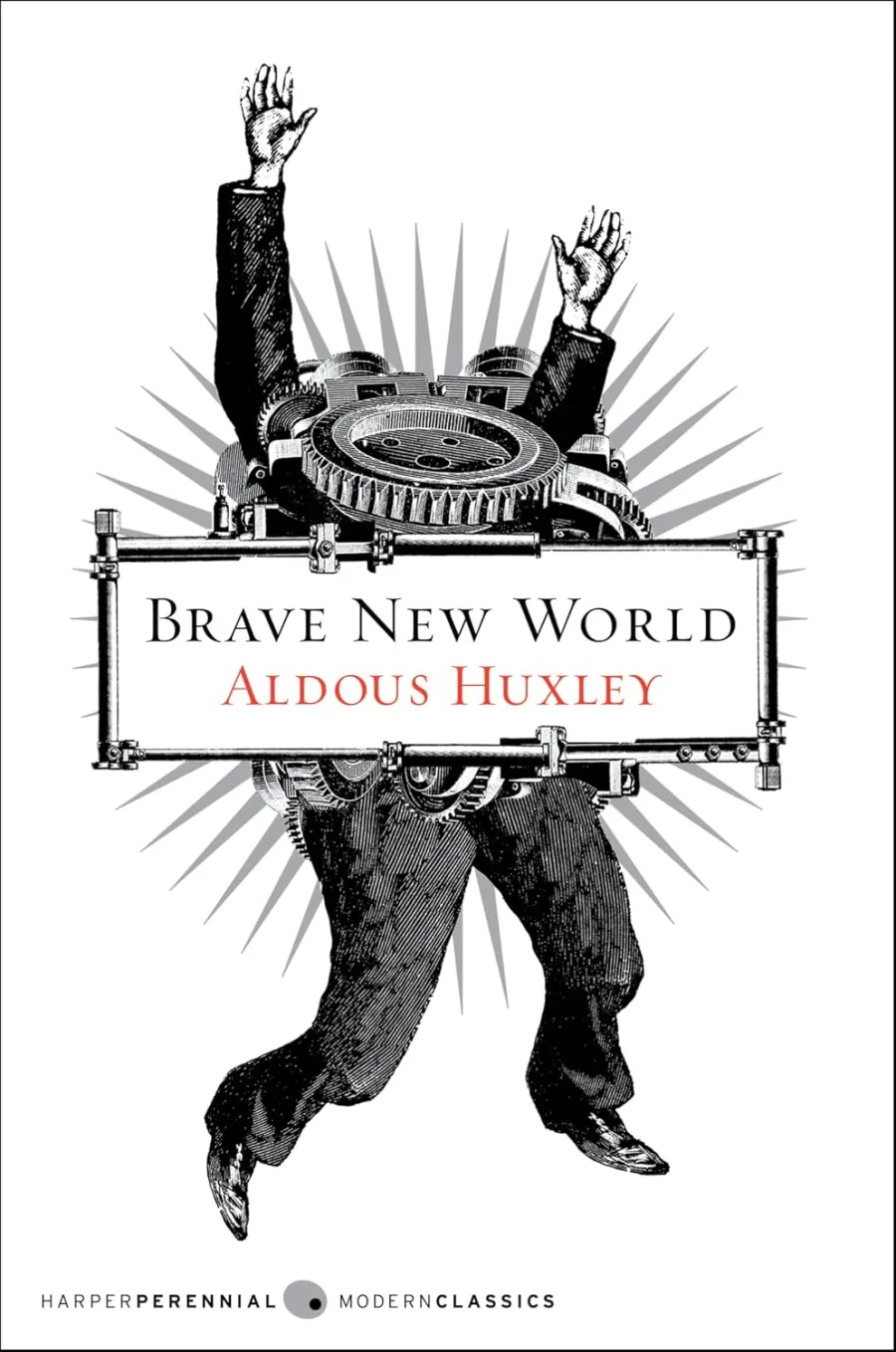
Brave New World
Paperback
• 288 Pages
• USD 18.99
• English
• 9780060850524
No ratings yet
| Publisher | Harper Perennial |
|---|---|
| ISBN13 | 9780060850524 |
| ASIN/SKU | 0060850523 |
| Book Format | Paperback |
| Language | English |
| Pages | 288 |
| List Price | USD 18.99 |
| Publishing Date | 17/10/2006 |
| Dimensions | 0.7 x 5.2 x 7.8 inches |
| Weight | 8 ounces |
| Book Code | BD00067197 |
Buy this Book
Amazon Stores
Ebook Stores
Other Stores
Discover Brave New World by Aldous Huxley. This book is published by Harper Perennial in Paperback format, ISBN 9780060850524, ASIN 0060850523, under Literature and Fiction, Genetic Engineering Science Fiction, British and Irish Literature and Fiction.
Book Description
Now more than ever: Aldous Huxley's enduring masterwork must be read and understood by anyone concerned with preserving the human spirit
"A masterpiece. ... One of the most prophetic dystopian works." —Wall Street Journal
Aldous Huxley's profoundly important classic of world literature, Brave New World is a searching vision of an unequal, technologically-advanced future where humans are genetically bred, socially indoctrinated, and pharmaceutically anesthetized to passively uphold an authoritarian ruling order–all at the cost of our freedom, full humanity, and perhaps also our souls. “A genius [who] who spent his life decrying the onward march of the Machine” (The New Yorker), Huxley was a man of incomparable talents: equally an artist, a spiritual seeker, and one of history’s keenest observers of human nature and civilization. Brave New World, his masterpiece, has enthralled and terrified millions of readers, and retains its urgent relevance to this day as both a warning to be heeded as we head into tomorrow and as thought-provoking, satisfying work of literature. Written in the shadow of the rise of fascism during the 1930s, Brave New World likewise speaks to a 21st-century world dominated by mass-entertainment, technology, medicine and pharmaceuticals, the arts of persuasion, and the hidden influence of elites.
"Aldous Huxley is the greatest 20th century writer in English." —Chicago Tribune
"A masterpiece. ... One of the most prophetic dystopian works." —Wall Street Journal
Aldous Huxley's profoundly important classic of world literature, Brave New World is a searching vision of an unequal, technologically-advanced future where humans are genetically bred, socially indoctrinated, and pharmaceutically anesthetized to passively uphold an authoritarian ruling order–all at the cost of our freedom, full humanity, and perhaps also our souls. “A genius [who] who spent his life decrying the onward march of the Machine” (The New Yorker), Huxley was a man of incomparable talents: equally an artist, a spiritual seeker, and one of history’s keenest observers of human nature and civilization. Brave New World, his masterpiece, has enthralled and terrified millions of readers, and retains its urgent relevance to this day as both a warning to be heeded as we head into tomorrow and as thought-provoking, satisfying work of literature. Written in the shadow of the rise of fascism during the 1930s, Brave New World likewise speaks to a 21st-century world dominated by mass-entertainment, technology, medicine and pharmaceuticals, the arts of persuasion, and the hidden influence of elites.
"Aldous Huxley is the greatest 20th century writer in English." —Chicago Tribune
Author Biography
Aldous Huxley (1894-1963) is the author of the classic novels Island, Eyeless in Gaza, and The Genius and the Goddess, as well as such critically acclaimed nonfiction works as The Devils of Loudun, The Doors of Perception, and The Perennial Philosophy. Born in Surrey, England, and educated at Oxford, he died in Los Angeles.
Editorial Reviews
“[A] masterpiece. ... One of the most prophetic dystopian works of the 20th century.” - Wall Street Journal
“One of the 20th century’s greatest writers.” - Washington Post
“Chilling. . . . That he gave us the dark side of genetic engineering in 1932 is amazing.” - Providence Journal-Bulletin
“A genius . . . a writer who spent his life decrying the onward march of the Machine.” - The New Yorker
“Aldous Huxley is the greatest 20th century writer in English.” - Chicago Tribune
“Huxley uses his erudite knowledge of human relations to compare our actual world with his prophetic fantasy of 1931. It is a frightening experience, indeed, to discover how much of his satirical prediction of a distant future became reality in so short a time.” - New York Times Book Review
“A sometimes appallingly accurate view of today’s world.” - St. Louis Post-Dispatch
“It’s time for everyone to read or reread Brave New World.” - Raleigh News & Observer
"One of the best American novels of the 20th century and surprisingly apt at predicting future scientific advancements, including reproductive technology and psychological conditioning." - Entertainment Weekly
“One of the 20th century’s greatest writers.” - Washington Post
“Chilling. . . . That he gave us the dark side of genetic engineering in 1932 is amazing.” - Providence Journal-Bulletin
“A genius . . . a writer who spent his life decrying the onward march of the Machine.” - The New Yorker
“Aldous Huxley is the greatest 20th century writer in English.” - Chicago Tribune
“Huxley uses his erudite knowledge of human relations to compare our actual world with his prophetic fantasy of 1931. It is a frightening experience, indeed, to discover how much of his satirical prediction of a distant future became reality in so short a time.” - New York Times Book Review
“A sometimes appallingly accurate view of today’s world.” - St. Louis Post-Dispatch
“It’s time for everyone to read or reread Brave New World.” - Raleigh News & Observer
"One of the best American novels of the 20th century and surprisingly apt at predicting future scientific advancements, including reproductive technology and psychological conditioning." - Entertainment Weekly
Book Summary
Aldous Huxley’s Brave New World presents a chilling vision of a futuristic society set in London in the year 2540, known as the World State. Controlled by a council of World Controllers, this society operates under the motto "Community, Identity, Stability." Human beings are no longer born naturally; instead, they are mass-produced in state hatcheries through industrial cloning. From conception, children are engineered into a rigid five-tiered caste system ranging from the highly intelligent Alpha elites down to the brain-damaged, menial-labor Epsilon workers. Through intensive psychological conditioning, sleep-learning, and chemical manipulation, every citizen is programmed to love their assigned station in life and never question the social order.
In this world, traditional concepts like family, pregnancy, and marriage are viewed as repulsive taboos. To preserve social harmony and eliminate emotional distress, citizens are conditioned to pursue endless, superficial pleasure. Monogamy is outlawed in favor of casual sexual promiscuity, while art, literature, philosophy, and religion are banned because they evoke deep, destabilizing emotions. Whenever anyone experiences anxiety, grief, or doubt, they consume soma, a state-issued drug that provides instant euphoria without hangover or side effects. The entire economy relies on hyper-consumerism, keeping the population perpetually distracted by high-tech, sensory entertainment like "feelies."
Despite relentless conditioning, cracks exist in the system. Bernard Marx, an Alpha-Plus psychologist, feels like an outcast. Due to an alleged error during his embryonic development, Bernard is physically smaller than other Alphas and harbors deep insecurities. His resentment toward society leads him to question its values and dream of personal freedom. Bernard becomes fascinated with Lenina Crowne, a popular Beta nurse who strictly follows social norms but finds Bernard’s odd nature intriguing. Seeking to explore something outside their sterile world, Bernard receives permission from his superior, the Director of Hatcheries, to take Lenina on vacation to the Savage Reservation in New Mexico.
The Reservation stands in stark contrast to the polished World State. Enclosed by an electrified fence, it is home to communities living without modern technology, where people still give birth, age naturally, practice religion, and endure disease. Lenina is horrified by the dirt and suffering, but Bernard is fascinated. There, they meet Linda, a former World State citizen abandoned years earlier during a storm. Linda gave birth to a son named John, whose father is Bernard’s boss, the Director. Raised in isolation, John taught himself to read using an old copy of Shakespeare's plays. His worldview is shaped by Shakespearean ideals of honor, tragic romance, and morality, making him an outsider to both traditional villagers and modern citizens.
Seeing an opportunity to boost his status and protect himself from an impending job transfer, Bernard brings John and Linda back to London. The World State public becomes fascinated with John, dubbed "the Savage." Bernard instantly becomes a celebrity by association, using John to gain social standing. Linda, broken by years of exile, retreats into a fatal soma coma. Meanwhile, John is appalled by London society. He finds the citizens' lives completely empty, devoid of art, passion, and soul. His feelings for Lenina shatter when she tries to seduce him casually, unable to understand his romantic ideals of devotion and courtship.
The tension explodes when Linda dies in a soma hospital. Overcome with grief and rage, John tries to "free" a group of lower-caste workers by throwing their soma supply out a window, sparking a riot. Bernard and his friend Helmholtz Watson—a brilliant writer who also craves creative depth—arrive to help, but all three are arrested. They are brought before Mustapha Mond, one of the ten World Controllers. In a philosophical debate, Mond explains the ultimate trade-off of their society: genuine art, truth, beauty, and freedom were sacrificed to achieve total peace and comfort. Mond sentences Bernard and Helmholtz to exile on remote islands—a destination Helmholtz welcomes as a haven for independent thinkers.
Mond refuses to let John leave, viewing him as a fascinating psychological study. Desperate for spiritual purification, John flees to an abandoned lighthouse in the English countryside. He attempts to cleanse himself of society's corrupting influence through hard physical labor, prayer, and self-flagellation. However, his dramatic penance attracts journalists and crowds of tourists, who turn his suffering into a sensation. When a mob of spectators, including Lenina, arrives by helicopter and demands he perform his whip ritual, the overwhelming pressure drives John into a soma-fueled frenzy. The next morning, crushed by guilt over betraying his principles, John hangs himself in the lighthouse, bringing a tragic end to his fight against an unfeeling world.
In this world, traditional concepts like family, pregnancy, and marriage are viewed as repulsive taboos. To preserve social harmony and eliminate emotional distress, citizens are conditioned to pursue endless, superficial pleasure. Monogamy is outlawed in favor of casual sexual promiscuity, while art, literature, philosophy, and religion are banned because they evoke deep, destabilizing emotions. Whenever anyone experiences anxiety, grief, or doubt, they consume soma, a state-issued drug that provides instant euphoria without hangover or side effects. The entire economy relies on hyper-consumerism, keeping the population perpetually distracted by high-tech, sensory entertainment like "feelies."
Despite relentless conditioning, cracks exist in the system. Bernard Marx, an Alpha-Plus psychologist, feels like an outcast. Due to an alleged error during his embryonic development, Bernard is physically smaller than other Alphas and harbors deep insecurities. His resentment toward society leads him to question its values and dream of personal freedom. Bernard becomes fascinated with Lenina Crowne, a popular Beta nurse who strictly follows social norms but finds Bernard’s odd nature intriguing. Seeking to explore something outside their sterile world, Bernard receives permission from his superior, the Director of Hatcheries, to take Lenina on vacation to the Savage Reservation in New Mexico.
The Reservation stands in stark contrast to the polished World State. Enclosed by an electrified fence, it is home to communities living without modern technology, where people still give birth, age naturally, practice religion, and endure disease. Lenina is horrified by the dirt and suffering, but Bernard is fascinated. There, they meet Linda, a former World State citizen abandoned years earlier during a storm. Linda gave birth to a son named John, whose father is Bernard’s boss, the Director. Raised in isolation, John taught himself to read using an old copy of Shakespeare's plays. His worldview is shaped by Shakespearean ideals of honor, tragic romance, and morality, making him an outsider to both traditional villagers and modern citizens.
Seeing an opportunity to boost his status and protect himself from an impending job transfer, Bernard brings John and Linda back to London. The World State public becomes fascinated with John, dubbed "the Savage." Bernard instantly becomes a celebrity by association, using John to gain social standing. Linda, broken by years of exile, retreats into a fatal soma coma. Meanwhile, John is appalled by London society. He finds the citizens' lives completely empty, devoid of art, passion, and soul. His feelings for Lenina shatter when she tries to seduce him casually, unable to understand his romantic ideals of devotion and courtship.
The tension explodes when Linda dies in a soma hospital. Overcome with grief and rage, John tries to "free" a group of lower-caste workers by throwing their soma supply out a window, sparking a riot. Bernard and his friend Helmholtz Watson—a brilliant writer who also craves creative depth—arrive to help, but all three are arrested. They are brought before Mustapha Mond, one of the ten World Controllers. In a philosophical debate, Mond explains the ultimate trade-off of their society: genuine art, truth, beauty, and freedom were sacrificed to achieve total peace and comfort. Mond sentences Bernard and Helmholtz to exile on remote islands—a destination Helmholtz welcomes as a haven for independent thinkers.
Mond refuses to let John leave, viewing him as a fascinating psychological study. Desperate for spiritual purification, John flees to an abandoned lighthouse in the English countryside. He attempts to cleanse himself of society's corrupting influence through hard physical labor, prayer, and self-flagellation. However, his dramatic penance attracts journalists and crowds of tourists, who turn his suffering into a sensation. When a mob of spectators, including Lenina, arrives by helicopter and demands he perform his whip ritual, the overwhelming pressure drives John into a soma-fueled frenzy. The next morning, crushed by guilt over betraying his principles, John hangs himself in the lighthouse, bringing a tragic end to his fight against an unfeeling world.
Sample Chapters
Sample Chapters will be added soon…
Reader Reviews
No reviews yet.
Brave New World
Download Cover Image
Do you want to download the full cover image for Brave New World?