
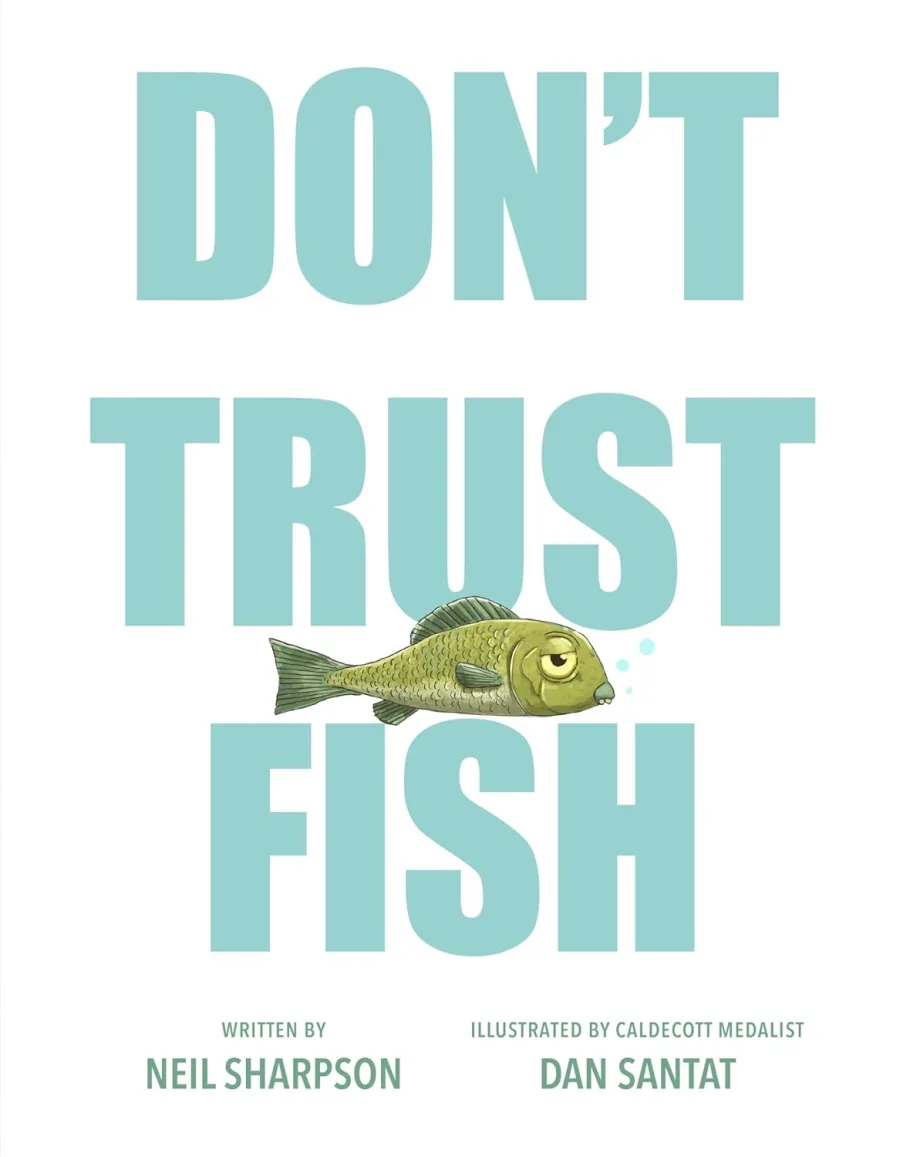
Don't Trust Fish
Neil Sharpson, Dan Santat (Illustrator)
Hardcover
• 40 Pages
• USD 18.99
• English
• 9780593616673
No ratings yet
| Publisher | Dial Books |
|---|---|
| ISBN13 | 9780593616673 |
| ASIN/SKU | 0593616677 |
| Book Format | Hardcover |
| Language | English |
| Pages | 40 |
| List Price | USD 18.99 |
| Publishing Date | 08/04/2025 |
| Dimensions | 8.88 x 0.4 x 11.31 inches |
| Weight | 1 pounds |
| Book Code | BD00067208 |
Buy this Book
Amazon Stores
Ebook Stores
Other Stores
Discover Don't Trust Fish by Neil Sharpson. This book is published by Dial Books in Hardcover format, ISBN 9780593616673, ASIN 0593616677, under Children's Books, Children's Science Fiction Books, Children's Fish Books.
Book Description
NATIONAL BESTSELLER • An absurdly laugh-out-loud funny picture book about the villainy of fish, illustrated by National Book Award-winning creator Dan Santat
"A ribald and uproarious warning to those unschooled in fishy goings-on." —Kirkus, starred review
ONE OF SLATE'S 25 GREATEST PICTURE BOOKS OF THE PAST 25 YEARS
ONE OF BOOKPAGE'S TEN BEST BOOKS OF THE YEAR
A BEST BOOK OF THE YEAR: New York Magazine, NPR, Chicago Public Library, Smithsonian Magazine, Libby, Kirkus, Publishers Weekly, Publishers Lunch, BookPage, Booklist, School Library Journal, Book Riot, BCCB, Imagination Soup, Parent Map, The Children's Book Review, EBSCO NoveList
Why, dear reader, must you NEVER EVER trust fish?
1) They spend all their time in the water where we can’t see them.
2) Some are as big as a bus—that is not okay.
3) We don't know what they're teaching in their "schools."
4) They are likely plotting our doom.
This nature-guide-gone-wrong is a hilarious, off-the-rails exploration of the seemingly innocent animals that live in the water.
"A ribald and uproarious warning to those unschooled in fishy goings-on." —Kirkus, starred review
ONE OF SLATE'S 25 GREATEST PICTURE BOOKS OF THE PAST 25 YEARS
ONE OF BOOKPAGE'S TEN BEST BOOKS OF THE YEAR
A BEST BOOK OF THE YEAR: New York Magazine, NPR, Chicago Public Library, Smithsonian Magazine, Libby, Kirkus, Publishers Weekly, Publishers Lunch, BookPage, Booklist, School Library Journal, Book Riot, BCCB, Imagination Soup, Parent Map, The Children's Book Review, EBSCO NoveList
Why, dear reader, must you NEVER EVER trust fish?
1) They spend all their time in the water where we can’t see them.
2) Some are as big as a bus—that is not okay.
3) We don't know what they're teaching in their "schools."
4) They are likely plotting our doom.
This nature-guide-gone-wrong is a hilarious, off-the-rails exploration of the seemingly innocent animals that live in the water.
Author Biography
Neil Sharpson lives in Dublin with his wife and their two children. Having written for theatre since his teens, Neil transitioned to writing novels in 2017, adapting his own play The Caspian Sea into When The Sparrow Falls.
A huge fan of animation, Neil writes Unshaved Mouse, a comedic review blog mostly focusing on animated film and comic book movies.
A huge fan of animation, Neil writes Unshaved Mouse, a comedic review blog mostly focusing on animated film and comic book movies.
Editorial Reviews
Voted #1 K-2 book by Children's Book Council's KIDS FAVORITES: Kid Read. Kid Chosen! program, 2026
Bank Street College of Education 2026 Irma Black Award Medalist
Libby Book Award for Best Picture Book, 2026
★ "[A] rapid-fire comedy of piscine paranoia." —Publishers Weekly, starred review
★ "A ribald and uproarious warning to those unschooled in fishy goings-on." —Kirkus, starred review
★ "With exceptional timing in a dry comic voice, veteran playwright and novelist Sharpson's picture-book debut is immersively silly fun, while award winner Santat's always-superb art lands at every possible visual punch line." —Booklist, starred review
★ “Sharpson and Santat's co-creation is a symbiotic marvel.” —Shelf Awareness, starred review
★ “Wonderfully hilarious…Don’t Trust Fish is an educational and highly entertaining delight, sure to inspire interest in oceanography and ichthyology—and lots of rereads.” —BookPage, starred review
★ "A must for every library. It is accessible to young and old, wildly entertaining, and effortlessly instructive."—School Library Journal, starred review
“Consider a book that makes everybody, and I do mean everybody, laugh from the cover onwards. THAT, my friends, is a picture book worth celebrating! That is a rarity! That… is Don’t Trust Fish.” —Betsy Bird, Fuse #8, School Library Journal
“Starting from an already comedic premise, this story goes gleefully off the rails, moving from funny to absolutely and wonderfully absurd, helped along by illustrations that build on jokes in previous spreads.” —The Bulletin of the Center for Children's Books
Bank Street College of Education 2026 Irma Black Award Medalist
Libby Book Award for Best Picture Book, 2026
★ "[A] rapid-fire comedy of piscine paranoia." —Publishers Weekly, starred review
★ "A ribald and uproarious warning to those unschooled in fishy goings-on." —Kirkus, starred review
★ "With exceptional timing in a dry comic voice, veteran playwright and novelist Sharpson's picture-book debut is immersively silly fun, while award winner Santat's always-superb art lands at every possible visual punch line." —Booklist, starred review
★ “Sharpson and Santat's co-creation is a symbiotic marvel.” —Shelf Awareness, starred review
★ “Wonderfully hilarious…Don’t Trust Fish is an educational and highly entertaining delight, sure to inspire interest in oceanography and ichthyology—and lots of rereads.” —BookPage, starred review
★ "A must for every library. It is accessible to young and old, wildly entertaining, and effortlessly instructive."—School Library Journal, starred review
“Consider a book that makes everybody, and I do mean everybody, laugh from the cover onwards. THAT, my friends, is a picture book worth celebrating! That is a rarity! That… is Don’t Trust Fish.” —Betsy Bird, Fuse #8, School Library Journal
“Starting from an already comedic premise, this story goes gleefully off the rails, moving from funny to absolutely and wonderfully absurd, helped along by illustrations that build on jokes in previous spreads.” —The Bulletin of the Center for Children's Books
Book Summary
Don't Trust Fish by Neil Sharpson, illustrated by Dan Santat, is a picture book that takes a very simple idea and turns it into a wildly funny, exaggerated warning about fish. On the surface, it looks like a nature book, but very quickly it becomes clear that this is not a calm educational guide. Instead, it is a playful, suspicious, and very dramatic argument that fish are not to be trusted, no matter how innocent they may appear.
The book’s humor comes from how seriously the narrator treats an obviously ridiculous idea. Fish are described as if they are secretive, mysterious, and possibly dangerous because they live underwater, where humans cannot easily watch them. The narrator points out that some fish are huge, some move in strange ways, and some even seem to gather in “schools,” which makes the whole thing sound like a conspiracy. The joke is that the narrator keeps building a case against fish using facts that are technically true but delivered in a way that makes them sound suspicious or alarming.
A big part of the book’s appeal is the narrator’s deadpan voice. The tone stays completely serious even as the statements become more and more absurd, and that contrast is what makes the story work so well. The narrator sounds like someone who has spent too much time thinking about fish and has become convinced that something is wrong with them. That over-the-top certainty gives the book its rhythm, and children are likely to enjoy the repeated warnings because they feel both silly and strangely convincing.
The structure of the book also helps the humor land. It starts by explaining other animals in a fairly straightforward way, then suddenly shifts into the idea that fish are different and possibly dangerous. From there, the narrator keeps stacking up reasons not to trust them: fish live where we can’t see them, some are as big as a bus, and they may be teaching each other strange things in their “schools”. Each point becomes more ridiculous than the last, but the book never admits it is joking. That straight-faced style is what makes the comedy so effective.
Dan Santat’s illustrations are a major part of the book’s success. His art gives the story visual energy and helps make the absurd claims feel even funnier. The images play along with the text, sometimes making fish look more dramatic or sinister than they really are, which adds another layer to the joke. The illustration style is crisp and expressive, and it keeps the book moving quickly so that each new “warning” feels like a punchline. Even when the narrator sounds worried, the visuals give readers room to laugh at the exaggeration.
At the same time, the book is more than just a string of jokes. It works because it understands how children think. Young readers often enjoy repetition, bold claims, and playful nonsense, especially when it is delivered with confidence. This book gives them all of that while also introducing them to some real fish facts in a way that feels entertaining rather than educational in the usual sense. Children may come away laughing, but they are also likely to remember that fish live in different habitats, that some are bioluminescent, and that the ocean is full of strange creatures.
The book also has a clever relationship with the idea of nonfiction. It imitates the voice of an informational guide, but then bends that form into comedy. That makes it especially fun for adults reading aloud, because they get to perform the seriousness of the narrator while children react to the ridiculousness of the claims. It is the kind of book that works on two levels at once: kids enjoy the silliness, and adults enjoy the irony.
Another reason the book stands out is that it feels energetic from start to finish. It never settles into a calm explanation or a moral lesson. Instead, it keeps escalating the fear of fish until the whole argument becomes completely unhinged. That escalation is important, because it gives the book a sense of comic momentum. By the end, readers are not meant to believe fish are evil; they are meant to enjoy how absurd the whole idea has become.
Overall, Don't Trust Fish is a lively, clever, and very funny picture book that turns suspicion into comedy. It uses a mock-serious narrator, playful facts, and bold illustrations to create a story that is easy to read, easy to laugh at, and hard to forget. The book does not ask children to trust the narrator’s claims; it asks them to enjoy the joke. That is what makes it memorable. It is a fake warning, a funny nature guide, and a wonderfully strange celebration of how silly a picture book can be when everyone involved commits fully to the bit.
The book’s humor comes from how seriously the narrator treats an obviously ridiculous idea. Fish are described as if they are secretive, mysterious, and possibly dangerous because they live underwater, where humans cannot easily watch them. The narrator points out that some fish are huge, some move in strange ways, and some even seem to gather in “schools,” which makes the whole thing sound like a conspiracy. The joke is that the narrator keeps building a case against fish using facts that are technically true but delivered in a way that makes them sound suspicious or alarming.
A big part of the book’s appeal is the narrator’s deadpan voice. The tone stays completely serious even as the statements become more and more absurd, and that contrast is what makes the story work so well. The narrator sounds like someone who has spent too much time thinking about fish and has become convinced that something is wrong with them. That over-the-top certainty gives the book its rhythm, and children are likely to enjoy the repeated warnings because they feel both silly and strangely convincing.
The structure of the book also helps the humor land. It starts by explaining other animals in a fairly straightforward way, then suddenly shifts into the idea that fish are different and possibly dangerous. From there, the narrator keeps stacking up reasons not to trust them: fish live where we can’t see them, some are as big as a bus, and they may be teaching each other strange things in their “schools”. Each point becomes more ridiculous than the last, but the book never admits it is joking. That straight-faced style is what makes the comedy so effective.
Dan Santat’s illustrations are a major part of the book’s success. His art gives the story visual energy and helps make the absurd claims feel even funnier. The images play along with the text, sometimes making fish look more dramatic or sinister than they really are, which adds another layer to the joke. The illustration style is crisp and expressive, and it keeps the book moving quickly so that each new “warning” feels like a punchline. Even when the narrator sounds worried, the visuals give readers room to laugh at the exaggeration.
At the same time, the book is more than just a string of jokes. It works because it understands how children think. Young readers often enjoy repetition, bold claims, and playful nonsense, especially when it is delivered with confidence. This book gives them all of that while also introducing them to some real fish facts in a way that feels entertaining rather than educational in the usual sense. Children may come away laughing, but they are also likely to remember that fish live in different habitats, that some are bioluminescent, and that the ocean is full of strange creatures.
The book also has a clever relationship with the idea of nonfiction. It imitates the voice of an informational guide, but then bends that form into comedy. That makes it especially fun for adults reading aloud, because they get to perform the seriousness of the narrator while children react to the ridiculousness of the claims. It is the kind of book that works on two levels at once: kids enjoy the silliness, and adults enjoy the irony.
Another reason the book stands out is that it feels energetic from start to finish. It never settles into a calm explanation or a moral lesson. Instead, it keeps escalating the fear of fish until the whole argument becomes completely unhinged. That escalation is important, because it gives the book a sense of comic momentum. By the end, readers are not meant to believe fish are evil; they are meant to enjoy how absurd the whole idea has become.
Overall, Don't Trust Fish is a lively, clever, and very funny picture book that turns suspicion into comedy. It uses a mock-serious narrator, playful facts, and bold illustrations to create a story that is easy to read, easy to laugh at, and hard to forget. The book does not ask children to trust the narrator’s claims; it asks them to enjoy the joke. That is what makes it memorable. It is a fake warning, a funny nature guide, and a wonderfully strange celebration of how silly a picture book can be when everyone involved commits fully to the bit.
Sample Chapters
Sample Chapters will be added soon…
Reader Reviews
No reviews yet.
Don't Trust Fish
Download Cover Image
Do you want to download the full cover image for Don't Trust Fish?