
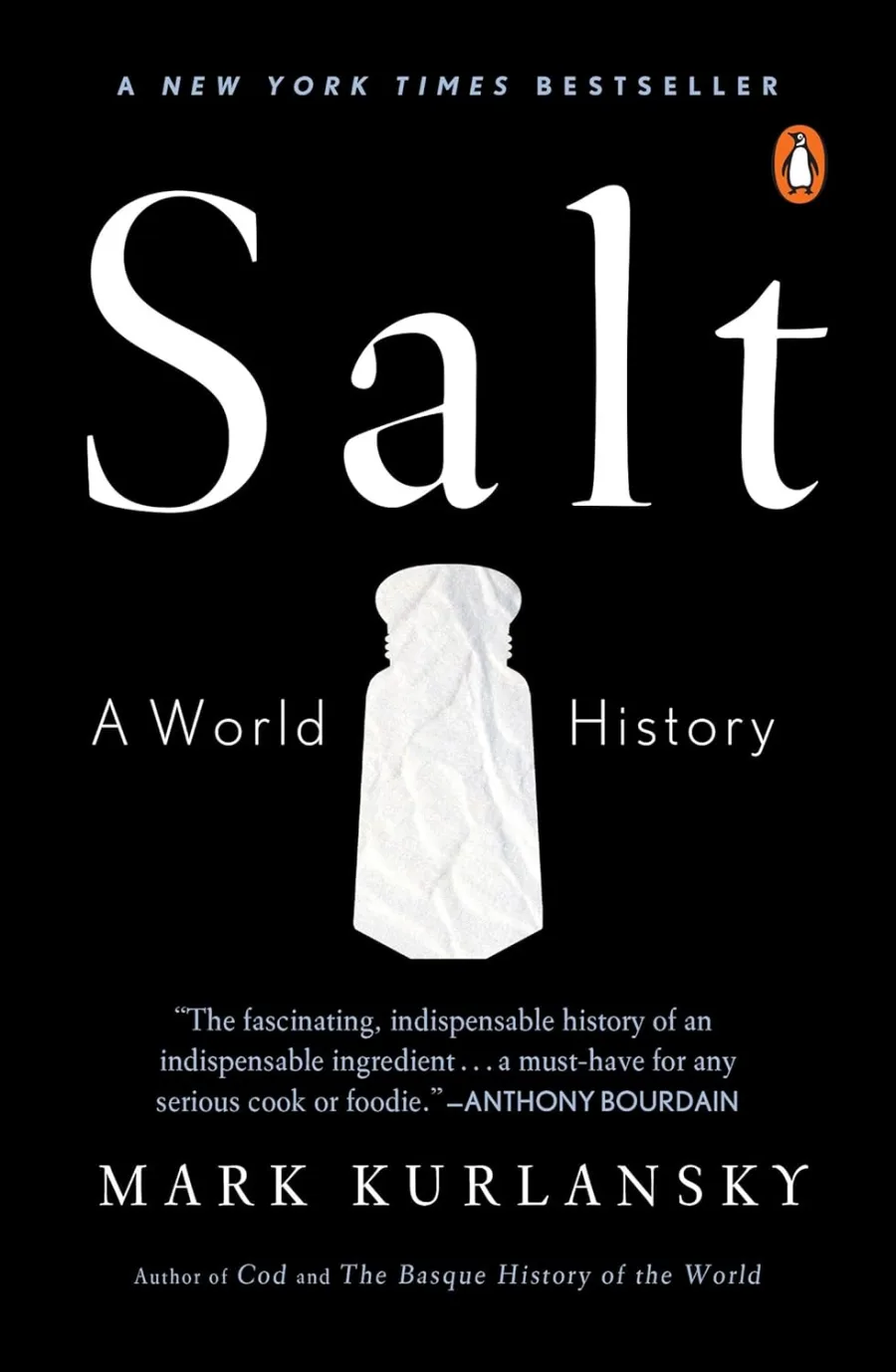
Salt: A World History
Paperback
• 497 Pages
• USD 19.00
• English
• 9780142001615
No ratings yet
| Publisher | Penguin Publishing Group |
|---|---|
| ISBN13 | 9780142001615 |
| ASIN/SKU | 0142001619 |
| Book Format | Paperback |
| Language | English |
| Pages | 497 |
| List Price | USD 19.00 |
| Publishing Date | 28/01/2003 |
| Dimensions | 5.12 x 0.91 x 7.72 inches |
| Weight | 11.6 ounces |
| Book Code | BD00067217 |
Buy this Book
Amazon Stores
Ebook Stores
Other Stores
Discover Salt: A World History by Mark Kurlansky. This book is published by Penguin Publishing Group in Paperback format, ISBN 9780142001615, ASIN 0142001619, under Science and Math, Geology, Rocks and Minerals.
Book Description
“Kurlansky finds the world in a grain of salt.” - New York Times Book Review
An unlikely world history from the bestselling author of Cod and The Basque History of the World
Best-selling author Mark Kurlansky turns his attention to a common household item with a long and intriguing history: salt. The only rock we eat, salt has shaped civilization from the very beginning, and its story is a glittering, often surprising part of the history of humankind. A substance so valuable it served as currency, salt has influenced the establishment of trade routes and cities, provoked and financed wars, secured empires, and inspired revolutions. Populated by colorful characters and filled with an unending series of fascinating details, Salt is a supremely entertaining, multi-layered masterpiece.
An unlikely world history from the bestselling author of Cod and The Basque History of the World
Best-selling author Mark Kurlansky turns his attention to a common household item with a long and intriguing history: salt. The only rock we eat, salt has shaped civilization from the very beginning, and its story is a glittering, often surprising part of the history of humankind. A substance so valuable it served as currency, salt has influenced the establishment of trade routes and cities, provoked and financed wars, secured empires, and inspired revolutions. Populated by colorful characters and filled with an unending series of fascinating details, Salt is a supremely entertaining, multi-layered masterpiece.
Author Biography
Mark Kurlansky is a New York Times bestselling and James A. Beard Award-winning author. He is the recipient of a Bon Appétit American Food and Entertaining Award for Food Writer of the Year, and the Glenfiddich Food and Drink Award for Food Book of the year.
Photo by Wes Washington (Own work) [CC BY-SA 3.0 (http://creativecommons.org/licenses/by-sa/3.0)], via Wikimedia Commons.
Photo by Wes Washington (Own work) [CC BY-SA 3.0 (http://creativecommons.org/licenses/by-sa/3.0)], via Wikimedia Commons.
Editorial Reviews
"Kurlansky finds the world in a grain of salt...fascination and surprise regularly erupt from the detail." —The New York Times Book Review
This is terrific food writing; like fleur de sel, something scarce and to be savored." —San Francisco Chronicle
"Kurlansky continues to prove himself remarkably adept at taking a most unlikely candidate and telling its tale with epic grandeur. " —Los Angeles Times Book Review
"If you are drawn to history and curious about the origins of foods, allow Mark Kurlansky to take you on an incredible journey through the centuries by way of salt." —The Baltimore Sun
"Kurlansky does a masterful job of expanding the reader's horizons....This book of minutely researched data and history can literally make the mouth water." —The Boston Globe
This is terrific food writing; like fleur de sel, something scarce and to be savored." —San Francisco Chronicle
"Kurlansky continues to prove himself remarkably adept at taking a most unlikely candidate and telling its tale with epic grandeur. " —Los Angeles Times Book Review
"If you are drawn to history and curious about the origins of foods, allow Mark Kurlansky to take you on an incredible journey through the centuries by way of salt." —The Baltimore Sun
"Kurlansky does a masterful job of expanding the reader's horizons....This book of minutely researched data and history can literally make the mouth water." —The Boston Globe
Book Summary
Mark Kurlansky’s Salt: A World History is a masterful work of microhistory that takes a completely ubiquitous, seemingly mundane household item and reveals it to be one of the most powerful driving forces in the development of human civilization. In the modern era, salt is something we take entirely for granted, a cheap commodity sitting passively in shakers on every dining table. However, Kurlansky meticulously peels back the layers of time to demonstrate that for millennia, this simple crystalline compound was the world's most fiercely contested and highly valued strategic resource. By tracking the global obsession with sodium chloride, the book provides a sweeping, fascinating alternative lens through which to view the rise and fall of empires, the establishment of global trade routes, the funding of devastating wars, and the sparking of monumental political revolutions.
The foundational premise of the book rests on a basic biological and agricultural reality: before the invention of artificial refrigeration in the late nineteenth century, salt was the primary means of preserving food. This singular characteristic made it an absolute necessity for human survival. Without salt, communities were entirely bound to seasonal food availability, unable to store surplus harvests or travel long distances. Kurlansky illustrates how the ability to cure meats and fish with salt allowed early societies to stockpile provisions for harsh winters, provision massive armies for lengthy campaigns, and supply ships for transoceanic voyages of exploration. In ancient Egypt, salt was not only crucial for preserving the daily food supply but was also an essential ingredient in the complex chemical process of mummification. Meanwhile, early Chinese dynasties recognized the immense power of the mineral, establishing strict government monopolies on salt production that provided the massive financial foundation required to build and maintain the Great Wall.
As human societies expanded, salt quickly evolved from a simple tool of survival into the backbone of international commerce and a globally recognized form of currency. Kurlansky traces the etymology of everyday words to highlight this deeply ingrained economic importance, noting most famously that the word "salary" derives from the Latin salarium, which was the allowance paid to Roman soldiers specifically to purchase their vital salt rations. The book details how ancient trade routes, long before the famous Silk Road, were carved across unforgiving deserts and rugged mountain ranges explicitly to transport heavy blocks of salt. The author vividly describes how the staggering wealth of the Venetian Republic during the Middle Ages was not built primarily on exotic silks or rare spices, as is commonly assumed, but rather on their ruthless, monopolistic control of the salt trade across the Mediterranean basin. By acting as the middleman for this essential preservative, Venice amassed the incredible fortunes that funded their legendary art and architecture.
Because salt was an absolute biological necessity that no citizen could simply opt out of buying, it became the ultimate tool for political control and state-sponsored taxation. Kurlansky explores how this inescapable financial burden frequently became the tipping point for popular uprisings. In France, the deeply despised and highly unequal salt tax known as the gabelle placed a crushing financial weight on the peasantry while exempting the nobility, creating a deep-seated, simmering resentment that served as a major catalyst for the French Revolution. Centuries later, the British Empire utilized a similar tactic in colonial India, outlawing the local production of salt to force the population to buy highly taxed British imports. This oppressive policy famously culminated in Mahatma Gandhi’s historic 1930 Salt March, where the simple, defiant act of walking to the Arabian Sea to harvest a handful of untaxed salt became the defining symbol of the Indian independence movement, proving that controlling this mineral equated directly to controlling the populace.
The narrative also thoroughly examines the critical role of salt in the development of the Americas. Early European colonists struggled immensely to establish permanent settlements until they could secure reliable, local sources of salt to preserve their fish and livestock. During the American Civil War, salt transformed into a desperately needed military asset. Kurlansky details how the Union Army deployed strategic blockades and launched targeted inland raids specifically designed to destroy Confederate salt works, fully understanding that crippling the South's ability to preserve food for its troops was just as devastating as defeating them in direct combat. It was a war of attrition fought as much over brine springs as over territory.
Ultimately, Kurlansky concludes his sweeping narrative by examining the rapid devaluation of salt in the modern era. The advent of modern canning, electric refrigeration, and advanced freezing techniques completely stripped salt of its historical monopoly on food preservation. Simultaneously, modern geology and industrial mining techniques revealed that the earth possesses a nearly inexhaustible supply of the mineral, causing its price to plummet permanently. Today, the vast majority of the world's salt is not even used for human consumption, but rather for de-icing winter roads and manufacturing industrial chemicals. Salt: A World History is a brilliantly executed paradigm shift. It forces the reader to fundamentally reconsider the contents of their kitchen pantry, beautifully illustrating how a simple rock, once worth its weight in gold, shaped the modern world before quietly fading into the background of everyday life.
The foundational premise of the book rests on a basic biological and agricultural reality: before the invention of artificial refrigeration in the late nineteenth century, salt was the primary means of preserving food. This singular characteristic made it an absolute necessity for human survival. Without salt, communities were entirely bound to seasonal food availability, unable to store surplus harvests or travel long distances. Kurlansky illustrates how the ability to cure meats and fish with salt allowed early societies to stockpile provisions for harsh winters, provision massive armies for lengthy campaigns, and supply ships for transoceanic voyages of exploration. In ancient Egypt, salt was not only crucial for preserving the daily food supply but was also an essential ingredient in the complex chemical process of mummification. Meanwhile, early Chinese dynasties recognized the immense power of the mineral, establishing strict government monopolies on salt production that provided the massive financial foundation required to build and maintain the Great Wall.
As human societies expanded, salt quickly evolved from a simple tool of survival into the backbone of international commerce and a globally recognized form of currency. Kurlansky traces the etymology of everyday words to highlight this deeply ingrained economic importance, noting most famously that the word "salary" derives from the Latin salarium, which was the allowance paid to Roman soldiers specifically to purchase their vital salt rations. The book details how ancient trade routes, long before the famous Silk Road, were carved across unforgiving deserts and rugged mountain ranges explicitly to transport heavy blocks of salt. The author vividly describes how the staggering wealth of the Venetian Republic during the Middle Ages was not built primarily on exotic silks or rare spices, as is commonly assumed, but rather on their ruthless, monopolistic control of the salt trade across the Mediterranean basin. By acting as the middleman for this essential preservative, Venice amassed the incredible fortunes that funded their legendary art and architecture.
Because salt was an absolute biological necessity that no citizen could simply opt out of buying, it became the ultimate tool for political control and state-sponsored taxation. Kurlansky explores how this inescapable financial burden frequently became the tipping point for popular uprisings. In France, the deeply despised and highly unequal salt tax known as the gabelle placed a crushing financial weight on the peasantry while exempting the nobility, creating a deep-seated, simmering resentment that served as a major catalyst for the French Revolution. Centuries later, the British Empire utilized a similar tactic in colonial India, outlawing the local production of salt to force the population to buy highly taxed British imports. This oppressive policy famously culminated in Mahatma Gandhi’s historic 1930 Salt March, where the simple, defiant act of walking to the Arabian Sea to harvest a handful of untaxed salt became the defining symbol of the Indian independence movement, proving that controlling this mineral equated directly to controlling the populace.
The narrative also thoroughly examines the critical role of salt in the development of the Americas. Early European colonists struggled immensely to establish permanent settlements until they could secure reliable, local sources of salt to preserve their fish and livestock. During the American Civil War, salt transformed into a desperately needed military asset. Kurlansky details how the Union Army deployed strategic blockades and launched targeted inland raids specifically designed to destroy Confederate salt works, fully understanding that crippling the South's ability to preserve food for its troops was just as devastating as defeating them in direct combat. It was a war of attrition fought as much over brine springs as over territory.
Ultimately, Kurlansky concludes his sweeping narrative by examining the rapid devaluation of salt in the modern era. The advent of modern canning, electric refrigeration, and advanced freezing techniques completely stripped salt of its historical monopoly on food preservation. Simultaneously, modern geology and industrial mining techniques revealed that the earth possesses a nearly inexhaustible supply of the mineral, causing its price to plummet permanently. Today, the vast majority of the world's salt is not even used for human consumption, but rather for de-icing winter roads and manufacturing industrial chemicals. Salt: A World History is a brilliantly executed paradigm shift. It forces the reader to fundamentally reconsider the contents of their kitchen pantry, beautifully illustrating how a simple rock, once worth its weight in gold, shaped the modern world before quietly fading into the background of everyday life.
Sample Chapters
Sample Chapters will be added soon…
Reader Reviews
No reviews yet.
Salt: A World History
Download Cover Image
Do you want to download the full cover image for Salt: A World History?