
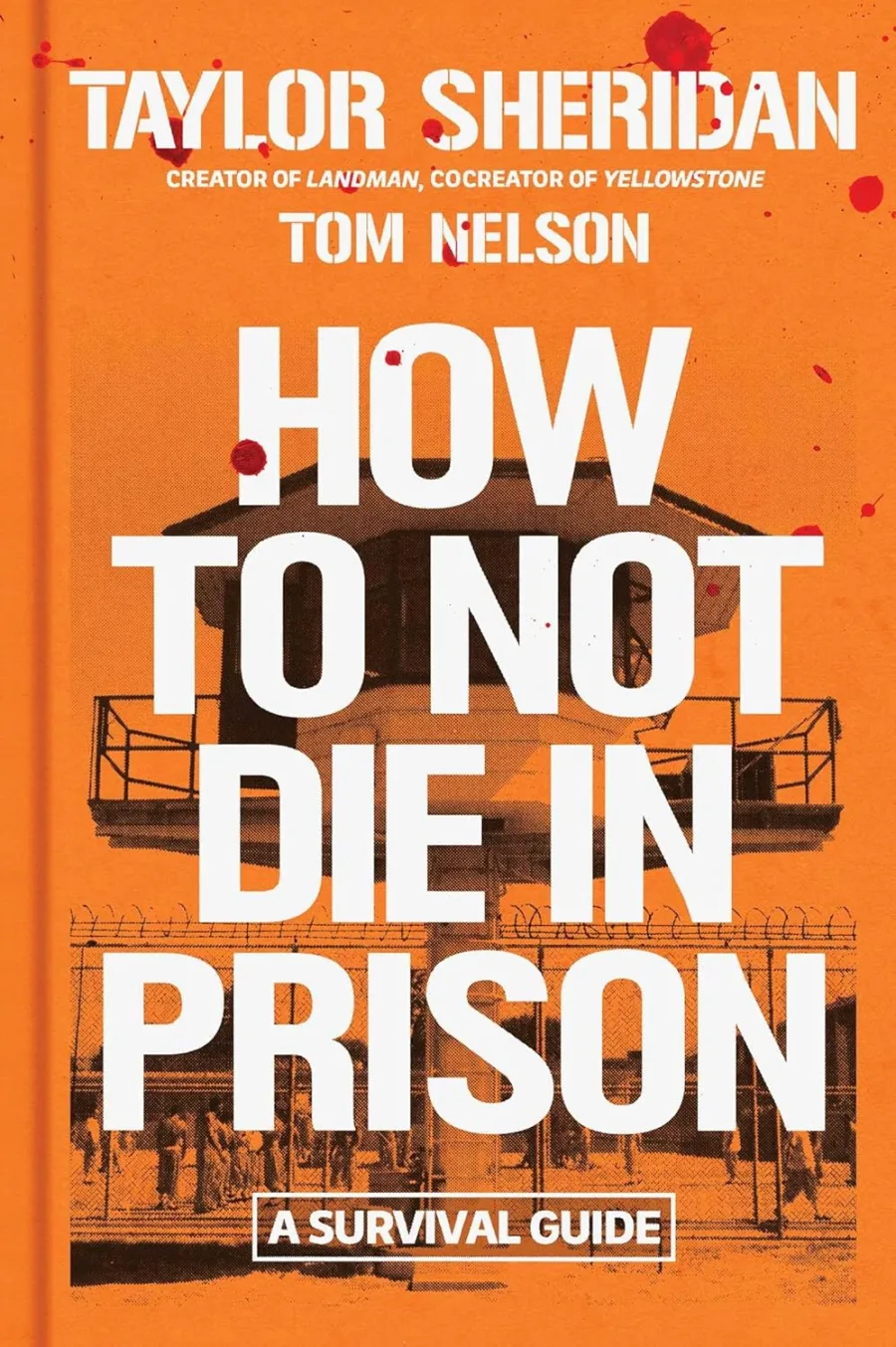
How to Not Die in Prison: A Survival Guide
eBook
• 256 Pages
• USD 29.00
• English
• 9781668213476
No ratings yet
| Publisher | Simon & Schuster |
|---|---|
| ISBN13 | 9781668213476 |
| ASIN/SKU | B0GN3R3RM9 |
| Book Format | eBook |
| Language | English |
| Pages | 256 |
| List Price | USD 29.00 |
| Publishing Date | 23/06/2026 |
| Book Code | BD00067307 |
Buy this Book
Amazon Stores
Ebook Stores
Other Stores
Discover How to Not Die in Prison: A Survival Guide by Taylor Sheridan. This book is published by Simon and Schuster in eBook format, ISBN 9781668213476, ASIN B0GN3R3RM9, under Self-Help, Survival and Emergency Preparedness.
Book Description
The debut book from Academy Award–nominated filmmaker Taylor Sheridan, creator of Landman and cocreator of Yellowstone—a no-bullsh*t, darkly funny survival guide to life inside a maximum-security prison, cowritten with prison-hardened ex-con Tom Nelson.
So, you f*cked up. Can't talk your way out of it, buy your way out of it, or beg your way out of it.
You are going to prison. You will be living under a set of rules made up by men who have demonstrated to society that they need a big ol' time out. There is no book of these rules. Nobody will tell them to you. But when you break one—boy, will you know it. For the newbie, the fish, the fresh meat—this book is your survival guide. How to mind your business without becoming a target. When to walk away. When to stand your ground.
This is how you don't die. Follow the advice in this book, and you just might make it out alive.
So, you f*cked up. Can't talk your way out of it, buy your way out of it, or beg your way out of it.
You are going to prison. You will be living under a set of rules made up by men who have demonstrated to society that they need a big ol' time out. There is no book of these rules. Nobody will tell them to you. But when you break one—boy, will you know it. For the newbie, the fish, the fresh meat—this book is your survival guide. How to mind your business without becoming a target. When to walk away. When to stand your ground.
This is how you don't die. Follow the advice in this book, and you just might make it out alive.
Author Biography
Tom Nelson was a cocaine trafficker during the crack epidemic of Los Angeles. His clientele ranged from Hollywood celebrities to supplying crack houses in Downtown and South Central LA. That life came to an end when Tom was busted in 1997 and sentenced to 7 years in prison. Now, Tom is an entrepreneur and philanthropist who gives back to the communities he once harmed by performing public speaking and other forms of community outreach.
Tom is the founder and president of the Kelly Maddon Foundation which helps existing domestic violence organizations with managerial and fundraising support.
Tom also owns the largest private training facility in Los Angeles and is one of the most sought after nutrition specialists and fitness trainers in California. In 2013, Tom was voted “Trainer of the Year” and received a commendation from the City of West Hollywood for his contributions to fitness within the community. In addition, Tom’s facility - Muscle Mechanics - won the “Best of Los Angeles Award” for being the Best Gym in Los Angeles - 2020.
Tom restores classic American muscle cars in his spare time and writes novels about the harrowing experiences of his past.
Tom resides in the quiet little town of Solvang, California with his loving family - a million miles away from the crazy life he once lived!
Tom is the founder and president of the Kelly Maddon Foundation which helps existing domestic violence organizations with managerial and fundraising support.
Tom also owns the largest private training facility in Los Angeles and is one of the most sought after nutrition specialists and fitness trainers in California. In 2013, Tom was voted “Trainer of the Year” and received a commendation from the City of West Hollywood for his contributions to fitness within the community. In addition, Tom’s facility - Muscle Mechanics - won the “Best of Los Angeles Award” for being the Best Gym in Los Angeles - 2020.
Tom restores classic American muscle cars in his spare time and writes novels about the harrowing experiences of his past.
Tom resides in the quiet little town of Solvang, California with his loving family - a million miles away from the crazy life he once lived!
Editorial Reviews
"A guide to surviving (but not necessarily thriving) in prison if you’ve made some really bad decisions. . . . Frank and enlightening." — Kirkus
Book Summary
How to Not Die in Prison: A Survival Guide by Taylor Sheridan and Tom Nelson is a blunt, darkly funny, and surprisingly human look at life inside maximum-security prison. Published in June 2026, the book is presented as a practical guide for someone who has suddenly found himself facing incarceration, but it is also much more than that. Beneath its crude humor and deliberately outrageous language is a serious examination of prison culture, survival, mental health, relationships, violence, and the difficult journey back into ordinary life. Sheridan brings his experience as a writer and filmmaker fascinated by crime and prison systems, while Nelson contributes firsthand knowledge from more than seventeen years spent in medium- and maximum-security prisons.
The book begins with an uncomfortable reality: prison operates according to rules that are rarely written down. A newcomer may know the official rules of the institution, but those rules do not necessarily explain how to behave around other prisoners, how to avoid unnecessary conflict, or how to understand the social hierarchy. The authors therefore approach prison as a world with its own language, customs, alliances, dangers, and unwritten expectations. Their first lesson is essentially one of awareness: a new prisoner must observe, listen, and learn before assuming that ordinary social habits will work behind bars.
The opening sections introduce the reader to the shock of incarceration. The authors discuss the transition from county jail to prison and the psychological adjustment required when freedom suddenly disappears. Everyday activities become controlled by schedules and institutional rules. Privacy becomes scarce, personal possessions become limited, and even seemingly simple decisions can have consequences. The authors' humor makes these experiences easier to read about, but the underlying message is bleak: prison is not an adventure or a badge of toughness; it is an environment in which mistakes can carry serious consequences.
A major part of the book concerns relationships and social survival. Prisoners quickly learn that they cannot interact with everyone in the same way. The authors discuss friendships, rivalries, prison groups, cellmates, guards, and the importance of staying out of unnecessary disputes. One of the recurring lessons is to avoid drawing attention to yourself for the wrong reasons. The book encourages readers to understand their surroundings, respect boundaries, and recognize when a situation is becoming dangerous rather than trying to prove themselves.
The discussion of prison gangs and informal alliances reveals how complicated prison society can become. People form groups for protection, companionship, identity, and practical reasons, but those associations can also create obligations and conflicts. The authors emphasize that survival often depends less on being the strongest person in the room than on knowing when to speak, when to listen, when to walk away, and when a situation requires firm boundaries.
The book then turns to the prison economy. Work assignments, commissary, privileges, and informal exchanges all become part of daily life. The authors explain how prisoners adapt to limited resources and create small systems of trade and social interaction. Food becomes particularly important. The book describes ways prisoners combine commissary ingredients into improvised meals, turning limited supplies into something more satisfying than institutional food. These passages are often comic, but they also demonstrate human adaptability: even in an intensely controlled environment, people find ways to create small pleasures and a sense of normality.
When the book reaches the section dealing with emergencies, its tone becomes more serious. Riots, lockdowns, violence, solitary confinement, and other dangers are discussed from the perspective of someone trying to remain alive and mentally intact. The authors' basic message is not to seek confrontation or imitate prison violence but to avoid becoming part of it whenever possible. The book also discusses the reality of physical danger without romanticizing it. The emphasis remains on awareness, restraint, and survival rather than bravado.
Health is another major concern. Prisoners may have limited access to medical care, restricted food choices, and difficult living conditions. The authors discuss the effects of poor nutrition, stress, inadequate healthcare, and long periods of inactivity. Their observations reveal that surviving prison is not simply about avoiding violence. A person must also take care of the body under circumstances that may make ordinary self-care difficult.
The authors give particular attention to mental health. Prison can create loneliness, anxiety, anger, depression, hopelessness, and emotional numbness. The book discusses the psychological strain of confinement and the importance of finding constructive ways to occupy the mind. Reading, studying, creating art, exercising, developing skills, and maintaining some form of spiritual life can help a prisoner retain a sense of identity. The authors treat mental survival as just as important as physical survival.
Relationships with people outside prison form another emotional center of the book. The authors discuss visiting days, letters, phone calls, care packages, romantic relationships, and parenting from prison. These connections can provide motivation, but they can also become complicated by distance, shame, financial pressures, and the emotional burden placed on loved ones. The book recognizes that incarceration affects entire families rather than only the person serving the sentence.
Eventually, the guide turns toward reentry. This is one of its most important sections because leaving prison does not automatically mean returning to a normal life. Former prisoners must find employment, rebuild relationships, deal with restrictions, adjust to technology and social changes, and resist the habits that contributed to their incarceration. The authors stress that freedom brings its own challenges. Without the structure of prison, a person must make responsible decisions independently.
Tom Nelson's own story gives this section particular weight. His past included drug addiction and serious crimes, followed by more than seventeen years behind bars. After prison, he rebuilt his life and became a husband, father, and personal trainer. His experience demonstrates that a criminal past does not have to remain the final definition of a person's identity.
Ultimately, How to Not Die in Prison is not really a celebration of prison survival. Its deeper lesson is that the best way to survive prison is not to go there in the first place—and, if you do, to use the experience as an opportunity to change. Sheridan and Nelson deliberately strip away the glamour sometimes associated with prison stories. Their world is frightening, restrictive, lonely, and exhausting.
The book's humor makes its difficult subject accessible, but its final message is serious. Prison exposes the consequences of destructive choices, yet it also demonstrates the possibility of adaptation, learning, and redemption. By the end, the focus has shifted from surviving incarceration to building a life that makes returning to prison unnecessary.
In that sense, How to Not Die in Prison is ultimately a book about consequences, resilience, and second chances. It offers an unusually direct look at a hidden social world while reminding readers that the most valuable freedom is the freedom to make better choices before those choices disappear.
The book begins with an uncomfortable reality: prison operates according to rules that are rarely written down. A newcomer may know the official rules of the institution, but those rules do not necessarily explain how to behave around other prisoners, how to avoid unnecessary conflict, or how to understand the social hierarchy. The authors therefore approach prison as a world with its own language, customs, alliances, dangers, and unwritten expectations. Their first lesson is essentially one of awareness: a new prisoner must observe, listen, and learn before assuming that ordinary social habits will work behind bars.
The opening sections introduce the reader to the shock of incarceration. The authors discuss the transition from county jail to prison and the psychological adjustment required when freedom suddenly disappears. Everyday activities become controlled by schedules and institutional rules. Privacy becomes scarce, personal possessions become limited, and even seemingly simple decisions can have consequences. The authors' humor makes these experiences easier to read about, but the underlying message is bleak: prison is not an adventure or a badge of toughness; it is an environment in which mistakes can carry serious consequences.
A major part of the book concerns relationships and social survival. Prisoners quickly learn that they cannot interact with everyone in the same way. The authors discuss friendships, rivalries, prison groups, cellmates, guards, and the importance of staying out of unnecessary disputes. One of the recurring lessons is to avoid drawing attention to yourself for the wrong reasons. The book encourages readers to understand their surroundings, respect boundaries, and recognize when a situation is becoming dangerous rather than trying to prove themselves.
The discussion of prison gangs and informal alliances reveals how complicated prison society can become. People form groups for protection, companionship, identity, and practical reasons, but those associations can also create obligations and conflicts. The authors emphasize that survival often depends less on being the strongest person in the room than on knowing when to speak, when to listen, when to walk away, and when a situation requires firm boundaries.
The book then turns to the prison economy. Work assignments, commissary, privileges, and informal exchanges all become part of daily life. The authors explain how prisoners adapt to limited resources and create small systems of trade and social interaction. Food becomes particularly important. The book describes ways prisoners combine commissary ingredients into improvised meals, turning limited supplies into something more satisfying than institutional food. These passages are often comic, but they also demonstrate human adaptability: even in an intensely controlled environment, people find ways to create small pleasures and a sense of normality.
When the book reaches the section dealing with emergencies, its tone becomes more serious. Riots, lockdowns, violence, solitary confinement, and other dangers are discussed from the perspective of someone trying to remain alive and mentally intact. The authors' basic message is not to seek confrontation or imitate prison violence but to avoid becoming part of it whenever possible. The book also discusses the reality of physical danger without romanticizing it. The emphasis remains on awareness, restraint, and survival rather than bravado.
Health is another major concern. Prisoners may have limited access to medical care, restricted food choices, and difficult living conditions. The authors discuss the effects of poor nutrition, stress, inadequate healthcare, and long periods of inactivity. Their observations reveal that surviving prison is not simply about avoiding violence. A person must also take care of the body under circumstances that may make ordinary self-care difficult.
The authors give particular attention to mental health. Prison can create loneliness, anxiety, anger, depression, hopelessness, and emotional numbness. The book discusses the psychological strain of confinement and the importance of finding constructive ways to occupy the mind. Reading, studying, creating art, exercising, developing skills, and maintaining some form of spiritual life can help a prisoner retain a sense of identity. The authors treat mental survival as just as important as physical survival.
Relationships with people outside prison form another emotional center of the book. The authors discuss visiting days, letters, phone calls, care packages, romantic relationships, and parenting from prison. These connections can provide motivation, but they can also become complicated by distance, shame, financial pressures, and the emotional burden placed on loved ones. The book recognizes that incarceration affects entire families rather than only the person serving the sentence.
Eventually, the guide turns toward reentry. This is one of its most important sections because leaving prison does not automatically mean returning to a normal life. Former prisoners must find employment, rebuild relationships, deal with restrictions, adjust to technology and social changes, and resist the habits that contributed to their incarceration. The authors stress that freedom brings its own challenges. Without the structure of prison, a person must make responsible decisions independently.
Tom Nelson's own story gives this section particular weight. His past included drug addiction and serious crimes, followed by more than seventeen years behind bars. After prison, he rebuilt his life and became a husband, father, and personal trainer. His experience demonstrates that a criminal past does not have to remain the final definition of a person's identity.
Ultimately, How to Not Die in Prison is not really a celebration of prison survival. Its deeper lesson is that the best way to survive prison is not to go there in the first place—and, if you do, to use the experience as an opportunity to change. Sheridan and Nelson deliberately strip away the glamour sometimes associated with prison stories. Their world is frightening, restrictive, lonely, and exhausting.
The book's humor makes its difficult subject accessible, but its final message is serious. Prison exposes the consequences of destructive choices, yet it also demonstrates the possibility of adaptation, learning, and redemption. By the end, the focus has shifted from surviving incarceration to building a life that makes returning to prison unnecessary.
In that sense, How to Not Die in Prison is ultimately a book about consequences, resilience, and second chances. It offers an unusually direct look at a hidden social world while reminding readers that the most valuable freedom is the freedom to make better choices before those choices disappear.
Sample Chapters
Sample Chapters will be added soon…
Reader Reviews
No reviews yet.
How to Not Die in Prison: A Survival Guide
Download Cover Image
Do you want to download the full cover image for How to Not Die in Prison: A Survival Guide?