
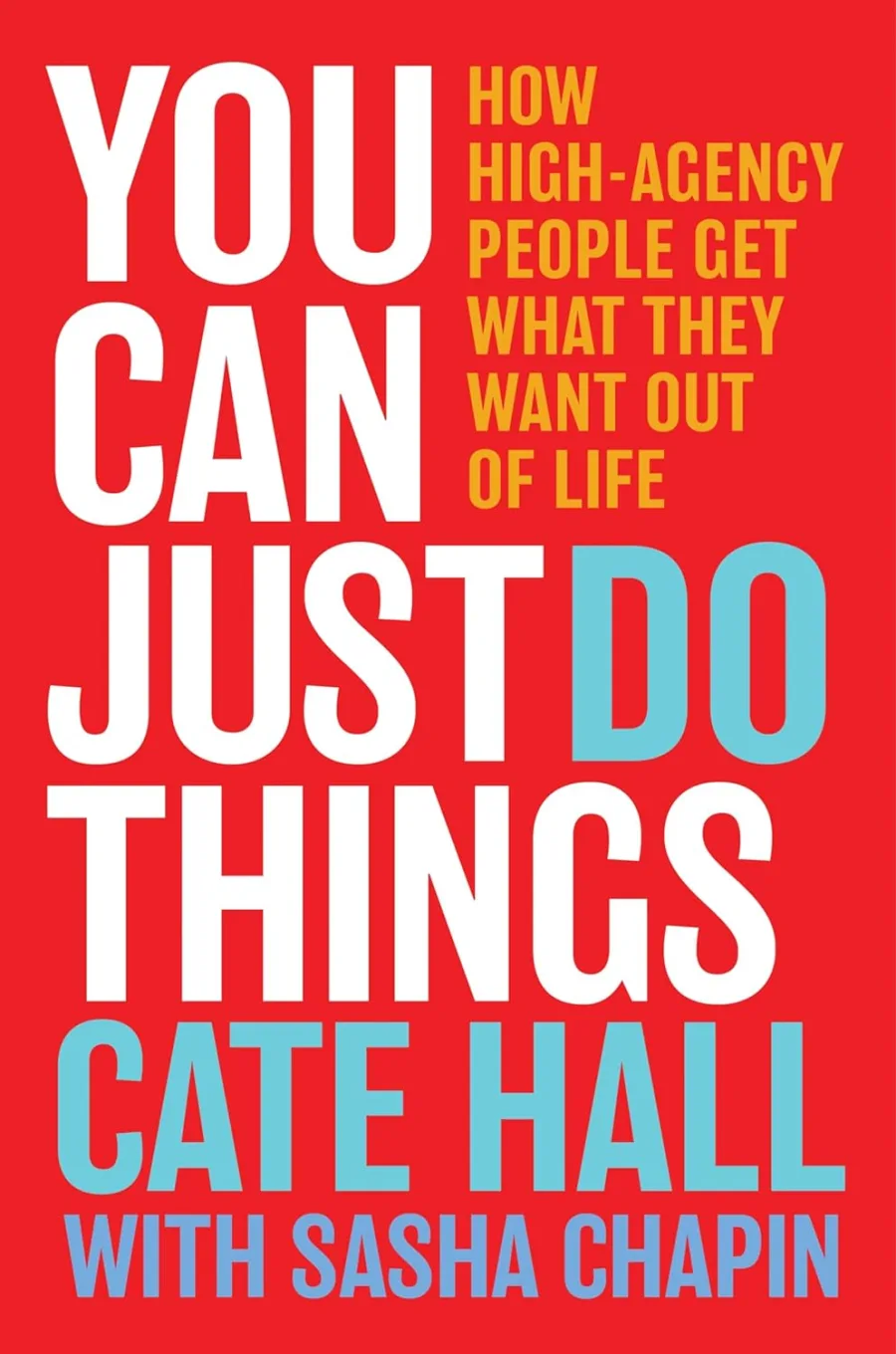
You Can Just Do Things: How High-Agency People Get What They Want Out of Life
eBook
• 218 Pages
• USD 32.99
• English
• 9780063488465
No ratings yet
| Publisher | Harper Edge |
|---|---|
| ISBN13 | 9780063488465 |
| ASIN/SKU | B0FPG3WCZH |
| Book Format | eBook |
| Language | English |
| Pages | 218 |
| List Price | USD 32.99 |
| Publishing Date | 21/07/2026 |
| Book Code | BD00067313 |
Buy this Book
Amazon Stores
Ebook Stores
Other Stores
Discover You Can Just Do Things: How High-Agency People Get What They Want Out of Life by Cate Hall. This book is published by Harper Edge in eBook format, ISBN 9780063488465, ASIN B0FPG3WCZH, under Business and Money, Career Advancement and Professional Development, Personal Success in Business.
Book Description
You’ve been taught success comes from careful planning, learning the ropes, and earning one promotion at a time. But what about the people who seem to skip all that?
We all know a few rare individuals who never stop moving, taking wild risks, and collecting public failures, yet somehow always seem to land on top. Cate Hall is one of those maddening, inspiring people. She left an elite legal career just before making partner to gamble for a living — and became the world’s top-ranked female poker player. A drug addiction left her broke and brain-damaged, but a year after emerging from it, she co-founded a biotech startup that set a clinical trial speed record. Not long after, she took the helm of one of the world’s largest philanthropic foundations.
Why don’t the rules apply to her? What if they don’t apply to you either?
In You Can Just Do Things, Cate Hall argues that the so-called “rules” of success aren’t rules at all — they’re productivity guidelines for low-agency people. Hall shows readers how to live with agency and take control of your future:
Increase your surface area for luck
Take every shortcut available
Build “forcing functions” that ensure commitment
Use your deepest insecurities as fuel for growth
Are you ready to cross the cringe minefield? To show up where you don’t belong, apply for jobs you’re not qualified for, call people who aren’t expecting it, and risk looking foolish in front of others? Every time you think, “Somebody should do this,” that somebody can be you.
An uncomfortable psychological journey and a toolkit for bold living, You Can Just Do Things reveals how to stop waiting and start building the life you want.
We all know a few rare individuals who never stop moving, taking wild risks, and collecting public failures, yet somehow always seem to land on top. Cate Hall is one of those maddening, inspiring people. She left an elite legal career just before making partner to gamble for a living — and became the world’s top-ranked female poker player. A drug addiction left her broke and brain-damaged, but a year after emerging from it, she co-founded a biotech startup that set a clinical trial speed record. Not long after, she took the helm of one of the world’s largest philanthropic foundations.
Why don’t the rules apply to her? What if they don’t apply to you either?
In You Can Just Do Things, Cate Hall argues that the so-called “rules” of success aren’t rules at all — they’re productivity guidelines for low-agency people. Hall shows readers how to live with agency and take control of your future:
Increase your surface area for luck
Take every shortcut available
Build “forcing functions” that ensure commitment
Use your deepest insecurities as fuel for growth
Are you ready to cross the cringe minefield? To show up where you don’t belong, apply for jobs you’re not qualified for, call people who aren’t expecting it, and risk looking foolish in front of others? Every time you think, “Somebody should do this,” that somebody can be you.
An uncomfortable psychological journey and a toolkit for bold living, You Can Just Do Things reveals how to stop waiting and start building the life you want.
Author Biography
Cate Hall is a former Supreme Court attorney and the ex-#1 ranked female poker player in the world. She co-founded Alvea, a pandemic medicine company that set the record for the fastest startup to take a drug candidate to Phase I clinical trial. Later, she served as CEO of the Astera Institute, a multibillion dollar private foundation. She received a BS in biochemistry and a BA in philosophy from the University of Arizona, and a law degree from Yale Law School.
Editorial Reviews
Cate Hall’s journey is a vivid reminder that a meaningful life isn’t something that happens to you—it’s something you author. You Can Just Do Things is more than just a title; it’s a radical shift in perspective that challenges us to take full responsibility for our own potential. A must-read for anyone tired of their own "stuckness." — Lori Gottlieb, New York Times bestselling author of Maybe You Should Talk to Someone
Millions feel stuck in a rut in their lives—preprogrammed and unable to change. In You Can Just Do Things, Cate Hall has the answer. Through small, decisive actions, you can take control of your life and live the way you want. — Arthur C. Brooks, Harvard professor and #1 New York Times bestselling author
“You Can Just Do Things is a guide to building life on your own terms. Cate Hall—former top-ranked poker pro, biotech founder, and unlikely nonprofit CEO—dismantles the myth that success follows a fixed path. Through raw personal stories and innovative strategies, she introduces the high-agency mindset: A way of seeing hidden possibilities, making fast bets, and acting with radical ownership.” — Charles Duhigg, New York Times bestselling author of Supercommunicators and The Power of Habit
The biggest obstacle to change is in the mind: the mistaken belief that trying is pointless or too hard. Cate Hall elegantly demolishes this barrier with stories drawn from her own experiences. She ably demonstrates that we all have a role to play in what she calls 'the great collective improvement project of humanity.' You Can Just Do Things is essential reading for anyone who wants to be part of that grand project." — Eric Ries, New York Times bestselling author of The Lean Startup and Incorruptible and founder of The Long-Term Stock Exchange
Building something new is hard. But it doesn’t have to be miserable. In You Can Just Do Things, Cate Hall lays out principles for navigating uncertainty, learning from failure, and staying resilient without burning out. It’s refreshing to read a book so ambitious and humane at the same time. — Ali Abdaal, New York Times bestselling author of Feel-Good Productivity
Cate Hall reminds us that momentum beats mastery, and courage is built by doing, not waiting to feel ready. You Can Just Do Things challenges the polite lies we tell ourselves about readiness and risk and replaces them with movement. — Jenny Wood, New York Times bestselling author of Wild Courage
Without realizing it, many of us are living within a prison of our own making—one whose bars are made of delusional assumptions about what is and isn’t possible. You Can Just Do Things is a prison break instruction manual—a wildly empowering how-to guide for getting out of your own way so you can realize your true potential. — Tim Urban, Creator of Wait But Why, bestselling author of What’s Our Problem?
"Cate Hall ruined my life. With her clear language and what I only can describe as earned wisdom, she forced me to look at the hot, radiating sphere of avoidant behavior that was making me miserable. Only to then empower me to actually take action and radically improve my life – it turns out you really can just do things." — Philipp Dettmer, creator of Kurzgesagt – In a Nutshell
"Mixing a unique personal story with concrete, actionable advice, this will resonate with those feeling stuck." — Publishers Weekly
Millions feel stuck in a rut in their lives—preprogrammed and unable to change. In You Can Just Do Things, Cate Hall has the answer. Through small, decisive actions, you can take control of your life and live the way you want. — Arthur C. Brooks, Harvard professor and #1 New York Times bestselling author
“You Can Just Do Things is a guide to building life on your own terms. Cate Hall—former top-ranked poker pro, biotech founder, and unlikely nonprofit CEO—dismantles the myth that success follows a fixed path. Through raw personal stories and innovative strategies, she introduces the high-agency mindset: A way of seeing hidden possibilities, making fast bets, and acting with radical ownership.” — Charles Duhigg, New York Times bestselling author of Supercommunicators and The Power of Habit
The biggest obstacle to change is in the mind: the mistaken belief that trying is pointless or too hard. Cate Hall elegantly demolishes this barrier with stories drawn from her own experiences. She ably demonstrates that we all have a role to play in what she calls 'the great collective improvement project of humanity.' You Can Just Do Things is essential reading for anyone who wants to be part of that grand project." — Eric Ries, New York Times bestselling author of The Lean Startup and Incorruptible and founder of The Long-Term Stock Exchange
Building something new is hard. But it doesn’t have to be miserable. In You Can Just Do Things, Cate Hall lays out principles for navigating uncertainty, learning from failure, and staying resilient without burning out. It’s refreshing to read a book so ambitious and humane at the same time. — Ali Abdaal, New York Times bestselling author of Feel-Good Productivity
Cate Hall reminds us that momentum beats mastery, and courage is built by doing, not waiting to feel ready. You Can Just Do Things challenges the polite lies we tell ourselves about readiness and risk and replaces them with movement. — Jenny Wood, New York Times bestselling author of Wild Courage
Without realizing it, many of us are living within a prison of our own making—one whose bars are made of delusional assumptions about what is and isn’t possible. You Can Just Do Things is a prison break instruction manual—a wildly empowering how-to guide for getting out of your own way so you can realize your true potential. — Tim Urban, Creator of Wait But Why, bestselling author of What’s Our Problem?
"Cate Hall ruined my life. With her clear language and what I only can describe as earned wisdom, she forced me to look at the hot, radiating sphere of avoidant behavior that was making me miserable. Only to then empower me to actually take action and radically improve my life – it turns out you really can just do things." — Philipp Dettmer, creator of Kurzgesagt – In a Nutshell
"Mixing a unique personal story with concrete, actionable advice, this will resonate with those feeling stuck." — Publishers Weekly
Book Summary
You Can Just Do Things: How High-Agency People Get What They Want Out of Life by Cate Hall and Sasha Chapin explores the concept of "high agency"—the belief that individuals have more influence over their lives than they often realize. Rather than presenting success as something determined primarily by luck, talent, or circumstance, the authors argue that people who consistently achieve meaningful goals tend to share a common mindset. They see obstacles as problems to solve instead of permanent barriers, take initiative instead of waiting for permission, and actively shape their circumstances rather than passively accepting them. Through practical advice, psychological insights, and real-world examples, the book encourages readers to develop this high-agency mindset and apply it to every area of life.
The book begins by challenging one of the most common assumptions people hold: that important opportunities are controlled by someone else. Many individuals wait for ideal conditions, approval, or perfect timing before taking action. According to the authors, this mindset often keeps people stuck, even when they possess the skills and resources needed to move forward. High-agency people recognize that uncertainty is a normal part of life. Instead of waiting until every variable is known, they begin acting with the information available and adjust their approach as they learn more.
A central theme throughout the book is the importance of taking responsibility for one's choices. The authors acknowledge that everyone faces limitations, and they do not claim that determination alone can overcome every obstacle. However, they argue that people frequently underestimate the amount of influence they do have. By focusing attention on what can be controlled rather than what cannot, individuals become more effective problem-solvers and are better equipped to create meaningful change in their personal and professional lives.
The book encourages readers to replace passive thinking with active experimentation. Instead of endlessly planning or searching for certainty, the authors recommend treating life as a series of experiments. Trying new approaches, gathering feedback, and making gradual improvements often produces better results than attempting to design a perfect plan before taking the first step. This willingness to test ideas reduces the fear of failure because every outcome becomes a source of information rather than a final judgment of one's abilities.
Another important lesson is that confidence often develops through action rather than preceding it. Many people believe they must feel fully prepared before pursuing ambitious goals, but the authors suggest the opposite is usually true. Confidence grows as people repeatedly face unfamiliar situations, solve problems, and discover they are more capable than they initially believed. Waiting to feel completely ready often delays progress indefinitely, while taking small but meaningful actions builds competence over time.
The authors also examine the role of fear in decision-making. Fear of rejection, embarrassment, criticism, or failure frequently prevents people from pursuing opportunities that could improve their lives. High-agency individuals are not necessarily fearless; instead, they recognize these emotions without allowing them to dictate every decision. They understand that discomfort is often a natural part of growth and that meaningful progress usually requires stepping beyond familiar routines.
Throughout the book, problem-solving is presented as a skill that can be developed rather than an inborn talent. When faced with challenges, high-agency people tend to ask productive questions instead of assuming a situation is impossible. Rather than immediately accepting limitations, they explore alternatives, seek creative solutions, and look for overlooked opportunities. This mindset encourages persistence without ignoring reality, balancing optimism with practical thinking.
Relationships and communication also play a significant role in the discussion of agency. The authors explain that many opportunities emerge through conversations, collaboration, and the willingness to ask for help. People often avoid reaching out because they fear rejection or assume others will not be interested. High-agency individuals are more likely to initiate conversations, make requests respectfully, and build networks through genuine curiosity and generosity. They understand that many doors open simply because someone was willing to ask.
The book also challenges perfectionism, describing it as one of the biggest obstacles to meaningful action. Many people delay projects because they want everything to be flawless before sharing their work with the world. The authors argue that this pursuit of perfection often masks fear of judgment. High-agency people instead focus on creating, learning, and improving through repeated practice. They accept that early efforts may be imperfect but recognize that progress depends on producing real work rather than endlessly refining ideas in private.
Another recurring idea is the importance of adaptability. Circumstances inevitably change, and plans rarely unfold exactly as expected. Instead of becoming discouraged by unexpected setbacks, high-agency individuals treat them as opportunities to reassess and adjust. Flexibility allows them to continue moving toward their goals even when the original path is no longer available. This resilience helps transform obstacles into learning experiences rather than permanent defeats.
The authors also discuss the influence of personal narratives. Many people unknowingly limit themselves through stories they tell about who they are or what they are capable of achieving. Beliefs such as "I'm not good at networking," "I'm not creative," or "People like me don't succeed in this field" can quietly shape behavior for years. The book encourages readers to question these assumptions and replace them with more accurate, empowering perspectives based on evidence and experience rather than fear.
Practical action remains at the heart of the book's message. Rather than encouraging readers to seek endless motivation or consume more advice, the authors repeatedly emphasize the value of doing. Small actions taken consistently often produce far greater results than elaborate plans that never leave the planning stage. Momentum builds through execution, and every completed action creates new opportunities that would not have existed otherwise.
Throughout the book, the tone remains encouraging without becoming unrealistic. The authors acknowledge that external circumstances, privilege, and chance influence people's lives, but they maintain that individuals almost always possess more capacity for meaningful action than they initially believe. High agency is presented not as a personality trait reserved for a fortunate few but as a way of thinking and behaving that can be practiced, strengthened, and applied gradually over time.
Overall, You Can Just Do Things is an empowering guide that encourages readers to become active participants in shaping their own lives. Cate Hall and Sasha Chapin argue that meaningful progress comes from initiative, experimentation, resilience, and the willingness to take responsibility for what can be controlled. Rather than waiting for permission, perfect conditions, or guaranteed success, the book invites readers to embrace uncertainty, act with intention, and learn through experience. Its central message is both simple and powerful: many of the opportunities people seek begin with the realization that they already have the ability to take the first step.
The book begins by challenging one of the most common assumptions people hold: that important opportunities are controlled by someone else. Many individuals wait for ideal conditions, approval, or perfect timing before taking action. According to the authors, this mindset often keeps people stuck, even when they possess the skills and resources needed to move forward. High-agency people recognize that uncertainty is a normal part of life. Instead of waiting until every variable is known, they begin acting with the information available and adjust their approach as they learn more.
A central theme throughout the book is the importance of taking responsibility for one's choices. The authors acknowledge that everyone faces limitations, and they do not claim that determination alone can overcome every obstacle. However, they argue that people frequently underestimate the amount of influence they do have. By focusing attention on what can be controlled rather than what cannot, individuals become more effective problem-solvers and are better equipped to create meaningful change in their personal and professional lives.
The book encourages readers to replace passive thinking with active experimentation. Instead of endlessly planning or searching for certainty, the authors recommend treating life as a series of experiments. Trying new approaches, gathering feedback, and making gradual improvements often produces better results than attempting to design a perfect plan before taking the first step. This willingness to test ideas reduces the fear of failure because every outcome becomes a source of information rather than a final judgment of one's abilities.
Another important lesson is that confidence often develops through action rather than preceding it. Many people believe they must feel fully prepared before pursuing ambitious goals, but the authors suggest the opposite is usually true. Confidence grows as people repeatedly face unfamiliar situations, solve problems, and discover they are more capable than they initially believed. Waiting to feel completely ready often delays progress indefinitely, while taking small but meaningful actions builds competence over time.
The authors also examine the role of fear in decision-making. Fear of rejection, embarrassment, criticism, or failure frequently prevents people from pursuing opportunities that could improve their lives. High-agency individuals are not necessarily fearless; instead, they recognize these emotions without allowing them to dictate every decision. They understand that discomfort is often a natural part of growth and that meaningful progress usually requires stepping beyond familiar routines.
Throughout the book, problem-solving is presented as a skill that can be developed rather than an inborn talent. When faced with challenges, high-agency people tend to ask productive questions instead of assuming a situation is impossible. Rather than immediately accepting limitations, they explore alternatives, seek creative solutions, and look for overlooked opportunities. This mindset encourages persistence without ignoring reality, balancing optimism with practical thinking.
Relationships and communication also play a significant role in the discussion of agency. The authors explain that many opportunities emerge through conversations, collaboration, and the willingness to ask for help. People often avoid reaching out because they fear rejection or assume others will not be interested. High-agency individuals are more likely to initiate conversations, make requests respectfully, and build networks through genuine curiosity and generosity. They understand that many doors open simply because someone was willing to ask.
The book also challenges perfectionism, describing it as one of the biggest obstacles to meaningful action. Many people delay projects because they want everything to be flawless before sharing their work with the world. The authors argue that this pursuit of perfection often masks fear of judgment. High-agency people instead focus on creating, learning, and improving through repeated practice. They accept that early efforts may be imperfect but recognize that progress depends on producing real work rather than endlessly refining ideas in private.
Another recurring idea is the importance of adaptability. Circumstances inevitably change, and plans rarely unfold exactly as expected. Instead of becoming discouraged by unexpected setbacks, high-agency individuals treat them as opportunities to reassess and adjust. Flexibility allows them to continue moving toward their goals even when the original path is no longer available. This resilience helps transform obstacles into learning experiences rather than permanent defeats.
The authors also discuss the influence of personal narratives. Many people unknowingly limit themselves through stories they tell about who they are or what they are capable of achieving. Beliefs such as "I'm not good at networking," "I'm not creative," or "People like me don't succeed in this field" can quietly shape behavior for years. The book encourages readers to question these assumptions and replace them with more accurate, empowering perspectives based on evidence and experience rather than fear.
Practical action remains at the heart of the book's message. Rather than encouraging readers to seek endless motivation or consume more advice, the authors repeatedly emphasize the value of doing. Small actions taken consistently often produce far greater results than elaborate plans that never leave the planning stage. Momentum builds through execution, and every completed action creates new opportunities that would not have existed otherwise.
Throughout the book, the tone remains encouraging without becoming unrealistic. The authors acknowledge that external circumstances, privilege, and chance influence people's lives, but they maintain that individuals almost always possess more capacity for meaningful action than they initially believe. High agency is presented not as a personality trait reserved for a fortunate few but as a way of thinking and behaving that can be practiced, strengthened, and applied gradually over time.
Overall, You Can Just Do Things is an empowering guide that encourages readers to become active participants in shaping their own lives. Cate Hall and Sasha Chapin argue that meaningful progress comes from initiative, experimentation, resilience, and the willingness to take responsibility for what can be controlled. Rather than waiting for permission, perfect conditions, or guaranteed success, the book invites readers to embrace uncertainty, act with intention, and learn through experience. Its central message is both simple and powerful: many of the opportunities people seek begin with the realization that they already have the ability to take the first step.
Sample Chapters
Sample Chapters will be added soon…
Reader Reviews
No reviews yet.
You Can Just Do Things: How High-Agency People Get What They Want Out of Life
Download Cover Image
Do you want to download the full cover image for You Can Just Do Things: How High-Agency People Get What They Want Out of Life?