
Mating in Captivity: Reconciling the Erotic and the Domestic
eBook
• 306 Pages
• USD 18.99
• English
• 9780063589728
No ratings yet
| Publisher | Harper Perennial |
|---|---|
| ISBN13 | 9780063589728 |
| ASIN/SKU | B0H15HJC57 |
| Book Format | eBook |
| Language | English |
| Pages | 306 |
| List Price | USD 18.99 |
| Publishing Date | 12/05/2026 |
| Book Code | BD00067315 |
Buy this Book
Amazon Stores
Ebook Stores
Other Stores
Discover Mating in Captivity: Reconciling the Erotic and the Domestic by Esther Perel. This book is published by Harper Perennial in eBook format, ISBN 9780063589728, ASIN B0H15HJC57, under Health, Fitness and Dieting, Counseling and Psychology eBooks on Human Sexuality, General Sexual Health.
Book Description
With a New Preface by the Author
"The world’s best-known relationship expert.”- The New York Times
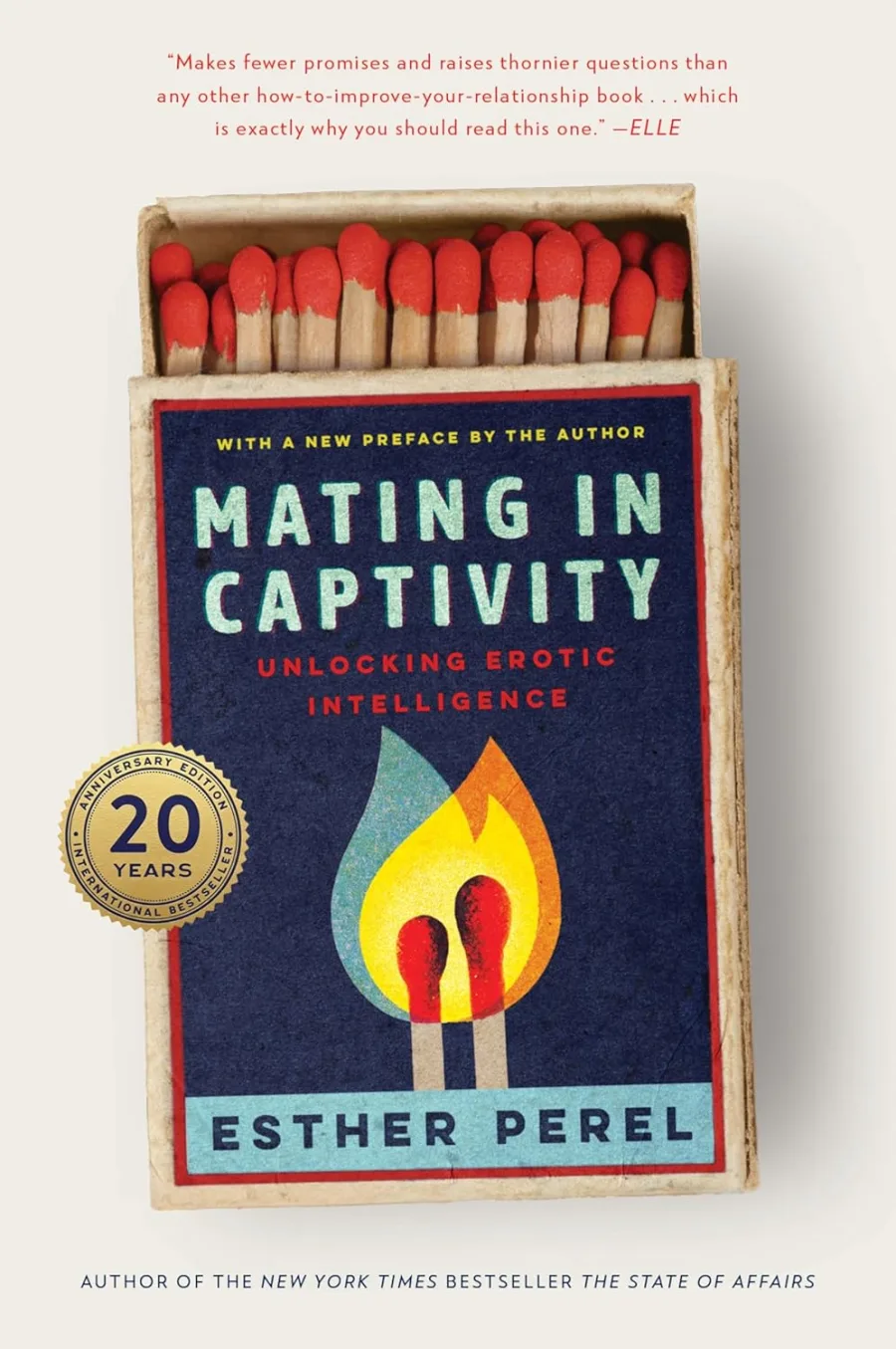
“Makes fewer promises and raises thornier questions than any other how-to-improve-your-relationship book. . . which is exactly why you should read this one.” —ELLE
A special twentieth-anniversary edition of the internationally bestselling and culturally groundbreaking book that cemented Esther Perel as the iconic relationship psychotherapist for today.
In the twenty years since Mating in Captivity was published in 2006, it has become a global phenomenon, as has its author, Esther Perel. As a psychotherapist and thought leader, Perel is widely considered one of the world’s most original and respected voices on erotic intelligence.
Drawing on decades of clinical experience, Mating in Captivity examines the obstacles and anxieties that arise when our quest for secure love conflicts with our pursuit for freedom and passion. It illuminates the complexities of sustaining desire in long-term relationships and shows how more playful, adventurous, and even poetic sex is possible. Wise, witty, and as revelatory as it is practical, Perel’s bold and provocative take on intimacy is ever more relevant today, asking:
Why does great sex so often fade for couples who claim to love each other as much as ever? Why doesn’t good intimacy guarantee good sex?
Can we want what we already have?
Why does the transition to parenthood so often spell erotic disaster?
In a new preface, Perel reveals the personal origin story behind the book and reflects upon the many cultural shifts since its publication. This twentieth-anniversary edition invites us to reconsider the timeless paradoxical union of domesticity and desire—and offers a guide to bringing lust home.
"The world’s best-known relationship expert.”- The New York Times
“Makes fewer promises and raises thornier questions than any other how-to-improve-your-relationship book. . . which is exactly why you should read this one.” —ELLE
A special twentieth-anniversary edition of the internationally bestselling and culturally groundbreaking book that cemented Esther Perel as the iconic relationship psychotherapist for today.
In the twenty years since Mating in Captivity was published in 2006, it has become a global phenomenon, as has its author, Esther Perel. As a psychotherapist and thought leader, Perel is widely considered one of the world’s most original and respected voices on erotic intelligence.
Drawing on decades of clinical experience, Mating in Captivity examines the obstacles and anxieties that arise when our quest for secure love conflicts with our pursuit for freedom and passion. It illuminates the complexities of sustaining desire in long-term relationships and shows how more playful, adventurous, and even poetic sex is possible. Wise, witty, and as revelatory as it is practical, Perel’s bold and provocative take on intimacy is ever more relevant today, asking:
Why does great sex so often fade for couples who claim to love each other as much as ever? Why doesn’t good intimacy guarantee good sex?
Can we want what we already have?
Why does the transition to parenthood so often spell erotic disaster?
In a new preface, Perel reveals the personal origin story behind the book and reflects upon the many cultural shifts since its publication. This twentieth-anniversary edition invites us to reconsider the timeless paradoxical union of domesticity and desire—and offers a guide to bringing lust home.
Author Biography
'Hello, I'm Esther... I imagine a world where we experience a sense of aliveness and vitality in our relationships, because the quality of our relationships determines the quality of our lives. I've dedicated my life and career to understanding and improving human relationships. Let's continue to learn together.'
Psychotherapist and New York Times bestselling author Esther Perel is recognized as one of today’s most insightful and original voices on modern relationships. Fluent in nine languages, she helms a therapy practice in New York City and serves as an organizational consultant for Fortune 500 companies around the world. Her celebrated TED Talks have garnered more than 20 million views and her international bestseller Mating in Captivity: Unlocking Erotic Intelligence became a global phenomenon translated into 25 languages. Her newest book is theNew York Times bestseller The State of Affairs: Rethinking Infidelity. Esther is also an executive producer and host of the award-winning podcast Where Should We Begin? Learn more at EstherPerel.com or by following @EstherPerelOfficial on Instagram.
Psychotherapist and New York Times bestselling author Esther Perel is recognized as one of today’s most insightful and original voices on modern relationships. Fluent in nine languages, she helms a therapy practice in New York City and serves as an organizational consultant for Fortune 500 companies around the world. Her celebrated TED Talks have garnered more than 20 million views and her international bestseller Mating in Captivity: Unlocking Erotic Intelligence became a global phenomenon translated into 25 languages. Her newest book is theNew York Times bestseller The State of Affairs: Rethinking Infidelity. Esther is also an executive producer and host of the award-winning podcast Where Should We Begin? Learn more at EstherPerel.com or by following @EstherPerelOfficial on Instagram.
Editorial Reviews
“Perel is the people’s therapist.” —The Financial Times
"Esther doesn’t shy away from the hard truths about relationships, love and desire … and our marriage is better for it … Mating in Captivity is a gift to relationships everywhere … There was an entire 6 months where every conversation started with ‘so what Esther would say is…’" —Glennon
Doyle and Abby Wambach, activists, New York Times bestselling authors of Untamed and Wolfpack, and hosts of the podcast We Can Do Hard Things
“Esther Perel has the number-one secret to chemistry that lasts.” —Jay Shetty, #1 New York Times bestselling author and host of the On Purpose podcast
“Few works have been as impactful as Mating in Captivity in expanding the world’s imagination for what is possible and desired, in navigating the delicious tumult of our erotic lives.” —Dr.
Justin Garcia, PhD, executive director of the Kinsey Institute and author of The Intimate Animal
“She knows why sex falters in long-term relationships, and how to remedy it.” —The Guardian
“Esther Perel’s Mating in Captivity is transformative. [Perel’s] work laid the foundation for the conversations I can have with guests on Call Her Daddy and the way our society talks about modern relationships, love, and intimacy. It’s one of those books that I always come back to.” —Alex Cooper, founder of Unwell and creator of the Call Her Daddy podcast
“The key to a sexy marriage.” —Glamour
“For twenty years, Mating in Captivity has stood as one of the most honest explorations of modern love—not the love we perform for others, but the one we struggle to sustain behind closed doors. Esther’s genius lies in her ability to see people fully, without judgement, holding the complexity of who we are with compassion and precision. At a time when society rushes to label and divide, she reminds us that understanding begins where judgement ends. Her work gave language to the quiet tensions that live inside intimacy: desire and duty, safety and adventure, love and autonomy. It helped us see that these contradictions are not failures, but features of the human experience. Few voices have shaped our understanding of relationships as profoundly as hers. In a world obsessed with image and performance, Esther continues to bring us back to the truth of what it means to connect, to want, and to be seen.” —Trevor Noah, comedian and New York Times bestselling author of Born a Crime
“Mating in Captivity takes a hard line against one of the most time-honored institutions in human history: the sexless marriage…It reads like a cross between the works of Jacques Lacan and French Women Don’t Get Fat.” —The New Yorker
"In her two seminal books Esther Perel illuminates liberation without license, eroticism without concupiscence, intimacy without fusion, individuality without isolation, and ethics without moralizing. She honors our healthily lustful nature but does not reduce us to our animal drives. Not conflating craving with affection, Esther empowers us to desire and to love. Her eloquent writing explores and celebrates our free humanity, a humanity all too often hobbled by the blandishments and strictures of a crudely seductive modern culture that entices and forbids at the same time." —Gabor Maté, MD, New York Times bestselling author, The Myth of Normal: Trauma, Illness, and Healing in a Toxic Culture
“As revelatory as it is straightforward . . . nicely accessible . . . Perel offers the estranged modern couple a unique richness of experience.” —Publishers Weekly
"Esther doesn’t shy away from the hard truths about relationships, love and desire … and our marriage is better for it … Mating in Captivity is a gift to relationships everywhere … There was an entire 6 months where every conversation started with ‘so what Esther would say is…’" —Glennon
Doyle and Abby Wambach, activists, New York Times bestselling authors of Untamed and Wolfpack, and hosts of the podcast We Can Do Hard Things
“Esther Perel has the number-one secret to chemistry that lasts.” —Jay Shetty, #1 New York Times bestselling author and host of the On Purpose podcast
“Few works have been as impactful as Mating in Captivity in expanding the world’s imagination for what is possible and desired, in navigating the delicious tumult of our erotic lives.” —Dr.
Justin Garcia, PhD, executive director of the Kinsey Institute and author of The Intimate Animal
“She knows why sex falters in long-term relationships, and how to remedy it.” —The Guardian
“Esther Perel’s Mating in Captivity is transformative. [Perel’s] work laid the foundation for the conversations I can have with guests on Call Her Daddy and the way our society talks about modern relationships, love, and intimacy. It’s one of those books that I always come back to.” —Alex Cooper, founder of Unwell and creator of the Call Her Daddy podcast
“The key to a sexy marriage.” —Glamour
“For twenty years, Mating in Captivity has stood as one of the most honest explorations of modern love—not the love we perform for others, but the one we struggle to sustain behind closed doors. Esther’s genius lies in her ability to see people fully, without judgement, holding the complexity of who we are with compassion and precision. At a time when society rushes to label and divide, she reminds us that understanding begins where judgement ends. Her work gave language to the quiet tensions that live inside intimacy: desire and duty, safety and adventure, love and autonomy. It helped us see that these contradictions are not failures, but features of the human experience. Few voices have shaped our understanding of relationships as profoundly as hers. In a world obsessed with image and performance, Esther continues to bring us back to the truth of what it means to connect, to want, and to be seen.” —Trevor Noah, comedian and New York Times bestselling author of Born a Crime
“Mating in Captivity takes a hard line against one of the most time-honored institutions in human history: the sexless marriage…It reads like a cross between the works of Jacques Lacan and French Women Don’t Get Fat.” —The New Yorker
"In her two seminal books Esther Perel illuminates liberation without license, eroticism without concupiscence, intimacy without fusion, individuality without isolation, and ethics without moralizing. She honors our healthily lustful nature but does not reduce us to our animal drives. Not conflating craving with affection, Esther empowers us to desire and to love. Her eloquent writing explores and celebrates our free humanity, a humanity all too often hobbled by the blandishments and strictures of a crudely seductive modern culture that entices and forbids at the same time." —Gabor Maté, MD, New York Times bestselling author, The Myth of Normal: Trauma, Illness, and Healing in a Toxic Culture
“As revelatory as it is straightforward . . . nicely accessible . . . Perel offers the estranged modern couple a unique richness of experience.” —Publishers Weekly
Book Summary
Esther Perel’s Mating in Captivity: Reconciling the Erotic and the Domestic explores one of the most perplexing paradoxes of modern relationships: the fundamental conflict between our deep need for security and our equally strong desire for passion. In her groundbreaking work, Perel, a renowned couples therapist, investigates why sexual desire often fades in long-term relationships, even when couples deeply love each other. She challenges the conventional wisdom that good intimacy naturally guarantees good sex. Instead, she presents a radical premise: the very elements that nurture a stable, loving domestic life—familiarity, predictability, and safety—are often the exact things that extinguish the spark of eroticism. The book serves as a profound exploration of how couples can navigate the ongoing tension between the comfort of love and the thrilling edge of desire.
To understand this dynamic, Perel examines the overwhelming expectations placed on modern marriage. Historically, marriage was primarily an economic and social institution designed for survival, reproduction, and communal stability. Today, however, we expect our partners to fulfill an unprecedented array of roles. We want them to be our best friend, our trusted confidant, an equal co-parent, a financial partner, and on top of all that, a passionate, adventurous lover. Perel argues that this modern model overburdens the relationship. By trying to fit all our complex human needs into one person, we create a stifling environment where the space required for desire to breathe is entirely suffocated by the heavy, practical demands of domesticity.
The core of the issue lies in the contrasting nature of love and desire. Perel explains that love is built on a foundation of intimacy, which craves closeness, mutual knowing, and a shrinking of the space between two people. We want to know everything about our partners to feel secure and grounded. Desire, on the other hand, requires distance. It thrives on mystery, novelty, and the thrill of the unknown. Fire needs air to burn, and eroticism needs psychological space to exist. When couples merge so completely that they lose their individual identities, the gap across which a spark can ignite disappears. By constantly seeking to bridge the gap through radical honesty and constant togetherness, couples inadvertently neutralize the very tension that makes sex exciting.
A significant portion of the book delves into how egalitarian ideals, while crucial for a fair and functioning household, can sometimes be the enemy of eroticism. Modern couples strive for fairness, shared chores, and democratic decision-making. While these are excellent principles for managing a home and raising children, the bedroom operates under a entirely different set of rules. Eroticism frequently feeds on power dynamics, transgression, playfulness, and a temporary release from the responsible, fair-minded constraints of daily life. Perel encourages couples to separate their egalitarian daytime roles from their erotic nighttime personas. She emphasizes that fantasies do not have to be politically correct or perfectly mirror the equitable structure of the marriage; they are private playgrounds where individuals can safely explore dominance, submission, and wildness without threatening the safety of their domestic life.
The transition into parenthood is highlighted as a particularly perilous time for a couple's erotic life. When a couple has children, the romantic dyad transforms into a family structure. The roles of "mother" and "father" often completely overshadow the roles of "lovers." The sheer physical exhaustion of parenting, combined with a societal tendency to view the parental role as wholly desexualized, leaves little room or energy for erotic play. Perel stresses the absolute necessity for parents to ruthlessly carve out a private, adult-only space that is physically and mentally separated from their children. Reclaiming this space is essential for reminding each other that before they were co-managers of a family logistics center, they were autonomous individuals drawn to one another by pure magnetism.
To reconcile the erotic and the domestic, Perel suggests that couples must consciously cultivate separateness. This does not mean creating emotional distance or cold secrecy, but rather maintaining a strong sense of individual self. When partners pursue their own passions, maintain their own friendships, and engage in their own interests, they remain vibrant and dynamic to one another. Perel notes that people often find their partners most attractive when they observe them in their element, doing something they are exceptionally good at, or interacting with others from a distance. It is in these moments of observing our partner as a separate, autonomous entity that we realize we do not truly "own" them. This realization of a partner's inherent elusiveness is a powerful trigger for renewed desire.
Ultimately, Mating in Captivity does not offer a quick, magical fix or a generic checklist for spicing up a stale marriage. Instead, it offers a profound shift in perspective. Perel teaches readers that keeping passion alive is an ongoing practice of managing a contradiction. It is about understanding that safety and adventure will always pull in opposite directions, and that long-term passion is not a given—it is an intentional art form. By learning to tolerate a little uncertainty, maintaining personal boundaries, and giving desire the oxygen it needs to breathe, couples can successfully sustain a relationship that is both deeply comforting and intensely vibrant.
To understand this dynamic, Perel examines the overwhelming expectations placed on modern marriage. Historically, marriage was primarily an economic and social institution designed for survival, reproduction, and communal stability. Today, however, we expect our partners to fulfill an unprecedented array of roles. We want them to be our best friend, our trusted confidant, an equal co-parent, a financial partner, and on top of all that, a passionate, adventurous lover. Perel argues that this modern model overburdens the relationship. By trying to fit all our complex human needs into one person, we create a stifling environment where the space required for desire to breathe is entirely suffocated by the heavy, practical demands of domesticity.
The core of the issue lies in the contrasting nature of love and desire. Perel explains that love is built on a foundation of intimacy, which craves closeness, mutual knowing, and a shrinking of the space between two people. We want to know everything about our partners to feel secure and grounded. Desire, on the other hand, requires distance. It thrives on mystery, novelty, and the thrill of the unknown. Fire needs air to burn, and eroticism needs psychological space to exist. When couples merge so completely that they lose their individual identities, the gap across which a spark can ignite disappears. By constantly seeking to bridge the gap through radical honesty and constant togetherness, couples inadvertently neutralize the very tension that makes sex exciting.
A significant portion of the book delves into how egalitarian ideals, while crucial for a fair and functioning household, can sometimes be the enemy of eroticism. Modern couples strive for fairness, shared chores, and democratic decision-making. While these are excellent principles for managing a home and raising children, the bedroom operates under a entirely different set of rules. Eroticism frequently feeds on power dynamics, transgression, playfulness, and a temporary release from the responsible, fair-minded constraints of daily life. Perel encourages couples to separate their egalitarian daytime roles from their erotic nighttime personas. She emphasizes that fantasies do not have to be politically correct or perfectly mirror the equitable structure of the marriage; they are private playgrounds where individuals can safely explore dominance, submission, and wildness without threatening the safety of their domestic life.
The transition into parenthood is highlighted as a particularly perilous time for a couple's erotic life. When a couple has children, the romantic dyad transforms into a family structure. The roles of "mother" and "father" often completely overshadow the roles of "lovers." The sheer physical exhaustion of parenting, combined with a societal tendency to view the parental role as wholly desexualized, leaves little room or energy for erotic play. Perel stresses the absolute necessity for parents to ruthlessly carve out a private, adult-only space that is physically and mentally separated from their children. Reclaiming this space is essential for reminding each other that before they were co-managers of a family logistics center, they were autonomous individuals drawn to one another by pure magnetism.
To reconcile the erotic and the domestic, Perel suggests that couples must consciously cultivate separateness. This does not mean creating emotional distance or cold secrecy, but rather maintaining a strong sense of individual self. When partners pursue their own passions, maintain their own friendships, and engage in their own interests, they remain vibrant and dynamic to one another. Perel notes that people often find their partners most attractive when they observe them in their element, doing something they are exceptionally good at, or interacting with others from a distance. It is in these moments of observing our partner as a separate, autonomous entity that we realize we do not truly "own" them. This realization of a partner's inherent elusiveness is a powerful trigger for renewed desire.
Ultimately, Mating in Captivity does not offer a quick, magical fix or a generic checklist for spicing up a stale marriage. Instead, it offers a profound shift in perspective. Perel teaches readers that keeping passion alive is an ongoing practice of managing a contradiction. It is about understanding that safety and adventure will always pull in opposite directions, and that long-term passion is not a given—it is an intentional art form. By learning to tolerate a little uncertainty, maintaining personal boundaries, and giving desire the oxygen it needs to breathe, couples can successfully sustain a relationship that is both deeply comforting and intensely vibrant.
Sample Chapters
Sample Chapters will be added soon…
Reader Reviews
No reviews yet.
Mating in Captivity: Reconciling the Erotic and the Domestic
Download Cover Image
Do you want to download the full cover image for Mating in Captivity: Reconciling the Erotic and the Domestic?