
Inside the Box: How Constraints Make Us Better
eBook
• 300 Pages
• USD 16.99
• English
• 9780593715734
No ratings yet
| Publisher | Riverhead Books |
|---|---|
| ISBN13 | 9780593715734 |
| ASIN/SKU | B0FMXMFHKH |
| Book Format | eBook |
| Language | English |
| Pages | 300 |
| List Price | USD 16.99 |
| Publishing Date | 05/05/2026 |
| Book Code | BD00067316 |
Buy this Book
Amazon Stores
Ebook Stores
Other Stores
Discover Inside the Box: How Constraints Make Us Better by David Epstein. This book is published by Riverhead Books in eBook format, ISBN 9780593715734, ASIN B0FMXMFHKH, under Business and Money, Organizational Behavior, Business Processes and Infrastructure.
Book Description
NEW YORK TIMES BESTSELLER
"Fascinating stories. . . . Boxing ourselves in may be the ultimate way to think outside the box." —Wall Street Journal
“I thought David Epstein’s first two books were brilliant, but Inside the Box is his best. I’ll never think about my own work the same way again.” —Malcolm Gladwell
It's never been easier to do too much. From the #1 New York Times bestselling author of Range, why limits are the key to stimulating creativity, innovation, collaboration, and personal contentment.
We live in a world that gives us seemingly infinite choices and prizes freedom above all else. We have an unprecedented number of options regarding what to do, who to be, and how to spend our time. All that choice is wonderful; it is also overwhelming. The irony is that total freedom can be paralyzing, and unlimited resources don’t necessarily lead to the biggest breakthroughs. In fact, overvaluing complete freedom can be disastrous for everything from starting a company to harnessing creativity to finding personal satisfaction.
David Epstein argues that all of us—individuals, businesses, institutions, even societies—can benefit from narrowing our options. He dives into the science and practice of constraints, exploring exactly when and how guardrails can be beneficial, whether we’re working with limited resources or using self-imposed boundaries to tap unexpected wells of focus and innovation.
Original, galvanizing, and deeply researched, Inside the Box tells absorbing stories of people and organizations that embraced constraints to transform themselves, and the world—as well as a few that struggled from a lack of limits. Epstein reveals how boundaries create breakthroughs, and how setting the right constraints can help you become the most creative, productive, and satisfied version of yourself.
"Fascinating stories. . . . Boxing ourselves in may be the ultimate way to think outside the box." —Wall Street Journal
“I thought David Epstein’s first two books were brilliant, but Inside the Box is his best. I’ll never think about my own work the same way again.” —Malcolm Gladwell
It's never been easier to do too much. From the #1 New York Times bestselling author of Range, why limits are the key to stimulating creativity, innovation, collaboration, and personal contentment.
We live in a world that gives us seemingly infinite choices and prizes freedom above all else. We have an unprecedented number of options regarding what to do, who to be, and how to spend our time. All that choice is wonderful; it is also overwhelming. The irony is that total freedom can be paralyzing, and unlimited resources don’t necessarily lead to the biggest breakthroughs. In fact, overvaluing complete freedom can be disastrous for everything from starting a company to harnessing creativity to finding personal satisfaction.
David Epstein argues that all of us—individuals, businesses, institutions, even societies—can benefit from narrowing our options. He dives into the science and practice of constraints, exploring exactly when and how guardrails can be beneficial, whether we’re working with limited resources or using self-imposed boundaries to tap unexpected wells of focus and innovation.
Original, galvanizing, and deeply researched, Inside the Box tells absorbing stories of people and organizations that embraced constraints to transform themselves, and the world—as well as a few that struggled from a lack of limits. Epstein reveals how boundaries create breakthroughs, and how setting the right constraints can help you become the most creative, productive, and satisfied version of yourself.
Author Biography
David Epstein is the author of the #1 New York Times best seller Range: Why Generalists Triumph in a Specialized World , and of the New York Times best seller The Sports Gene, which has been translated in 18 languages. (To his surprise, it was purchased not only by his sister but also by President Barack Obama and former Secretary of State Condoleezza Rice.)
He was previously a science and investigative reporter at ProPublica, and prior to that a senior writer at Sports Illustrated, where he co-authored the story that revealed Yankees third baseman Alex Rodriguez had used steroids. His writing has been honored by an array of organizations, from the National Academies of Sciences, Engineering, and Medicine, to the Society of Professional Journalists and the National Center on Disability and Journalism, and has been included in the Best American Science and Nature Writing anthology. His story “Following the Trail of Broken Hearts,” on sudden cardiac death in athletes, was chosen as one of the top 100 stories of the last 100 years by Columbia Journalism alumni.
David has given talks about performance science and the uses (and misuses) of data on five continents; his TED Talk has been viewed 8.5 million times, and was shared by Bill Gates. Three of his stories have been optioned for films: a Sports Illustrated story on the only living Olympian to have survived a concentration camp; an Atlantic/ProPublica piece detailing the DEA’s fraught pursuit of Chapo Guzman’s rivals; and a 2016 “This American Life” episode he wrote and narrated about a woman with two rare diseases who shares a mutant gene with an Olympic medalist.
David has master’s degrees in environmental science and journalism, and is reasonably sure he’s the only person to have co-authored a paper in the journal of Arctic, Antarctic, and Alpine Research while a writer at Sports Illustrated. (Like many of the characters in Range, he has benefitted from a winding career.) He has worked as an ecology researcher in the Arctic, studied geology and astronomy while residing in the Sonoran Desert, and blithely signed up to work on the D-deck of a seismic research vessel shortly after it had been attacked by pirates.
David enjoys volunteering with the Pat Tillman Foundation and Classroom Champions. An avid runner, he was a Columbia University record holder and twice NCAA All-East as an 800-meter runner.
He was previously a science and investigative reporter at ProPublica, and prior to that a senior writer at Sports Illustrated, where he co-authored the story that revealed Yankees third baseman Alex Rodriguez had used steroids. His writing has been honored by an array of organizations, from the National Academies of Sciences, Engineering, and Medicine, to the Society of Professional Journalists and the National Center on Disability and Journalism, and has been included in the Best American Science and Nature Writing anthology. His story “Following the Trail of Broken Hearts,” on sudden cardiac death in athletes, was chosen as one of the top 100 stories of the last 100 years by Columbia Journalism alumni.
David has given talks about performance science and the uses (and misuses) of data on five continents; his TED Talk has been viewed 8.5 million times, and was shared by Bill Gates. Three of his stories have been optioned for films: a Sports Illustrated story on the only living Olympian to have survived a concentration camp; an Atlantic/ProPublica piece detailing the DEA’s fraught pursuit of Chapo Guzman’s rivals; and a 2016 “This American Life” episode he wrote and narrated about a woman with two rare diseases who shares a mutant gene with an Olympic medalist.
David has master’s degrees in environmental science and journalism, and is reasonably sure he’s the only person to have co-authored a paper in the journal of Arctic, Antarctic, and Alpine Research while a writer at Sports Illustrated. (Like many of the characters in Range, he has benefitted from a winding career.) He has worked as an ecology researcher in the Arctic, studied geology and astronomy while residing in the Sonoran Desert, and blithely signed up to work on the D-deck of a seismic research vessel shortly after it had been attacked by pirates.
David enjoys volunteering with the Pat Tillman Foundation and Classroom Champions. An avid runner, he was a Columbia University record holder and twice NCAA All-East as an 800-meter runner.
Editorial Reviews
“David Epstein is one of my favorite writers, and Inside the Box is my favorite of his books—wonderfully personal, blessedly practical, full of stories I found myself retelling. A gift for anyone who, like me, needs to be reminded that less can be more.”—Angela Duckworth, bestselling author of Grit
“A masterful case that limits are what set us free. David Epstein is one of the best science writers on the planet, and he shows how smart boundaries can unblock insight, unleash creativity, and unlock potential.” —Adam Grant, bestselling author of Hidden Potential and Think Again
“[A] counterintuitive and groundbreaking exploration…Through captivating case studies, Epstein reveals the transformative power of obstacles. It’s a game changer.” —Publishers Weekly (starred review)
"From UPS routes to early computers to Bach’s strictly structured musical conventions to Michelangelo’s David, set limits and sharper focus produce the best results....This is for anyone who has ever been overwhelmed in a grocery aisle." —Booklist
“Creativity comes from limits, not excess. This book explains what I’ve spent years trying to teach cooks: how to make something delicious out of nothing.” —David Chang, founder of Momofuku
"In a culture obsessed with optionality, David Epstein makes the counterintuitive case that the right constraints can be design tools for thinking, learning, and creating. Inside the Box is an antidote to the pressure of infinite choice and an invitation to experiment with the boundaries that shape our lives." —Anne-Laure Le Cunff, neuroscientist and author of Tiny Experiments
"We think we want total freedom. We think we want to avoid obstacles and limitations. In fact, these are precisely the things we need to be creative, successful, even happy...I loved this book." —Ryan Holiday, bestselling author of The Daily Stoic and Ego Is the Enemy
"It's not possible to think outside the box. It's dark and empty out there. But on the edge of the box, that's where we can make a difference. This is a brilliant, practical book. Find some edges." —Seth Godin, bestselling author of Tribes and The Dip
“Great book. . . . Everyone building products, companies, or creative work should read this one.” —Tony Fadell, founder of Nest Labs, on X
“Inside the Box is spot on. David Epstein is, as always, a powerful source of provocation and curiosity. This book is a compelling reminder that many failures come not from scarcity, but from excess — and that well-chosen limits may be our most under-appreciated competitive advantage.” —Ed Hoffman, NASA's first Chief Knowledge Officer
“A masterful case that limits are what set us free. David Epstein is one of the best science writers on the planet, and he shows how smart boundaries can unblock insight, unleash creativity, and unlock potential.” —Adam Grant, bestselling author of Hidden Potential and Think Again
“[A] counterintuitive and groundbreaking exploration…Through captivating case studies, Epstein reveals the transformative power of obstacles. It’s a game changer.” —Publishers Weekly (starred review)
"From UPS routes to early computers to Bach’s strictly structured musical conventions to Michelangelo’s David, set limits and sharper focus produce the best results....This is for anyone who has ever been overwhelmed in a grocery aisle." —Booklist
“Creativity comes from limits, not excess. This book explains what I’ve spent years trying to teach cooks: how to make something delicious out of nothing.” —David Chang, founder of Momofuku
"In a culture obsessed with optionality, David Epstein makes the counterintuitive case that the right constraints can be design tools for thinking, learning, and creating. Inside the Box is an antidote to the pressure of infinite choice and an invitation to experiment with the boundaries that shape our lives." —Anne-Laure Le Cunff, neuroscientist and author of Tiny Experiments
"We think we want total freedom. We think we want to avoid obstacles and limitations. In fact, these are precisely the things we need to be creative, successful, even happy...I loved this book." —Ryan Holiday, bestselling author of The Daily Stoic and Ego Is the Enemy
"It's not possible to think outside the box. It's dark and empty out there. But on the edge of the box, that's where we can make a difference. This is a brilliant, practical book. Find some edges." —Seth Godin, bestselling author of Tribes and The Dip
“Great book. . . . Everyone building products, companies, or creative work should read this one.” —Tony Fadell, founder of Nest Labs, on X
“Inside the Box is spot on. David Epstein is, as always, a powerful source of provocation and curiosity. This book is a compelling reminder that many failures come not from scarcity, but from excess — and that well-chosen limits may be our most under-appreciated competitive advantage.” —Ed Hoffman, NASA's first Chief Knowledge Officer
Book Summary
Inside the Box: How Constraints Make Us Better by David Epstein is a persuasive argument for an idea that sounds backward at first: limits often help us think more clearly, work more creatively, and make better decisions. Rather than treating freedom as the ultimate good, Epstein shows that too much choice, too many resources, and too little structure can actually weaken performance. The book challenges the common advice to “think outside the box” by making the case that the right box, with the right limits, can bring out our best work. His central point is not that constraints are always pleasant, but that they often force the mind to move beyond its defaults and do deeper, more original thinking.
Epstein builds this case through stories, studies, and examples from a wide range of fields. He shows how breakthroughs often happen not in moments of unlimited freedom, but in situations where people had to work within tight boundaries. One example is Dr. Seuss, who wrote one of his most famous books using only fifty words after accepting a challenge that restricted his choices. Another is Haruki Murakami, who found his own style by writing under self-imposed limits. Epstein uses these examples to show that creative effort often becomes sharper when it has to answer to a rule, a deadline, or a narrow frame. Constraints do not kill imagination; they can focus it.
A major theme in the book is that the human brain tends to take the easiest path available. If there are many options and no clear pressure to narrow them, people often rely on familiar patterns instead of doing the harder work of invention. Epstein argues that this is why complete freedom can be so unproductive. Without a boundary to push against, the mind tends to settle for the obvious. Constraints interrupt that habit. They make people ask better questions, simplify problems, and pay closer attention to what actually matters. In that sense, a limit is not just a restriction; it is a tool for better thinking.
The book also distinguishes between creativity and originality, which Epstein treats as related but not identical. He suggests that modern culture often confuses creativity with novelty for its own sake, but historically creativity was more about improving, reshaping, or recombining what already existed. That idea helps explain why some of the greatest thinkers were not working from scratch. They were working inside inherited forms, with pressures and restrictions that gave structure to their ideas. Epstein uses this broader view of creativity to show that innovation does not require total openness. Often it needs a direction, a problem, or a limit to become useful.
Epstein also applies this logic to organizations and institutions. He points to cases where projects failed not because they lacked talent, but because they had too much freedom and too few hard boundaries. General Magic, for example, is described as a company with abundant resources and ambition but not enough constraint to turn vision into a finished product. By contrast, successful creative and technical work often depends on deadlines, bottlenecks, and focused problem-solving. In Epstein’s telling, a useful constraint can prevent drift, reduce waste, and keep a team from expanding an idea beyond what it can realistically support.
Another important idea in the book is that constraints can improve communication and collaboration. When people have to work within a smaller set of choices, they often become clearer about their goals and more aligned with one another. Epstein suggests that this can be especially valuable in workplaces, where endless freedom can create confusion, indecision, and wasted energy. By limiting options, teams can reduce friction and spend more time solving the right problem. The book’s logic here is practical as well as philosophical: fewer choices can sometimes lead to better execution.
Epstein also explores the psychological side of constraint. He argues that people often believe more freedom will make them happier, but endless choice can instead produce anxiety and dissatisfaction. When everything is possible, it becomes harder to commit, harder to finish, and harder to feel content with what was chosen. Constraint can relieve that burden. It narrows the field, reduces the pressure of constant optimization, and makes action easier. This ties into the idea of “satisficing,” or choosing what is good enough rather than endlessly searching for the perfect option. Epstein presents this as both a decision-making strategy and a way to live with more ease.
The book’s strongest message is that limits are not the enemy of greatness; they are often the condition that makes greatness possible. Epstein does not argue for rigid rules in every situation. He acknowledges that constraints can backfire if they are badly designed or too restrictive. But he insists that many of the most fruitful limits are not obstacles to creativity, but the very things that push us to exceed our defaults. That insight gives the book its force. It suggests that people, teams, and institutions should stop assuming that more freedom automatically means better results. In many cases, the better question is what kind of limit would make the work sharper, clearer, and more meaningful.
Overall, Inside the Box is a thoughtful and often surprising book about how the right boundaries can unlock better thinking. Epstein combines science, history, and vivid examples to show that constraints can improve creativity, focus, and collaboration. His argument is simple enough to remember but bold enough to change how people approach work and life. Instead of chasing unlimited options, he asks readers to see the value of narrowing the field and committing to a structure. In his view, that is not a loss of freedom. It is often the beginning of real progress.
Epstein builds this case through stories, studies, and examples from a wide range of fields. He shows how breakthroughs often happen not in moments of unlimited freedom, but in situations where people had to work within tight boundaries. One example is Dr. Seuss, who wrote one of his most famous books using only fifty words after accepting a challenge that restricted his choices. Another is Haruki Murakami, who found his own style by writing under self-imposed limits. Epstein uses these examples to show that creative effort often becomes sharper when it has to answer to a rule, a deadline, or a narrow frame. Constraints do not kill imagination; they can focus it.
A major theme in the book is that the human brain tends to take the easiest path available. If there are many options and no clear pressure to narrow them, people often rely on familiar patterns instead of doing the harder work of invention. Epstein argues that this is why complete freedom can be so unproductive. Without a boundary to push against, the mind tends to settle for the obvious. Constraints interrupt that habit. They make people ask better questions, simplify problems, and pay closer attention to what actually matters. In that sense, a limit is not just a restriction; it is a tool for better thinking.
The book also distinguishes between creativity and originality, which Epstein treats as related but not identical. He suggests that modern culture often confuses creativity with novelty for its own sake, but historically creativity was more about improving, reshaping, or recombining what already existed. That idea helps explain why some of the greatest thinkers were not working from scratch. They were working inside inherited forms, with pressures and restrictions that gave structure to their ideas. Epstein uses this broader view of creativity to show that innovation does not require total openness. Often it needs a direction, a problem, or a limit to become useful.
Epstein also applies this logic to organizations and institutions. He points to cases where projects failed not because they lacked talent, but because they had too much freedom and too few hard boundaries. General Magic, for example, is described as a company with abundant resources and ambition but not enough constraint to turn vision into a finished product. By contrast, successful creative and technical work often depends on deadlines, bottlenecks, and focused problem-solving. In Epstein’s telling, a useful constraint can prevent drift, reduce waste, and keep a team from expanding an idea beyond what it can realistically support.
Another important idea in the book is that constraints can improve communication and collaboration. When people have to work within a smaller set of choices, they often become clearer about their goals and more aligned with one another. Epstein suggests that this can be especially valuable in workplaces, where endless freedom can create confusion, indecision, and wasted energy. By limiting options, teams can reduce friction and spend more time solving the right problem. The book’s logic here is practical as well as philosophical: fewer choices can sometimes lead to better execution.
Epstein also explores the psychological side of constraint. He argues that people often believe more freedom will make them happier, but endless choice can instead produce anxiety and dissatisfaction. When everything is possible, it becomes harder to commit, harder to finish, and harder to feel content with what was chosen. Constraint can relieve that burden. It narrows the field, reduces the pressure of constant optimization, and makes action easier. This ties into the idea of “satisficing,” or choosing what is good enough rather than endlessly searching for the perfect option. Epstein presents this as both a decision-making strategy and a way to live with more ease.
The book’s strongest message is that limits are not the enemy of greatness; they are often the condition that makes greatness possible. Epstein does not argue for rigid rules in every situation. He acknowledges that constraints can backfire if they are badly designed or too restrictive. But he insists that many of the most fruitful limits are not obstacles to creativity, but the very things that push us to exceed our defaults. That insight gives the book its force. It suggests that people, teams, and institutions should stop assuming that more freedom automatically means better results. In many cases, the better question is what kind of limit would make the work sharper, clearer, and more meaningful.
Overall, Inside the Box is a thoughtful and often surprising book about how the right boundaries can unlock better thinking. Epstein combines science, history, and vivid examples to show that constraints can improve creativity, focus, and collaboration. His argument is simple enough to remember but bold enough to change how people approach work and life. Instead of chasing unlimited options, he asks readers to see the value of narrowing the field and committing to a structure. In his view, that is not a loss of freedom. It is often the beginning of real progress.
Sample Chapters
Sample Chapters will be added soon…
Reader Reviews
No reviews yet.
Inside the Box: How Constraints Make Us Better
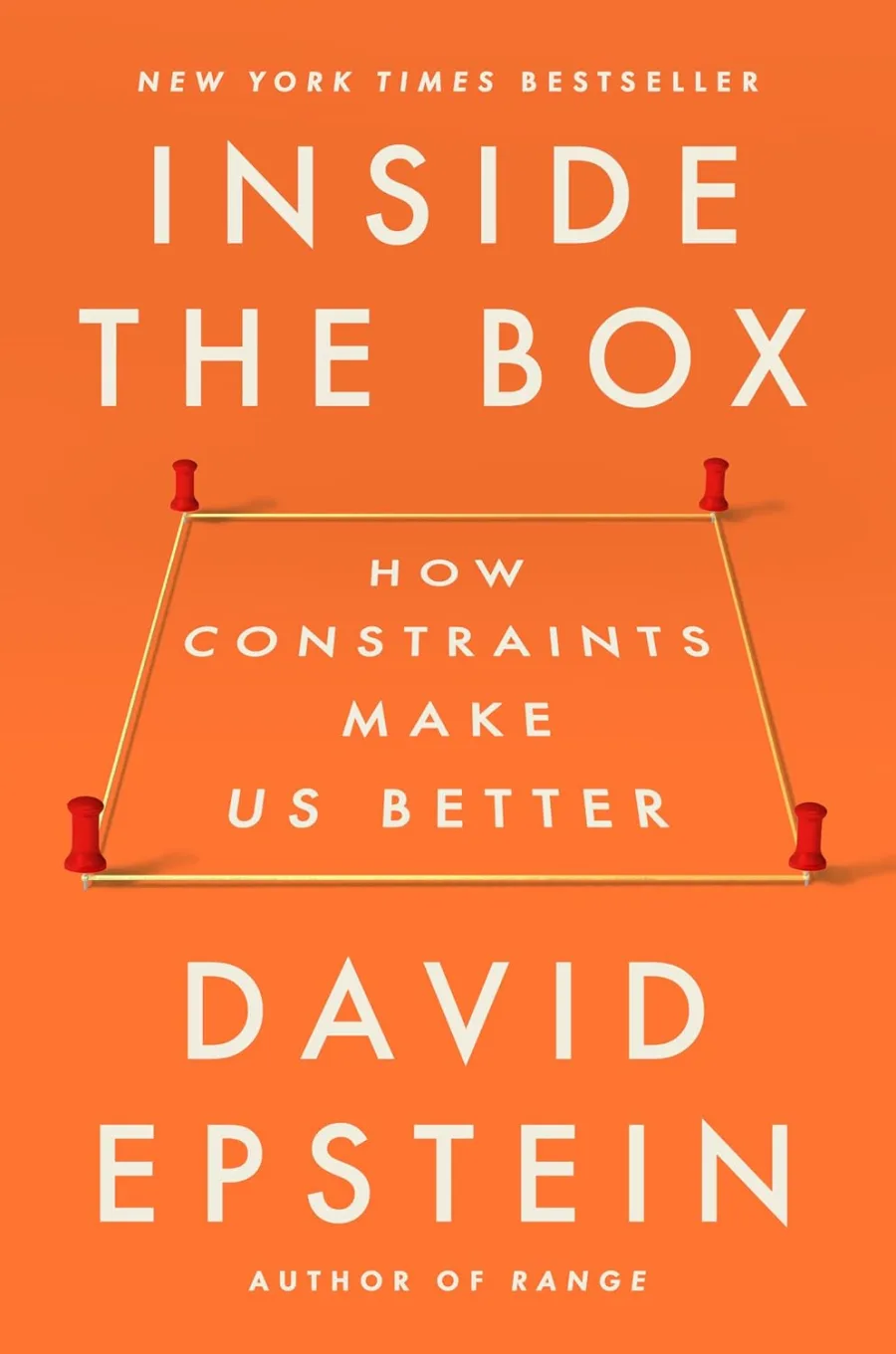
Download Cover Image
Do you want to download the full cover image for Inside the Box: How Constraints Make Us Better?