
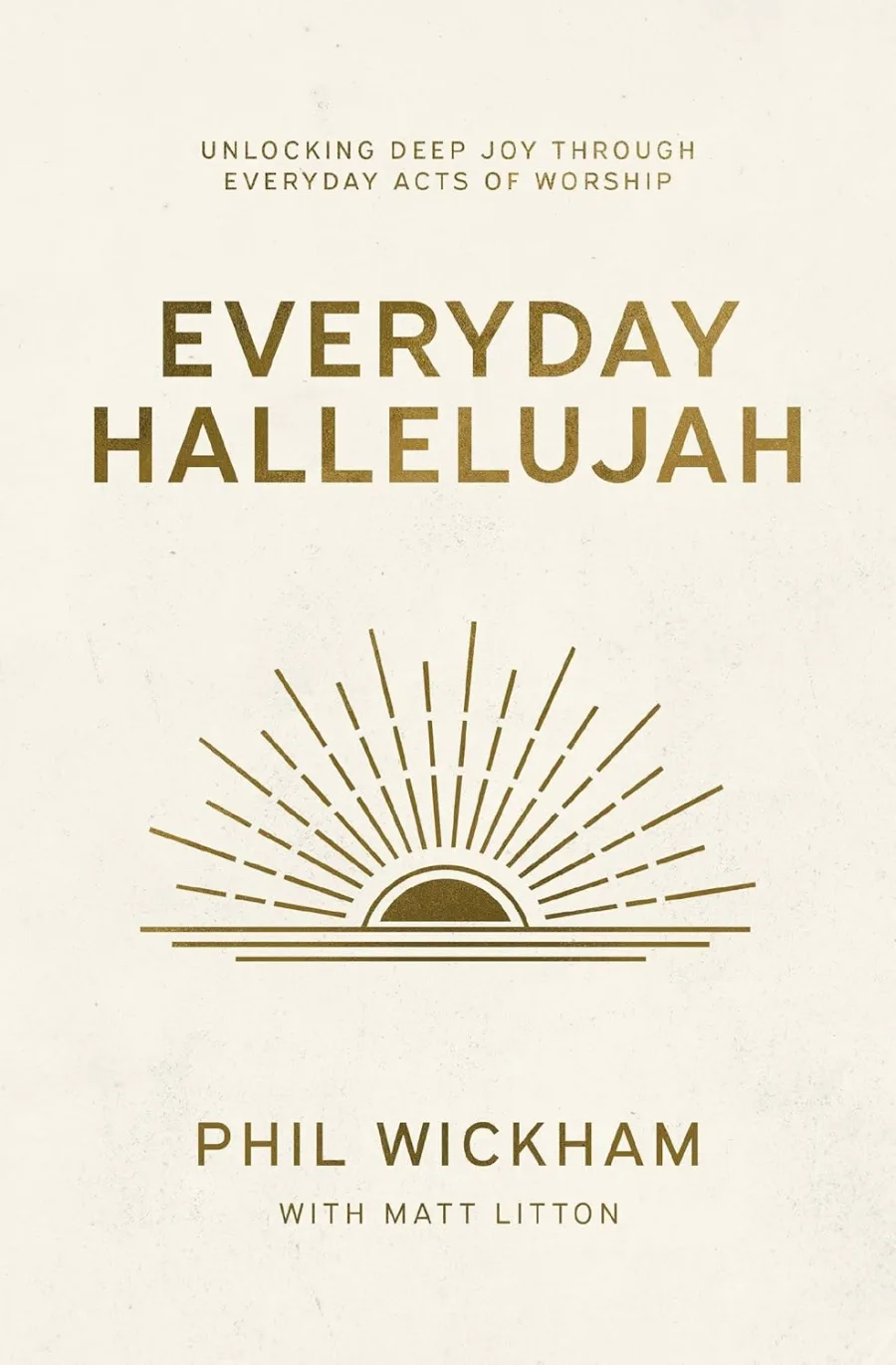
Everyday Hallelujah: Unlocking Deep Joy Through Everyday Acts of Worship
Hardcover
• 208 Pages
• USD 29.99
• English
• 9781400257058
No ratings yet
| Publisher | Thomas Nelson |
|---|---|
| ISBN13 | 9781400257058 |
| ASIN/SKU | 1400257050 |
| Book Format | Hardcover |
| Language | English |
| Pages | 208 |
| List Price | USD 29.99 |
| Publishing Date | 11/08/2026 |
| Dimensions | 5.68 x 0.76 x 8.65 inches |
| Weight | 10.5 ounces |
| Book Code | BD00067426 |
Buy this Book
Amazon Stores
Ebook Stores
Other Stores
Discover Everyday Hallelujah: Unlocking Deep Joy Through Everyday Acts of Worship by Phil Wickham. This book is published by Thomas Nelson in Hardcover format, ISBN 9781400257058, ASIN 1400257050, under Christian Books and Bibles, Christian Rites and Ceremonies Books, Prayer.
Book Description
Every hallelujah doesn’t have to be sung. Some hallelujahs are lived.
What if understanding worship as our truest purpose could move us beyond a surface-level faith and into a life of true spiritual intimacy and joy with God?
In Everyday Hallelujah singer-songwriter Phil Wickham invites us to see worship not as a Sunday-morning ritual but as a way of life, a way to receive and give God’s grace and to celebrate his faithfulness. With contagious passion, Phil takes readers on a journey through Scripture to explore how worship shapes the way we live, work, love, and reflect God’s presence to the world around us. Phil shows us how:
Adam and Eve expressed their worship through their work, relationships, and obedience
Daniel’s everyday-worship habits prepared him for the lion’s den
Elijah worshiped boldly by declaring God’s promises on Mount Carmel
Mary and Martha learned how to worship in the waiting
Paul and Silas sang songs in the night to break strongholds
Worship is the very reason we exist. When our hearts are turned toward God’s glory in the everyday moments of life, we begin to see that every place we stand is holy ground.
What if understanding worship as our truest purpose could move us beyond a surface-level faith and into a life of true spiritual intimacy and joy with God?
In Everyday Hallelujah singer-songwriter Phil Wickham invites us to see worship not as a Sunday-morning ritual but as a way of life, a way to receive and give God’s grace and to celebrate his faithfulness. With contagious passion, Phil takes readers on a journey through Scripture to explore how worship shapes the way we live, work, love, and reflect God’s presence to the world around us. Phil shows us how:
Adam and Eve expressed their worship through their work, relationships, and obedience
Daniel’s everyday-worship habits prepared him for the lion’s den
Elijah worshiped boldly by declaring God’s promises on Mount Carmel
Mary and Martha learned how to worship in the waiting
Paul and Silas sang songs in the night to break strongholds
Worship is the very reason we exist. When our hearts are turned toward God’s glory in the everyday moments of life, we begin to see that every place we stand is holy ground.
Author Biography
Phil Wickham is a Grammy-nominated, Dove Award–winning modern worship artist whose songs have been sung in churches around the world. His latest album, Song of the Saints, released September 2025 and debuted as his largest release to date. The album includes the longest running number one single of 2025: "What an Awesome God." His 2024 Grammy-nominated album, I Believe, went number one on the Billboard Top Christian Albums. At the 2024 GMA Dove Awards, Wickham was the most awarded artist, taking home nine awards, including Song of the Year and Worship Album of the Year. At the 2025 GMA Dove Awards, he also won Christmas Album of the Year. From his platinum-certified singles—“This Is Amazing Grace,” “Living Hope,” and "Battle Belongs"—to his latest project, Song of the Saints, Wickham’s music has received billions of streams in the US alone. His discography includes ten full-length projects, multiple Christmas releases, and a series of popular sing-along records. In addition, he has authored multiple devotionals including On Our Knees: 40 Days to Living Boldly in Prayer and I Believe Devotional, where he invites people on a fourteen-day journey of living a life of greater faith.
Editorial Reviews
Editorial Reviews will be added soon…
Book Summary
Phil Wickham’s Everyday Hallelujah: Unlocking Deep Joy Through Everyday Acts of Worship is a Christian devotional book built around a simple but transformative idea: worship is not something Christians do only when they sing at church. It is a way of living. Released by Thomas Nelson on August 11, 2026, the 208-page book invites readers to rethink worship as a daily response to God’s presence, grace, faithfulness, and love. Wickham, a Grammy-nominated and Dove Award–winning worship artist, draws on Scripture, personal experience, and years of leading people in worship to make the case that ordinary life itself can become an expression of praise. The book’s central message is beautifully captured in its premise: every hallelujah does not have to be sung; some hallelujahs are lived. In other words, worship can be expressed through the way a person works, loves, waits, serves, suffers, chooses gratitude, responds to difficulty, and treats other people.
At the heart of Everyday Hallelujah is Wickham’s attempt to broaden the reader’s understanding of the word “worship.” For many Christians, worship is closely associated with music: a Sunday service, a worship band, a familiar hymn, raised hands, or a powerful contemporary Christian song. Wickham does not reject musical worship—in fact, music has been central to his own life and ministry—but he argues that limiting worship to singing makes our understanding of God far too small. Worship, in the framework of this book, is fundamentally about where the heart is directed. When a person turns toward God in trust, gratitude, obedience, love, or surrender, that person is worshiping. The book therefore asks readers to stop dividing life into “spiritual” and “ordinary” categories. If God is present everywhere, then the kitchen, workplace, car, classroom, family table, difficult conversation, quiet morning, and lonely night can all become places of worship.
This idea gives the book its strong emphasis on everyday Christian living. Wickham wants readers to understand that spiritual intimacy with God is not reserved for people who have extraordinary experiences. A person does not need to stand on a stage, lead a Bible study, travel on a mission trip, or experience an emotional breakthrough to worship meaningfully. The smallest faithful actions can matter. According to the book’s official description, worship shapes how people live, work, love, and reflect God’s presence to the world around them. This makes Everyday Hallelujah particularly relevant for Christians who feel that their faith has become routine or compartmentalized. Wickham’s invitation is to move from simply participating in religious activities to recognizing the presence of God throughout the whole rhythm of life.
The book develops this message through a series of short devotional reflections rooted in biblical stories and principles. Its table of contents reveals a progression through themes such as God’s presence, grace, gratitude, obedience, waiting, discipline, freedom, mission, resistance, suffering, joy, Scripture, community, and hope. Rather than presenting worship as one isolated spiritual practice, Wickham explores the many ways it can transform a person’s outlook. Worship becomes an answer to fear, a response to uncertainty, a discipline during difficult seasons, a source of joy in good seasons, and a way of remembering who God is when circumstances make faith difficult.
One of the book’s important biblical foundations comes from the story of Adam and Eve. Wickham uses their lives to illustrate that worship was never intended to be restricted to a religious gathering. Work, relationships, responsibility, and obedience were part of humanity’s original calling. This provides an important foundation for the book’s argument. If human beings were created to reflect God’s character and live in relationship with Him, then worship cannot be reduced to songs. The ordinary responsibilities of life can become expressions of devotion when they are approached with the right heart. Doing a job honestly, caring for a family, serving another person, creating something useful, or choosing patience when irritation would be easier can all become forms of worship.
Daniel provides another powerful example. His story demonstrates the importance of developing everyday habits of faith before a crisis arrives. Wickham points to Daniel’s regular practices as preparation for the lion’s den. The larger lesson is that deep faith is rarely created in a single dramatic moment. It is formed through repeated choices. A person who learns to trust God in ordinary circumstances becomes better prepared to trust Him when circumstances become frightening. Worship, therefore, is not simply an emotional response to a crisis; it is a lifestyle that gradually shapes the person who practices it.
The story of Elijah on Mount Carmel introduces another dimension of worship: courage. Elijah worships not by retreating from confrontation but by boldly declaring God’s promises. This challenges the assumption that worship is always quiet, peaceful, or inward. Sometimes worship means standing firmly for what is true. Sometimes it means refusing to let fear determine our behavior. Sometimes the worshipful response is to speak faithfully when silence would be easier. Wickham’s approach makes worship an active force that influences decisions rather than merely an emotional experience.
Mary and Martha provide a very different picture. Their story becomes an illustration of worship in the waiting. This is one of the book’s most relatable themes because waiting is an unavoidable part of human life. People wait for answers to prayers, healing, reconciliation, direction, opportunities, relationships, and changes in circumstances. Waiting can make God seem distant, especially when a person wants an immediate answer. Wickham encourages readers to see waiting not as wasted time but as a place where faith can deepen. Worship in such moments means continuing to trust God even when the desired outcome has not yet arrived.
The example of Paul and Silas takes the theme even further. Their singing in prison demonstrates worship in circumstances that appear completely opposed to joy. Their story becomes a picture of worship as resistance. The table of contents specifically identifies “Worship Is an Act of Resistance” and “Worship in the Valley of the Shadows,” showing that the book intentionally addresses the spiritual reality of difficult seasons. Wickham’s point is not that Christians should pretend suffering is pleasant. Rather, worship can become a declaration that hardship does not have the final word. Gratitude, trust, prayer, and praise can become ways of resisting despair.
This leads naturally into one of the book’s strongest ideas: worship changes the way people see reality. Instead of beginning with circumstances and then deciding how to feel about God, Wickham encourages readers to begin with who God is. When circumstances change, God’s character does not. Remembering God’s faithfulness therefore becomes an essential part of everyday worship. The contents include chapters such as “Remembering That God Is Faithful,” “Because of the Promise,” and “Worship with Great Expectations,” suggesting a movement from remembering what God has done to trusting what He will do.
Another recurring theme is gratitude. Wickham presents gratitude not merely as a pleasant personality trait but as a spiritual discipline. The book includes “Worship Begins with Gratitude,” reinforcing the idea that learning to notice God’s goodness changes the way a person experiences ordinary life. Gratitude does not require denying hardship. Instead, it helps people recognize that difficulty is not the entirety of their story. There can still be beauty, grace, friendship, provision, forgiveness, creation, Scripture, family, community, and countless small gifts even in an imperfect life. Worship begins when those gifts are noticed and received as evidence of God’s goodness.
The book also emphasizes Scripture. “Worship with God’s Word” appears among its later chapters, reflecting Wickham’s conviction that worship needs more than emotion. Feelings can change rapidly, but biblical truth provides an anchor. Scripture helps believers remember what they might forget when fear or disappointment becomes overwhelming. In this sense, worship involves training the mind as well as moving the heart. Knowing God’s Word gives believers language for gratitude, sorrow, hope, confession, courage, and trust.
One of the most appealing aspects of Everyday Hallelujah is its emphasis on joy. Wickham is not describing a shallow happiness based on everything going well. The book’s subtitle, Unlocking Deep Joy Through Everyday Acts of Worship, points toward something deeper: joy that comes from recognizing God’s presence. The contents include “Worship Is Choosing Joy,” suggesting that joy is sometimes a deliberate spiritual posture rather than an automatic emotional response. A person can acknowledge that life is difficult while still choosing to believe that God is good. That kind of joy is not denial; it is faith.
The book also moves beyond personal spirituality toward relationships and mission. Worship affects how people love others and how they represent God to the world. The official description specifically says that worship shapes how Christians live and reflect God’s presence around them. This means a worshipful life should eventually become visible in behavior. Compassion, generosity, forgiveness, hospitality, humility, service, and love become outward expressions of an inward relationship with God. Worship is therefore not an escape from the world but a way of engaging the world differently.
This outward movement is especially evident in chapters such as “Launching Love and Mission,” “Worship Will Change the World,” and “Church Is the Center of Worship.” Wickham does not argue that private devotion is unimportant. Instead, he presents personal worship and communal worship as connected. The church provides a place where believers gather, sing, learn, encourage one another, and remember together who God is. But what happens inside the church is meant to influence what happens outside it. Sunday worship should spill into Monday life.
Ultimately, Everyday Hallelujah is a book about changing the way we see the ordinary. Its most important challenge is not simply “worship more,” but “recognize that your whole life can become worship.” A commute can become prayer. Work can become service. Parenting can become an expression of patience and love. Waiting can become trust. Suffering can become an opportunity to declare God’s faithfulness. Gratitude can become a daily discipline. Scripture can become a source of stability. Community can become a place where worship is shared. Even difficult circumstances can become spaces where faith is practiced rather than merely discussed.
For readers searching for an Everyday Hallelujah book summary, an explanation of Phil Wickham’s teachings on worship, Christian books about finding joy in everyday life, devotional books about worship, or books about growing closer to God, the central message is remarkably accessible. Wickham argues that worship is not primarily about creating a certain atmosphere or experiencing a particular emotion. It is about turning the heart toward God again and again. The ordinary becomes sacred when it is lived with awareness of God’s presence.
In the end, Everyday Hallelujah offers a hopeful vision of Christian life. It does not require readers to manufacture constant happiness or wait for extraordinary spiritual experiences. Instead, it encourages them to discover God in the life they already have. Its message is that worship can happen in the spectacular and the mundane, in celebration and grief, on mountaintops and in valleys, in church and at home. The deepest transformation comes when praise stops being something we occasionally sing and becomes something our lives continually express. As Wickham’s own description of the book puts it, learning to recognize God’s presence in everyday moments can move faith from routine to relationship. That is the heart of Everyday Hallelujah: not merely singing about joy, but learning to live with a heart that can say “hallelujah” in the middle of ordinary life.
At the heart of Everyday Hallelujah is Wickham’s attempt to broaden the reader’s understanding of the word “worship.” For many Christians, worship is closely associated with music: a Sunday service, a worship band, a familiar hymn, raised hands, or a powerful contemporary Christian song. Wickham does not reject musical worship—in fact, music has been central to his own life and ministry—but he argues that limiting worship to singing makes our understanding of God far too small. Worship, in the framework of this book, is fundamentally about where the heart is directed. When a person turns toward God in trust, gratitude, obedience, love, or surrender, that person is worshiping. The book therefore asks readers to stop dividing life into “spiritual” and “ordinary” categories. If God is present everywhere, then the kitchen, workplace, car, classroom, family table, difficult conversation, quiet morning, and lonely night can all become places of worship.
This idea gives the book its strong emphasis on everyday Christian living. Wickham wants readers to understand that spiritual intimacy with God is not reserved for people who have extraordinary experiences. A person does not need to stand on a stage, lead a Bible study, travel on a mission trip, or experience an emotional breakthrough to worship meaningfully. The smallest faithful actions can matter. According to the book’s official description, worship shapes how people live, work, love, and reflect God’s presence to the world around them. This makes Everyday Hallelujah particularly relevant for Christians who feel that their faith has become routine or compartmentalized. Wickham’s invitation is to move from simply participating in religious activities to recognizing the presence of God throughout the whole rhythm of life.
The book develops this message through a series of short devotional reflections rooted in biblical stories and principles. Its table of contents reveals a progression through themes such as God’s presence, grace, gratitude, obedience, waiting, discipline, freedom, mission, resistance, suffering, joy, Scripture, community, and hope. Rather than presenting worship as one isolated spiritual practice, Wickham explores the many ways it can transform a person’s outlook. Worship becomes an answer to fear, a response to uncertainty, a discipline during difficult seasons, a source of joy in good seasons, and a way of remembering who God is when circumstances make faith difficult.
One of the book’s important biblical foundations comes from the story of Adam and Eve. Wickham uses their lives to illustrate that worship was never intended to be restricted to a religious gathering. Work, relationships, responsibility, and obedience were part of humanity’s original calling. This provides an important foundation for the book’s argument. If human beings were created to reflect God’s character and live in relationship with Him, then worship cannot be reduced to songs. The ordinary responsibilities of life can become expressions of devotion when they are approached with the right heart. Doing a job honestly, caring for a family, serving another person, creating something useful, or choosing patience when irritation would be easier can all become forms of worship.
Daniel provides another powerful example. His story demonstrates the importance of developing everyday habits of faith before a crisis arrives. Wickham points to Daniel’s regular practices as preparation for the lion’s den. The larger lesson is that deep faith is rarely created in a single dramatic moment. It is formed through repeated choices. A person who learns to trust God in ordinary circumstances becomes better prepared to trust Him when circumstances become frightening. Worship, therefore, is not simply an emotional response to a crisis; it is a lifestyle that gradually shapes the person who practices it.
The story of Elijah on Mount Carmel introduces another dimension of worship: courage. Elijah worships not by retreating from confrontation but by boldly declaring God’s promises. This challenges the assumption that worship is always quiet, peaceful, or inward. Sometimes worship means standing firmly for what is true. Sometimes it means refusing to let fear determine our behavior. Sometimes the worshipful response is to speak faithfully when silence would be easier. Wickham’s approach makes worship an active force that influences decisions rather than merely an emotional experience.
Mary and Martha provide a very different picture. Their story becomes an illustration of worship in the waiting. This is one of the book’s most relatable themes because waiting is an unavoidable part of human life. People wait for answers to prayers, healing, reconciliation, direction, opportunities, relationships, and changes in circumstances. Waiting can make God seem distant, especially when a person wants an immediate answer. Wickham encourages readers to see waiting not as wasted time but as a place where faith can deepen. Worship in such moments means continuing to trust God even when the desired outcome has not yet arrived.
The example of Paul and Silas takes the theme even further. Their singing in prison demonstrates worship in circumstances that appear completely opposed to joy. Their story becomes a picture of worship as resistance. The table of contents specifically identifies “Worship Is an Act of Resistance” and “Worship in the Valley of the Shadows,” showing that the book intentionally addresses the spiritual reality of difficult seasons. Wickham’s point is not that Christians should pretend suffering is pleasant. Rather, worship can become a declaration that hardship does not have the final word. Gratitude, trust, prayer, and praise can become ways of resisting despair.
This leads naturally into one of the book’s strongest ideas: worship changes the way people see reality. Instead of beginning with circumstances and then deciding how to feel about God, Wickham encourages readers to begin with who God is. When circumstances change, God’s character does not. Remembering God’s faithfulness therefore becomes an essential part of everyday worship. The contents include chapters such as “Remembering That God Is Faithful,” “Because of the Promise,” and “Worship with Great Expectations,” suggesting a movement from remembering what God has done to trusting what He will do.
Another recurring theme is gratitude. Wickham presents gratitude not merely as a pleasant personality trait but as a spiritual discipline. The book includes “Worship Begins with Gratitude,” reinforcing the idea that learning to notice God’s goodness changes the way a person experiences ordinary life. Gratitude does not require denying hardship. Instead, it helps people recognize that difficulty is not the entirety of their story. There can still be beauty, grace, friendship, provision, forgiveness, creation, Scripture, family, community, and countless small gifts even in an imperfect life. Worship begins when those gifts are noticed and received as evidence of God’s goodness.
The book also emphasizes Scripture. “Worship with God’s Word” appears among its later chapters, reflecting Wickham’s conviction that worship needs more than emotion. Feelings can change rapidly, but biblical truth provides an anchor. Scripture helps believers remember what they might forget when fear or disappointment becomes overwhelming. In this sense, worship involves training the mind as well as moving the heart. Knowing God’s Word gives believers language for gratitude, sorrow, hope, confession, courage, and trust.
One of the most appealing aspects of Everyday Hallelujah is its emphasis on joy. Wickham is not describing a shallow happiness based on everything going well. The book’s subtitle, Unlocking Deep Joy Through Everyday Acts of Worship, points toward something deeper: joy that comes from recognizing God’s presence. The contents include “Worship Is Choosing Joy,” suggesting that joy is sometimes a deliberate spiritual posture rather than an automatic emotional response. A person can acknowledge that life is difficult while still choosing to believe that God is good. That kind of joy is not denial; it is faith.
The book also moves beyond personal spirituality toward relationships and mission. Worship affects how people love others and how they represent God to the world. The official description specifically says that worship shapes how Christians live and reflect God’s presence around them. This means a worshipful life should eventually become visible in behavior. Compassion, generosity, forgiveness, hospitality, humility, service, and love become outward expressions of an inward relationship with God. Worship is therefore not an escape from the world but a way of engaging the world differently.
This outward movement is especially evident in chapters such as “Launching Love and Mission,” “Worship Will Change the World,” and “Church Is the Center of Worship.” Wickham does not argue that private devotion is unimportant. Instead, he presents personal worship and communal worship as connected. The church provides a place where believers gather, sing, learn, encourage one another, and remember together who God is. But what happens inside the church is meant to influence what happens outside it. Sunday worship should spill into Monday life.
Ultimately, Everyday Hallelujah is a book about changing the way we see the ordinary. Its most important challenge is not simply “worship more,” but “recognize that your whole life can become worship.” A commute can become prayer. Work can become service. Parenting can become an expression of patience and love. Waiting can become trust. Suffering can become an opportunity to declare God’s faithfulness. Gratitude can become a daily discipline. Scripture can become a source of stability. Community can become a place where worship is shared. Even difficult circumstances can become spaces where faith is practiced rather than merely discussed.
For readers searching for an Everyday Hallelujah book summary, an explanation of Phil Wickham’s teachings on worship, Christian books about finding joy in everyday life, devotional books about worship, or books about growing closer to God, the central message is remarkably accessible. Wickham argues that worship is not primarily about creating a certain atmosphere or experiencing a particular emotion. It is about turning the heart toward God again and again. The ordinary becomes sacred when it is lived with awareness of God’s presence.
In the end, Everyday Hallelujah offers a hopeful vision of Christian life. It does not require readers to manufacture constant happiness or wait for extraordinary spiritual experiences. Instead, it encourages them to discover God in the life they already have. Its message is that worship can happen in the spectacular and the mundane, in celebration and grief, on mountaintops and in valleys, in church and at home. The deepest transformation comes when praise stops being something we occasionally sing and becomes something our lives continually express. As Wickham’s own description of the book puts it, learning to recognize God’s presence in everyday moments can move faith from routine to relationship. That is the heart of Everyday Hallelujah: not merely singing about joy, but learning to live with a heart that can say “hallelujah” in the middle of ordinary life.
Sample Chapters
Sample Chapters will be added soon…
Reader Reviews
No reviews yet.
Everyday Hallelujah: Unlocking Deep Joy Through Everyday Acts of Worship
Download Cover Image
Do you want to download the full cover image for Everyday Hallelujah: Unlocking Deep Joy Through Everyday Acts of Worship?