I Eat the Stars: How to Live Fully and Beautifully in a Collapsing World
eBook
• 333 Pages
• USD 16.99
• English
• 9780593995006
No ratings yet
| Publisher | Penguin Life |
|---|---|
| ISBN13 | 9780593995006 |
| ASIN/SKU | B0FRD3HGSL |
| Book Format | eBook |
| Language | English |
| Pages | 333 |
| List Price | USD 16.99 |
| Publishing Date | 16/06/2026 |
| Book Code | BD00067471 |
Buy this Book
Amazon Stores
Ebook Stores
Other Stores
Discover I Eat the Stars: How to Live Fully and Beautifully in a Collapsing World by Sarah Wilson. This book is published by Penguin Life in eBook format, ISBN 9780593995006, ASIN B0FRD3HGSL, under Science and Math, Environmental Science.
Book Description
INTERNATIONAL BESTSELLER
From New York Times bestselling author Sarah Wilson comes a deeply moving, wise guide to finding joy and meaning in a world that seems to be falling apart
It’s hard to escape the feeling that something is deeply wrong . . . that life has become precariously off-balance. We are hit hourly with headlines about catastrophic wildfires, unprecedented flooding, record heat waves, collapsing democracies, AI and nuclear threat, rising economic inequality, widespread unrest, and more. In I Eat the Stars, Sarah Wilson argues we are undergoing what every complex civilization before us has—systemic collapse.
So how do we continue to live as sensitive humans amidst such a tumultuous shift? What does life look like when the systems we rely on deteriorate? Should we be having kids? How do we make financial decisions? Should we be prepping? And, most importantly, how do we avoid succumbing to doom and despair?
In I Eat the Stars, Sarah Wilson delves into these pressing questions. Drawing on many years of research and wisdom gained from more than 200 conversations with philosophers, poets, game theorists, and spiritual leaders, Wilson takes readers on an intimate journey as she lays out a path for living fully, meaningfully, and beautifully through these troubled times. Our predicament, she argues, is ultimately an urgent call to us all to relish what is valuable to us—to eat the stars—and to return to our humanity once again.
I Eat the Stars empowers readers to move beyond panic, doom, and despair. With her warm, incisively intelligent, wise, and down-to-earth voice, Wilson creates a space for readers to confront their fears and anxieties about an uncertain future, guiding them toward one rooted in truth, hope, justice, creativity, community, and to step up as “warriors” and meet the moment.
We are in what we were warned about for decades. But from a crisis comes stunning possibility.
From New York Times bestselling author Sarah Wilson comes a deeply moving, wise guide to finding joy and meaning in a world that seems to be falling apart
It’s hard to escape the feeling that something is deeply wrong . . . that life has become precariously off-balance. We are hit hourly with headlines about catastrophic wildfires, unprecedented flooding, record heat waves, collapsing democracies, AI and nuclear threat, rising economic inequality, widespread unrest, and more. In I Eat the Stars, Sarah Wilson argues we are undergoing what every complex civilization before us has—systemic collapse.
So how do we continue to live as sensitive humans amidst such a tumultuous shift? What does life look like when the systems we rely on deteriorate? Should we be having kids? How do we make financial decisions? Should we be prepping? And, most importantly, how do we avoid succumbing to doom and despair?
In I Eat the Stars, Sarah Wilson delves into these pressing questions. Drawing on many years of research and wisdom gained from more than 200 conversations with philosophers, poets, game theorists, and spiritual leaders, Wilson takes readers on an intimate journey as she lays out a path for living fully, meaningfully, and beautifully through these troubled times. Our predicament, she argues, is ultimately an urgent call to us all to relish what is valuable to us—to eat the stars—and to return to our humanity once again.
I Eat the Stars empowers readers to move beyond panic, doom, and despair. With her warm, incisively intelligent, wise, and down-to-earth voice, Wilson creates a space for readers to confront their fears and anxieties about an uncertain future, guiding them toward one rooted in truth, hope, justice, creativity, community, and to step up as “warriors” and meet the moment.
We are in what we were warned about for decades. But from a crisis comes stunning possibility.
Author Biography
Sarah Wilson is a New York Times bestselling author, journalist and founder of IQuitSugar.com. She has published 15 I Quit Sugar books in 46 countries and most recently she published First, We Make the Beast Beautiful, A New Story of Anxiety. She was ranked as one of the top 200 most influential authors in the world in 2017 and 2018, based on web and international book scan algorithms and in Greatist.com’s 100 most influential health experts in 2015.
Mark Manson has described "The Beast" as “the best book about anxiety” he’s ever read. NBC's Carson Daly cited it as has "favorite book". Former Australian of the Year Prof Patrick McGorry described it as, “indeed quite extraordinary, illuminating what is at once a nomadic journey, a cri de coeur and a compendium of hard-won wisdom flowing from a uniquely talented individual… a tour de force.”
Other facts that might interest: Sarah was the editor-in-chief of Cosmopolitan Magazine Australia at 29, the host of MasterChef Australia, holds a record in the Guinness Book (you can Google that further if you like), is a mad hiker, explorer and minimalist. She lives between the US and Bondi Beach, Sydney and ocean swims most days.
Mark Manson has described "The Beast" as “the best book about anxiety” he’s ever read. NBC's Carson Daly cited it as has "favorite book". Former Australian of the Year Prof Patrick McGorry described it as, “indeed quite extraordinary, illuminating what is at once a nomadic journey, a cri de coeur and a compendium of hard-won wisdom flowing from a uniquely talented individual… a tour de force.”
Other facts that might interest: Sarah was the editor-in-chief of Cosmopolitan Magazine Australia at 29, the host of MasterChef Australia, holds a record in the Guinness Book (you can Google that further if you like), is a mad hiker, explorer and minimalist. She lives between the US and Bondi Beach, Sydney and ocean swims most days.
Editorial Reviews
One of Book Riot’s 7 Best New Nonfiction Releases of June 2026
One of AARP’s 32 of the Season’s Top New Books
One of Next Big Idea Club’s June 2026 Must-Read Books
One of Balanced Achievement’s 10 Transformative Self-Help Books Released in June 2026
“Humanity seems to be at a pretty precarious point in history (climate change, political instability — all the things), which can leave some of us feeling helpless and hopeless. Wilson’s soul-searching book poses hard questions about the future while exploring ways to grapple with uncertainty and find joy despite it all.”
—AARP
“Sarah Wilson became a bestselling author with her book First, We Make the Beast Beautiful. Now she’s back with I Eat the Stars. Wilson wants you to know that you aren’t the only one struggling to live in a world seemingly on fire. Everyone is fighting to keep hope during these troubled times. In her new book, Wilson gives advice on how we can move forward and keep hope, against all of the odds against us.”
—Book Riot
“I Eat the Stars is a book for right now. It is timely and urgent. The writing is incredibly present and conscious. It brings a sense of urgency to the lessons Wilson imparts, proving that the work we do to understand and the decisions we make to live beautifully anyway matter. . . . You will uncover a new way of living that will inspire you to forge forward into a deeply uncertain future.”
—BookTrib
“Sarah Wilson delivers one of the year’s most original and thought-provoking explorations of how to live wisely through uncertain times.”
—Balanced Achievement
"What the hell is happening to our world? The wonderful Sarah Wilson writes straight to the beating heart of what we all need to hear. This loving and uplifting book is the wise guide that can hold our hands as we tread these dark times."
—Liam Neeson, actor and Goodwill Ambassador for UNICEF
"This book feels like a raw conversation with the friend who can capture where we are as a collective. There are some people I do not want to ever leave this planet. If we can keep Sarah Wilson and David Attenborough forever, there will always be beacons of possibility to guide us."
—Lena Headey, activist and star of Game of Thrones
"Praising Sarah Wilson sufficiently is a prodigious task. Her range, her freedom of spirit, her brilliance, her unflinching honesty. . . . I Eat the Stars is a feisty, outspoken testament that devours wobbly beliefs and half-lived lies. Wilson’s not here to soothe. Her writing agitates. It awakens our exasperation, but also our compassion. It is unlike any book you have ever read. Be warned: you may never see the world again as you do now."
—Paul Hawken, New York Times bestselling author of Drawdown
"As I read chapter after chapter of this book, I realized that Sarah Wilson understands it all—every aspect of our species, our societies, and our inclinations that make us vulnerable to collapse. I have met no one else with such knowledge and insight. Whatever your taste in reading, if you are concerned about our future, take this book seriously."
—Joseph A. Tainter, author of The Collapse of Complex Societies
"A chilling and important book about the chaos and complexity of what’s happening in the world—and how to understand it at a human level."
—Johann Hari, New York Times bestselling author of Stolen Focus
"Sarah Wilson has taken material that I am deeply familiar with in my own work and made it
come alive in compelling and captivating ways. I love her memorable prose. I love the
non-linear romp through facts and emotions. I love her presence. This is a long, hard road we’re on, and I am glad for her companionship on the journey."
—Margaret J. Wheatley, collapse theorist and author of Who Do We Choose to Be?
"A book for dark times that is filled with light and hope. Thoughtful, sometimes unsettling, but always brave."
—Peter Frankopan, international bestselling author of The Silk Roads
One of AARP’s 32 of the Season’s Top New Books
One of Next Big Idea Club’s June 2026 Must-Read Books
One of Balanced Achievement’s 10 Transformative Self-Help Books Released in June 2026
“Humanity seems to be at a pretty precarious point in history (climate change, political instability — all the things), which can leave some of us feeling helpless and hopeless. Wilson’s soul-searching book poses hard questions about the future while exploring ways to grapple with uncertainty and find joy despite it all.”
—AARP
“Sarah Wilson became a bestselling author with her book First, We Make the Beast Beautiful. Now she’s back with I Eat the Stars. Wilson wants you to know that you aren’t the only one struggling to live in a world seemingly on fire. Everyone is fighting to keep hope during these troubled times. In her new book, Wilson gives advice on how we can move forward and keep hope, against all of the odds against us.”
—Book Riot
“I Eat the Stars is a book for right now. It is timely and urgent. The writing is incredibly present and conscious. It brings a sense of urgency to the lessons Wilson imparts, proving that the work we do to understand and the decisions we make to live beautifully anyway matter. . . . You will uncover a new way of living that will inspire you to forge forward into a deeply uncertain future.”
—BookTrib
“Sarah Wilson delivers one of the year’s most original and thought-provoking explorations of how to live wisely through uncertain times.”
—Balanced Achievement
"What the hell is happening to our world? The wonderful Sarah Wilson writes straight to the beating heart of what we all need to hear. This loving and uplifting book is the wise guide that can hold our hands as we tread these dark times."
—Liam Neeson, actor and Goodwill Ambassador for UNICEF
"This book feels like a raw conversation with the friend who can capture where we are as a collective. There are some people I do not want to ever leave this planet. If we can keep Sarah Wilson and David Attenborough forever, there will always be beacons of possibility to guide us."
—Lena Headey, activist and star of Game of Thrones
"Praising Sarah Wilson sufficiently is a prodigious task. Her range, her freedom of spirit, her brilliance, her unflinching honesty. . . . I Eat the Stars is a feisty, outspoken testament that devours wobbly beliefs and half-lived lies. Wilson’s not here to soothe. Her writing agitates. It awakens our exasperation, but also our compassion. It is unlike any book you have ever read. Be warned: you may never see the world again as you do now."
—Paul Hawken, New York Times bestselling author of Drawdown
"As I read chapter after chapter of this book, I realized that Sarah Wilson understands it all—every aspect of our species, our societies, and our inclinations that make us vulnerable to collapse. I have met no one else with such knowledge and insight. Whatever your taste in reading, if you are concerned about our future, take this book seriously."
—Joseph A. Tainter, author of The Collapse of Complex Societies
"A chilling and important book about the chaos and complexity of what’s happening in the world—and how to understand it at a human level."
—Johann Hari, New York Times bestselling author of Stolen Focus
"Sarah Wilson has taken material that I am deeply familiar with in my own work and made it
come alive in compelling and captivating ways. I love her memorable prose. I love the
non-linear romp through facts and emotions. I love her presence. This is a long, hard road we’re on, and I am glad for her companionship on the journey."
—Margaret J. Wheatley, collapse theorist and author of Who Do We Choose to Be?
"A book for dark times that is filled with light and hope. Thoughtful, sometimes unsettling, but always brave."
—Peter Frankopan, international bestselling author of The Silk Roads
Book Summary
I Eat the Stars: How to Live Fully and Beautifully in a Collapsing World by Sarah Wilson is a deeply reflective and compassionate book about facing an uncertain future without allowing fear to consume the present. Wilson begins with a difficult idea: the world may not simply be experiencing a collection of separate crises, but a much larger period of systemic collapse. Climate change, extreme weather, political instability, economic inequality, social division, resource pressures, conflict, artificial intelligence, and threats to democracy all appear to be part of an interconnected problem. Rather than offering easy optimism, Wilson asks a more difficult question: How do we live meaningfully when the systems we depend on may no longer remain stable?
The book grows out of Wilson's own attempt to understand what is happening. She has spent years writing about climate change, anxiety, consumption, and social issues, and her research eventually led her beyond the idea of treating each crisis separately. She argues that complex civilizations throughout history have eventually reached points where their systems become too complicated, resource-intensive, unequal, or unstable to continue in the same form. For Wilson, recognizing this possibility changes the conversation. Instead of asking only how to return to the world we once knew, we must ask how to live during a profound transition.
One of the book's most important themes is the difference between collapse and crisis. A crisis can suggest that something has gone wrong but can eventually be repaired. Collapse is more unsettling because it implies that the underlying structure itself may be changing. Wilson connects climate disruption with other pressures, including inequality, political polarization, conflict, resource shortages, authoritarianism, and technological disruption. She argues that these forces cannot always be understood independently because they interact and reinforce one another.
This realization creates an emotional problem. If people become convinced that the future is frightening, they can easily fall into doom and despair. Wilson openly acknowledges having experienced this herself. She understands the temptation to consume endless information, worry about every new headline, and feel guilty for not doing enough. Yet she argues that constant anxiety is not the same thing as responsible engagement. Being overwhelmed can actually make people less capable of responding intelligently to the world around them.
This is where Wilson makes one of her most distinctive arguments: perhaps we need to let go of the kind of hope that depends on everything returning to normal. She does not argue that people should become hopeless or indifferent. Instead, she questions whether forced optimism is useful when reality is genuinely frightening. For Wilson, truth can sometimes provide a stronger foundation than reassurance. Once people stop demanding certainty from the future, they may become more capable of dealing with what is actually happening.
Her alternative is not despair but presence. If the future is uncertain, there is a danger in postponing life until circumstances become safer. Modern culture often teaches people to save, accumulate, work, plan, and wait for a later period when they will finally have time to enjoy themselves. Wilson challenges this mindset. If life is fragile, then meaningful experiences cannot always be deferred. Relationships, creativity, nature, friendship, love, curiosity, and simple pleasures deserve attention now.
This idea is captured beautifully by the book's title. I Eat the Stars comes from a poem by astronomer and poet Rebecca Elson, who wrote the words while confronting her own mortality. For Wilson, "eating the stars" becomes a metaphor for fully experiencing life in the face of death and uncertainty. The point is not to pretend that danger does not exist. It is to respond to danger by becoming more awake to the preciousness of existence.
The book repeatedly returns to the question of what really matters. If many of the systems that define modern life become unstable, people may need to reconsider their priorities. Wilson explores questions that can feel intensely personal: Should we have children? How should we make financial decisions? Should we prepare for disruption? What should we buy? What should we stop buying? How much should we work? And how can we make choices that remain meaningful when the future cannot be predicted?
Rather than giving one universal answer, Wilson encourages readers to examine the assumptions behind their decisions. A major target is the belief in infinite growth and endless consumption. If the systems producing environmental and social instability are partly driven by the demand for ever-increasing consumption, simply consuming more efficiently may not solve the underlying problem. Wilson therefore advocates a simpler approach: buy less, take less, consume less, and reduce the constant pressure to optimize every part of life.
At the same time, she rejects the idea that individual self-sufficiency is the best answer. Wilson is skeptical of an isolated "prepper" mentality in which people attempt to build private shelters against a collapsing world. Instead, she emphasizes community and cooperation. When large systems become unreliable, relationships may become more important, not less. Neighbors, friends, families, local communities, and networks of mutual support can provide practical knowledge, emotional strength, companionship, and resilience.
This emphasis on connection also leads to one of the book's central ideas: humanity itself may be the resource we most need to recover. Wilson argues that modern systems can encourage competition, individualism, distraction, and constant consumption. A period of disruption could force people to rediscover qualities that are easy to overlook when life feels secure—generosity, cooperation, creativity, courage, compassion, and genuine attention to other people.
Wilson's research is broad. The book draws on more than 200 conversations with philosophers, scientists, economists, historians, game theorists, spiritual leaders, and other thinkers, including people she encountered through her podcast and wider research. Rather than building a rigid academic argument, she brings these different perspectives together in a conversational and exploratory way.
This gives the book a personal quality. Wilson is not presenting herself as someone who has solved the problem of collapse. She is a person trying to understand an overwhelming reality alongside her readers. The book therefore contains uncertainty, questions, emotional struggle, and moments of wonder. Its purpose is less to provide a perfect survival manual than to offer companionship for people who are frightened by the future.
Ultimately, I Eat the Stars argues that collapse does not have to mean the end of meaning. In fact, confronting the possibility of endings can make meaning more urgent. Wilson encourages readers to remain informed without becoming consumed by information, to act without believing they can control everything, and to care deeply without demanding certainty.
The deepest message of the book is simple: we cannot know exactly what the future will bring, but we can choose how fully we inhabit the present. We can strengthen our communities, protect what we value, resist apathy, consume more thoughtfully, nurture relationships, and continue creating beauty even when the world feels unstable.
In the end, Wilson's response to collapse is neither denial nor surrender. It is a call to live more deliberately. If the old assumptions about endless growth, perfect stability, and guaranteed progress are weakening, then we have an opportunity to reconsider what a good life actually means. I Eat the Stars suggests that the answer may be found in less consumption and more connection, less frantic striving and more presence, less fear of uncertainty and more courage to live within it. The world may be changing profoundly, but Wilson's message is that we are still allowed—and perhaps more than ever, required—to live fully, beautifully, and humanely within that change.
The book grows out of Wilson's own attempt to understand what is happening. She has spent years writing about climate change, anxiety, consumption, and social issues, and her research eventually led her beyond the idea of treating each crisis separately. She argues that complex civilizations throughout history have eventually reached points where their systems become too complicated, resource-intensive, unequal, or unstable to continue in the same form. For Wilson, recognizing this possibility changes the conversation. Instead of asking only how to return to the world we once knew, we must ask how to live during a profound transition.
One of the book's most important themes is the difference between collapse and crisis. A crisis can suggest that something has gone wrong but can eventually be repaired. Collapse is more unsettling because it implies that the underlying structure itself may be changing. Wilson connects climate disruption with other pressures, including inequality, political polarization, conflict, resource shortages, authoritarianism, and technological disruption. She argues that these forces cannot always be understood independently because they interact and reinforce one another.
This realization creates an emotional problem. If people become convinced that the future is frightening, they can easily fall into doom and despair. Wilson openly acknowledges having experienced this herself. She understands the temptation to consume endless information, worry about every new headline, and feel guilty for not doing enough. Yet she argues that constant anxiety is not the same thing as responsible engagement. Being overwhelmed can actually make people less capable of responding intelligently to the world around them.
This is where Wilson makes one of her most distinctive arguments: perhaps we need to let go of the kind of hope that depends on everything returning to normal. She does not argue that people should become hopeless or indifferent. Instead, she questions whether forced optimism is useful when reality is genuinely frightening. For Wilson, truth can sometimes provide a stronger foundation than reassurance. Once people stop demanding certainty from the future, they may become more capable of dealing with what is actually happening.
Her alternative is not despair but presence. If the future is uncertain, there is a danger in postponing life until circumstances become safer. Modern culture often teaches people to save, accumulate, work, plan, and wait for a later period when they will finally have time to enjoy themselves. Wilson challenges this mindset. If life is fragile, then meaningful experiences cannot always be deferred. Relationships, creativity, nature, friendship, love, curiosity, and simple pleasures deserve attention now.
This idea is captured beautifully by the book's title. I Eat the Stars comes from a poem by astronomer and poet Rebecca Elson, who wrote the words while confronting her own mortality. For Wilson, "eating the stars" becomes a metaphor for fully experiencing life in the face of death and uncertainty. The point is not to pretend that danger does not exist. It is to respond to danger by becoming more awake to the preciousness of existence.
The book repeatedly returns to the question of what really matters. If many of the systems that define modern life become unstable, people may need to reconsider their priorities. Wilson explores questions that can feel intensely personal: Should we have children? How should we make financial decisions? Should we prepare for disruption? What should we buy? What should we stop buying? How much should we work? And how can we make choices that remain meaningful when the future cannot be predicted?
Rather than giving one universal answer, Wilson encourages readers to examine the assumptions behind their decisions. A major target is the belief in infinite growth and endless consumption. If the systems producing environmental and social instability are partly driven by the demand for ever-increasing consumption, simply consuming more efficiently may not solve the underlying problem. Wilson therefore advocates a simpler approach: buy less, take less, consume less, and reduce the constant pressure to optimize every part of life.
At the same time, she rejects the idea that individual self-sufficiency is the best answer. Wilson is skeptical of an isolated "prepper" mentality in which people attempt to build private shelters against a collapsing world. Instead, she emphasizes community and cooperation. When large systems become unreliable, relationships may become more important, not less. Neighbors, friends, families, local communities, and networks of mutual support can provide practical knowledge, emotional strength, companionship, and resilience.
This emphasis on connection also leads to one of the book's central ideas: humanity itself may be the resource we most need to recover. Wilson argues that modern systems can encourage competition, individualism, distraction, and constant consumption. A period of disruption could force people to rediscover qualities that are easy to overlook when life feels secure—generosity, cooperation, creativity, courage, compassion, and genuine attention to other people.
Wilson's research is broad. The book draws on more than 200 conversations with philosophers, scientists, economists, historians, game theorists, spiritual leaders, and other thinkers, including people she encountered through her podcast and wider research. Rather than building a rigid academic argument, she brings these different perspectives together in a conversational and exploratory way.
This gives the book a personal quality. Wilson is not presenting herself as someone who has solved the problem of collapse. She is a person trying to understand an overwhelming reality alongside her readers. The book therefore contains uncertainty, questions, emotional struggle, and moments of wonder. Its purpose is less to provide a perfect survival manual than to offer companionship for people who are frightened by the future.
Ultimately, I Eat the Stars argues that collapse does not have to mean the end of meaning. In fact, confronting the possibility of endings can make meaning more urgent. Wilson encourages readers to remain informed without becoming consumed by information, to act without believing they can control everything, and to care deeply without demanding certainty.
The deepest message of the book is simple: we cannot know exactly what the future will bring, but we can choose how fully we inhabit the present. We can strengthen our communities, protect what we value, resist apathy, consume more thoughtfully, nurture relationships, and continue creating beauty even when the world feels unstable.
In the end, Wilson's response to collapse is neither denial nor surrender. It is a call to live more deliberately. If the old assumptions about endless growth, perfect stability, and guaranteed progress are weakening, then we have an opportunity to reconsider what a good life actually means. I Eat the Stars suggests that the answer may be found in less consumption and more connection, less frantic striving and more presence, less fear of uncertainty and more courage to live within it. The world may be changing profoundly, but Wilson's message is that we are still allowed—and perhaps more than ever, required—to live fully, beautifully, and humanely within that change.
Sample Chapters
Sample Chapters will be added soon…
Reader Reviews
No reviews yet.
I Eat the Stars: How to Live Fully and Beautifully in a Collapsing World
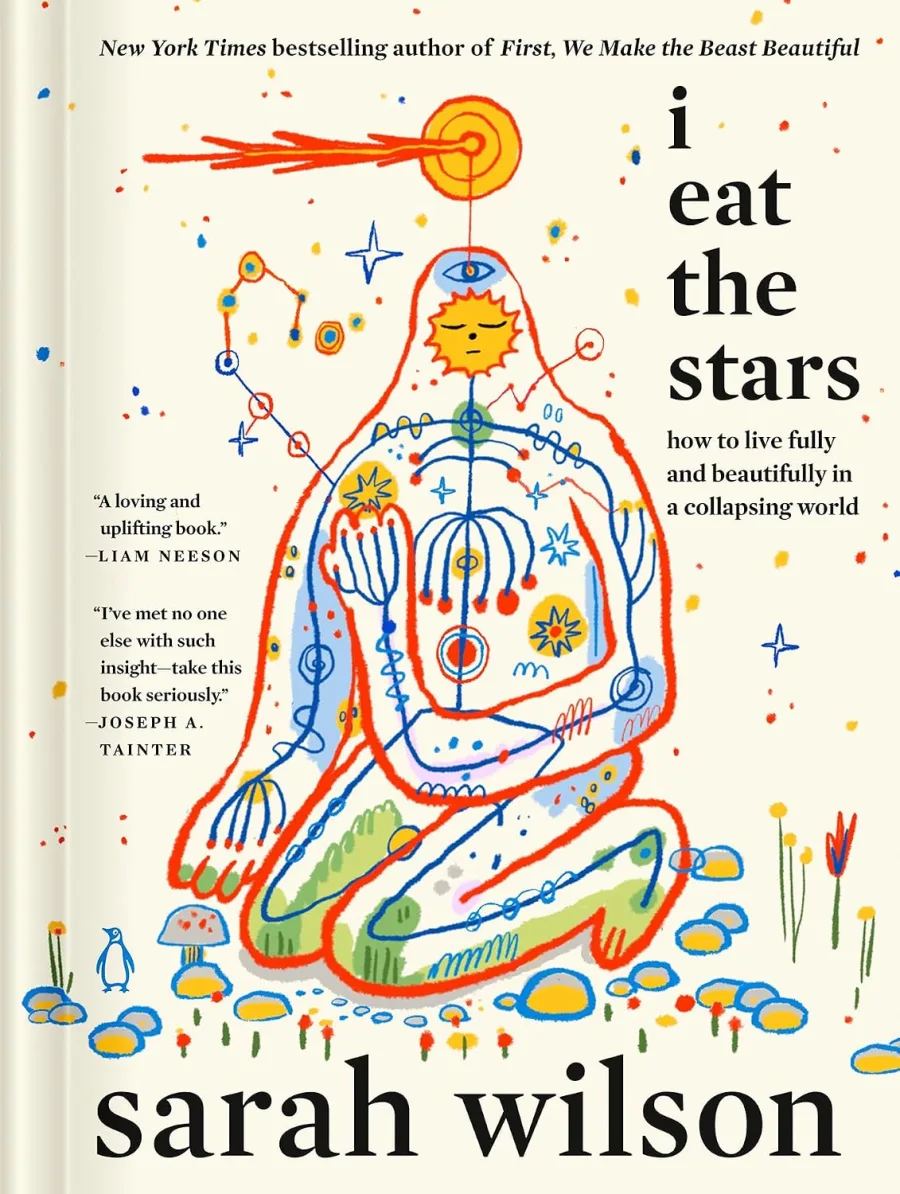
Download Cover Image
Do you want to download the full cover image for I Eat the Stars: How to Live Fully and Beautifully in a Collapsing World?