
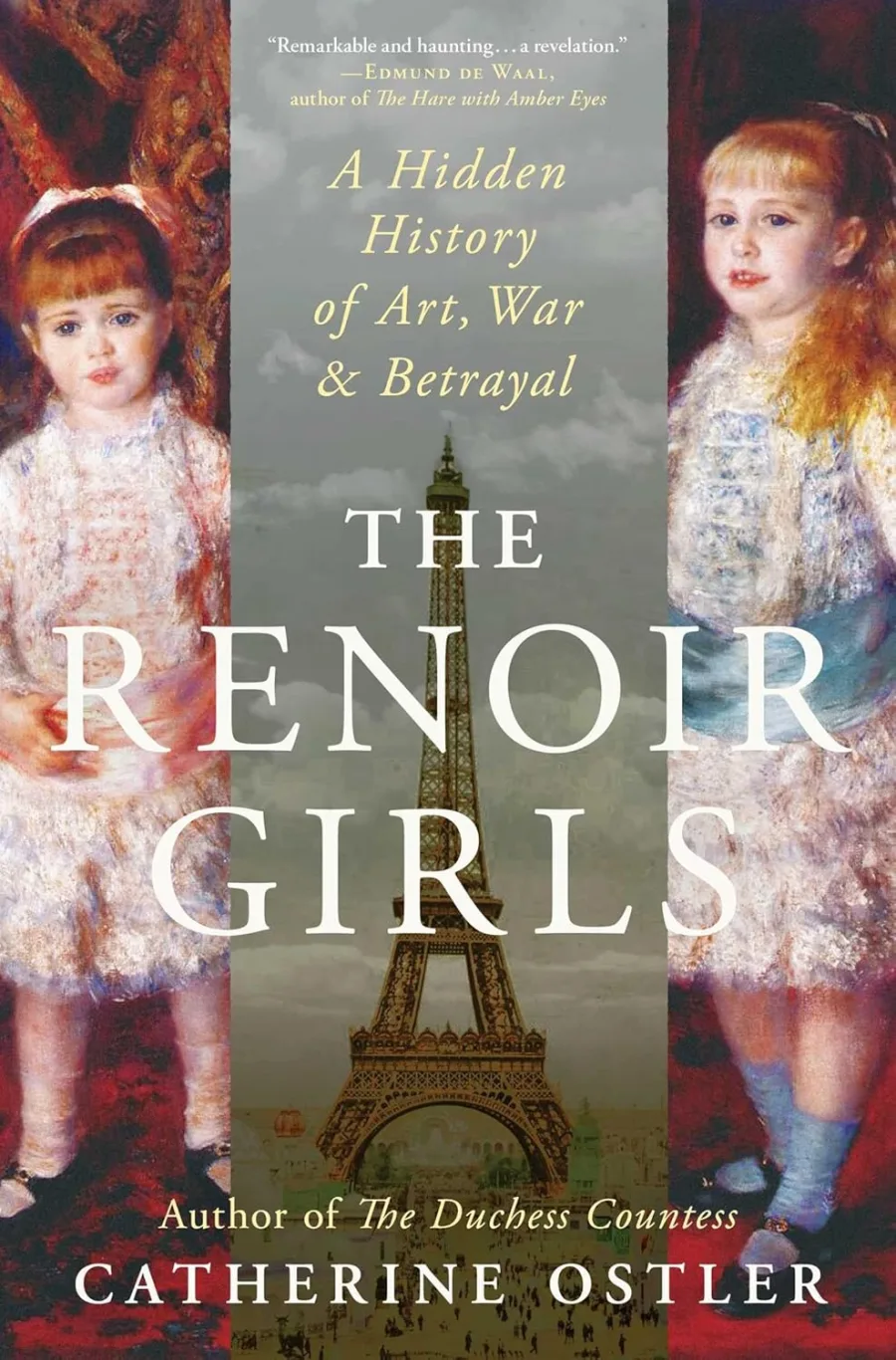
The Renoir Girls: A Hidden History of Art, War & Betrayal
Hardcover
• 432 Pages
• USD 35.00
• English
• 9781668232484
No ratings yet
| Publisher | Atria Books |
|---|---|
| ISBN13 | 9781668232484 |
| ASIN/SKU | 1668232480 |
| Book Format | Hardcover |
| Language | English |
| Pages | 432 |
| List Price | USD 35.00 |
| Publishing Date | 14/07/2026 |
| Dimensions | 6 x 1.5 x 9 inches |
| Weight | 1.35 pounds |
| Book Code | BD00069362 |
Buy this Book
Amazon Stores
Ebook Stores
Other Stores
Discover The Renoir Girls: A Hidden History of Art, War and Betrayal by Catherine Ostler. This book is published by Atria Books in Hardcover format, ISBN 9781668232484, ASIN 1668232480, under History, European Art History, Jewish Holocaust History.
Book Description
INSTANT NEW YORK TIMES BESTSELLER
“Immensely rewarding...Ostler transforms history’s grand sweep into intimate profile.” —The Washington Post
Three sisters, the daughters of a prominent French Jewish family, all painted as children by Pierre-Auguste Renoir. In the turbulent years from the Belle Epoque to World War II, one would marry an English aristocrat and escape; one would become a collaborator with the Nazis; one would die in Auschwitz. This is the remarkable hidden history of the lives behind Renoir’s beguiling portraits.
Paris, 1881. The artist Pierre-Auguste Renoir knocks on the door of a wealthy Jewish family’s home in the 8th arrondissement, the grandest quarter of Paris. He has arrived to paint the portrait of the family’s two youngest daughters. The parents, the Cahen d’Anvers, are bankers, collectors, philanthropists, and pillars of Parisian society. They go to balls, breed racehorses, and ride in the Bois de Boulogne with their aristocratic friends. But for the Jewish community, the undercurrents of Parisian sentiment are already moving in a sinister direction. The story of the Renoir girls will end in the duplicity and the horror of the Second World War.
With an extraordinary cast of characters, from the girls themselves, their mother’s lovers, a heroic British General; from the King of Spain to Dreyfus, Proust, and Maupassant—this is a story about one of the world’s most famous pictures, The Pink and the Blue. But really it is a story about Paris—one that prefers to be hidden. With access to never-before-seen letters, diaries, and personal recollections—it is a tale of privilege, beauty, and betrayal almost lost in the shimmering memory of a vanished world.
“Immensely rewarding...Ostler transforms history’s grand sweep into intimate profile.” —The Washington Post
Three sisters, the daughters of a prominent French Jewish family, all painted as children by Pierre-Auguste Renoir. In the turbulent years from the Belle Epoque to World War II, one would marry an English aristocrat and escape; one would become a collaborator with the Nazis; one would die in Auschwitz. This is the remarkable hidden history of the lives behind Renoir’s beguiling portraits.
Paris, 1881. The artist Pierre-Auguste Renoir knocks on the door of a wealthy Jewish family’s home in the 8th arrondissement, the grandest quarter of Paris. He has arrived to paint the portrait of the family’s two youngest daughters. The parents, the Cahen d’Anvers, are bankers, collectors, philanthropists, and pillars of Parisian society. They go to balls, breed racehorses, and ride in the Bois de Boulogne with their aristocratic friends. But for the Jewish community, the undercurrents of Parisian sentiment are already moving in a sinister direction. The story of the Renoir girls will end in the duplicity and the horror of the Second World War.
With an extraordinary cast of characters, from the girls themselves, their mother’s lovers, a heroic British General; from the King of Spain to Dreyfus, Proust, and Maupassant—this is a story about one of the world’s most famous pictures, The Pink and the Blue. But really it is a story about Paris—one that prefers to be hidden. With access to never-before-seen letters, diaries, and personal recollections—it is a tale of privilege, beauty, and betrayal almost lost in the shimmering memory of a vanished world.
Author Biography
Catherine Ostler is an author and journalist who has been Editor-in-Chief of Tatler, the English Standard (London), the Evening Standard magazine (London), and Editor of The Times (London) Weekend. She has also written for a wide range of publications, including The Wall Street Journal, The Daily Telegraph (London), the Financial Times, and Vogue. She studied English at Oxford University. Her first book was the critically acclaimed The Duchess Countess: The Woman Who Scandalized Eighteenth-Century London.
Editorial Reviews
“[The Renoir Girls] proves immensely rewarding . . . Ostler transforms history’s grand sweep into intimate profile. . . You get the sense Ostler could walk into a party between the years 1871 and 1939 and tell you not only who’s who, but who’s sleeping with whom.”
—The Washington Post
“Fascinating. . . Ostler pieces together what happened to the two girls in the decades after the portrait was completed. A final, thunder-clap revelation is the capstone of her absorbing account.”
—The New York Post
“The Renoir Girls is much more than an engrossing family saga about lucky people brought low. Its real subject is antisemitism, which starts as a background whisper and becomes a terrifying roar. This makes it essential reading for our times, a terrible warning about how racial hatred can lie dormant for decades before reappearing with a vengeance in times of political and financial chill.”
—Kathryn Hughes, The Times (UK), Book of the Week
“This book is an epic tale of a changing world that ends up all too close to our own . . . Some scenes will live with me for a long time, in their tragedy but also their revelations of courage.”
—Lara Feigel, The Observer
“Profoundly moving . . . With consummate skill and impressive research, Ostler tells the story. Reading the early chapters, when the Cahen d’Anvers family were at the pinnacle of Belle Epoque high life, I felt I was inside an Impressionist painting, dazzled by color and fun.”
—Ysenda Maxtone-Graham, Daily Mail, Book of the Week
“[A] story that is at once intimate and expansive, rooted in the particulars of a single family, yet reaching outward to encompass some of the defining events of modern European history. In the end, The Renoir Girls is less about a painting than about what lies beyond its frame: the passage of time, the shifting of identities, the sudden and often catastrophic turns of history.”
—Guy Walters, Independent
“[An] evocative work of narrative history . . . Miss Ostler has scoured family papers to add rich and telling detail to the sweep of her story . . . As befits such an involving and wide-ranging family saga, she even keeps a big twist in reserve for the very end.”
—Michael Prodger, Country Life
“The final reveal—which makes one gasp—only underlines the artifice of the world Ostler has portrayed, where almost limitless wealth, privilege, and familial connections proved in the end no match for the overwhelming evil of anti-Semitism.”
—Ariane Bankes, Spectator
“This is a remarkable and haunting book, bringing the lives of the three young Jewish sisters, painted by Renoir in fin de siècle Paris, into extraordinary focus. It is a revelation.”
—Edmund de Waal, author of The Hare with Amber Eyes
“[An] impressive biography. . . . A single painting foreshadows a tragic, expansive account of antisemitism and war.”
—Kirkus
“The Renoir Girls is a dazzling achievement: heartbreaking, glamorous, elegiac, revelatory, and utterly gripping. It is simultaneously a portrait of Belle Époque Paris, the chronicle of a powerful French family in a world of palaces, estates and the late 19th-century high society of grand aristocrats and bankers, a story of great love, forbidden affairs and family secrets, a biography of Renoir and his artistic milieu, a history of France from Second Empire to World War Two, and the story of French Jews from the court of Napoleon III to the killing camps of the Holocaust—and at its heart are the extraordinary lives of three sisters and a famous painting. A tale with echoes of Proust and The Hare with Amber Eyes, it is deeply researched, beautifully written, delicious, haunting, and horribly timely.”
—Simon Sebag Montefiore, author of The World: A Family History of Humanity
—The Washington Post
“Fascinating. . . Ostler pieces together what happened to the two girls in the decades after the portrait was completed. A final, thunder-clap revelation is the capstone of her absorbing account.”
—The New York Post
“The Renoir Girls is much more than an engrossing family saga about lucky people brought low. Its real subject is antisemitism, which starts as a background whisper and becomes a terrifying roar. This makes it essential reading for our times, a terrible warning about how racial hatred can lie dormant for decades before reappearing with a vengeance in times of political and financial chill.”
—Kathryn Hughes, The Times (UK), Book of the Week
“This book is an epic tale of a changing world that ends up all too close to our own . . . Some scenes will live with me for a long time, in their tragedy but also their revelations of courage.”
—Lara Feigel, The Observer
“Profoundly moving . . . With consummate skill and impressive research, Ostler tells the story. Reading the early chapters, when the Cahen d’Anvers family were at the pinnacle of Belle Epoque high life, I felt I was inside an Impressionist painting, dazzled by color and fun.”
—Ysenda Maxtone-Graham, Daily Mail, Book of the Week
“[A] story that is at once intimate and expansive, rooted in the particulars of a single family, yet reaching outward to encompass some of the defining events of modern European history. In the end, The Renoir Girls is less about a painting than about what lies beyond its frame: the passage of time, the shifting of identities, the sudden and often catastrophic turns of history.”
—Guy Walters, Independent
“[An] evocative work of narrative history . . . Miss Ostler has scoured family papers to add rich and telling detail to the sweep of her story . . . As befits such an involving and wide-ranging family saga, she even keeps a big twist in reserve for the very end.”
—Michael Prodger, Country Life
“The final reveal—which makes one gasp—only underlines the artifice of the world Ostler has portrayed, where almost limitless wealth, privilege, and familial connections proved in the end no match for the overwhelming evil of anti-Semitism.”
—Ariane Bankes, Spectator
“This is a remarkable and haunting book, bringing the lives of the three young Jewish sisters, painted by Renoir in fin de siècle Paris, into extraordinary focus. It is a revelation.”
—Edmund de Waal, author of The Hare with Amber Eyes
“[An] impressive biography. . . . A single painting foreshadows a tragic, expansive account of antisemitism and war.”
—Kirkus
“The Renoir Girls is a dazzling achievement: heartbreaking, glamorous, elegiac, revelatory, and utterly gripping. It is simultaneously a portrait of Belle Époque Paris, the chronicle of a powerful French family in a world of palaces, estates and the late 19th-century high society of grand aristocrats and bankers, a story of great love, forbidden affairs and family secrets, a biography of Renoir and his artistic milieu, a history of France from Second Empire to World War Two, and the story of French Jews from the court of Napoleon III to the killing camps of the Holocaust—and at its heart are the extraordinary lives of three sisters and a famous painting. A tale with echoes of Proust and The Hare with Amber Eyes, it is deeply researched, beautifully written, delicious, haunting, and horribly timely.”
—Simon Sebag Montefiore, author of The World: A Family History of Humanity
Book Summary
The Renoir Girls: A Hidden History of Art, War & Betrayal by Catherine Ostler is a compelling work of historical nonfiction that uncovers the remarkable lives of the women connected to the celebrated French Impressionist painter Pierre-Auguste Renoir. Rather than focusing solely on Renoir's artistic achievements, Ostler turns her attention to the women who inspired, influenced, and inherited his legacy. Drawing on extensive archival research, personal letters, diaries, and historical records, she reveals a story that stretches across generations and is shaped by love, privilege, conflict, war, and betrayal. The book offers a fresh perspective on one of history's most famous artistic families, showing how personal relationships and historical upheavals often determine the fate of both people and great works of art.
The narrative begins by introducing the world surrounding Pierre-Auguste Renoir during the height of his artistic career in late nineteenth-century France. Renoir's paintings celebrated beauty, family life, and joyful everyday moments, but behind these luminous canvases existed a complex network of relationships. The women in his life—including his wife, children, daughters-in-law, granddaughters, models, and muses—were far more than background figures. They supported the artist emotionally, managed family affairs, protected his work, and became guardians of a legacy that would eventually be tested by some of the darkest events of the twentieth century. Ostler argues that understanding these women is essential to understanding the full history of the Renoir family.
As the story progresses, readers are introduced to several generations of women whose lives become deeply intertwined with the family's artistic reputation. Some marry into the Renoir family, while others are born into its remarkable legacy. Although they enjoy the cultural prestige associated with one of France's greatest painters, they also face expectations, family tensions, and difficult personal choices. Ostler portrays them as intelligent, resilient individuals navigating a world where women often had limited social and legal power. Their personal ambitions, loyalties, and relationships shape the family's future in ways that traditional art histories have often overlooked.
A major theme throughout the book is the relationship between art and inheritance. Renoir's paintings, which would later become some of the world's most valuable works of art, are not merely beautiful objects but symbols of family identity, financial security, and emotional attachment. As ownership of these masterpieces passes through generations, disagreements emerge over responsibility, preservation, and control. The paintings become both treasured heirlooms and sources of conflict, illustrating how valuable cultural objects can strengthen family bonds while also creating rivalry and mistrust. Ostler demonstrates that the history of great art often extends far beyond the studio where it was created.
The outbreak of the Second World War dramatically transforms the family's circumstances. As Nazi Germany occupies France, artworks throughout Europe become vulnerable to confiscation, forced sales, looting, and destruction. The Renoir family's collection suddenly carries not only artistic and financial value but also political significance. Ostler carefully explains how families across occupied Europe struggled to protect priceless cultural treasures while facing uncertainty, fear, and impossible moral decisions. The women at the center of the story are forced to navigate a dangerous world where trust becomes scarce and every decision may carry life-altering consequences.
War also exposes the complexities of loyalty and survival. The book avoids presenting history in simple terms of heroes and villains. Instead, Ostler explores the difficult choices individuals made under extraordinary pressure. Some family members attempt to preserve both their loved ones and their artistic inheritance, while others find themselves caught between competing responsibilities and shifting political realities. Questions of collaboration, resistance, silence, and self-preservation emerge repeatedly, showing that history is often shaped by circumstances far more complicated than later generations might assume. These moral ambiguities give the narrative emotional depth and historical realism.
Betrayal forms another central thread running through the story. The betrayals depicted are not limited to wartime politics but also include personal relationships, family disagreements, broken trust, and hidden secrets that remain concealed for decades. Ostler gradually uncovers these forgotten episodes through meticulous research, revealing how unresolved conflicts continued to influence later generations. The emotional consequences of these betrayals prove just as significant as their financial or legal effects, reminding readers that family history is often defined by both affection and misunderstanding. Even as years pass, the legacy of past decisions continues to shape the lives of descendants.
Alongside its historical narrative, the book explores the evolving role of women within both family and society. Many of the Renoir women are expected to preserve traditions, support male relatives, and quietly manage domestic responsibilities. Yet Ostler demonstrates that they exercised considerable influence behind the scenes, making critical decisions about property, inheritance, relationships, and the preservation of artistic heritage. Their resilience, intelligence, and determination become increasingly evident as the story unfolds. By bringing their experiences into focus, the author challenges traditional histories that have concentrated primarily on celebrated male artists while overlooking the contributions of the women around them.
The book also reflects on the enduring importance of memory and historical research. Ostler pieces together forgotten letters, photographs, official documents, and family records to reconstruct lives that had largely disappeared from public attention. In doing so, she illustrates how history is rarely complete and how new discoveries can reshape familiar narratives. The Renoir family's story becomes an example of how personal archives and overlooked voices can transform our understanding of cultural history. Rather than presenting art as something separate from everyday life, the book shows that paintings carry the emotions, relationships, and struggles of the people who created and protected them.
Ultimately, The Renoir Girls: A Hidden History of Art, War & Betrayal is much more than a biography of an artist's family. Catherine Ostler combines art history, family biography, and wartime history into a richly detailed narrative that reveals the human stories behind some of the world's most admired paintings. By focusing on the women whose lives were intertwined with Renoir's legacy, she uncovers a history filled with love, sacrifice, courage, conflict, and resilience. The book reminds readers that great works of art do not exist in isolation—they pass through generations shaped by the people who preserve them, fight for them, and sometimes lose them. In bringing these hidden lives to light, Ostler offers a thoughtful exploration of how family, history, and culture become inseparable, leaving readers with a deeper appreciation for both the enduring power of art and the remarkable individuals whose stories have too often remained untold.
The narrative begins by introducing the world surrounding Pierre-Auguste Renoir during the height of his artistic career in late nineteenth-century France. Renoir's paintings celebrated beauty, family life, and joyful everyday moments, but behind these luminous canvases existed a complex network of relationships. The women in his life—including his wife, children, daughters-in-law, granddaughters, models, and muses—were far more than background figures. They supported the artist emotionally, managed family affairs, protected his work, and became guardians of a legacy that would eventually be tested by some of the darkest events of the twentieth century. Ostler argues that understanding these women is essential to understanding the full history of the Renoir family.
As the story progresses, readers are introduced to several generations of women whose lives become deeply intertwined with the family's artistic reputation. Some marry into the Renoir family, while others are born into its remarkable legacy. Although they enjoy the cultural prestige associated with one of France's greatest painters, they also face expectations, family tensions, and difficult personal choices. Ostler portrays them as intelligent, resilient individuals navigating a world where women often had limited social and legal power. Their personal ambitions, loyalties, and relationships shape the family's future in ways that traditional art histories have often overlooked.
A major theme throughout the book is the relationship between art and inheritance. Renoir's paintings, which would later become some of the world's most valuable works of art, are not merely beautiful objects but symbols of family identity, financial security, and emotional attachment. As ownership of these masterpieces passes through generations, disagreements emerge over responsibility, preservation, and control. The paintings become both treasured heirlooms and sources of conflict, illustrating how valuable cultural objects can strengthen family bonds while also creating rivalry and mistrust. Ostler demonstrates that the history of great art often extends far beyond the studio where it was created.
The outbreak of the Second World War dramatically transforms the family's circumstances. As Nazi Germany occupies France, artworks throughout Europe become vulnerable to confiscation, forced sales, looting, and destruction. The Renoir family's collection suddenly carries not only artistic and financial value but also political significance. Ostler carefully explains how families across occupied Europe struggled to protect priceless cultural treasures while facing uncertainty, fear, and impossible moral decisions. The women at the center of the story are forced to navigate a dangerous world where trust becomes scarce and every decision may carry life-altering consequences.
War also exposes the complexities of loyalty and survival. The book avoids presenting history in simple terms of heroes and villains. Instead, Ostler explores the difficult choices individuals made under extraordinary pressure. Some family members attempt to preserve both their loved ones and their artistic inheritance, while others find themselves caught between competing responsibilities and shifting political realities. Questions of collaboration, resistance, silence, and self-preservation emerge repeatedly, showing that history is often shaped by circumstances far more complicated than later generations might assume. These moral ambiguities give the narrative emotional depth and historical realism.
Betrayal forms another central thread running through the story. The betrayals depicted are not limited to wartime politics but also include personal relationships, family disagreements, broken trust, and hidden secrets that remain concealed for decades. Ostler gradually uncovers these forgotten episodes through meticulous research, revealing how unresolved conflicts continued to influence later generations. The emotional consequences of these betrayals prove just as significant as their financial or legal effects, reminding readers that family history is often defined by both affection and misunderstanding. Even as years pass, the legacy of past decisions continues to shape the lives of descendants.
Alongside its historical narrative, the book explores the evolving role of women within both family and society. Many of the Renoir women are expected to preserve traditions, support male relatives, and quietly manage domestic responsibilities. Yet Ostler demonstrates that they exercised considerable influence behind the scenes, making critical decisions about property, inheritance, relationships, and the preservation of artistic heritage. Their resilience, intelligence, and determination become increasingly evident as the story unfolds. By bringing their experiences into focus, the author challenges traditional histories that have concentrated primarily on celebrated male artists while overlooking the contributions of the women around them.
The book also reflects on the enduring importance of memory and historical research. Ostler pieces together forgotten letters, photographs, official documents, and family records to reconstruct lives that had largely disappeared from public attention. In doing so, she illustrates how history is rarely complete and how new discoveries can reshape familiar narratives. The Renoir family's story becomes an example of how personal archives and overlooked voices can transform our understanding of cultural history. Rather than presenting art as something separate from everyday life, the book shows that paintings carry the emotions, relationships, and struggles of the people who created and protected them.
Ultimately, The Renoir Girls: A Hidden History of Art, War & Betrayal is much more than a biography of an artist's family. Catherine Ostler combines art history, family biography, and wartime history into a richly detailed narrative that reveals the human stories behind some of the world's most admired paintings. By focusing on the women whose lives were intertwined with Renoir's legacy, she uncovers a history filled with love, sacrifice, courage, conflict, and resilience. The book reminds readers that great works of art do not exist in isolation—they pass through generations shaped by the people who preserve them, fight for them, and sometimes lose them. In bringing these hidden lives to light, Ostler offers a thoughtful exploration of how family, history, and culture become inseparable, leaving readers with a deeper appreciation for both the enduring power of art and the remarkable individuals whose stories have too often remained untold.
Sample Chapters
Sample Chapters will be added soon…
Reader Reviews
No reviews yet.
The Renoir Girls: A Hidden History of Art, War & Betrayal
Download Cover Image
Do you want to download the full cover image for The Renoir Girls: A Hidden History of Art, War & Betrayal?