
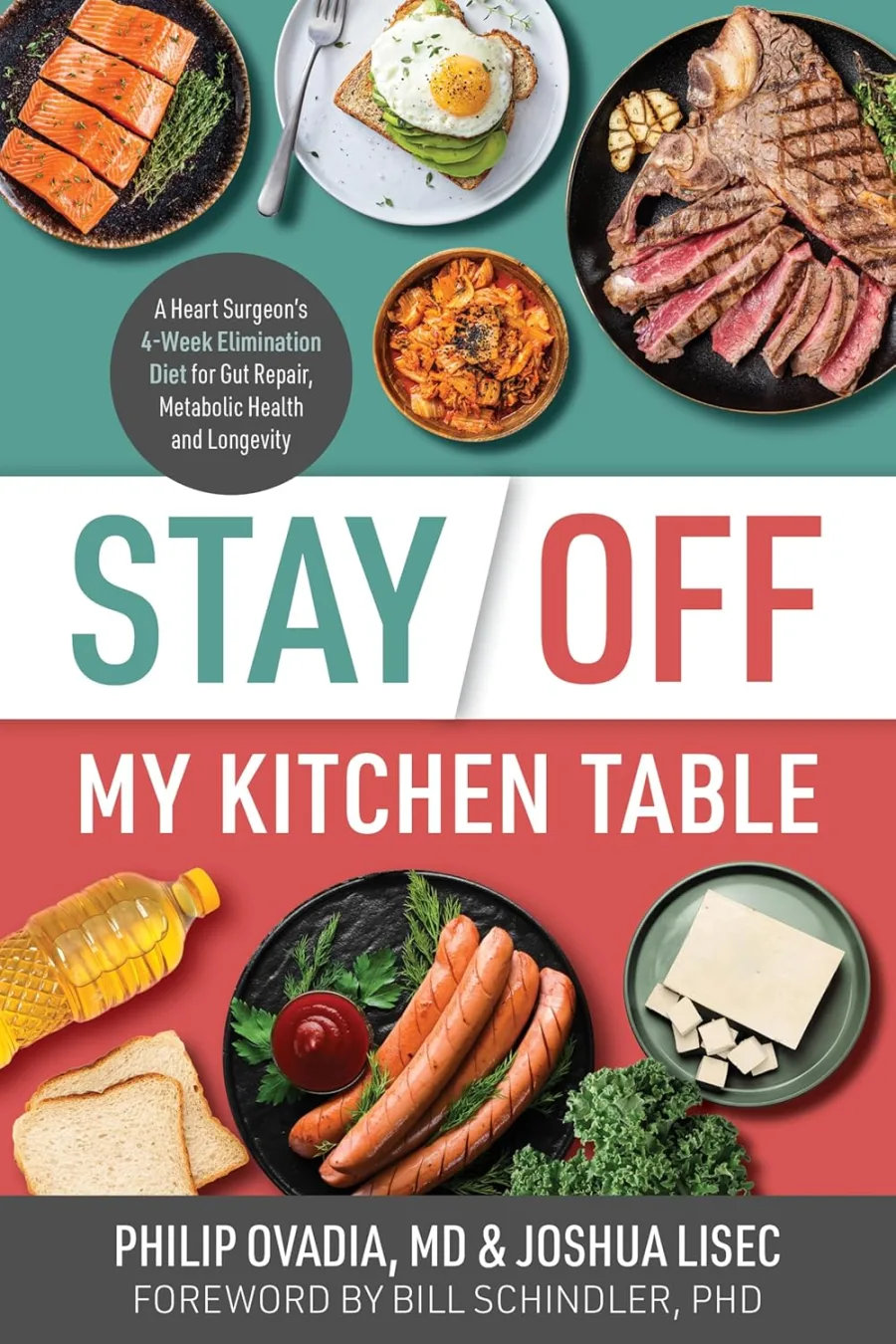
Stay Off My Kitchen Table
Paperback
• 384 Pages
• USD 29.95
• English
• 9781628606515
No ratings yet
| Publisher | Victory Belt Publishing |
|---|---|
| ISBN13 | 9781628606515 |
| ASIN/SKU | 1628606517 |
| Book Format | Paperback |
| Language | English |
| Pages | 384 |
| List Price | USD 29.95 |
| Publishing Date | 28/07/2026 |
| Dimensions | 6 x 1 x 9 inches |
| Weight | 1.15 pounds |
| Book Code | BD00069669 |
Buy this Book
Amazon Stores
Ebook Stores
Other Stores
Discover Stay Off My Kitchen Table by Philip Ovadia. This book is published by Victory Belt Publishing in Paperback format, ISBN 9781628606515, ASIN 1628606517, under Health, Fitness and Dieting, Aging and Longevity, Nutrition.
Book Description
From the bestselling authors who launched the metabolic health movement, Dr. Philip Ovadia and Joshua Lisec, comes the nutrition breakthrough you've been waiting for.
You cleaned up your diet. You followed the plan. So why aren't you seeing the results?
The truth is, it's not just what you eat; it's what your body absorbs.
In this long-awaited follow-up to Stay Off My Operating Table, Dr. Philip Ovadia and Joshua Lisec reveal the best-kept secret in nutrition science: Your gut health and nutrient absorption matter just as much as the food on your plate. If you're stuck on a plateau, struggling with inflammation, or wondering why your "healthy" choices aren't working, this book explains exactly why.
Stay Off My Kitchen Table emphasizes a vital truth: To achieve lasting health, you must remove foods that harm your metabolism, spike your blood sugar, cause inflammation, or block nutrient absorption from your kitchen. This book shows you how to eliminate those hidden offenders and fill your table with nourishing, body-friendly foods that support healing and vitality.
Through clear explanations and a proven step-by-step plan, Stay Off My Kitchen Table teaches you how to optimize your internal engine so your body can finally absorb the nutrients it needs to heal, energize, and thrive. You will discover that the path to a longer lifespan and healthspan is not to do more; it’s to do less. With the manageable, intuitive, and even fun dietary changes you’ll be making, your kitchen table will never look the same—and neither will you.
It all starts with a 4-week elimination diet designed to reduce inflammation, reset your gut, and remove the hidden food triggers that are sabotaging your progress. By the end of the month, you'll have a clean slate and a clear path forward—no guesswork, no gimmicks.
In this groundbreaking guide, you’ll discover:
Why some people thrive on new diets while others crash
How to increase bioavailability and get more nutrition from fewer foods
The truth about anti-nutrients and why some "superfoods" backfire
A powerful 4-week elimination diet to reboot digestion and unlock nutrient absorption
How to test your gut health, track your progress, and fix what's broken
Why absorption is the future of longevity, energy, and weight loss
The complete absorption-first system to heal your gut and supercharge your metabolism
Whether you're trying to repair your digestion, escape the cycle of failed diets, or finally feel like yourself again, Stay Off My Kitchen Table delivers the insight and tools to take control of your health for good.
The last diet book you'll ever need. Because once your body absorbs what's missing, everything changes.
You cleaned up your diet. You followed the plan. So why aren't you seeing the results?
The truth is, it's not just what you eat; it's what your body absorbs.
In this long-awaited follow-up to Stay Off My Operating Table, Dr. Philip Ovadia and Joshua Lisec reveal the best-kept secret in nutrition science: Your gut health and nutrient absorption matter just as much as the food on your plate. If you're stuck on a plateau, struggling with inflammation, or wondering why your "healthy" choices aren't working, this book explains exactly why.
Stay Off My Kitchen Table emphasizes a vital truth: To achieve lasting health, you must remove foods that harm your metabolism, spike your blood sugar, cause inflammation, or block nutrient absorption from your kitchen. This book shows you how to eliminate those hidden offenders and fill your table with nourishing, body-friendly foods that support healing and vitality.
Through clear explanations and a proven step-by-step plan, Stay Off My Kitchen Table teaches you how to optimize your internal engine so your body can finally absorb the nutrients it needs to heal, energize, and thrive. You will discover that the path to a longer lifespan and healthspan is not to do more; it’s to do less. With the manageable, intuitive, and even fun dietary changes you’ll be making, your kitchen table will never look the same—and neither will you.
It all starts with a 4-week elimination diet designed to reduce inflammation, reset your gut, and remove the hidden food triggers that are sabotaging your progress. By the end of the month, you'll have a clean slate and a clear path forward—no guesswork, no gimmicks.
In this groundbreaking guide, you’ll discover:
Why some people thrive on new diets while others crash
How to increase bioavailability and get more nutrition from fewer foods
The truth about anti-nutrients and why some "superfoods" backfire
A powerful 4-week elimination diet to reboot digestion and unlock nutrient absorption
How to test your gut health, track your progress, and fix what's broken
Why absorption is the future of longevity, energy, and weight loss
The complete absorption-first system to heal your gut and supercharge your metabolism
Whether you're trying to repair your digestion, escape the cycle of failed diets, or finally feel like yourself again, Stay Off My Kitchen Table delivers the insight and tools to take control of your health for good.
The last diet book you'll ever need. Because once your body absorbs what's missing, everything changes.
Author Biography
Dr. Philip Ovadia is a board-certified Cardiac Surgeon and founder of Ovadia Heart Health. His mission is to optimize the public’s metabolic health and help people stay off his operating table. As a heart surgeon who used to be morbidly obese, Dr. Ovadia has seen firsthand the failures of mainstream diets and medicine. He realized that what helped him lose over 100 pounds was the same solution that could have prevented most of the thousands of open heart surgeries he has performed—metabolic health.
In Stay off My Operating Table: A Heart Surgeon’s Metabolic Health Guide to Lose Weight, Prevent Disease, and Feel Your Best Every Day, Dr. Ovadia shares the complete metabolic health system to prevent disease.
Dr. Ovadia grew up in New York and graduated from the accelerated Pre-Med/Med program at the Pennsylvania State University and Jefferson Medical College. This was followed by a residency in General Surgery at the University of Medicine and Dentistry at New Jersey and a Fellowship in Cardiothoracic Surgery at Tufts – New England Medical School.
Learn more about Dr. Ovadia at www.OvadiaHeartHealth.com.
In Stay off My Operating Table: A Heart Surgeon’s Metabolic Health Guide to Lose Weight, Prevent Disease, and Feel Your Best Every Day, Dr. Ovadia shares the complete metabolic health system to prevent disease.
Dr. Ovadia grew up in New York and graduated from the accelerated Pre-Med/Med program at the Pennsylvania State University and Jefferson Medical College. This was followed by a residency in General Surgery at the University of Medicine and Dentistry at New Jersey and a Fellowship in Cardiothoracic Surgery at Tufts – New England Medical School.
Learn more about Dr. Ovadia at www.OvadiaHeartHealth.com.
Editorial Reviews
"In Stay Off My Operating Table, Dr. Philip Ovadia showed readers why metabolic health is the foundation of heart health. In Stay Off My Kitchen Table, he takes the next essential step: showing that it is not only what you eat, but what your body can actually digest, absorb, and use. As a physician, I’ve spent years teaching people that real food can change the trajectory of their health. Dr. Ovadia has seen that same truth from the other end of the medical system, standing over the operating table. That gives this book a seriousness most nutrition books do not have. This is a practical, testable guide to real food, gut repair, metabolic health, and discovering which foods belong on your kitchen table and which ones do not."— Ken D Berry, MD, President of The American Diabetes Society and the Bestselling Author of Lies My Doctor Told Me
"Dr. Ovadia has spent his career operating on hearts that never should have ended up on his table. Stay Off My Kitchen Table is the prevention plan he wishes every one of those patients had read first — Just a surgeon's clear-eyed take on why metabolic health breaks down and a 4-week protocol to put it back together. "Read it before your kitchen sends you to the OR."—Ben Azadi, New York Times Best Selling Author of Metabolic Freedom
"Elimination diets are the most underused dietary strategy for creating transformative health and wellness results faster than most patients believe is possible ... even their doctors! Stay Off My Kitchen Table shows how to do it right, and more importantly, why to do it this way as uniquely taught by the world-renowned Dr. Philip Ovadia and longtime medical science communications partner Joshua Lisec. If you know someone who is 'eating right' but getting the 'wrong' results, this may be the last book they'll ever need."—Dr. Aseem Malhotra, Consultant Cardiologist and Author of A Statin-Free Life
"Most diet books tell you what to eat. This one tells you what your body's actually doing with it — which is the part nobody talks about. Dr. Ovadia goes deep on bioavailability and gut health without making it complicated. Honestly, it's the missing piece for a lot of people." —Eric Berg DC
"Dr. Ovadia is a true breath of fresh air in the medical community. We all want to stay off his operating table, and his brilliant new book, Stay Off My Kitchen Table, gives us the exact steps and food choices to do just that. Dr. Ovadia proves that profound healing can happen through simple teachings. This is a highly recommended read for anyone ready to take control of their health."— Dr. Robert Kiltz
"Dialing in your health is one of the most important decisions you can make as an adult. How your body feels is how you really feel about everything. But a lot of people get stuck trying different diets or fitness plans that don't really get them where they want to go, and they don't know why. Stay Off My Kitchen Table is going to help a lot of these people finally, finally break through. Good health is a multitude of factors ranging from nutrient absorption to what you actually eat (and don't), how often you work out and what you do during it. I highly recommend this book for people who are looking for that extra edge but haven't found 'it' yet."— Ed Latimore, Author of Hard Lessons From The Hurt Business: Boxing and The Art of Life
Dr. Ovadia’s first book Stay Off My Operating Table should put most cardiologists out of business. This book should put the fake-detox industry out of business. Read it now, then roll up your sleeves and put real, healing foods on your kitchen table—where health actually begins. —Dr. Cate Shanahan
"Dr. Ovadia has spent his career operating on hearts that never should have ended up on his table. Stay Off My Kitchen Table is the prevention plan he wishes every one of those patients had read first — Just a surgeon's clear-eyed take on why metabolic health breaks down and a 4-week protocol to put it back together. "Read it before your kitchen sends you to the OR."—Ben Azadi, New York Times Best Selling Author of Metabolic Freedom
"Elimination diets are the most underused dietary strategy for creating transformative health and wellness results faster than most patients believe is possible ... even their doctors! Stay Off My Kitchen Table shows how to do it right, and more importantly, why to do it this way as uniquely taught by the world-renowned Dr. Philip Ovadia and longtime medical science communications partner Joshua Lisec. If you know someone who is 'eating right' but getting the 'wrong' results, this may be the last book they'll ever need."—Dr. Aseem Malhotra, Consultant Cardiologist and Author of A Statin-Free Life
"Most diet books tell you what to eat. This one tells you what your body's actually doing with it — which is the part nobody talks about. Dr. Ovadia goes deep on bioavailability and gut health without making it complicated. Honestly, it's the missing piece for a lot of people." —Eric Berg DC
"Dr. Ovadia is a true breath of fresh air in the medical community. We all want to stay off his operating table, and his brilliant new book, Stay Off My Kitchen Table, gives us the exact steps and food choices to do just that. Dr. Ovadia proves that profound healing can happen through simple teachings. This is a highly recommended read for anyone ready to take control of their health."— Dr. Robert Kiltz
"Dialing in your health is one of the most important decisions you can make as an adult. How your body feels is how you really feel about everything. But a lot of people get stuck trying different diets or fitness plans that don't really get them where they want to go, and they don't know why. Stay Off My Kitchen Table is going to help a lot of these people finally, finally break through. Good health is a multitude of factors ranging from nutrient absorption to what you actually eat (and don't), how often you work out and what you do during it. I highly recommend this book for people who are looking for that extra edge but haven't found 'it' yet."— Ed Latimore, Author of Hard Lessons From The Hurt Business: Boxing and The Art of Life
Dr. Ovadia’s first book Stay Off My Operating Table should put most cardiologists out of business. This book should put the fake-detox industry out of business. Read it now, then roll up your sleeves and put real, healing foods on your kitchen table—where health actually begins. —Dr. Cate Shanahan
Book Summary
Stay Off My Kitchen Table by Dr. Philip Ovadia, co-authored with Joshua Lisec, builds upon the ideas introduced in Stay Off My Operating Table by arguing that lasting health depends on far more than simply choosing the "right" foods. Dr. Ovadia, a board-certified cardiac surgeon who once struggled with obesity himself, contends that many people continue to experience fatigue, weight-loss plateaus, digestive issues, and chronic inflammation despite following healthy diets because they overlook one critical factor: the body's ability to digest, absorb, and utilize nutrients effectively. The book introduces a practical, four-week elimination program designed to repair gut health, reduce inflammation, and restore metabolic function, ultimately helping readers improve both their lifespan and healthspan.
The book begins by challenging a common assumption in nutrition—that eating healthy automatically leads to better health. Dr. Ovadia explains that while food quality certainly matters, nutrition is only beneficial if the body can properly process what is consumed. A person may eat vegetables, lean proteins, and whole foods every day, yet still suffer from poor energy, digestive discomfort, or chronic disease if inflammation, gut damage, or impaired nutrient absorption prevents those nutrients from reaching the body's cells. According to the author, this missing piece explains why so many well-intentioned diets fail to produce lasting results.
One of the book's central themes is metabolic health. Rather than focusing exclusively on weight loss, Dr. Ovadia argues that metabolic health should be the primary goal because it influences nearly every aspect of physical well-being, including heart disease, diabetes, obesity, inflammation, and longevity. Healthy metabolism is presented as the body's ability to efficiently regulate blood sugar, process nutrients, produce energy, and repair damaged tissues. When metabolism is impaired, even carefully planned diets often produce disappointing results because the body's internal systems are no longer functioning optimally.
A major focus of the book is the relationship between gut health and overall wellness. Dr. Ovadia describes the digestive tract as far more than a food-processing system. It also functions as an important regulator of immune activity, inflammation, hormone balance, and nutrient absorption. When the intestinal lining becomes damaged or irritated, unwanted substances may enter the bloodstream while beneficial nutrients fail to be absorbed effectively. This imbalance can contribute to digestive disorders, fatigue, autoimmune conditions, persistent inflammation, and metabolic dysfunction. Restoring gut integrity therefore becomes a foundational step toward improving overall health.
To address these issues, the authors introduce a structured four-week elimination diet. Rather than serving as another restrictive fad diet, the elimination program functions as a diagnostic and healing tool. During this period, participants temporarily remove foods that commonly contribute to inflammation, digestive irritation, blood sugar instability, or poor nutrient absorption. The goal is not permanent restriction but creating an opportunity for the digestive system to recover while allowing individuals to identify foods that may be causing hidden problems unique to their own bodies.
The elimination phase also emphasizes simplicity. Instead of requiring complicated meal plans or expensive specialty products, readers are encouraged to focus on whole, nutrient-dense foods that are less likely to provoke inflammatory responses. By temporarily removing potential dietary triggers, the body receives an opportunity to reduce chronic inflammation and begin repairing the digestive system. After the initial four weeks, foods are gradually reintroduced in a systematic manner so individuals can observe how their bodies respond. This personalized approach recognizes that no single diet works equally well for everyone.
Another important concept explored throughout the book is bioavailability—the proportion of nutrients that the body can actually absorb and use. Dr. Ovadia explains that nutritional labels only reveal what is present in food, not what ultimately reaches the body's tissues. Factors such as digestive function, gut microbiome balance, inflammation, enzyme production, and food preparation all influence nutrient absorption. Improving bioavailability, therefore, allows individuals to obtain greater nutritional benefit from the same foods without necessarily eating more.
The authors also examine anti-nutrients and naturally occurring compounds that may interfere with mineral absorption or digestive function in susceptible individuals. While these substances are not universally harmful, the book argues that certain people may benefit from temporarily reducing their intake during the gut-healing process. Rather than labeling foods as inherently "good" or "bad," Dr. Ovadia encourages readers to evaluate how individual foods affect their own health through careful observation and structured experimentation.
Throughout the book, Dr. Ovadia remains critical of conventional dietary advice and the healthcare system's traditional approach to chronic disease. He argues that modern medicine frequently emphasizes medications and surgical treatments after illness develops while giving insufficient attention to preventing disease through metabolic health. As a cardiac surgeon who has performed thousands of operations, he describes witnessing countless cases in which earlier nutritional intervention might have reduced the likelihood of serious cardiovascular disease. His experience provides the motivation behind his preventive philosophy: helping people stay healthy enough to avoid becoming surgical patients in the first place.
Practical implementation receives considerable attention. Readers are encouraged to monitor symptoms, digestive changes, energy levels, sleep quality, mood, and other markers throughout the elimination process. This emphasis on self-observation transforms nutrition into a personalized investigation rather than strict adherence to generalized dietary rules. Instead of chasing rapid weight loss or dramatic short-term transformations, the program focuses on sustainable improvements that support long-term health.
The writing remains accessible despite discussing complex physiological concepts. Medical explanations are presented in clear language that allows readers without scientific backgrounds to understand how digestion, inflammation, metabolism, and nutrient absorption interact. Throughout the book, scientific principles are connected directly to everyday food choices, making the recommendations practical rather than purely theoretical.
Ultimately, Stay Off My Kitchen Table argues that lasting health begins not only with choosing nutritious foods but also with creating an internal environment capable of benefiting from them. Dr. Philip Ovadia presents gut repair, metabolic optimization, and personalized nutrition as interconnected elements of disease prevention and healthy aging. Rather than promising quick fixes or miracle diets, the book offers a systematic framework for identifying dietary obstacles, restoring digestive function, and improving nutrient absorption through a manageable four-week elimination protocol. Its central message is both simple and empowering: true wellness depends not merely on what appears on the kitchen table, but on whether the body can effectively transform that food into health, energy, resilience, and longevity.
The book begins by challenging a common assumption in nutrition—that eating healthy automatically leads to better health. Dr. Ovadia explains that while food quality certainly matters, nutrition is only beneficial if the body can properly process what is consumed. A person may eat vegetables, lean proteins, and whole foods every day, yet still suffer from poor energy, digestive discomfort, or chronic disease if inflammation, gut damage, or impaired nutrient absorption prevents those nutrients from reaching the body's cells. According to the author, this missing piece explains why so many well-intentioned diets fail to produce lasting results.
One of the book's central themes is metabolic health. Rather than focusing exclusively on weight loss, Dr. Ovadia argues that metabolic health should be the primary goal because it influences nearly every aspect of physical well-being, including heart disease, diabetes, obesity, inflammation, and longevity. Healthy metabolism is presented as the body's ability to efficiently regulate blood sugar, process nutrients, produce energy, and repair damaged tissues. When metabolism is impaired, even carefully planned diets often produce disappointing results because the body's internal systems are no longer functioning optimally.
A major focus of the book is the relationship between gut health and overall wellness. Dr. Ovadia describes the digestive tract as far more than a food-processing system. It also functions as an important regulator of immune activity, inflammation, hormone balance, and nutrient absorption. When the intestinal lining becomes damaged or irritated, unwanted substances may enter the bloodstream while beneficial nutrients fail to be absorbed effectively. This imbalance can contribute to digestive disorders, fatigue, autoimmune conditions, persistent inflammation, and metabolic dysfunction. Restoring gut integrity therefore becomes a foundational step toward improving overall health.
To address these issues, the authors introduce a structured four-week elimination diet. Rather than serving as another restrictive fad diet, the elimination program functions as a diagnostic and healing tool. During this period, participants temporarily remove foods that commonly contribute to inflammation, digestive irritation, blood sugar instability, or poor nutrient absorption. The goal is not permanent restriction but creating an opportunity for the digestive system to recover while allowing individuals to identify foods that may be causing hidden problems unique to their own bodies.
The elimination phase also emphasizes simplicity. Instead of requiring complicated meal plans or expensive specialty products, readers are encouraged to focus on whole, nutrient-dense foods that are less likely to provoke inflammatory responses. By temporarily removing potential dietary triggers, the body receives an opportunity to reduce chronic inflammation and begin repairing the digestive system. After the initial four weeks, foods are gradually reintroduced in a systematic manner so individuals can observe how their bodies respond. This personalized approach recognizes that no single diet works equally well for everyone.
Another important concept explored throughout the book is bioavailability—the proportion of nutrients that the body can actually absorb and use. Dr. Ovadia explains that nutritional labels only reveal what is present in food, not what ultimately reaches the body's tissues. Factors such as digestive function, gut microbiome balance, inflammation, enzyme production, and food preparation all influence nutrient absorption. Improving bioavailability, therefore, allows individuals to obtain greater nutritional benefit from the same foods without necessarily eating more.
The authors also examine anti-nutrients and naturally occurring compounds that may interfere with mineral absorption or digestive function in susceptible individuals. While these substances are not universally harmful, the book argues that certain people may benefit from temporarily reducing their intake during the gut-healing process. Rather than labeling foods as inherently "good" or "bad," Dr. Ovadia encourages readers to evaluate how individual foods affect their own health through careful observation and structured experimentation.
Throughout the book, Dr. Ovadia remains critical of conventional dietary advice and the healthcare system's traditional approach to chronic disease. He argues that modern medicine frequently emphasizes medications and surgical treatments after illness develops while giving insufficient attention to preventing disease through metabolic health. As a cardiac surgeon who has performed thousands of operations, he describes witnessing countless cases in which earlier nutritional intervention might have reduced the likelihood of serious cardiovascular disease. His experience provides the motivation behind his preventive philosophy: helping people stay healthy enough to avoid becoming surgical patients in the first place.
Practical implementation receives considerable attention. Readers are encouraged to monitor symptoms, digestive changes, energy levels, sleep quality, mood, and other markers throughout the elimination process. This emphasis on self-observation transforms nutrition into a personalized investigation rather than strict adherence to generalized dietary rules. Instead of chasing rapid weight loss or dramatic short-term transformations, the program focuses on sustainable improvements that support long-term health.
The writing remains accessible despite discussing complex physiological concepts. Medical explanations are presented in clear language that allows readers without scientific backgrounds to understand how digestion, inflammation, metabolism, and nutrient absorption interact. Throughout the book, scientific principles are connected directly to everyday food choices, making the recommendations practical rather than purely theoretical.
Ultimately, Stay Off My Kitchen Table argues that lasting health begins not only with choosing nutritious foods but also with creating an internal environment capable of benefiting from them. Dr. Philip Ovadia presents gut repair, metabolic optimization, and personalized nutrition as interconnected elements of disease prevention and healthy aging. Rather than promising quick fixes or miracle diets, the book offers a systematic framework for identifying dietary obstacles, restoring digestive function, and improving nutrient absorption through a manageable four-week elimination protocol. Its central message is both simple and empowering: true wellness depends not merely on what appears on the kitchen table, but on whether the body can effectively transform that food into health, energy, resilience, and longevity.
Sample Chapters
Sample Chapters will be added soon…
Reader Reviews
No reviews yet.
Stay Off My Kitchen Table
Download Cover Image
Do you want to download the full cover image for Stay Off My Kitchen Table?