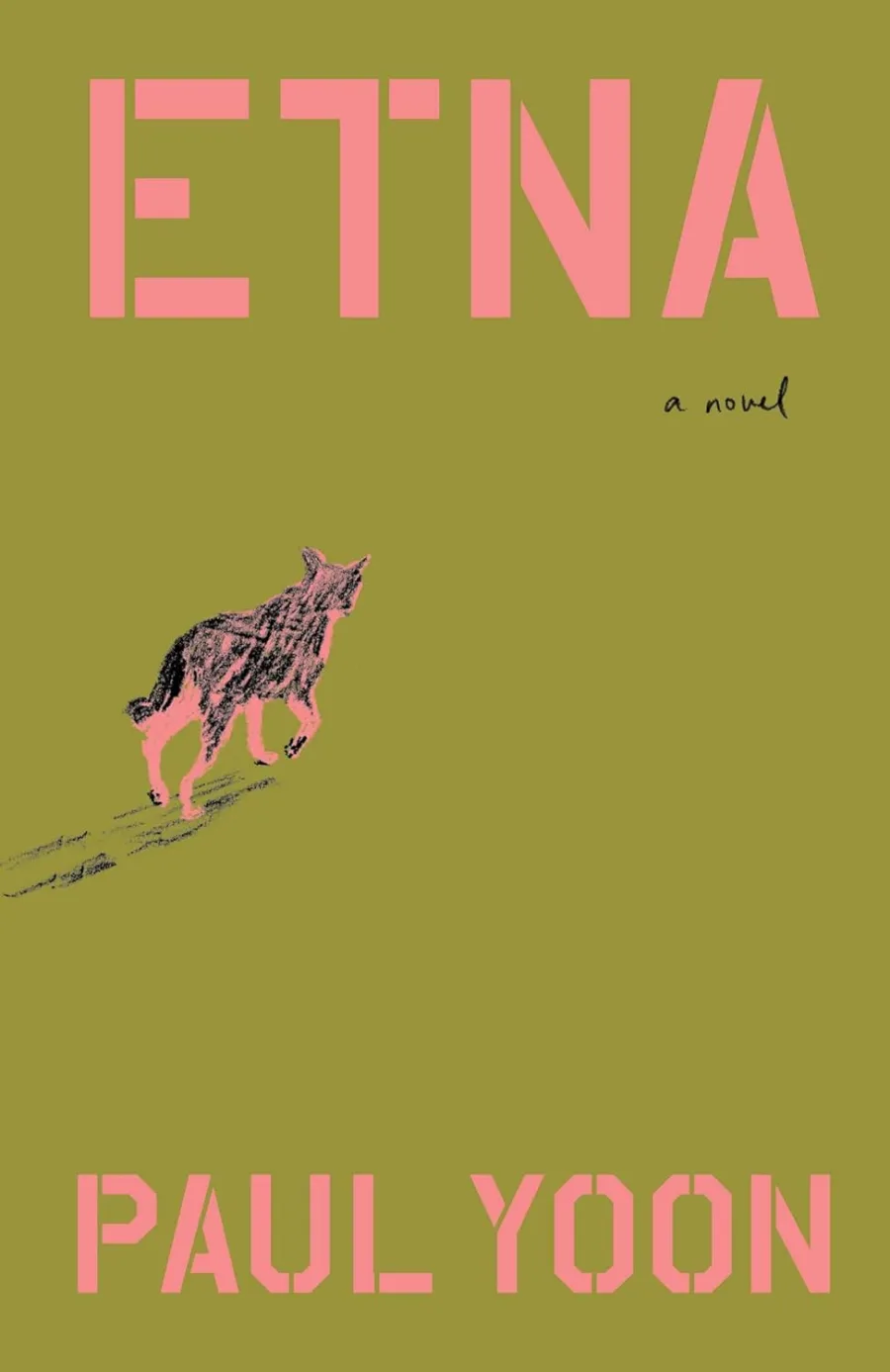
Etna: A Novel
Hardcover
• 208 Pages
• USD 28.00
• English
• 9781668020821
No ratings yet
| Publisher | Scribner |
|---|---|
| ISBN13 | 9781668020821 |
| ASIN/SKU | 1668020823 |
| Book Format | Hardcover |
| Language | English |
| Pages | 208 |
| List Price | USD 28.00 |
| Publishing Date | 04/08/2026 |
| Dimensions | 5.5 x 0.9 x 8.38 inches |
| Weight | 12 ounces |
| Book Code | BD00069674 |
Buy this Book
Amazon Stores
Ebook Stores
Other Stores
Discover Etna: A Novel by Paul Yoon. This book is published by Scribner in Hardcover format, ISBN 9781668020821, ASIN 1668020823, under Literature and Fiction, Animal Fiction, Literary Fiction.
Book Description
NAMED A MOST ANTICIPATED BOOK OF 2026 BY THE NEW YORK TIMES, TIME, and LITHUB
A BEST BOOK OF THE SUMMER FOR THE NEW YORK TIMES, CHICAGO TRIBUNE, THE BOSTON GLOBE, LITHUB,and SCARY MOMMY
Beloved author and winner of The Story Prize, Paul Yoon, is back with the unforgettable story of a working dog, Etna, who, after a devastating war, embarks on an odyssey in the hopes of returning home.
Set in a fictional country in the present day, this is a story told through the eyes of an ex-military dog, Etna. After surviving years of a devastating war, Etna decides one night to leave the men he has fought alongside for years and return home—to the place where he was taken from when he was young, in the thin but persistent hope that if a home exists for him, it might be there.
Thus begins an exhilarating odyssey told through the eyes of a dog as he traverses across ruined landscapes and fights to survive in a world that, even in peacetime, proves to be just as precarious. Along the way, he encounters other animals and humans who are attempting to figure out how to start again. What makes a life when there is no home to go back to? How do we begin to trust each other again after such profound loss?
This is a novel about the power of an idea, about never giving up, and ultimately a novel about finding hope in the most dire of times.
A BEST BOOK OF THE SUMMER FOR THE NEW YORK TIMES, CHICAGO TRIBUNE, THE BOSTON GLOBE, LITHUB,and SCARY MOMMY
Beloved author and winner of The Story Prize, Paul Yoon, is back with the unforgettable story of a working dog, Etna, who, after a devastating war, embarks on an odyssey in the hopes of returning home.
Set in a fictional country in the present day, this is a story told through the eyes of an ex-military dog, Etna. After surviving years of a devastating war, Etna decides one night to leave the men he has fought alongside for years and return home—to the place where he was taken from when he was young, in the thin but persistent hope that if a home exists for him, it might be there.
Thus begins an exhilarating odyssey told through the eyes of a dog as he traverses across ruined landscapes and fights to survive in a world that, even in peacetime, proves to be just as precarious. Along the way, he encounters other animals and humans who are attempting to figure out how to start again. What makes a life when there is no home to go back to? How do we begin to trust each other again after such profound loss?
This is a novel about the power of an idea, about never giving up, and ultimately a novel about finding hope in the most dire of times.
Author Biography
Paul Yoon is the author of five works of fiction: Once the Shore, which was a New York Times Notable Book; Snow Hunters, which won the Young Lions Fiction Award; The Mountain, which was an NPR Best Book of the Year; Run Me to Earth, which was longlisted for the Andrew Carnegie Medal for Excellence in Fiction; and most recently, The Hive and the Honey, which won The Story Prize. A recipient of a Guggenheim Fellowship and an Award in Literature from the American Academy of Arts and Letters, his stories have appeared in The New Yorker, The Atlantic, Harper’s, and The Best American Short Stories. He lives in the Hudson Valley, New York, with his wife and dog, and a new novel, Etna, is forthcoming from Scribner in the summer of 2026.
Editorial Reviews
Keenly wrought… Etna stands out among Yoon’s work… For all its compactness, Etna has the shape of an epic…tied deeply into both ancient literary tradition and tragically perennial concerns…In Yoon’s hands, a character’s suffering never overwhelms their capacity for tenderness. The author always insists on the enduring humanity of his displaced subject—even when they aren’t human.”—Rachel Vorona Cote, The Atlantic
“A moving experience.”—Sam Sacks, Wall Street Journal
“Poignant...a story on the importance of storytelling itself, as a way to resist cruelty and recognize hope." —Chicago Tribune
"Simply put, I've never read a book like this. Yoon's novel is concise and unique and just sticks with you after reading." —Scary Mommy
“Paul Yoon’s stories and novels reveal an author of uncommon generosity and grace. Much of his fiction takes place during, after, or—perhaps most accurately—between wars, and Yoon renders both the brutality and the beauty of the human experience with remarkable clarity. As if igniting a simple chunk of carbon, Yoon employs an economy of language to transform a common sight carefully observed—a reflection breaking apart in troubled water, a dog raising its head to meet a kind hand—into a lucid vision of life…We cannot evaluate how accurately Yoon renders a dog’s interior life, but thankfully the rigors of realism do not always apply. With Etna, Paul Yoon delivers a nonhuman voice that reminds us we only share this world, and so much of it exists beyond our understanding.” —Benjamin Samuel, BOMB Magazine
“An engrossing, often deeply moving parable about the evils of war, the instinct for survival and the irresistible pull of home… This normally mild-mannered animal has seen humanity at its worst, and yet somehow embodies the qualities—loyalty, empathy, resilience—of humanity at its best. His persistence in attempting to find peace and sanity in an insane world is nothing short of inspirational.” —BookPage
“Magnificent… an epic journey of hope… Yoon crafts yet another literary miracle, gorgeous in spare prose and dense with wrenching empathy on pages that may become saturated with tears. Amid today’s exhausted desensitization, Yoon gives readers an antidote of pure emotion.”—Booklist, Starred Review
"Thrilling...A propulsive narrative of unrelenting sadness may sound oxymoronic, but that's the conjurer's trick Yoon pulls off. The ability to return home after tragic events sometimes requires a redefinition of home, as Etna and his compatriots discover in this elegant work." —Shelf Awareness, starred review
“Yoon’s story of a military working dog attempting a treacherous journey home in the aftermath of an unnamed war rarely moves in expected ways…Yoon’s fabulist shading situates the story at a nexus of grim reality and hopeful fairy tale, enlivening and devastating readers in equal measure as they watch Etna reckon with the all-too-human conclusion that one can’t go home again. Yoon sidesteps the schmaltz of so many animal stories and delivers something far richer in emotion and conviction.” —Library Journal, Starred Review
“Yoon’s Homeric parable punches above its weight, minimalism deftly crafted for maximalist impact.”—Boston Globe, “Best Books of the Summer”
"A combat-trained dog sets out for home after a war in this magnificent novel... Not only does Yoon pull off a fresh take on well-worn Homeric themes and convincingly capture a dog’s perspective, but he offers subtle and stirring insights on the nature of faith, which might not always provide salvation but can be enough to keep people (and dogs) going. The author has outdone himself." —Publishers Weekly, Starred Review
"[A] spare, hypnotic novel... In the tradition of George Orwell’s Animal Farm, Yoon’s parable limns the politics of destruction and the emotional wisdom of man’s best friend." —TIME Magazine “The 36 Most Anticipated Books of 2026”
“A moving experience.”—Sam Sacks, Wall Street Journal
“Poignant...a story on the importance of storytelling itself, as a way to resist cruelty and recognize hope." —Chicago Tribune
"Simply put, I've never read a book like this. Yoon's novel is concise and unique and just sticks with you after reading." —Scary Mommy
“Paul Yoon’s stories and novels reveal an author of uncommon generosity and grace. Much of his fiction takes place during, after, or—perhaps most accurately—between wars, and Yoon renders both the brutality and the beauty of the human experience with remarkable clarity. As if igniting a simple chunk of carbon, Yoon employs an economy of language to transform a common sight carefully observed—a reflection breaking apart in troubled water, a dog raising its head to meet a kind hand—into a lucid vision of life…We cannot evaluate how accurately Yoon renders a dog’s interior life, but thankfully the rigors of realism do not always apply. With Etna, Paul Yoon delivers a nonhuman voice that reminds us we only share this world, and so much of it exists beyond our understanding.” —Benjamin Samuel, BOMB Magazine
“An engrossing, often deeply moving parable about the evils of war, the instinct for survival and the irresistible pull of home… This normally mild-mannered animal has seen humanity at its worst, and yet somehow embodies the qualities—loyalty, empathy, resilience—of humanity at its best. His persistence in attempting to find peace and sanity in an insane world is nothing short of inspirational.” —BookPage
“Magnificent… an epic journey of hope… Yoon crafts yet another literary miracle, gorgeous in spare prose and dense with wrenching empathy on pages that may become saturated with tears. Amid today’s exhausted desensitization, Yoon gives readers an antidote of pure emotion.”—Booklist, Starred Review
"Thrilling...A propulsive narrative of unrelenting sadness may sound oxymoronic, but that's the conjurer's trick Yoon pulls off. The ability to return home after tragic events sometimes requires a redefinition of home, as Etna and his compatriots discover in this elegant work." —Shelf Awareness, starred review
“Yoon’s story of a military working dog attempting a treacherous journey home in the aftermath of an unnamed war rarely moves in expected ways…Yoon’s fabulist shading situates the story at a nexus of grim reality and hopeful fairy tale, enlivening and devastating readers in equal measure as they watch Etna reckon with the all-too-human conclusion that one can’t go home again. Yoon sidesteps the schmaltz of so many animal stories and delivers something far richer in emotion and conviction.” —Library Journal, Starred Review
“Yoon’s Homeric parable punches above its weight, minimalism deftly crafted for maximalist impact.”—Boston Globe, “Best Books of the Summer”
"A combat-trained dog sets out for home after a war in this magnificent novel... Not only does Yoon pull off a fresh take on well-worn Homeric themes and convincingly capture a dog’s perspective, but he offers subtle and stirring insights on the nature of faith, which might not always provide salvation but can be enough to keep people (and dogs) going. The author has outdone himself." —Publishers Weekly, Starred Review
"[A] spare, hypnotic novel... In the tradition of George Orwell’s Animal Farm, Yoon’s parable limns the politics of destruction and the emotional wisdom of man’s best friend." —TIME Magazine “The 36 Most Anticipated Books of 2026”
Book Summary
Paul Yoon's Etna is a quiet yet profoundly moving literary novel that transforms the timeless idea of an odyssey into an intimate meditation on war, memory, belonging, and hope. Set in an unnamed contemporary country devastated by years of brutal conflict, the novel is told through the perspective of Etna, a military working dog who embarks on a perilous journey home after the fighting ends. Rather than focusing on military strategy or political causes, Yoon examines the emotional and moral aftermath of war through the eyes of a creature whose loyalty never wavers, even as the world around him falls apart. The result is a deeply human story told from an unconventional perspective, exploring what it means to survive when everything familiar has been destroyed.
Etna was once an ordinary shepherd dog living peacefully on a coastal farm. His early life was simple, defined by companionship, routine, and the comforting rhythms of home. That peaceful existence ends abruptly when he is taken into military service during a devastating war. A woman named Soojin, whose remarkable ability to understand and communicate with dogs makes her unique among humans, recruits him for specialized training. Under her care, Etna becomes a bomb-sniffing military dog assigned to assist soldiers by detecting land mines and identifying hidden dangers. Though he never fully understands the politics of the conflict, he quickly learns that his purpose is to protect those beside him, carrying out his duties with unwavering devotion.
Years of warfare leave permanent marks on both the land and everyone who survives it. Etna witnesses unimaginable destruction, constant violence, and the loss of countless companions. Entire villages disappear, forests become minefields, and the landscape itself bears the scars of endless conflict. Although he continues performing his tasks with discipline and courage, the war slowly transforms him. His instincts remain sharp, but beneath them lies exhaustion, confusion, and an unspoken longing for the place he once called home.
When the war finally ends, peace brings surprisingly little comfort. The soldiers who fought beside Etna are emotionally broken, and the nation itself remains devastated despite the cessation of fighting. Recognizing that his role has come to an end, Etna quietly slips away from the military camp one night. Driven by little more than memory and instinct, he begins an uncertain journey toward the coastal farm where he spent his earliest years. He cannot know whether anyone or anything remains there, but the hope that home might still exist becomes powerful enough to guide every step of his journey.
As Etna travels across the ruined countryside, the novel unfolds as a modern version of The Odyssey. Every stage of his journey introduces new encounters that reveal different ways individuals attempt to survive after catastrophe. Some people have responded to tragedy with extraordinary kindness, while others have surrendered to fear, suspicion, or violence. These encounters gradually illustrate that rebuilding a society requires far more than ending a war—it demands restoring trust between strangers who have learned to expect betrayal.
Among the most memorable figures Etna meets is an elderly blind dog who has somehow managed to survive alone amid the wreckage of an abandoned farm. Scarred by hardship yet remarkably resilient, the old dog teaches Etna that survival often depends less on strength than on patience, adaptability, and refusing to surrender hope. Their brief companionship reflects the quiet solidarity that develops among those who have endured profound suffering without losing their dignity.
Later, Etna encounters a compassionate man named Hong and his partner, a doctor who tirelessly treats both human refugees and injured animals despite dwindling resources. Their home becomes a temporary sanctuary where compassion continues to exist even in a fractured world. Through them, Etna experiences genuine kindness that asks for nothing in return. Their work demonstrates that healing extends beyond physical wounds; restoring faith in others may be equally important for rebuilding lives shattered by conflict.
Another meaningful relationship develops with a younger city dog who joins Etna for part of his journey. Unlike the seasoned military veteran, this companion represents innocence that has survived despite widespread devastation. Together they face hunger, danger, and uncertainty, gradually forming a friendship built on mutual protection rather than necessity. Their companionship reminds Etna that even after profound loss, meaningful bonds remain possible.
Throughout the novel, memories of Soojin continue to shape Etna's understanding of humanity. She stands apart from nearly every other human he has known because she respected animals not merely as tools but as individuals with emotions, fears, and intelligence. Her ability to understand him symbolizes the possibility of genuine communication across seemingly impossible divides. Although much of Etna's journey is solitary, his memories of her remain a quiet source of comfort and guidance, reinforcing the idea that kindness can leave lasting impressions long after people have disappeared.
One of the novel's greatest strengths lies in its portrayal of the world through Etna's perspective. Yoon avoids giving the dog human reasoning or complex philosophical arguments. Instead, Etna understands life through scent, movement, memory, instinct, and emotional connection. His observations remain direct and unembellished, allowing readers to witness the consequences of war without ideological interpretation. Human cruelty, generosity, grief, and resilience appear simply as lived experiences rather than abstract concepts. This restrained narrative voice gives the novel remarkable emotional power while emphasizing the universal costs of violence.
As Etna moves ever closer to the coast, the question of whether home still exists becomes increasingly symbolic. The novel gradually suggests that home is not merely a physical destination but also a state of emotional belonging. The places Etna remembers may have changed forever, and many of the people he once knew may no longer be there. Yet his determination to continue moving forward reflects an enduring belief that life retains meaning despite irreversible loss.
Ultimately, Etna is far more than the story of a dog's journey. It is a meditation on endurance, loyalty, memory, and the fragile hope that persists even after unimaginable devastation. Paul Yoon uses Etna's odyssey to explore how individuals recover from trauma, how compassion survives amid destruction, and how the search for home often becomes a search for identity itself. Rich in lyrical prose and quiet emotional depth, the novel demonstrates that courage is found not only on the battlefield but also in the willingness to trust again after suffering. By the journey's end, Etna offers no easy answers, yet it leaves readers with a profound belief that even in the darkest landscapes, hope can remain alive, guiding the lost toward healing, belonging, and a future worth embracing.
Etna was once an ordinary shepherd dog living peacefully on a coastal farm. His early life was simple, defined by companionship, routine, and the comforting rhythms of home. That peaceful existence ends abruptly when he is taken into military service during a devastating war. A woman named Soojin, whose remarkable ability to understand and communicate with dogs makes her unique among humans, recruits him for specialized training. Under her care, Etna becomes a bomb-sniffing military dog assigned to assist soldiers by detecting land mines and identifying hidden dangers. Though he never fully understands the politics of the conflict, he quickly learns that his purpose is to protect those beside him, carrying out his duties with unwavering devotion.
Years of warfare leave permanent marks on both the land and everyone who survives it. Etna witnesses unimaginable destruction, constant violence, and the loss of countless companions. Entire villages disappear, forests become minefields, and the landscape itself bears the scars of endless conflict. Although he continues performing his tasks with discipline and courage, the war slowly transforms him. His instincts remain sharp, but beneath them lies exhaustion, confusion, and an unspoken longing for the place he once called home.
When the war finally ends, peace brings surprisingly little comfort. The soldiers who fought beside Etna are emotionally broken, and the nation itself remains devastated despite the cessation of fighting. Recognizing that his role has come to an end, Etna quietly slips away from the military camp one night. Driven by little more than memory and instinct, he begins an uncertain journey toward the coastal farm where he spent his earliest years. He cannot know whether anyone or anything remains there, but the hope that home might still exist becomes powerful enough to guide every step of his journey.
As Etna travels across the ruined countryside, the novel unfolds as a modern version of The Odyssey. Every stage of his journey introduces new encounters that reveal different ways individuals attempt to survive after catastrophe. Some people have responded to tragedy with extraordinary kindness, while others have surrendered to fear, suspicion, or violence. These encounters gradually illustrate that rebuilding a society requires far more than ending a war—it demands restoring trust between strangers who have learned to expect betrayal.
Among the most memorable figures Etna meets is an elderly blind dog who has somehow managed to survive alone amid the wreckage of an abandoned farm. Scarred by hardship yet remarkably resilient, the old dog teaches Etna that survival often depends less on strength than on patience, adaptability, and refusing to surrender hope. Their brief companionship reflects the quiet solidarity that develops among those who have endured profound suffering without losing their dignity.
Later, Etna encounters a compassionate man named Hong and his partner, a doctor who tirelessly treats both human refugees and injured animals despite dwindling resources. Their home becomes a temporary sanctuary where compassion continues to exist even in a fractured world. Through them, Etna experiences genuine kindness that asks for nothing in return. Their work demonstrates that healing extends beyond physical wounds; restoring faith in others may be equally important for rebuilding lives shattered by conflict.
Another meaningful relationship develops with a younger city dog who joins Etna for part of his journey. Unlike the seasoned military veteran, this companion represents innocence that has survived despite widespread devastation. Together they face hunger, danger, and uncertainty, gradually forming a friendship built on mutual protection rather than necessity. Their companionship reminds Etna that even after profound loss, meaningful bonds remain possible.
Throughout the novel, memories of Soojin continue to shape Etna's understanding of humanity. She stands apart from nearly every other human he has known because she respected animals not merely as tools but as individuals with emotions, fears, and intelligence. Her ability to understand him symbolizes the possibility of genuine communication across seemingly impossible divides. Although much of Etna's journey is solitary, his memories of her remain a quiet source of comfort and guidance, reinforcing the idea that kindness can leave lasting impressions long after people have disappeared.
One of the novel's greatest strengths lies in its portrayal of the world through Etna's perspective. Yoon avoids giving the dog human reasoning or complex philosophical arguments. Instead, Etna understands life through scent, movement, memory, instinct, and emotional connection. His observations remain direct and unembellished, allowing readers to witness the consequences of war without ideological interpretation. Human cruelty, generosity, grief, and resilience appear simply as lived experiences rather than abstract concepts. This restrained narrative voice gives the novel remarkable emotional power while emphasizing the universal costs of violence.
As Etna moves ever closer to the coast, the question of whether home still exists becomes increasingly symbolic. The novel gradually suggests that home is not merely a physical destination but also a state of emotional belonging. The places Etna remembers may have changed forever, and many of the people he once knew may no longer be there. Yet his determination to continue moving forward reflects an enduring belief that life retains meaning despite irreversible loss.
Ultimately, Etna is far more than the story of a dog's journey. It is a meditation on endurance, loyalty, memory, and the fragile hope that persists even after unimaginable devastation. Paul Yoon uses Etna's odyssey to explore how individuals recover from trauma, how compassion survives amid destruction, and how the search for home often becomes a search for identity itself. Rich in lyrical prose and quiet emotional depth, the novel demonstrates that courage is found not only on the battlefield but also in the willingness to trust again after suffering. By the journey's end, Etna offers no easy answers, yet it leaves readers with a profound belief that even in the darkest landscapes, hope can remain alive, guiding the lost toward healing, belonging, and a future worth embracing.
Sample Chapters
Sample Chapters will be added soon…
Reader Reviews
No reviews yet.
Etna: A Novel