
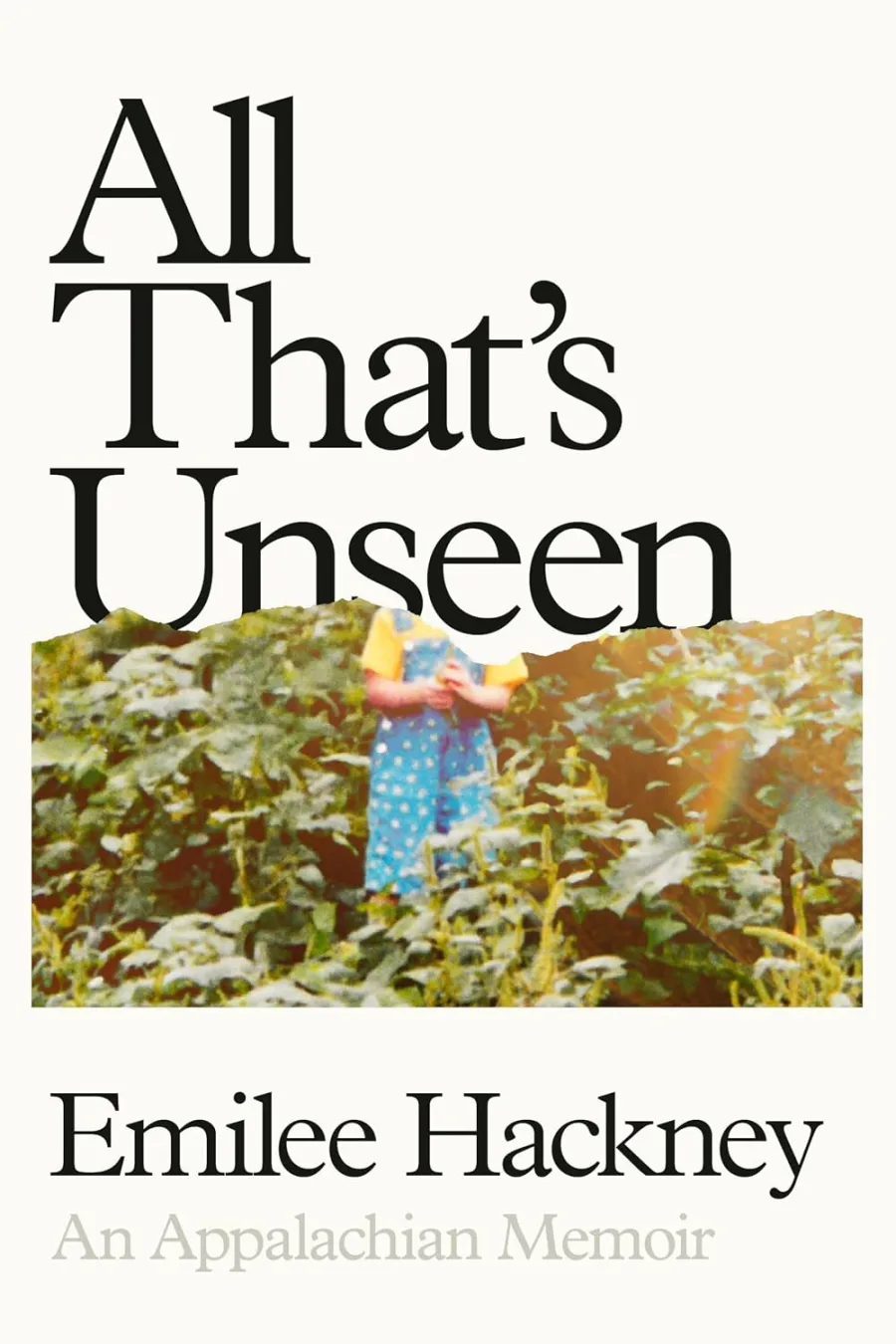
All That's Unseen: An Appalachian Memoir
Hardcover
• 384 Pages
• USD 30.99
• English
• 9780593831403
No ratings yet
| Publisher | Penguin Press |
|---|---|
| ISBN13 | 9780593831403 |
| ASIN/SKU | 0593831403 |
| Book Format | Hardcover |
| Language | English |
| Pages | 384 |
| List Price | USD 30.99 |
| Publishing Date | 28/07/2026 |
| Dimensions | 6.35 x 1.3 x 9.29 inches |
| Weight | 1.25 pounds |
| Book Code | BD00069681 |
Buy this Book
Amazon Stores
Ebook Stores
Other Stores
Discover All That's Unseen: An Appalachian Memoir by Emilee Hackney. This book is published by Penguin Press in Hardcover format, ISBN 9780593831403, ASIN 0593831403, under Biographies and Memoirs, Community and Culture Biographies, Memoirs.
Book Description
“[An] achingly intelligent memoir . . . It’s been 10 years since the publication of Hillbilly Elegy, by Vice President JD Vance, and we finally have an Appalachian memoir worthy of its origins.” —New York Times
In her luminous debut, Emilee Hackney offers both a love letter to and a reckoning of the place that made her—a story of losing her faith, finding her way back to her Appalachian home, and discovering what endures
Born and raised deep in the hollers of the Appalachian Mountains, Emilee Hackney knew little beyond the ridgelines and coalfields of southwest Virginia. As an eighth-generation Appalachian, her childhood was steeped in the stories of her grandparents—tales of the coal mines’ brutal grip and the way the land, both beautiful and unforgiving, never quite let anyone go. At fourteen, Emilee meets Sam, a senior at her high school, who offers her a glimpse at a promising future together. But as they begin attending services at Deliverance Christian Church as a couple, Emilee is thrust into the radical realm of Pentecostalism. In a culture where marriage at nineteen isn’t uncommon, Emilee is engaged to Sam. Eager to make her relationship work, she embraces the extremist doctrines of the religion, submitting herself fully to God, to Sam, and to a life of repentance. But what she doesn’t yet know is the man she plans to marry is not who he claims to be.
Years later, Emilee finds herself isolated from friends, family, and her own sense of truth. Wracked with shame and self-doubt, she reaches a breaking point. On the verge of spiraling out of control, in a stunning act of defiance and hope, she applies to Harvard; against all odds, she is accepted. From the magisterial mountains of Tazewell to the storied halls of Cambridge, Emilee begins the arduous process of reinventing herself and her relationships with her home, faith, and values against the backdrop of the divisive 2016 election. All That’s Unseen is Emilee Hackney’s fiercely honest memoir about spiritual entrapment, hard-won liberation, and the courage to reclaim her voice after she had been taught to stay silent.
In her luminous debut, Emilee Hackney offers both a love letter to and a reckoning of the place that made her—a story of losing her faith, finding her way back to her Appalachian home, and discovering what endures
Born and raised deep in the hollers of the Appalachian Mountains, Emilee Hackney knew little beyond the ridgelines and coalfields of southwest Virginia. As an eighth-generation Appalachian, her childhood was steeped in the stories of her grandparents—tales of the coal mines’ brutal grip and the way the land, both beautiful and unforgiving, never quite let anyone go. At fourteen, Emilee meets Sam, a senior at her high school, who offers her a glimpse at a promising future together. But as they begin attending services at Deliverance Christian Church as a couple, Emilee is thrust into the radical realm of Pentecostalism. In a culture where marriage at nineteen isn’t uncommon, Emilee is engaged to Sam. Eager to make her relationship work, she embraces the extremist doctrines of the religion, submitting herself fully to God, to Sam, and to a life of repentance. But what she doesn’t yet know is the man she plans to marry is not who he claims to be.
Years later, Emilee finds herself isolated from friends, family, and her own sense of truth. Wracked with shame and self-doubt, she reaches a breaking point. On the verge of spiraling out of control, in a stunning act of defiance and hope, she applies to Harvard; against all odds, she is accepted. From the magisterial mountains of Tazewell to the storied halls of Cambridge, Emilee begins the arduous process of reinventing herself and her relationships with her home, faith, and values against the backdrop of the divisive 2016 election. All That’s Unseen is Emilee Hackney’s fiercely honest memoir about spiritual entrapment, hard-won liberation, and the courage to reclaim her voice after she had been taught to stay silent.
Author Biography
Emilee Hackney grew up in the coalfields of southwest Virginia. She graduated from Harvard University with a BA in English and briefly attended Vanderbilt University’s MFA program. All That’s Unseen is her first book.
Editorial Reviews
“All That’s Unseen, by Emilee Hackney, an eighth-generation Appalachian, offers a portrait both loving and cleareyed of the region that formed her . . . [An] achingly intelligent memoir . . . Hackney disentangles the oppressive mores of her church and culture from a family and region she cannot help loving . . . As she recounts growing up in the literal shadow of the Appalachians and in the figurative shadow of the Pentecostal church, she asks: Is salvation in ministry or mountains, pulpit or place? Do I belong to one or the other? To both or neither? It’s been 10 years since the publication of Hillbilly Elegy, by Vice President JD Vance, and we finally have an Appalachian memoir worthy of its origins, by a Gen Z writer—an eighth-generation Appalachian—who is too smart, and too authentically of her place, to reinscribe stereotypes . . . To her great credit, Hackney refuses to let her story become a bootstraps narrative . . . In Hackney’s telling, there are no welfare-state villains or hard-working heroes. There are only individuals: living, breathing humans with all their nuance and complexity. When it comes to writing about rural Appalachia, Hackney’s memoir proves that an elegy is the last thing we need.” —The New York Times Book Review
“In her unflinching new memoir, All That’s Unseen, Hackney gives readers an intimate look at a way of life unfamiliar to many but more widespread than imagined by those of us whose worldview is shaped by social media and pop culture . . . All That’s Unseen is a gripping exploration of identity, class, religion and a large swath of American life that is fighting with all its might to survive.” —Atlanta Journal Constitution
“Harvard graduate Hackney debuts with a thought-provoking account of her early life in Appalachian Virginia, which was characterized by lush landscapes, financial hardship, and church . . . Hackney examines the explosive intersection of charismatic Christianity, misogyny, and young love, and offers an inspiring testament to writing one’s way out. This heartfelt missive successfully humanizes hot-button subjects.” —Publishers Weekly
“Thoughtful memoir of a forgotten corner of forgotten Appalachia. The holler in southwestern Virginia in which Hackney grew up is but a small part of ‘a place undefinable, so worn and wild, that had been stripped and scavenged and shaken and robbed, yet never conceded to the forces that tried to hold it down.’ But, she makes clear, if there’s a stubborn pride to it, then the whole region is shadowed by a sense of hopelessness. Her first book is full of both moods . . . The educational adventure she recounts includes surprising and sometimes even shocking turns, while her visits home provoke both alienation and a determination to speak up for her home and its people, victims of eternal exploitation . . . A lucid portrait and defense of a region too often caricatured but little understood.” —Kirkus
"Hackney writes as though readers are sitting at a coffee shop talking to an old friend; her irrepressible spirit and drive to make something of her life making her instantly relatable. She paints a picture of Appalachia that counters its mainstream media gloom without shying away from portraying the area's problems, bringing a refreshing blend of realism and hope." —Booklist
“Devastating and hopeful in turn, All That’s Unseen exquisitely captures a complex and contradictory world.” —Jeannette Walls, New York Times bestselling author of The Glass Castle
“In her unflinching new memoir, All That’s Unseen, Hackney gives readers an intimate look at a way of life unfamiliar to many but more widespread than imagined by those of us whose worldview is shaped by social media and pop culture . . . All That’s Unseen is a gripping exploration of identity, class, religion and a large swath of American life that is fighting with all its might to survive.” —Atlanta Journal Constitution
“Harvard graduate Hackney debuts with a thought-provoking account of her early life in Appalachian Virginia, which was characterized by lush landscapes, financial hardship, and church . . . Hackney examines the explosive intersection of charismatic Christianity, misogyny, and young love, and offers an inspiring testament to writing one’s way out. This heartfelt missive successfully humanizes hot-button subjects.” —Publishers Weekly
“Thoughtful memoir of a forgotten corner of forgotten Appalachia. The holler in southwestern Virginia in which Hackney grew up is but a small part of ‘a place undefinable, so worn and wild, that had been stripped and scavenged and shaken and robbed, yet never conceded to the forces that tried to hold it down.’ But, she makes clear, if there’s a stubborn pride to it, then the whole region is shadowed by a sense of hopelessness. Her first book is full of both moods . . . The educational adventure she recounts includes surprising and sometimes even shocking turns, while her visits home provoke both alienation and a determination to speak up for her home and its people, victims of eternal exploitation . . . A lucid portrait and defense of a region too often caricatured but little understood.” —Kirkus
"Hackney writes as though readers are sitting at a coffee shop talking to an old friend; her irrepressible spirit and drive to make something of her life making her instantly relatable. She paints a picture of Appalachia that counters its mainstream media gloom without shying away from portraying the area's problems, bringing a refreshing blend of realism and hope." —Booklist
“Devastating and hopeful in turn, All That’s Unseen exquisitely captures a complex and contradictory world.” —Jeannette Walls, New York Times bestselling author of The Glass Castle
Book Summary
All That's Unseen: An Appalachian Memoir is Emilee Hackney’s deeply personal debut memoir, a moving account of growing up in the coalfields of southwest Virginia, escaping the grip of religious extremism and emotional control, and ultimately finding the courage to reclaim her identity. More than a story of personal success, the memoir is a thoughtful exploration of home, faith, poverty, education, and belonging. Hackney neither romanticizes nor condemns Appalachia. Instead, she offers an honest portrait of a place filled with beauty and hardship, loyalty and limitation, love and loss. Through her own journey, she asks what it truly means to leave home while still carrying it within you.
Hackney begins by describing her childhood in the mountains of Appalachia, where she is an eighth-generation resident. The landscape shapes every aspect of her identity. The hills, forests, winding roads, and abandoned coal mines are not simply scenery but living reminders of generations who struggled to survive. Her family works hard but often lives paycheck to paycheck, illustrating the economic challenges that have long defined many Appalachian communities. Despite financial hardship, she remembers a childhood rich in family stories, close relationships, and a deep attachment to the land.
The memoir carefully dismantles many stereotypes about Appalachia. Hackney acknowledges the region's struggles with poverty, declining industries, addiction, and limited opportunities, but she also highlights its resilience, generosity, and strong sense of community. She refuses to portray her home as either a hopeless wasteland or an idyllic rural paradise. Instead, she presents it as a complex place whose people possess dignity despite generations of economic exploitation.
As a teenager, Hackney meets Sam, an older student who soon becomes her boyfriend. Their relationship begins as a typical young romance but gradually changes as both become involved with an intensely conservative Pentecostal church. What initially appears to be a welcoming religious community slowly reveals itself as a rigid system built upon fear, submission, and unquestioning obedience.
The church teaches strict doctrines about gender, authority, and sin. Women are expected to be humble, silent, and entirely submissive to male leadership. Every aspect of life—from clothing and behavior to thoughts and emotions—is judged according to narrow religious standards. Hackney genuinely desires to become a faithful believer and wholeheartedly embraces these teachings because she believes they will bring purpose, security, and a successful future with Sam.
Over time, however, this devotion begins to isolate her. She learns to distrust her own instincts, suppress her doubts, and measure her worth according to impossible spiritual expectations. Feelings of guilt become constant companions. Rather than bringing peace, religion gradually becomes a source of anxiety and self-condemnation. Hackney vividly illustrates how spiritual manipulation can slowly erode a person's confidence until they no longer trust their own judgment.
As her relationship with Sam deepens, she becomes engaged while still very young. Like many around her, she believes marriage is the natural next step. She imagines building a life centered on faith, family, and service. Yet beneath the surface, warning signs begin to emerge. The man she loves is not entirely who he claims to be, and the foundation of their relationship becomes increasingly unstable.
The turning point arrives when Sam is arrested for possessing child sexual abuse material, shattering the future Hackney had imagined. The revelation devastates her emotionally and spiritually. She must confront not only the betrayal of someone she trusted but also the collapse of the religious world that had shaped nearly every decision she made. Her faith, identity, and sense of reality are thrown into crisis.
Following this traumatic experience, Hackney enters a period of profound uncertainty. She struggles with shame, confusion, and loneliness. Having spent years defining herself through religious expectations, she finds it difficult to imagine who she is without them. The process of leaving the church is neither quick nor easy. Instead, it involves painful questioning, emotional healing, and learning to trust her own voice again.
The memoir then shifts toward one of its most inspiring chapters. Refusing to allow despair to define her future, Hackney makes an extraordinary decision: she applies to Harvard University. For a young woman raised in rural Appalachia with limited financial resources and little confidence in her own abilities, the application itself feels almost impossible. Yet against overwhelming odds, she is accepted.
Arriving at Harvard introduces an entirely new set of challenges. Hackney suddenly finds herself surrounded by students from privileged backgrounds whose experiences differ dramatically from her own. She feels out of place, uncertain, and burdened by the fear that she does not belong. At the same time, she discovers that many people hold simplistic assumptions about Appalachia, often reducing it to stereotypes of ignorance, poverty, or political extremism.
These experiences complicate her understanding of home. While she has escaped some of the conditions that once limited her, she also realizes she cannot abandon the place that shaped her. Instead of rejecting Appalachia, she increasingly feels compelled to defend its people against misunderstanding while honestly acknowledging its struggles. She recognizes that love for one's home does not require denying its flaws.
Education becomes a powerful tool of transformation. Through literature, writing, history, and thoughtful conversations, Hackney gradually rebuilds the confidence that had been stripped away by years of religious control. She learns that asking difficult questions is not an act of rebellion but an essential part of intellectual and emotional growth. Writing itself becomes an act of healing, allowing her to examine painful memories with honesty and compassion.
One of the memoir's greatest strengths is its refusal to divide people into heroes and villains. Even those whose actions caused harm are portrayed as products of larger systems involving poverty, limited opportunity, rigid religious beliefs, and inherited cultural expectations. Hackney acknowledges accountability while also recognizing the complicated circumstances that shape individual lives.
The backdrop of the 2016 U.S. presidential election further highlights the cultural divide between rural Appalachia and elite academic institutions. Hackney finds herself caught between two worlds. At home, some people view her education with suspicion, as though leaving for Harvard represents a rejection of her roots. At university, others dismiss the region she loves without understanding its history or complexity. She gradually realizes she belongs fully to neither world, yet this in-between position gives her a unique perspective.
Throughout the memoir, Appalachia itself remains a central character. The mountains symbolize endurance, memory, and belonging. Even after leaving, Hackney finds that the landscape continues to shape her identity. Home is no longer simply a physical place but a complicated emotional inheritance that includes both wounds and deep affection.
Ultimately, All That's Unseen is a memoir about finding the courage to reclaim one's voice after years of silence. Emilee Hackney tells a story of survival without bitterness and of transformation without forgetting where she came from. Her journey from the coalfields of Virginia to the classrooms of Harvard is remarkable, but the memoir's greatest achievement lies in its emotional honesty. It reminds readers that freedom often begins with questioning what we have always been taught, that healing requires both truth and compassion, and that our deepest roots need not prevent us from growing toward a wider horizon. Through graceful prose and unflinching reflection, Hackney offers a powerful meditation on faith, identity, resilience, and the enduring pull of home.
Hackney begins by describing her childhood in the mountains of Appalachia, where she is an eighth-generation resident. The landscape shapes every aspect of her identity. The hills, forests, winding roads, and abandoned coal mines are not simply scenery but living reminders of generations who struggled to survive. Her family works hard but often lives paycheck to paycheck, illustrating the economic challenges that have long defined many Appalachian communities. Despite financial hardship, she remembers a childhood rich in family stories, close relationships, and a deep attachment to the land.
The memoir carefully dismantles many stereotypes about Appalachia. Hackney acknowledges the region's struggles with poverty, declining industries, addiction, and limited opportunities, but she also highlights its resilience, generosity, and strong sense of community. She refuses to portray her home as either a hopeless wasteland or an idyllic rural paradise. Instead, she presents it as a complex place whose people possess dignity despite generations of economic exploitation.
As a teenager, Hackney meets Sam, an older student who soon becomes her boyfriend. Their relationship begins as a typical young romance but gradually changes as both become involved with an intensely conservative Pentecostal church. What initially appears to be a welcoming religious community slowly reveals itself as a rigid system built upon fear, submission, and unquestioning obedience.
The church teaches strict doctrines about gender, authority, and sin. Women are expected to be humble, silent, and entirely submissive to male leadership. Every aspect of life—from clothing and behavior to thoughts and emotions—is judged according to narrow religious standards. Hackney genuinely desires to become a faithful believer and wholeheartedly embraces these teachings because she believes they will bring purpose, security, and a successful future with Sam.
Over time, however, this devotion begins to isolate her. She learns to distrust her own instincts, suppress her doubts, and measure her worth according to impossible spiritual expectations. Feelings of guilt become constant companions. Rather than bringing peace, religion gradually becomes a source of anxiety and self-condemnation. Hackney vividly illustrates how spiritual manipulation can slowly erode a person's confidence until they no longer trust their own judgment.
As her relationship with Sam deepens, she becomes engaged while still very young. Like many around her, she believes marriage is the natural next step. She imagines building a life centered on faith, family, and service. Yet beneath the surface, warning signs begin to emerge. The man she loves is not entirely who he claims to be, and the foundation of their relationship becomes increasingly unstable.
The turning point arrives when Sam is arrested for possessing child sexual abuse material, shattering the future Hackney had imagined. The revelation devastates her emotionally and spiritually. She must confront not only the betrayal of someone she trusted but also the collapse of the religious world that had shaped nearly every decision she made. Her faith, identity, and sense of reality are thrown into crisis.
Following this traumatic experience, Hackney enters a period of profound uncertainty. She struggles with shame, confusion, and loneliness. Having spent years defining herself through religious expectations, she finds it difficult to imagine who she is without them. The process of leaving the church is neither quick nor easy. Instead, it involves painful questioning, emotional healing, and learning to trust her own voice again.
The memoir then shifts toward one of its most inspiring chapters. Refusing to allow despair to define her future, Hackney makes an extraordinary decision: she applies to Harvard University. For a young woman raised in rural Appalachia with limited financial resources and little confidence in her own abilities, the application itself feels almost impossible. Yet against overwhelming odds, she is accepted.
Arriving at Harvard introduces an entirely new set of challenges. Hackney suddenly finds herself surrounded by students from privileged backgrounds whose experiences differ dramatically from her own. She feels out of place, uncertain, and burdened by the fear that she does not belong. At the same time, she discovers that many people hold simplistic assumptions about Appalachia, often reducing it to stereotypes of ignorance, poverty, or political extremism.
These experiences complicate her understanding of home. While she has escaped some of the conditions that once limited her, she also realizes she cannot abandon the place that shaped her. Instead of rejecting Appalachia, she increasingly feels compelled to defend its people against misunderstanding while honestly acknowledging its struggles. She recognizes that love for one's home does not require denying its flaws.
Education becomes a powerful tool of transformation. Through literature, writing, history, and thoughtful conversations, Hackney gradually rebuilds the confidence that had been stripped away by years of religious control. She learns that asking difficult questions is not an act of rebellion but an essential part of intellectual and emotional growth. Writing itself becomes an act of healing, allowing her to examine painful memories with honesty and compassion.
One of the memoir's greatest strengths is its refusal to divide people into heroes and villains. Even those whose actions caused harm are portrayed as products of larger systems involving poverty, limited opportunity, rigid religious beliefs, and inherited cultural expectations. Hackney acknowledges accountability while also recognizing the complicated circumstances that shape individual lives.
The backdrop of the 2016 U.S. presidential election further highlights the cultural divide between rural Appalachia and elite academic institutions. Hackney finds herself caught between two worlds. At home, some people view her education with suspicion, as though leaving for Harvard represents a rejection of her roots. At university, others dismiss the region she loves without understanding its history or complexity. She gradually realizes she belongs fully to neither world, yet this in-between position gives her a unique perspective.
Throughout the memoir, Appalachia itself remains a central character. The mountains symbolize endurance, memory, and belonging. Even after leaving, Hackney finds that the landscape continues to shape her identity. Home is no longer simply a physical place but a complicated emotional inheritance that includes both wounds and deep affection.
Ultimately, All That's Unseen is a memoir about finding the courage to reclaim one's voice after years of silence. Emilee Hackney tells a story of survival without bitterness and of transformation without forgetting where she came from. Her journey from the coalfields of Virginia to the classrooms of Harvard is remarkable, but the memoir's greatest achievement lies in its emotional honesty. It reminds readers that freedom often begins with questioning what we have always been taught, that healing requires both truth and compassion, and that our deepest roots need not prevent us from growing toward a wider horizon. Through graceful prose and unflinching reflection, Hackney offers a powerful meditation on faith, identity, resilience, and the enduring pull of home.
Sample Chapters
Sample Chapters will be added soon…
Reader Reviews
No reviews yet.
All That's Unseen: An Appalachian Memoir
Download Cover Image
Do you want to download the full cover image for All That's Unseen: An Appalachian Memoir?