
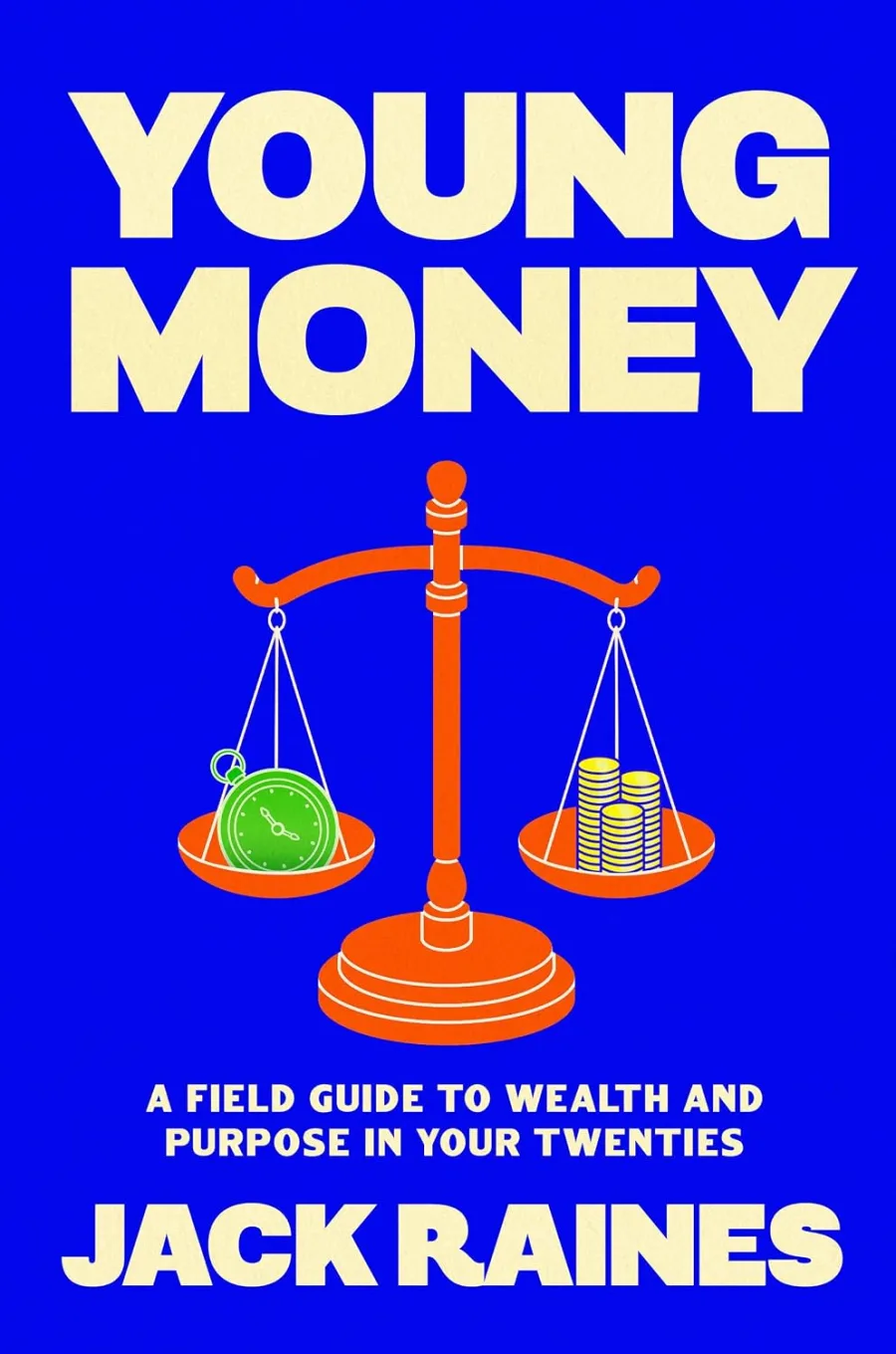
Young Money: A Field Guide to Wealth and Purpose in Your Twenties
Hardcover
• 272 Pages
• USD 32.00
• English
• 9798217046935
No ratings yet
| Publisher | Portfolio |
|---|---|
| ISBN13 | 9798217046935 |
| ASIN/SKU | B0FZS5PL15 |
| Book Format | Hardcover |
| Language | English |
| Pages | 272 |
| List Price | USD 32.00 |
| Publishing Date | 04/08/2026 |
| Dimensions | 5.81 x 1 x 8.56 inches |
| Weight | 12.8 ounces |
| Book Code | BD00069871 |
Buy this Book
Amazon Stores
Ebook Stores
Other Stores
Discover Young Money: A Field Guide to Wealth and Purpose in Your Twenties by Jack Raines. This book is published by Portfolio in Hardcover format, ISBN 9798217046935, ASIN B0FZS5PL15, under Business and Money, Motivational Management and Leadership, Business Motivation and Self-Improvement.
Book Description
From the creator of the hit newsletter Young Money, a guide for for Gen Z professionals fed up with the traditional career path and ready to rethink their relationship with money, work, and what it means to live well.
Jack Raines did everything right: get the grades, get the job, climb the ladder. But somewhere between the meetings and the paychecks, a question crept in—Is this it? What once looked like success started to feel like a trap. So he did the unthinkable: he walked away and decided to do it all differently.
What began as a quarter-life crisis turned into a full-on reinvention.
In Young Money, Raines exposes the trap so many twenty-somethings fall into—chasing status, salary, and stability without stopping to ask: Is this what I actually want? Is this actually how I want to spend my time?
Blending personal stories with cultural insight, he lays out a bold new manifesto for life and money:
Time is your most valuable currency.
Every dollar reflects the hours you traded to earn it.
Real wealth means buying freedom, not flexing status.
With humor and honesty, Young Money is the essential playbook for anyone just starting out in their post college life—and anyone ready to do it differently.
Jack Raines did everything right: get the grades, get the job, climb the ladder. But somewhere between the meetings and the paychecks, a question crept in—Is this it? What once looked like success started to feel like a trap. So he did the unthinkable: he walked away and decided to do it all differently.
What began as a quarter-life crisis turned into a full-on reinvention.
In Young Money, Raines exposes the trap so many twenty-somethings fall into—chasing status, salary, and stability without stopping to ask: Is this what I actually want? Is this actually how I want to spend my time?
Blending personal stories with cultural insight, he lays out a bold new manifesto for life and money:
Time is your most valuable currency.
Every dollar reflects the hours you traded to earn it.
Real wealth means buying freedom, not flexing status.
With humor and honesty, Young Money is the essential playbook for anyone just starting out in their post college life—and anyone ready to do it differently.
Author Biography
Author Biography will be added soon…
Editorial Reviews
Editorial Reviews will be added soon…
Book Summary
Young Money: A Field Guide to Wealth and Purpose in Your Twenties by Jack Raines is a candid, humorous, and practical reflection on what it means to build a meaningful life in your twenties. Written for a generation entering adulthood in a world of career pressure, social comparison, financial uncertainty, and endless choices, the book challenges the conventional idea that success simply means getting a good job, earning more money, climbing the corporate ladder, and eventually reaching a comfortable life. Raines argues that the more important question is not how much money you can make, but what you are willing to trade your time for.
The book grows out of Raines's own experience. After graduating with degrees in finance and Spanish and spending time in corporate finance, he found himself confronting a disturbing realization: he had followed the path that was supposed to lead to success, yet he was not convinced that he wanted to spend the next several decades continuing along it. At twenty-four, he quit his job, bought a one-way ticket to Barcelona, and spent a year living abroad, writing, working with a finance media company, and travelling. He later returned to the United States, attended Columbia Business School, worked at Robinhood, helped build Sherwood News, and eventually entered venture capital. His unconventional path becomes an important part of the book's argument: sometimes the most valuable thing you can do with your twenties is give yourself permission to experiment.
At the center of Young Money is the concept of time as the ultimate currency. Money can be earned again, but time cannot. Every salary, purchase, promotion, and career decision therefore has a hidden cost: the amount of life required to obtain it. Raines encourages readers to think about money in terms of the hours and experiences exchanged for it. A higher salary may look attractive on paper, but if earning it requires sacrificing nearly all of one's free time, relationships, health, or curiosity, its true value may be considerably lower than it first appears. In this way, the book asks readers to stop looking at money only as a number and start seeing it as a representation of human time.
This idea leads naturally to one of the book's strongest themes: opportunity cost. Every decision closes off other possibilities, at least temporarily. Choosing one career means not choosing another. Remaining in one city means giving up experiences that might have happened elsewhere. Staying in a comfortable job may mean sacrificing the opportunity to start a business, travel, write, study, or simply discover something new. Raines's point is not that every decision should maximize excitement or novelty. Instead, he wants young adults to recognize that doing nothing is also a decision. The safe path carries opportunity costs just as surely as the risky path does.
The author is particularly critical of the status game that shapes many young people's choices. From an early age, people learn to associate prestigious schools, impressive job titles, expensive apartments, fashionable cities, and high salaries with success. Social media intensifies this pressure by allowing people to compare their lives constantly with carefully selected images of other people's achievements. Raines argues that chasing status can become an endless competition because there is always someone earning more, living somewhere more desirable, or holding a more prestigious position. The result is a strange situation in which people can achieve exactly what society tells them to want and still feel dissatisfied.
The book therefore encourages readers to distinguish wealth from status. True wealth, in Raines's framework, is closely connected to freedom. Money is valuable because it can create choices: the ability to leave a bad job, take time off, move somewhere new, pursue an uncertain opportunity, or spend more time with people you love. A large income that leaves a person trapped in obligations may provide less genuine freedom than a more modest income accompanied by flexibility. Real financial success, then, is not necessarily about displaying what you own. It is about increasing control over your own life.
Another major concern is the uncertainty of the twenties. Raines recognizes that this period can feel uniquely confusing. Young adults are expected to make enormous decisions about careers, relationships, cities, money, and identity while still figuring out who they are. At the same time, social media constantly provides evidence that other people appear to be moving ahead: someone gets engaged, someone buys a house, someone receives a promotion, and someone else starts a successful company. This can create the painful feeling that one's own life is falling behind. Raines's response is reassuring: there is no universal timetable for adulthood, and the apparent certainty of other people's lives is often an illusion.
The book consequently presents the twenties as a period of experimentation rather than premature optimization. Raines believes young people often try to optimize their lives too early. They search for the perfect career, the highest possible salary, the safest investment, and the most impressive résumé before they have developed a clear understanding of what they actually value. But when the future is uncertain, flexibility can be more valuable than optimization. Trying different jobs, living in different places, meeting different kinds of people, travelling, writing, building projects, or taking calculated risks can reveal information about oneself that no amount of planning can provide.
This does not mean Raines advocates reckless behaviour. His argument is more nuanced: risk is often cheaper in your twenties than later in life. A person without major financial or family obligations may have more room to make mistakes, change direction, or start again. The author uses his own decision to leave corporate finance and move to Barcelona as an example of how a seemingly irrational choice can create unexpected opportunities. His broader message is that uncertainty should not automatically be treated as something to eliminate. Sometimes uncertainty is the environment in which discovery becomes possible.
The book also examines the complicated relationship between money and happiness. Raines does not dismiss financial security. Earning enough to meet basic needs, save, invest, and protect oneself from emergencies is important. But beyond a certain point, the pursuit of additional income can become disconnected from actual happiness. If each raise simply produces a desire for another raise, financial progress becomes an endless treadmill. The more useful question is what money enables. Does it provide security? Freedom? Experiences? Time with family? The ability to pursue meaningful work? If not, continually earning more may not solve the underlying problem.
Ultimately, Young Money is less a traditional personal-finance manual than a philosophy of intentional living. Its financial lessons matter, but they are part of a larger argument about how to spend the limited years of one's life. Raines wants readers to understand investing and money, but also to invest in experiences, relationships, skills, curiosity, and optionality. He argues that a person's twenties should not be sacrificed entirely in the hope of reaching some distant version of happiness later.
The deepest message of the book is that a successful life must be personally defined. A prestigious career is not automatically a good career. A high salary is not automatically wealth. Stability is not automatically security, and taking a risk is not automatically irresponsibility. The right choices depend on what an individual values, what they are willing to sacrifice, and what kind of life they want their money and work to support.
In the end, Young Money encourages readers to treat their twenties not as a race toward a predetermined finish line but as a period of exploration. Raines reminds us that life is finite, opportunities have hidden costs, and time is the one resource that cannot be replenished. The goal, therefore, is not simply to accumulate money or impress other people. It is to use money intelligently so that it creates freedom, choice, experiences, and purpose.
For young adults who feel uncertain, behind, or trapped by conventional definitions of success, the book offers an especially humane message: you do not have to have your entire life figured out yet. You can change your mind. You can take a different path. You can leave a respectable career if it is not the life you want. You can value experiences over appearances. And most importantly, you can build a definition of wealth that has less to do with what other people see and more to do with how you actually spend your finite time.
The book grows out of Raines's own experience. After graduating with degrees in finance and Spanish and spending time in corporate finance, he found himself confronting a disturbing realization: he had followed the path that was supposed to lead to success, yet he was not convinced that he wanted to spend the next several decades continuing along it. At twenty-four, he quit his job, bought a one-way ticket to Barcelona, and spent a year living abroad, writing, working with a finance media company, and travelling. He later returned to the United States, attended Columbia Business School, worked at Robinhood, helped build Sherwood News, and eventually entered venture capital. His unconventional path becomes an important part of the book's argument: sometimes the most valuable thing you can do with your twenties is give yourself permission to experiment.
At the center of Young Money is the concept of time as the ultimate currency. Money can be earned again, but time cannot. Every salary, purchase, promotion, and career decision therefore has a hidden cost: the amount of life required to obtain it. Raines encourages readers to think about money in terms of the hours and experiences exchanged for it. A higher salary may look attractive on paper, but if earning it requires sacrificing nearly all of one's free time, relationships, health, or curiosity, its true value may be considerably lower than it first appears. In this way, the book asks readers to stop looking at money only as a number and start seeing it as a representation of human time.
This idea leads naturally to one of the book's strongest themes: opportunity cost. Every decision closes off other possibilities, at least temporarily. Choosing one career means not choosing another. Remaining in one city means giving up experiences that might have happened elsewhere. Staying in a comfortable job may mean sacrificing the opportunity to start a business, travel, write, study, or simply discover something new. Raines's point is not that every decision should maximize excitement or novelty. Instead, he wants young adults to recognize that doing nothing is also a decision. The safe path carries opportunity costs just as surely as the risky path does.
The author is particularly critical of the status game that shapes many young people's choices. From an early age, people learn to associate prestigious schools, impressive job titles, expensive apartments, fashionable cities, and high salaries with success. Social media intensifies this pressure by allowing people to compare their lives constantly with carefully selected images of other people's achievements. Raines argues that chasing status can become an endless competition because there is always someone earning more, living somewhere more desirable, or holding a more prestigious position. The result is a strange situation in which people can achieve exactly what society tells them to want and still feel dissatisfied.
The book therefore encourages readers to distinguish wealth from status. True wealth, in Raines's framework, is closely connected to freedom. Money is valuable because it can create choices: the ability to leave a bad job, take time off, move somewhere new, pursue an uncertain opportunity, or spend more time with people you love. A large income that leaves a person trapped in obligations may provide less genuine freedom than a more modest income accompanied by flexibility. Real financial success, then, is not necessarily about displaying what you own. It is about increasing control over your own life.
Another major concern is the uncertainty of the twenties. Raines recognizes that this period can feel uniquely confusing. Young adults are expected to make enormous decisions about careers, relationships, cities, money, and identity while still figuring out who they are. At the same time, social media constantly provides evidence that other people appear to be moving ahead: someone gets engaged, someone buys a house, someone receives a promotion, and someone else starts a successful company. This can create the painful feeling that one's own life is falling behind. Raines's response is reassuring: there is no universal timetable for adulthood, and the apparent certainty of other people's lives is often an illusion.
The book consequently presents the twenties as a period of experimentation rather than premature optimization. Raines believes young people often try to optimize their lives too early. They search for the perfect career, the highest possible salary, the safest investment, and the most impressive résumé before they have developed a clear understanding of what they actually value. But when the future is uncertain, flexibility can be more valuable than optimization. Trying different jobs, living in different places, meeting different kinds of people, travelling, writing, building projects, or taking calculated risks can reveal information about oneself that no amount of planning can provide.
This does not mean Raines advocates reckless behaviour. His argument is more nuanced: risk is often cheaper in your twenties than later in life. A person without major financial or family obligations may have more room to make mistakes, change direction, or start again. The author uses his own decision to leave corporate finance and move to Barcelona as an example of how a seemingly irrational choice can create unexpected opportunities. His broader message is that uncertainty should not automatically be treated as something to eliminate. Sometimes uncertainty is the environment in which discovery becomes possible.
The book also examines the complicated relationship between money and happiness. Raines does not dismiss financial security. Earning enough to meet basic needs, save, invest, and protect oneself from emergencies is important. But beyond a certain point, the pursuit of additional income can become disconnected from actual happiness. If each raise simply produces a desire for another raise, financial progress becomes an endless treadmill. The more useful question is what money enables. Does it provide security? Freedom? Experiences? Time with family? The ability to pursue meaningful work? If not, continually earning more may not solve the underlying problem.
Ultimately, Young Money is less a traditional personal-finance manual than a philosophy of intentional living. Its financial lessons matter, but they are part of a larger argument about how to spend the limited years of one's life. Raines wants readers to understand investing and money, but also to invest in experiences, relationships, skills, curiosity, and optionality. He argues that a person's twenties should not be sacrificed entirely in the hope of reaching some distant version of happiness later.
The deepest message of the book is that a successful life must be personally defined. A prestigious career is not automatically a good career. A high salary is not automatically wealth. Stability is not automatically security, and taking a risk is not automatically irresponsibility. The right choices depend on what an individual values, what they are willing to sacrifice, and what kind of life they want their money and work to support.
In the end, Young Money encourages readers to treat their twenties not as a race toward a predetermined finish line but as a period of exploration. Raines reminds us that life is finite, opportunities have hidden costs, and time is the one resource that cannot be replenished. The goal, therefore, is not simply to accumulate money or impress other people. It is to use money intelligently so that it creates freedom, choice, experiences, and purpose.
For young adults who feel uncertain, behind, or trapped by conventional definitions of success, the book offers an especially humane message: you do not have to have your entire life figured out yet. You can change your mind. You can take a different path. You can leave a respectable career if it is not the life you want. You can value experiences over appearances. And most importantly, you can build a definition of wealth that has less to do with what other people see and more to do with how you actually spend your finite time.
Sample Chapters
Sample Chapters will be added soon…
Reader Reviews
No reviews yet.
Young Money: A Field Guide to Wealth and Purpose in Your Twenties
Download Cover Image
Do you want to download the full cover image for Young Money: A Field Guide to Wealth and Purpose in Your Twenties?