
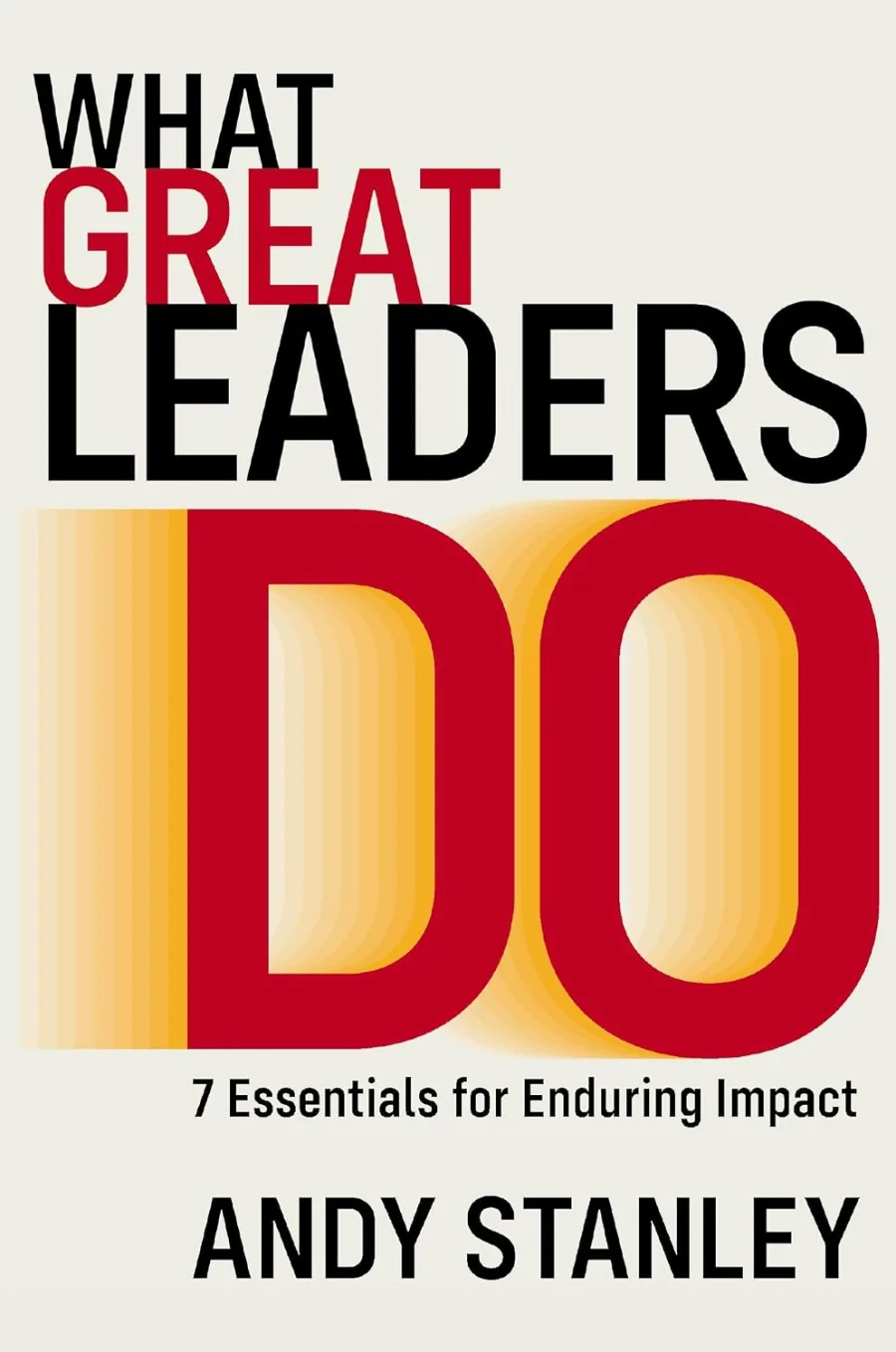
What Great Leaders Do: 7 Essentials for Enduring Impact
Hardcover
• 272 Pages
• USD 29.99
• English
• 9780310537038
No ratings yet
| Publisher | HarperCollins Leadership |
|---|---|
| ISBN13 | 9780310537038 |
| ASIN/SKU | 0310537037 |
| Book Format | Hardcover |
| Language | English |
| Pages | 272 |
| List Price | USD 29.99 |
| Publishing Date | 04/08/2026 |
| Dimensions | 6.4 x 1 x 9.3 inches |
| Weight | 14.4 ounces |
| Book Code | BD00069874 |
Buy this Book
Amazon Stores
Ebook Stores
Other Stores
Discover What Great Leaders Do: 7 Essentials for Enduring Impact by Andy Stanley. This book is published by HarperCollins Leadership in Hardcover format, ISBN 9780310537038, ASIN 0310537037, under Business and Money, Christian Pastoral Resources, Business Mentoring and Coaching.
Book Description
“Andy Stanley's seven essentials come directly from his thoughtful, curious approach to leadership and life. If you want to lead better, read this book.” —John C. Maxwell, New York Times bestselling author
Great is what great does.
In What Great Leaders Do, bestselling author Andy Stanley provides leaders with their to-do list. Seven essentials to ensure leaders and their organizations execute with maximum efficiency. These seven essentials will equip you to:
Ask the right questions
Lead yourself well.
Play to your strengths.
Differentiate between problems to solve and tensions to manage.
Leverage your intuition and the intuition of your team.
“Leadership is challenging. You want to get it right. I want to help. Specifically, I want to help you become a leader worth following. A leader who goes the distance. Leadership is a wonderful, dangerous gift. You’re stuck with it. Go do something great with it.” —Andy Stanley
Great is what great does.
In What Great Leaders Do, bestselling author Andy Stanley provides leaders with their to-do list. Seven essentials to ensure leaders and their organizations execute with maximum efficiency. These seven essentials will equip you to:
Ask the right questions
Lead yourself well.
Play to your strengths.
Differentiate between problems to solve and tensions to manage.
Leverage your intuition and the intuition of your team.
“Leadership is challenging. You want to get it right. I want to help. Specifically, I want to help you become a leader worth following. A leader who goes the distance. Leadership is a wonderful, dangerous gift. You’re stuck with it. Go do something great with it.” —Andy Stanley
Author Biography
Communicator, author, and pastor Andy Stanley founded Atlanta-based North Point Ministries (NPM) in 1995. Today, NPM consists of eight churches in the Atlanta area and a network of 180 churches around the globe that collectively serve over 200,000 people weekly.
As host of Your Move with Andy Stanley, which delivers over 10.5 million messages each month through television, digital platforms, and podcasts and author of more than 20 books, including Irresistible; Better Decisions, Fewer Regrets; and Deep & Wide, he is considered one of the most influential pastors in America.
Andy and his wife, Sandra, have three grown children and live near Atlanta.
As host of Your Move with Andy Stanley, which delivers over 10.5 million messages each month through television, digital platforms, and podcasts and author of more than 20 books, including Irresistible; Better Decisions, Fewer Regrets; and Deep & Wide, he is considered one of the most influential pastors in America.
Andy and his wife, Sandra, have three grown children and live near Atlanta.
Editorial Reviews
'I've always believed that leadership is about uniting people around a shared vision rooted in purpose and trust. Andy Stanley brings this to life beautifully. Through seven simple yet powerful essentials, he offers a clear and deeply human roadmap for leading with authenticity and creating impact that endures.' -- ANGELA AHRENDTS, DBE, Former CEO of Burberry and former Senior Vice President at Apple
'If you are interested in how the best leaders build great cultures, look no further. Andy Stanley's seven essentials come directly from his thoughtful, curious approach to leadership and life. If you want to lead better, read this book.' -- JOHN C. MAXWELL, New York Times bestselling author
'Most leaders plateau not because they lack talent, but because they lack clarity. What Great Leaders Do provides the difference-makers that separate leaders who merely survive from those who truly thrive. If you're feeling stuck, this is your way forward.' -- CAREY NIEUWHOF, Bestselling author and host of The Carey Nieuwhof Leadership Podcast
'This endorsement took me 25 years to write. I'm a fast writer but when I calculated how long I've benefitted from Andy Stanley's leadership I realized it had been a quarter of a century. As a young adult, I listened to his cassette tapes on my commute in Boston. When we moved to Atlanta we sat under his leadership as pastor of North Point. When I started freelancing, I watched him lead projects I was hired to write for North Point. When I started my own company, I'd grill him backstage at events we were both speaking at. The book is amazing, because of course it is. But rarely do I get to so confidently endorse a work like I do this one. I've been around the leadership block with Andy, and if you read this book, you'll be glad you have been, too!' -- JON ACUFF, New York Times bestselling author of Procrastination Proof, Never Get Stuck Again
'If you are interested in how the best leaders build great cultures, look no further. Andy Stanley's seven essentials come directly from his thoughtful, curious approach to leadership and life. If you want to lead better, read this book.' -- JOHN C. MAXWELL, New York Times bestselling author
'Most leaders plateau not because they lack talent, but because they lack clarity. What Great Leaders Do provides the difference-makers that separate leaders who merely survive from those who truly thrive. If you're feeling stuck, this is your way forward.' -- CAREY NIEUWHOF, Bestselling author and host of The Carey Nieuwhof Leadership Podcast
'This endorsement took me 25 years to write. I'm a fast writer but when I calculated how long I've benefitted from Andy Stanley's leadership I realized it had been a quarter of a century. As a young adult, I listened to his cassette tapes on my commute in Boston. When we moved to Atlanta we sat under his leadership as pastor of North Point. When I started freelancing, I watched him lead projects I was hired to write for North Point. When I started my own company, I'd grill him backstage at events we were both speaking at. The book is amazing, because of course it is. But rarely do I get to so confidently endorse a work like I do this one. I've been around the leadership block with Andy, and if you read this book, you'll be glad you have been, too!' -- JON ACUFF, New York Times bestselling author of Procrastination Proof, Never Get Stuck Again
Book Summary
What Great Leaders Do: 7 Essentials for Enduring Impact by Andy Stanley is a practical and thoughtful guide to leadership that focuses less on titles, authority, and short-term achievement and more on the qualities that allow leaders to make a lasting difference. Stanley argues that leadership is ultimately about influence and responsibility. A great leader does not simply get people to follow instructions; a great leader helps people become better, stronger, and more capable while creating an environment where an organization or community can thrive long after the leader is gone.
The book is especially concerned with enduring impact. Many leaders can produce impressive results for a short period, but sustaining those results requires a deeper kind of leadership. Stanley's approach encourages readers to look beyond immediate wins and ask whether their decisions are building something that can continue to grow. Leadership, in this sense, is not merely about reaching a goal. It is about establishing principles, habits, relationships, and systems that remain valuable over time.
One of Stanley's central ideas is that leadership begins with character. Skills can make a person effective, but character determines how that effectiveness is used. A leader who is intelligent and persuasive but dishonest, selfish, or careless can cause enormous damage. By contrast, a leader who demonstrates integrity earns trust, and trust becomes the foundation for sustainable influence. Stanley therefore encourages leaders to examine themselves before attempting to change everyone around them.
The first essential is closely connected to the idea of taking responsibility. Great leaders do not spend their energy blaming circumstances, competitors, employees, or previous leaders for problems. They ask what they can do about the situation in front of them. This does not mean accepting blame for everything that goes wrong. Rather, it means refusing to surrender personal agency. A leader who takes responsibility creates momentum because people see someone willing to confront reality instead of avoiding it.
Another important lesson is the need to define reality clearly. Leaders often have to make difficult decisions in situations where people would prefer comforting explanations. Stanley emphasizes the importance of telling the truth about where an organization stands, even when the truth is uncomfortable. A team cannot solve a problem it refuses to acknowledge. Honest assessment therefore becomes an essential leadership responsibility. Great leaders help people see the current situation accurately so that meaningful action becomes possible.
The book also stresses the importance of clarity of vision. People cannot effectively move toward a goal they do not understand. Leaders must communicate what they are trying to accomplish, why it matters, and what success will look like. Vision is not simply an inspirational slogan. It must be clear enough to influence everyday decisions. When people understand the larger purpose, they can make better choices without needing constant instructions from the person in charge.
Stanley also places considerable emphasis on priorities. Every organization has limited time, money, attention, and energy. Leaders therefore have to decide what matters most. One of the dangers of leadership is trying to pursue too many objectives simultaneously. When everything becomes important, nothing receives sufficient attention. Great leaders identify the activities and outcomes that deserve disproportionate focus and are willing to say no to opportunities that do not support the larger mission.
Closely related to this is the principle of empowering other people. Stanley challenges the idea that a leader must personally control every important decision. A leader who insists on doing everything may appear highly capable in the short term, but the organization becomes dependent on that person. Enduring leadership requires developing other leaders. This means giving people responsibility, allowing them to make decisions, trusting them with meaningful work, and helping them learn from mistakes.
Delegation, in Stanley's framework, is therefore not simply a way to reduce a leader's workload. It is a way to multiply leadership. When people are given opportunities to lead, the organization becomes stronger and more adaptable. The leader's influence expands because it is no longer limited by individual capacity.
Another recurring theme is the importance of relationships. Organizations are made up of people, and leadership is ultimately exercised through relationships. A leader who understands people's strengths, motivations, fears, and aspirations can communicate more effectively and build stronger teams. Stanley's approach recognizes that people rarely give their best simply because they are ordered to do so. They become committed when they trust the leader, understand the mission, and feel that their contribution matters.
The book also emphasizes the importance of learning from failure. Great leaders are not people who never make mistakes. They are people who know how to respond when mistakes happen. A culture that punishes every failure can discourage initiative because employees become afraid to experiment or take responsibility. On the other hand, a culture that ignores mistakes will never improve. Effective leaders create an environment where failures are examined honestly, lessons are extracted, and improvements are made.
Stanley also encourages leaders to remain adaptable. Circumstances change, organizations grow, and strategies that worked in the past may eventually stop working. A leader who becomes emotionally attached to old methods can unintentionally hold an organization back. Enduring impact requires the ability to distinguish between the principles that should remain constant and the practices that need to change.
Perhaps the most important idea in the book is that leadership is ultimately measured by what remains after the leader's direct involvement ends. A leader who creates dependence may appear powerful, but the organization becomes vulnerable when that person leaves. A leader who develops people, establishes healthy systems, communicates clear values, and creates a culture of responsibility leaves behind something much more valuable: an organization capable of continuing without them.
This idea transforms the meaning of success. Instead of asking only, "What did I accomplish?" Stanley encourages leaders to consider, "What did I build?" and "Who did I develop?" A leader's impact can therefore be measured not only through financial results, promotions, growth, or public recognition, but through the people who became better because of that leader's influence.
Ultimately, What Great Leaders Do: 7 Essentials for Enduring Impact presents leadership as a discipline of character, clarity, responsibility, empowerment, relationships, learning, and long-term thinking. Stanley's message is particularly useful because it moves leadership away from personality and toward practice. You do not have to be naturally charismatic or exceptionally powerful to become a good leader. You need to develop habits that build trust and help other people succeed.
The book's deepest lesson is that great leadership is not about becoming indispensable; it is about making yourself less indispensable by developing others. The strongest leaders create environments in which people can think, act, grow, and lead. Their influence continues because they have built something larger than themselves.
In the end, Stanley offers a compelling definition of enduring impact: it is the ability to leave people and organizations stronger than you found them. A leader's greatest achievement is therefore not simply what happens while they are in charge, but what continues to happen because they were there. That perspective turns leadership from a pursuit of personal importance into an opportunity for meaningful and lasting service.
The book is especially concerned with enduring impact. Many leaders can produce impressive results for a short period, but sustaining those results requires a deeper kind of leadership. Stanley's approach encourages readers to look beyond immediate wins and ask whether their decisions are building something that can continue to grow. Leadership, in this sense, is not merely about reaching a goal. It is about establishing principles, habits, relationships, and systems that remain valuable over time.
One of Stanley's central ideas is that leadership begins with character. Skills can make a person effective, but character determines how that effectiveness is used. A leader who is intelligent and persuasive but dishonest, selfish, or careless can cause enormous damage. By contrast, a leader who demonstrates integrity earns trust, and trust becomes the foundation for sustainable influence. Stanley therefore encourages leaders to examine themselves before attempting to change everyone around them.
The first essential is closely connected to the idea of taking responsibility. Great leaders do not spend their energy blaming circumstances, competitors, employees, or previous leaders for problems. They ask what they can do about the situation in front of them. This does not mean accepting blame for everything that goes wrong. Rather, it means refusing to surrender personal agency. A leader who takes responsibility creates momentum because people see someone willing to confront reality instead of avoiding it.
Another important lesson is the need to define reality clearly. Leaders often have to make difficult decisions in situations where people would prefer comforting explanations. Stanley emphasizes the importance of telling the truth about where an organization stands, even when the truth is uncomfortable. A team cannot solve a problem it refuses to acknowledge. Honest assessment therefore becomes an essential leadership responsibility. Great leaders help people see the current situation accurately so that meaningful action becomes possible.
The book also stresses the importance of clarity of vision. People cannot effectively move toward a goal they do not understand. Leaders must communicate what they are trying to accomplish, why it matters, and what success will look like. Vision is not simply an inspirational slogan. It must be clear enough to influence everyday decisions. When people understand the larger purpose, they can make better choices without needing constant instructions from the person in charge.
Stanley also places considerable emphasis on priorities. Every organization has limited time, money, attention, and energy. Leaders therefore have to decide what matters most. One of the dangers of leadership is trying to pursue too many objectives simultaneously. When everything becomes important, nothing receives sufficient attention. Great leaders identify the activities and outcomes that deserve disproportionate focus and are willing to say no to opportunities that do not support the larger mission.
Closely related to this is the principle of empowering other people. Stanley challenges the idea that a leader must personally control every important decision. A leader who insists on doing everything may appear highly capable in the short term, but the organization becomes dependent on that person. Enduring leadership requires developing other leaders. This means giving people responsibility, allowing them to make decisions, trusting them with meaningful work, and helping them learn from mistakes.
Delegation, in Stanley's framework, is therefore not simply a way to reduce a leader's workload. It is a way to multiply leadership. When people are given opportunities to lead, the organization becomes stronger and more adaptable. The leader's influence expands because it is no longer limited by individual capacity.
Another recurring theme is the importance of relationships. Organizations are made up of people, and leadership is ultimately exercised through relationships. A leader who understands people's strengths, motivations, fears, and aspirations can communicate more effectively and build stronger teams. Stanley's approach recognizes that people rarely give their best simply because they are ordered to do so. They become committed when they trust the leader, understand the mission, and feel that their contribution matters.
The book also emphasizes the importance of learning from failure. Great leaders are not people who never make mistakes. They are people who know how to respond when mistakes happen. A culture that punishes every failure can discourage initiative because employees become afraid to experiment or take responsibility. On the other hand, a culture that ignores mistakes will never improve. Effective leaders create an environment where failures are examined honestly, lessons are extracted, and improvements are made.
Stanley also encourages leaders to remain adaptable. Circumstances change, organizations grow, and strategies that worked in the past may eventually stop working. A leader who becomes emotionally attached to old methods can unintentionally hold an organization back. Enduring impact requires the ability to distinguish between the principles that should remain constant and the practices that need to change.
Perhaps the most important idea in the book is that leadership is ultimately measured by what remains after the leader's direct involvement ends. A leader who creates dependence may appear powerful, but the organization becomes vulnerable when that person leaves. A leader who develops people, establishes healthy systems, communicates clear values, and creates a culture of responsibility leaves behind something much more valuable: an organization capable of continuing without them.
This idea transforms the meaning of success. Instead of asking only, "What did I accomplish?" Stanley encourages leaders to consider, "What did I build?" and "Who did I develop?" A leader's impact can therefore be measured not only through financial results, promotions, growth, or public recognition, but through the people who became better because of that leader's influence.
Ultimately, What Great Leaders Do: 7 Essentials for Enduring Impact presents leadership as a discipline of character, clarity, responsibility, empowerment, relationships, learning, and long-term thinking. Stanley's message is particularly useful because it moves leadership away from personality and toward practice. You do not have to be naturally charismatic or exceptionally powerful to become a good leader. You need to develop habits that build trust and help other people succeed.
The book's deepest lesson is that great leadership is not about becoming indispensable; it is about making yourself less indispensable by developing others. The strongest leaders create environments in which people can think, act, grow, and lead. Their influence continues because they have built something larger than themselves.
In the end, Stanley offers a compelling definition of enduring impact: it is the ability to leave people and organizations stronger than you found them. A leader's greatest achievement is therefore not simply what happens while they are in charge, but what continues to happen because they were there. That perspective turns leadership from a pursuit of personal importance into an opportunity for meaningful and lasting service.
Sample Chapters
Sample Chapters will be added soon…
Reader Reviews
No reviews yet.
What Great Leaders Do: 7 Essentials for Enduring Impact
Download Cover Image
Do you want to download the full cover image for What Great Leaders Do: 7 Essentials for Enduring Impact?