
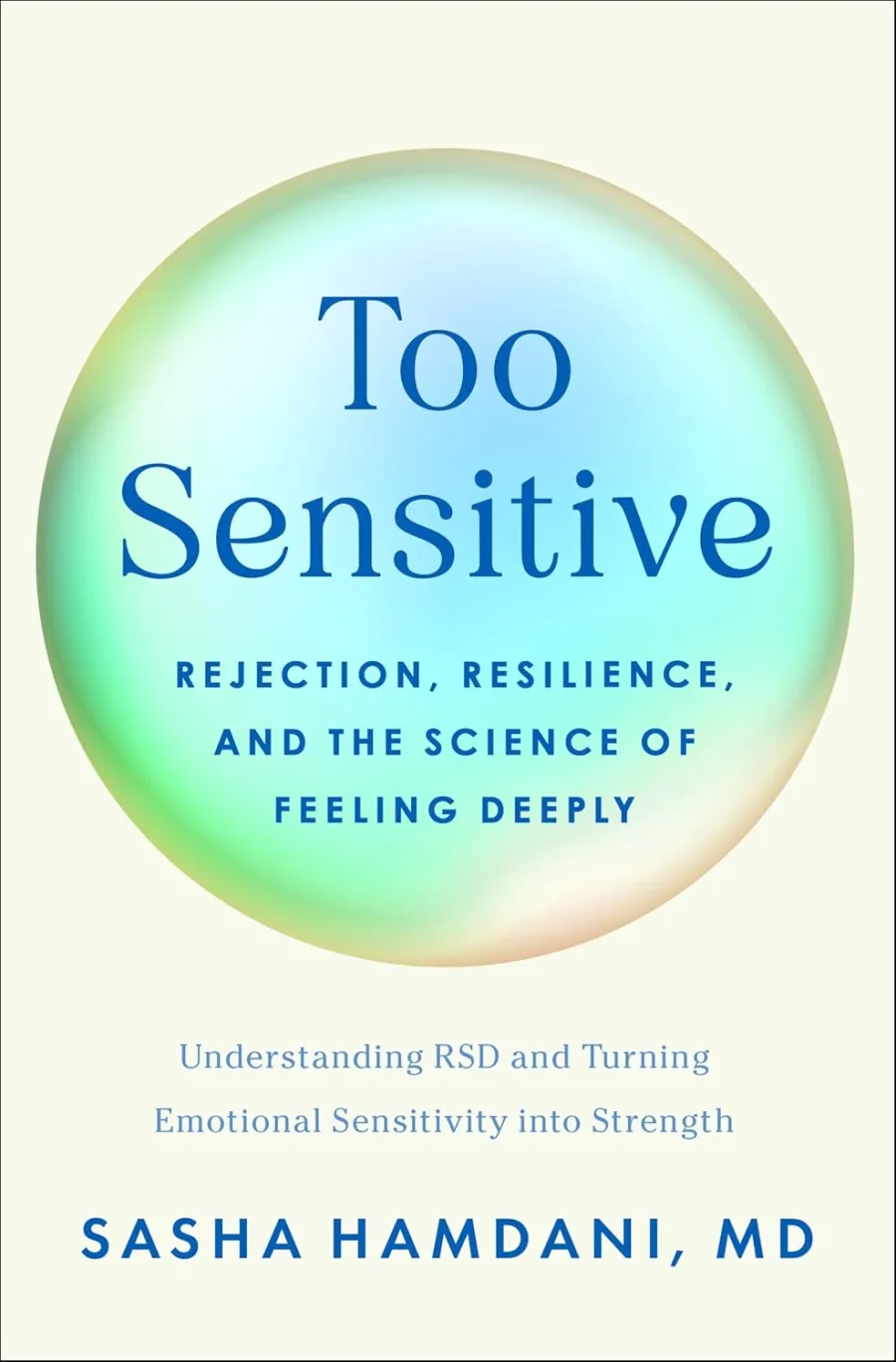
Too Sensitive: Rejection, Resilience, and the Science of Feeling Deeply
Hardcover
• 320 Pages
• USD 29.99
• English
• 9781250423764
No ratings yet
| Publisher | Flatiron Books |
|---|---|
| ISBN13 | 9781250423764 |
| ASIN/SKU | 1250423767 |
| Book Format | Hardcover |
| Language | English |
| Pages | 320 |
| List Price | USD 29.99 |
| Publishing Date | 25/08/2026 |
| Dimensions | 6.5 x 1 x 9.6 inches |
| Weight | 1.14 pounds |
| Book Code | BD00069877 |
Buy this Book
Amazon Stores
Ebook Stores
Other Stores
Discover Too Sensitive: Rejection, Resilience, and the Science of Feeling Deeply by Sasha Hamdani MD. This book is published by Flatiron Books in Hardcover format, ISBN 9781250423764, ASIN 1250423767, under Self-Help, Emotional Self Help, Self-Esteem.
Book Description
For anyone who has ever felt like they are too much, a groundbreaking guide to understanding emotional sensitivity.
Overly dramatic. Irrational. Too sensitive. These are some of the labels applied to those of us who are emotionally triggered by everyday moments. Whether it’s a delayed text message, a last-minute invite, or a subtle shift in tone, what begins as a flicker of uncertainty can spiral into self-doubt, shame, or withdrawal.
From the outside, these reactions may seem overblown. But what if emotional sensitivity is not a personality flaw but rather the result of a highly responsive and attuned nervous system? In Too Sensitive, Dr. Sasha Hamdani―known to her online following as @thepsychdoctormd―offers an accessible explanation of emotional sensitivity as well as practical guidance for how to manage it. For many people, especially those with ADHD and other forms of neurodivergence, emotional sensitivity may be recognized as Rejection Sensitive Dysphoria (RSD). Feelings of being excluded, overlooked, or dismissed are not all in our heads―they are based in our biology. In her groundbreaking book, Dr. Hamdani introduces the first assessment tool to discern where you fall on the emotional sensitivity spectrum and offers practical tools to restore calm to the nervous system.
Drawing from psychiatry, neuroscience, and the gentle compassion of lived experience, Dr. Hamdani shares research-informed strategies to regulate emotional surges, interrupt spirals, and build self-worth and resilience in relationships and at work. Most importantly, Too Sensitive reframes sensitivity not as fragility but as a powerful form of emotional awareness that can be understood and transformed into strength.
Overly dramatic. Irrational. Too sensitive. These are some of the labels applied to those of us who are emotionally triggered by everyday moments. Whether it’s a delayed text message, a last-minute invite, or a subtle shift in tone, what begins as a flicker of uncertainty can spiral into self-doubt, shame, or withdrawal.
From the outside, these reactions may seem overblown. But what if emotional sensitivity is not a personality flaw but rather the result of a highly responsive and attuned nervous system? In Too Sensitive, Dr. Sasha Hamdani―known to her online following as @thepsychdoctormd―offers an accessible explanation of emotional sensitivity as well as practical guidance for how to manage it. For many people, especially those with ADHD and other forms of neurodivergence, emotional sensitivity may be recognized as Rejection Sensitive Dysphoria (RSD). Feelings of being excluded, overlooked, or dismissed are not all in our heads―they are based in our biology. In her groundbreaking book, Dr. Hamdani introduces the first assessment tool to discern where you fall on the emotional sensitivity spectrum and offers practical tools to restore calm to the nervous system.
Drawing from psychiatry, neuroscience, and the gentle compassion of lived experience, Dr. Hamdani shares research-informed strategies to regulate emotional surges, interrupt spirals, and build self-worth and resilience in relationships and at work. Most importantly, Too Sensitive reframes sensitivity not as fragility but as a powerful form of emotional awareness that can be understood and transformed into strength.
Author Biography
Sasha Hamdani, MD, is a board-certified psychiatrist specializing in ADHD, RSD, and emotional regulation. As the creator of FocusGenie and the author of Self-Care for People with ADHD (part of a series published by Adams Media in 2023), she has become a leading voice in mental health. Honored with the CHADD Early Career Influencer Award and invited to the inaugural White House Creator Mental Health Summit, Dr. Hamdani also reaches over 2 million followers across social media, regularly delivering educational content and speaking at major conferences. She has been featured in a TEDx talk on focus and has appeared in The Washington Post, The New York Times, The Wall Street Journal, Forbes, and Vogue, on CNBC and TODAY, and on podcasts including Podcrushed with Penn Badgley, The Squeeze, Financial Feminist, Reese Witherspoon’s Brightside Podcast, and Berner Phone. She also is called upon for speaking engagements with medical and social organizations.
Editorial Reviews
“Too Sensitive is the book so many women have been waiting for. Dr. Hamdani connects the dots between brain chemistry, hormones, and emotional sensitivity in a way that is both validating and deeply practical. If you’ve ever felt like your emotions change in ways you can’t explain, this book gives you the science and the tools to finally understand why.” ―Mary Claire Haver, MD, author of The New Menopause
“Dr. Hamdani beautifully bridges science and self-compassion in a way that feels both validating and usable. Too Sensitive helps you move away from self-judgment and toward self-care, offering tools that meet you where you are instead of asking you to be someone else.” ―KC Davis, bestselling author of How To Keep House While Drowning
“Dr. Sasha Hamdani's work on Rejection Sensitive Dysphoria and ADHD is so powerful. She really sees us, and her guidance feels so validating. This book will help you understand your spirals and learn how to turn them into your strength!”―Paris Hilton, advocate, entrepreneur, and CEO of 11:11 Media
“Too Sensitive is the book so many women have needed. Dr. Sasha Hamdani brilliantly connects the female brain, hormones, and emotional sensitivity, showing that what is often labeled weakness is frequently biology. Insightful, compassionate, and empowering, this book offers a powerful new way to understand yourself.” ― Louann Brizendine, Neuropsychiatrist, Best-Selling Author of The Female Brain, and Founder of the UCSF Women’s Mood and Hormone Clinic
“Dr. Sasha Hamdani sheds light on an issue so many people―and so many women, in particular―have suffered with in silence for too long. Emotional sensitivity is not a character flaw, and it is not a weakness. It's based in biology―and it is a secret strength. For anyone out there who has ever been gaslit into believing their emotions are a liability, Too Sensitive is a salve―and a lifeline.” ―Dr. Judith Joseph, bestselling author of High Functioning
“If you’ve ever been told you’re too emotional, too sensitive, or 'a lot'―first of all, same. Second, this book feels like we finally have a doctor’s note and explains why we feel everything so loudly.” ―Penn and Kim Holderness, authors of ADHD is Awesome
“Dr. Hamdani beautifully bridges science and self-compassion in a way that feels both validating and usable. Too Sensitive helps you move away from self-judgment and toward self-care, offering tools that meet you where you are instead of asking you to be someone else.” ―KC Davis, bestselling author of How To Keep House While Drowning
“Dr. Sasha Hamdani's work on Rejection Sensitive Dysphoria and ADHD is so powerful. She really sees us, and her guidance feels so validating. This book will help you understand your spirals and learn how to turn them into your strength!”―Paris Hilton, advocate, entrepreneur, and CEO of 11:11 Media
“Too Sensitive is the book so many women have needed. Dr. Sasha Hamdani brilliantly connects the female brain, hormones, and emotional sensitivity, showing that what is often labeled weakness is frequently biology. Insightful, compassionate, and empowering, this book offers a powerful new way to understand yourself.” ― Louann Brizendine, Neuropsychiatrist, Best-Selling Author of The Female Brain, and Founder of the UCSF Women’s Mood and Hormone Clinic
“Dr. Sasha Hamdani sheds light on an issue so many people―and so many women, in particular―have suffered with in silence for too long. Emotional sensitivity is not a character flaw, and it is not a weakness. It's based in biology―and it is a secret strength. For anyone out there who has ever been gaslit into believing their emotions are a liability, Too Sensitive is a salve―and a lifeline.” ―Dr. Judith Joseph, bestselling author of High Functioning
“If you’ve ever been told you’re too emotional, too sensitive, or 'a lot'―first of all, same. Second, this book feels like we finally have a doctor’s note and explains why we feel everything so loudly.” ―Penn and Kim Holderness, authors of ADHD is Awesome
Book Summary
Too Sensitive: Rejection, Resilience, and the Science of Feeling Deeply by psychiatrist Sasha Hamdani, MD, is a compassionate and practical exploration of emotional sensitivity, rejection, and the experience of feeling things more intensely than other people seem to. Published in 2026, the 320-page book focuses especially on Rejection Sensitive Dysphoria (RSD), a term commonly used to describe severe emotional pain associated with perceived or actual rejection, criticism, exclusion, or failure. Hamdani's central argument is both reassuring and challenging: being highly sensitive does not automatically mean being weak, dramatic, irrational, or emotionally immature. Instead, intense reactions may reflect a highly responsive nervous system. The book combines psychiatry, neuroscience, personal experience, and practical emotional-regulation strategies to help readers understand why seemingly small events—such as a delayed text, a blunt message from a manager, or a subtle change in someone's tone—can sometimes trigger an overwhelming emotional response.
The book begins with a deeply personal example that immediately makes its subject understandable. Hamdani describes giving a TED Talk about ADHD and focus. Although she appeared calm and composed while speaking, the moment she left the stage she experienced an intense panic reaction. Her mind immediately began telling her that she had sounded foolish and that the presentation had gone badly. The contrast between her outward competence and inner distress becomes an important doorway into the book's larger argument. Someone can look successful, confident, intelligent, and capable while privately experiencing powerful emotional reactions to perceived failure or rejection. Hamdani uses her own experience not simply to tell a personal story but to demonstrate how emotional sensitivity can remain invisible to everyone except the person experiencing it.
This personal dimension continues throughout Too Sensitive. Hamdani writes as both a psychiatrist and someone who has experienced the emotional patterns she describes. That dual perspective gives the book an unusual tone. It is neither a detached medical textbook nor a purely autobiographical account. Instead, Hamdani translates psychiatric and neuroscience concepts into everyday language while repeatedly returning to the lived experience behind them. Her goal is to give readers something many emotionally sensitive people have lacked: language for an experience they may have spent years being told was simply an overreaction.
The central concept is Rejection Sensitive Dysphoria. Hamdani explains that RSD refers to extreme emotional pain triggered by perceived or actual rejection, criticism, or failure. The experience can involve a rapid emotional spiral in which an apparently small event becomes evidence that one is unwanted, incompetent, embarrassing, or unworthy. A friend who does not respond to a message may seem distant. A manager's short email may feel like proof that one's job is in danger. A partner who is temporarily distracted may appear emotionally withdrawn. The external event may be ambiguous, but the internal reaction can feel completely real and immediate. Hamdani emphasizes that people experiencing these reactions are not necessarily choosing to be dramatic; their nervous systems may be responding with extraordinary speed and intensity.
One of the book's most important ideas is that RSD is not officially recognized as a diagnosis in the DSM. Hamdani points out that people have been experiencing and describing these patterns for years without having a universally accepted diagnostic framework for them. This gap matters because a person who cannot name an experience may interpret it as a personal moral failure. Without language, someone may conclude, "I'm too emotional," "I'm impossible to be around," or "I can't handle anything." Hamdani instead encourages readers to recognize patterns in their emotional responses without turning those patterns into a negative judgment about their character.
The book's explanation of the brain's threat-response system is central to this reframing. Hamdani explains that the human brain evolved to react rapidly to threats. Long ago, social rejection could have had serious survival consequences because belonging to a group was closely connected to protection and access to resources. Modern life is radically different, but the brain still carries many of those older survival mechanisms. Today the perceived threat may be a text message that never arrives, a change in someone's facial expression, or criticism from a supervisor. Yet the nervous system can respond as though something much more dangerous has happened.
Hamdani describes the relationship between the emotional brain and the logical brain to explain why these reactions can feel so fast. The amygdala and broader limbic system can activate a threat response before the prefrontal cortex has fully evaluated what is happening. In practical terms, the body and emotions may react before the reasoning mind has had time to ask whether the interpretation is accurate. A person may therefore experience intense hurt, fear, anger, shame, or panic before they can consciously remind themselves that there may be another explanation. This does not mean that every emotional interpretation is correct. It means that the reaction can occur before careful reasoning has an opportunity to intervene.
This distinction between feeling and fact is one of the most useful ideas in the book. Hamdani does not tell readers to dismiss their emotions. Instead, she encourages them to recognize that an emotion can be completely genuine without every conclusion produced by that emotion being accurate. Feeling rejected does not necessarily prove that another person intended to reject you. Feeling like a failure does not establish that you have failed. Feeling that someone is angry does not prove that they are angry. Emotional regulation therefore begins not by denying the feeling but by creating enough space to investigate what the feeling is telling you.
The book also explores the relationship between emotional sensitivity and ADHD. Hamdani is a psychiatrist specializing in ADHD, and the book explains that rejection sensitivity is often discussed in connection with ADHD, although it is not exclusively experienced by people with ADHD. This distinction is important. Hamdani does not suggest that every emotionally sensitive person has ADHD or RSD. Instead, she presents emotional sensitivity as a broader phenomenon that can occur across different people and circumstances. The book is explicitly intended not only for people with an RSD diagnosis but also for anyone who experiences intense emotions, heightened sensitivity to criticism, or deep empathy.
A particularly valuable part of Too Sensitive is its discussion of the five factors that can influence emotional sensitivity. The book does not reduce a person's reaction to a single cause. Instead, it encourages readers to think about sensitivity as something shaped by multiple interacting factors. Biology, stress, previous experiences, environment, and current circumstances can all affect how intensely a person responds. This prevents the overly simple conclusion that someone is simply "born too sensitive." Emotional reactions emerge from a complicated relationship between the nervous system, personal history, social context, and present circumstances.
Hamdani also discusses the physical dimension of emotional distress. Emotional pain is not merely an abstract thought occurring inside the mind. Strong emotional reactions can activate the body's stress systems, producing sensations such as muscle tension, headaches, digestive discomfort, racing thoughts, changes in breathing, or other physical symptoms. This is one reason telling someone to "just get over it" is often ineffective. If the nervous system is activated, the person may need to regulate the body before they can think clearly about the situation.
This leads to the practical heart of the book: the CALM YOUR MIND toolkit. Rather than offering one magical technique for emotional sensitivity, Hamdani presents a collection of strategies that readers can use according to the situation. The twelve-part approach includes techniques such as labeling emotions and understanding triggers, along with approaches informed by cognitive behavioral therapy, dialectical behavior therapy, somatic tracking, narrative exposure, and mindfulness-based stress reduction.
The first important step in this toolkit is learning to label emotions. When someone is overwhelmed, everything may initially feel like one enormous emotional storm. Naming the experience can create distance from it. Instead of thinking, "Everything is terrible," a person can identify specific emotions: "I feel rejected," "I am embarrassed," "I am afraid that I disappointed someone," or "I feel angry because I interpreted that comment as criticism." This does not make the feeling disappear, but it makes the experience more specific and therefore easier to work with.
Another major step is understanding triggers. Hamdani encourages readers to notice patterns in the situations that repeatedly produce intense reactions. Some people may be particularly sensitive to silence or delayed responses. Others may react strongly to criticism, perceived exclusion, uncertainty, workplace feedback, changes in relationships, or situations involving comparison. Recognizing these patterns creates an opportunity for preparation. Instead of being surprised every time the emotional alarm sounds, a person can begin recognizing, "This is one of my triggers, and I know what happens next."
The book also emphasizes the importance of interrupting emotional spirals. RSD can produce a chain reaction: an event happens, the brain interprets it negatively, the body reacts, the person searches for additional evidence, and the increasingly negative interpretation creates even stronger emotions. The goal is not to suppress the initial feeling but to interrupt the chain before it becomes overwhelming. Hamdani's tools encourage readers to slow down the process, regulate their nervous system, examine their assumptions, and distinguish what they know from what they fear.
Cognitive strategies are particularly useful here. A person experiencing rejection sensitivity may engage in automatic thinking such as mind-reading, catastrophizing, all-or-nothing thinking, or personalizing ambiguous events. For example, a manager's short email might become "My boss hates my work," which becomes "I'm going to lose my job," which becomes "I'm a failure." The original event may have been nothing more than a brief email. Hamdani's approach encourages readers to examine the chain of interpretations rather than accepting the first explanation as fact.
The book's discussion of relationships is especially relevant because perceived rejection often feels most painful when it involves people we care about. Friends, partners, family members, and colleagues can unintentionally trigger emotional sensitivity simply by behaving in ways that are ambiguous. Hamdani's strategies encourage communication rather than assumption. Instead of silently constructing a story about what another person feels, a sensitive person can learn to pause, gather information, and communicate directly when appropriate.
The same principles apply to work and career. Professional environments contain constant opportunities for evaluation: performance reviews, meetings, emails, deadlines, promotions, mistakes, and comparisons with colleagues. Someone with heightened rejection sensitivity may interpret ordinary professional feedback as a judgment of their entire identity. Hamdani encourages readers to separate performance from worth. A criticism of one piece of work is not necessarily a criticism of the whole person. Developing that distinction can make professional feedback easier to tolerate and use constructively.
The book also examines self-worth. When rejection sensitivity is strong, external events can become measurements of personal value. A failed application may feel like proof of inadequacy. A breakup may become evidence of being unlovable. Being excluded from an invitation may seem to confirm that nobody wants you around. Hamdani's larger goal is to help readers build an identity that is not completely dependent on external approval. Resilience does not mean becoming indifferent to other people's opinions. It means learning that other people's reactions do not determine one's entire worth.
Perhaps the most hopeful idea in Too Sensitive is that sensitivity can become a strength. Hamdani distinguishes sensitivity from emotional intelligence. Sensitivity refers to how deeply and quickly a person perceives emotional information, while emotional intelligence involves learning how to respond to that information deliberately. A highly sensitive person may notice subtle changes in mood, tone, or interpersonal dynamics that others miss. This can become a source of empathy, creativity, connection, and awareness when paired with appropriate boundaries and emotional regulation skills.
This reframing is important because the book does not ask sensitive people to become less human. It does not say that the answer is to stop caring. Instead, it asks readers to develop the ability to feel deeply without being controlled by every feeling. That distinction captures the title's larger message. The problem is not necessarily sensitivity itself. The problem arises when intense sensitivity overwhelms a person's ability to interpret, regulate, communicate, and recover.
Ultimately, Too Sensitive is a book about replacing shame with understanding. Its central message is that an intense emotional response does not automatically mean a person is weak or irrational. The nervous system can be highly responsive, and that responsiveness can produce both difficulties and strengths. By understanding RSD, recognizing triggers, labeling emotions, regulating the body, questioning automatic interpretations, and practicing healthier responses, people can gradually develop greater resilience.
For readers searching for a summary of Too Sensitive by Sasha Hamdani, an explanation of Rejection Sensitive Dysphoria, or practical strategies for dealing with emotional sensitivity and rejection, the book's core lesson can be expressed simply: you do not have to stop feeling deeply in order to become emotionally resilient. Resilience is not the absence of strong emotion. It is the ability to experience that emotion without allowing it to dictate every conclusion, decision, relationship, or judgment about yourself.
In the end, Hamdani offers a compassionate alternative to the phrase "too sensitive." Instead of treating emotional intensity as a character defect, she asks readers to understand the biology, psychology, and personal history behind it. Her message is not that every painful reaction should be accepted without examination. Rather, the goal is to replace self-criticism with curiosity: What happened? What am I feeling? What triggered it? What story is my brain telling me? What do I actually know? What would help my nervous system calm down? And what response would reflect the person I want to be?
That shift—from shame to curiosity, from automatic reaction to deliberate response, and from seeing sensitivity as weakness to understanding it as a form of emotional awareness—is the heart of Too Sensitive. Hamdani ultimately presents sensitivity not as something that must be erased but as something that can be understood, regulated, and harnessed. The book's most reassuring promise is therefore not that difficult emotions will disappear. It is that with greater self-understanding and practical tools, people can learn to live with emotional depth without being overwhelmed by it, turning what once felt like an unbearable vulnerability into a more conscious and potentially powerful part of who they are.
The book begins with a deeply personal example that immediately makes its subject understandable. Hamdani describes giving a TED Talk about ADHD and focus. Although she appeared calm and composed while speaking, the moment she left the stage she experienced an intense panic reaction. Her mind immediately began telling her that she had sounded foolish and that the presentation had gone badly. The contrast between her outward competence and inner distress becomes an important doorway into the book's larger argument. Someone can look successful, confident, intelligent, and capable while privately experiencing powerful emotional reactions to perceived failure or rejection. Hamdani uses her own experience not simply to tell a personal story but to demonstrate how emotional sensitivity can remain invisible to everyone except the person experiencing it.
This personal dimension continues throughout Too Sensitive. Hamdani writes as both a psychiatrist and someone who has experienced the emotional patterns she describes. That dual perspective gives the book an unusual tone. It is neither a detached medical textbook nor a purely autobiographical account. Instead, Hamdani translates psychiatric and neuroscience concepts into everyday language while repeatedly returning to the lived experience behind them. Her goal is to give readers something many emotionally sensitive people have lacked: language for an experience they may have spent years being told was simply an overreaction.
The central concept is Rejection Sensitive Dysphoria. Hamdani explains that RSD refers to extreme emotional pain triggered by perceived or actual rejection, criticism, or failure. The experience can involve a rapid emotional spiral in which an apparently small event becomes evidence that one is unwanted, incompetent, embarrassing, or unworthy. A friend who does not respond to a message may seem distant. A manager's short email may feel like proof that one's job is in danger. A partner who is temporarily distracted may appear emotionally withdrawn. The external event may be ambiguous, but the internal reaction can feel completely real and immediate. Hamdani emphasizes that people experiencing these reactions are not necessarily choosing to be dramatic; their nervous systems may be responding with extraordinary speed and intensity.
One of the book's most important ideas is that RSD is not officially recognized as a diagnosis in the DSM. Hamdani points out that people have been experiencing and describing these patterns for years without having a universally accepted diagnostic framework for them. This gap matters because a person who cannot name an experience may interpret it as a personal moral failure. Without language, someone may conclude, "I'm too emotional," "I'm impossible to be around," or "I can't handle anything." Hamdani instead encourages readers to recognize patterns in their emotional responses without turning those patterns into a negative judgment about their character.
The book's explanation of the brain's threat-response system is central to this reframing. Hamdani explains that the human brain evolved to react rapidly to threats. Long ago, social rejection could have had serious survival consequences because belonging to a group was closely connected to protection and access to resources. Modern life is radically different, but the brain still carries many of those older survival mechanisms. Today the perceived threat may be a text message that never arrives, a change in someone's facial expression, or criticism from a supervisor. Yet the nervous system can respond as though something much more dangerous has happened.
Hamdani describes the relationship between the emotional brain and the logical brain to explain why these reactions can feel so fast. The amygdala and broader limbic system can activate a threat response before the prefrontal cortex has fully evaluated what is happening. In practical terms, the body and emotions may react before the reasoning mind has had time to ask whether the interpretation is accurate. A person may therefore experience intense hurt, fear, anger, shame, or panic before they can consciously remind themselves that there may be another explanation. This does not mean that every emotional interpretation is correct. It means that the reaction can occur before careful reasoning has an opportunity to intervene.
This distinction between feeling and fact is one of the most useful ideas in the book. Hamdani does not tell readers to dismiss their emotions. Instead, she encourages them to recognize that an emotion can be completely genuine without every conclusion produced by that emotion being accurate. Feeling rejected does not necessarily prove that another person intended to reject you. Feeling like a failure does not establish that you have failed. Feeling that someone is angry does not prove that they are angry. Emotional regulation therefore begins not by denying the feeling but by creating enough space to investigate what the feeling is telling you.
The book also explores the relationship between emotional sensitivity and ADHD. Hamdani is a psychiatrist specializing in ADHD, and the book explains that rejection sensitivity is often discussed in connection with ADHD, although it is not exclusively experienced by people with ADHD. This distinction is important. Hamdani does not suggest that every emotionally sensitive person has ADHD or RSD. Instead, she presents emotional sensitivity as a broader phenomenon that can occur across different people and circumstances. The book is explicitly intended not only for people with an RSD diagnosis but also for anyone who experiences intense emotions, heightened sensitivity to criticism, or deep empathy.
A particularly valuable part of Too Sensitive is its discussion of the five factors that can influence emotional sensitivity. The book does not reduce a person's reaction to a single cause. Instead, it encourages readers to think about sensitivity as something shaped by multiple interacting factors. Biology, stress, previous experiences, environment, and current circumstances can all affect how intensely a person responds. This prevents the overly simple conclusion that someone is simply "born too sensitive." Emotional reactions emerge from a complicated relationship between the nervous system, personal history, social context, and present circumstances.
Hamdani also discusses the physical dimension of emotional distress. Emotional pain is not merely an abstract thought occurring inside the mind. Strong emotional reactions can activate the body's stress systems, producing sensations such as muscle tension, headaches, digestive discomfort, racing thoughts, changes in breathing, or other physical symptoms. This is one reason telling someone to "just get over it" is often ineffective. If the nervous system is activated, the person may need to regulate the body before they can think clearly about the situation.
This leads to the practical heart of the book: the CALM YOUR MIND toolkit. Rather than offering one magical technique for emotional sensitivity, Hamdani presents a collection of strategies that readers can use according to the situation. The twelve-part approach includes techniques such as labeling emotions and understanding triggers, along with approaches informed by cognitive behavioral therapy, dialectical behavior therapy, somatic tracking, narrative exposure, and mindfulness-based stress reduction.
The first important step in this toolkit is learning to label emotions. When someone is overwhelmed, everything may initially feel like one enormous emotional storm. Naming the experience can create distance from it. Instead of thinking, "Everything is terrible," a person can identify specific emotions: "I feel rejected," "I am embarrassed," "I am afraid that I disappointed someone," or "I feel angry because I interpreted that comment as criticism." This does not make the feeling disappear, but it makes the experience more specific and therefore easier to work with.
Another major step is understanding triggers. Hamdani encourages readers to notice patterns in the situations that repeatedly produce intense reactions. Some people may be particularly sensitive to silence or delayed responses. Others may react strongly to criticism, perceived exclusion, uncertainty, workplace feedback, changes in relationships, or situations involving comparison. Recognizing these patterns creates an opportunity for preparation. Instead of being surprised every time the emotional alarm sounds, a person can begin recognizing, "This is one of my triggers, and I know what happens next."
The book also emphasizes the importance of interrupting emotional spirals. RSD can produce a chain reaction: an event happens, the brain interprets it negatively, the body reacts, the person searches for additional evidence, and the increasingly negative interpretation creates even stronger emotions. The goal is not to suppress the initial feeling but to interrupt the chain before it becomes overwhelming. Hamdani's tools encourage readers to slow down the process, regulate their nervous system, examine their assumptions, and distinguish what they know from what they fear.
Cognitive strategies are particularly useful here. A person experiencing rejection sensitivity may engage in automatic thinking such as mind-reading, catastrophizing, all-or-nothing thinking, or personalizing ambiguous events. For example, a manager's short email might become "My boss hates my work," which becomes "I'm going to lose my job," which becomes "I'm a failure." The original event may have been nothing more than a brief email. Hamdani's approach encourages readers to examine the chain of interpretations rather than accepting the first explanation as fact.
The book's discussion of relationships is especially relevant because perceived rejection often feels most painful when it involves people we care about. Friends, partners, family members, and colleagues can unintentionally trigger emotional sensitivity simply by behaving in ways that are ambiguous. Hamdani's strategies encourage communication rather than assumption. Instead of silently constructing a story about what another person feels, a sensitive person can learn to pause, gather information, and communicate directly when appropriate.
The same principles apply to work and career. Professional environments contain constant opportunities for evaluation: performance reviews, meetings, emails, deadlines, promotions, mistakes, and comparisons with colleagues. Someone with heightened rejection sensitivity may interpret ordinary professional feedback as a judgment of their entire identity. Hamdani encourages readers to separate performance from worth. A criticism of one piece of work is not necessarily a criticism of the whole person. Developing that distinction can make professional feedback easier to tolerate and use constructively.
The book also examines self-worth. When rejection sensitivity is strong, external events can become measurements of personal value. A failed application may feel like proof of inadequacy. A breakup may become evidence of being unlovable. Being excluded from an invitation may seem to confirm that nobody wants you around. Hamdani's larger goal is to help readers build an identity that is not completely dependent on external approval. Resilience does not mean becoming indifferent to other people's opinions. It means learning that other people's reactions do not determine one's entire worth.
Perhaps the most hopeful idea in Too Sensitive is that sensitivity can become a strength. Hamdani distinguishes sensitivity from emotional intelligence. Sensitivity refers to how deeply and quickly a person perceives emotional information, while emotional intelligence involves learning how to respond to that information deliberately. A highly sensitive person may notice subtle changes in mood, tone, or interpersonal dynamics that others miss. This can become a source of empathy, creativity, connection, and awareness when paired with appropriate boundaries and emotional regulation skills.
This reframing is important because the book does not ask sensitive people to become less human. It does not say that the answer is to stop caring. Instead, it asks readers to develop the ability to feel deeply without being controlled by every feeling. That distinction captures the title's larger message. The problem is not necessarily sensitivity itself. The problem arises when intense sensitivity overwhelms a person's ability to interpret, regulate, communicate, and recover.
Ultimately, Too Sensitive is a book about replacing shame with understanding. Its central message is that an intense emotional response does not automatically mean a person is weak or irrational. The nervous system can be highly responsive, and that responsiveness can produce both difficulties and strengths. By understanding RSD, recognizing triggers, labeling emotions, regulating the body, questioning automatic interpretations, and practicing healthier responses, people can gradually develop greater resilience.
For readers searching for a summary of Too Sensitive by Sasha Hamdani, an explanation of Rejection Sensitive Dysphoria, or practical strategies for dealing with emotional sensitivity and rejection, the book's core lesson can be expressed simply: you do not have to stop feeling deeply in order to become emotionally resilient. Resilience is not the absence of strong emotion. It is the ability to experience that emotion without allowing it to dictate every conclusion, decision, relationship, or judgment about yourself.
In the end, Hamdani offers a compassionate alternative to the phrase "too sensitive." Instead of treating emotional intensity as a character defect, she asks readers to understand the biology, psychology, and personal history behind it. Her message is not that every painful reaction should be accepted without examination. Rather, the goal is to replace self-criticism with curiosity: What happened? What am I feeling? What triggered it? What story is my brain telling me? What do I actually know? What would help my nervous system calm down? And what response would reflect the person I want to be?
That shift—from shame to curiosity, from automatic reaction to deliberate response, and from seeing sensitivity as weakness to understanding it as a form of emotional awareness—is the heart of Too Sensitive. Hamdani ultimately presents sensitivity not as something that must be erased but as something that can be understood, regulated, and harnessed. The book's most reassuring promise is therefore not that difficult emotions will disappear. It is that with greater self-understanding and practical tools, people can learn to live with emotional depth without being overwhelmed by it, turning what once felt like an unbearable vulnerability into a more conscious and potentially powerful part of who they are.
Sample Chapters
Sample Chapters will be added soon…
Reader Reviews
No reviews yet.
Too Sensitive: Rejection, Resilience, and the Science of Feeling Deeply
Download Cover Image
Do you want to download the full cover image for Too Sensitive: Rejection, Resilience, and the Science of Feeling Deeply?