
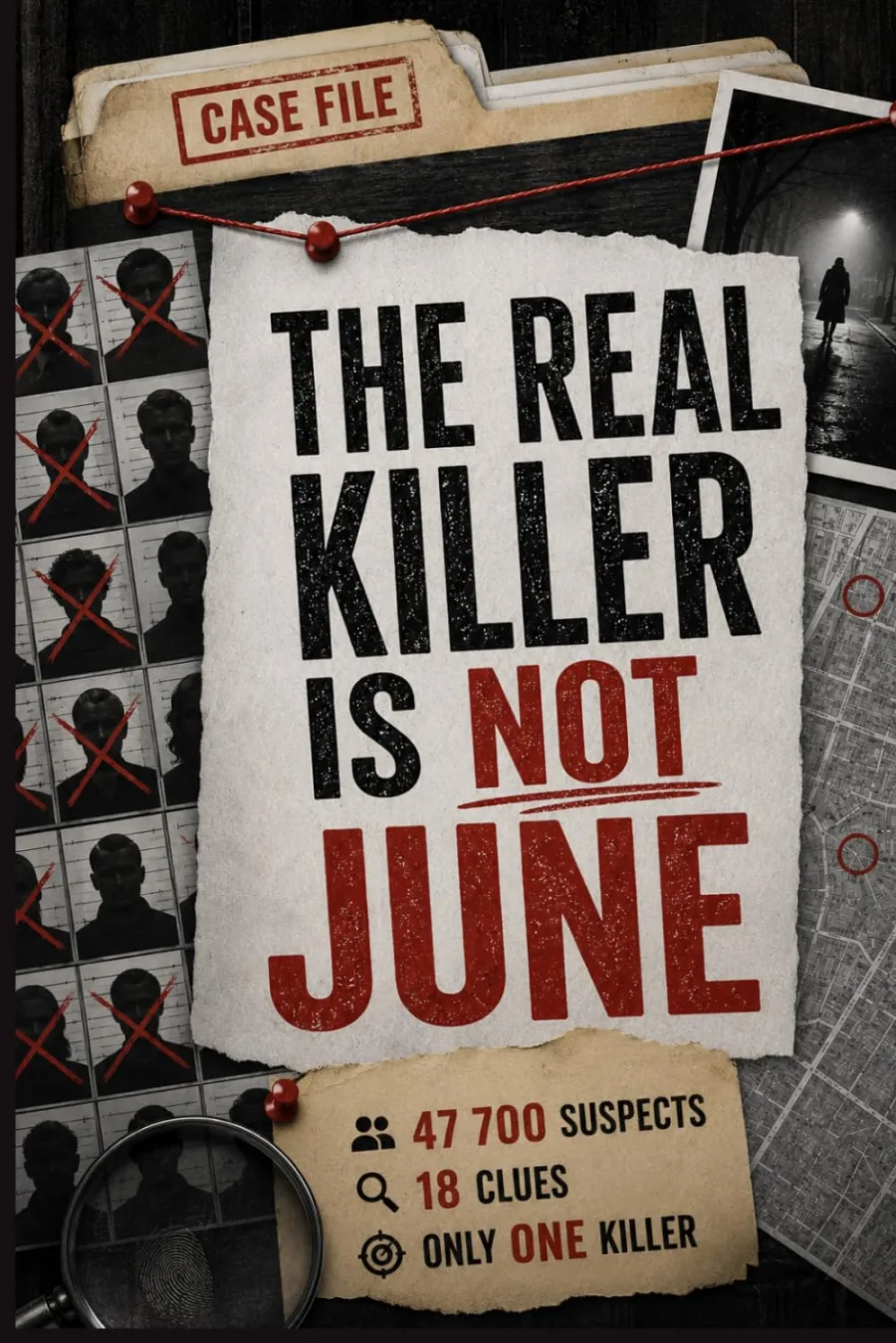
The Real Killer Is Not June
Paperback
• 201 Pages
• USD 13.99
• English
• 9798189965159
No ratings yet
| Publisher | Independently Published |
|---|---|
| ISBN13 | 9798189965159 |
| ASIN/SKU | B0HCLVWV94 |
| Book Format | Paperback |
| Language | English |
| Pages | 201 |
| List Price | USD 13.99 |
| Publishing Date | 30/07/2026 |
| Dimensions | 6 x 0.46 x 9 inches |
| Weight | 12.8 ounces |
| Book Code | BD00069985 |
Buy this Book
Amazon Stores
Ebook Stores
Other Stores
Discover The Real Killer Is Not June by bounaj ghanilo. This book is published by Independently Published in Paperback format, ISBN 9798189965159, ASIN B0HCLVWV94, under Humor and Entertainment, Puzzles, Word Games.
Book Description
Everyone was sure it was June. Everyone was wrong.
A murder has been committed, and suspicion fell fast on June. Her name surfaced early, her details seemed to fit, and the case nearly closed around her. But the evidence was misread — and the real killer is still hiding in a register of suspects.
The detective left you 18 critical clues. Exactly one person matches every single one.
Your mission: apply each clue, cross out every suspect who fails, and narrow the field until only one name survives — the guilty one.
Inside this book:
A full suspect register to work through, name by name
18 interlocking clues that reward careful, step-by-step deduction
A built-in elimination worksheet and clear how-to-play instructions
One — and only one — logically provable answer
A complete answer key with the full reasoning explained
No trivia. No guessing. No prior knowledge needed — just a pencil, patience, and sharp reasoning. Perfect for fans of murder mystery logic puzzles, whodunit deduction games, detective logic grids, and brain teasers who want one satisfying case to crack.
Can you clear June's name and catch the real killer? Scroll up and start the investigation.
A murder has been committed, and suspicion fell fast on June. Her name surfaced early, her details seemed to fit, and the case nearly closed around her. But the evidence was misread — and the real killer is still hiding in a register of suspects.
The detective left you 18 critical clues. Exactly one person matches every single one.
Your mission: apply each clue, cross out every suspect who fails, and narrow the field until only one name survives — the guilty one.
Inside this book:
A full suspect register to work through, name by name
18 interlocking clues that reward careful, step-by-step deduction
A built-in elimination worksheet and clear how-to-play instructions
One — and only one — logically provable answer
A complete answer key with the full reasoning explained
No trivia. No guessing. No prior knowledge needed — just a pencil, patience, and sharp reasoning. Perfect for fans of murder mystery logic puzzles, whodunit deduction games, detective logic grids, and brain teasers who want one satisfying case to crack.
Can you clear June's name and catch the real killer? Scroll up and start the investigation.
Author Biography
Author Biography will be added soon…
Editorial Reviews
Editorial Reviews will be added soon…
Book Summary
The Real Killer Is Not June by Bounaj Ghanilo is a mystery-driven story that revolves around a murder, a suspicious identity, and the difficult search for the truth hidden behind appearances. The title immediately suggests that the central mystery is not as simple as it first seems. Someone appears to be responsible, clues seem to point in a particular direction, and the people involved may have their own reasons for hiding what they know. As the story develops, the reader is encouraged to question every assumption and look beyond the obvious explanation. The book builds its tension around one important idea: the person who appears guilty is not necessarily the person who committed the crime.
At the heart of the story is June, whose name becomes closely connected with the mystery. Her presence, actions, and relationships become important pieces of a larger puzzle. Rather than presenting the truth immediately, the narrative gradually reveals information that changes the way the reader understands the situation. June becomes more than simply a character connected to a crime; she represents the uncertainty surrounding the entire case. What seems clear at one point becomes questionable later, and the reader is repeatedly pushed to reconsider earlier conclusions.
The mystery works because the characters do not simply reveal everything they know. People have secrets, personal motives, fears, and complicated relationships, and these make it difficult to separate truth from deception. In a murder investigation, even a small lie can become important, and the story uses this uncertainty to create suspense. A character who appears helpful may have something to hide, while someone who seems suspicious may actually be protecting another person. This creates a constant feeling that the real story is buried beneath several layers of misunderstanding.
One of the most interesting aspects of the book is the way it deals with appearances. People often judge others according to what they see, what they hear, or what they are told. But appearances can be misleading, especially when emotions and personal interests are involved. The investigation therefore becomes not only a search for a murderer but also a search for the truth about the people surrounding the case. The reader is made to understand that solving a crime requires more than finding a single piece of evidence. It requires understanding relationships, motives, past actions, and the reasons people behave as they do.
As the story progresses, suspicion moves from one person to another. Each new detail creates another possibility, making the mystery increasingly complicated. This shifting suspicion gives the narrative its momentum. Instead of allowing the reader to settle comfortably on one explanation, the story keeps introducing doubts. The central question is not simply “Who killed June?” but whether June is even the person the reader initially believes her to be and whether the obvious suspect has been correctly identified. The title itself becomes a clue, encouraging the reader to look beyond the most convenient answer.
The emotional side of the story is also important. Crime is never only about the act itself; it affects families, friendships, trust, and the way people see one another. A murder can expose tensions that existed long before the crime occurred. Old resentments, jealousy, fear, guilt, or hidden loyalties may suddenly become significant. The characters are therefore caught between their desire to protect themselves and the need to reveal the truth. This conflict makes the mystery more personal and gives the investigation an emotional dimension.
Another important theme is the danger of making judgments too quickly. The story shows how easily suspicion can become certainty when people want a simple answer. Once someone is labeled a suspect, every action can appear suspicious, even when there may be another explanation. At the same time, people who look innocent can sometimes hide the most important information. The narrative uses this contrast to remind readers that truth is rarely as straightforward as it appears.
The investigation gradually brings together scattered pieces of information. Details that seemed insignificant earlier can acquire a completely different meaning later. This is one of the pleasures of a mystery story: the reader can look back and realize that clues were present all along, even though their importance was not immediately obvious. The revelations encourage the reader to think carefully about motives and evidence rather than simply accepting the first explanation offered.
The title, The Real Killer Is Not June, captures the central tension of the story. It suggests that June may be wrongly associated with the crime or that the truth about her role is very different from what others believe. The phrase “real killer” also shifts attention toward the person who has remained hidden behind the confusion. The eventual discovery of the truth becomes meaningful because it challenges the assumptions that shaped the investigation from the beginning.
Overall, The Real Killer Is Not June is a suspenseful mystery built around deception, mistaken assumptions, hidden motives, and the search for truth. Its central appeal comes from the uncertainty surrounding the characters and the gradual uncovering of information. The story reminds readers that the truth is often complicated, and that finding it requires patience and careful attention. More than simply asking who committed a crime, the book explores why people hide things, why others are willing to believe appearances, and how easily an innocent person can become the focus of suspicion. By the time the mystery begins to come together, the reader is left with a stronger understanding of how secrets and assumptions can shape an entire investigation. The book ultimately suggests that solving a mystery is not only about identifying a killer; it is about understanding the complete story behind the crime and recognizing that the person everyone suspects may not be the person responsible after all.
At the heart of the story is June, whose name becomes closely connected with the mystery. Her presence, actions, and relationships become important pieces of a larger puzzle. Rather than presenting the truth immediately, the narrative gradually reveals information that changes the way the reader understands the situation. June becomes more than simply a character connected to a crime; she represents the uncertainty surrounding the entire case. What seems clear at one point becomes questionable later, and the reader is repeatedly pushed to reconsider earlier conclusions.
The mystery works because the characters do not simply reveal everything they know. People have secrets, personal motives, fears, and complicated relationships, and these make it difficult to separate truth from deception. In a murder investigation, even a small lie can become important, and the story uses this uncertainty to create suspense. A character who appears helpful may have something to hide, while someone who seems suspicious may actually be protecting another person. This creates a constant feeling that the real story is buried beneath several layers of misunderstanding.
One of the most interesting aspects of the book is the way it deals with appearances. People often judge others according to what they see, what they hear, or what they are told. But appearances can be misleading, especially when emotions and personal interests are involved. The investigation therefore becomes not only a search for a murderer but also a search for the truth about the people surrounding the case. The reader is made to understand that solving a crime requires more than finding a single piece of evidence. It requires understanding relationships, motives, past actions, and the reasons people behave as they do.
As the story progresses, suspicion moves from one person to another. Each new detail creates another possibility, making the mystery increasingly complicated. This shifting suspicion gives the narrative its momentum. Instead of allowing the reader to settle comfortably on one explanation, the story keeps introducing doubts. The central question is not simply “Who killed June?” but whether June is even the person the reader initially believes her to be and whether the obvious suspect has been correctly identified. The title itself becomes a clue, encouraging the reader to look beyond the most convenient answer.
The emotional side of the story is also important. Crime is never only about the act itself; it affects families, friendships, trust, and the way people see one another. A murder can expose tensions that existed long before the crime occurred. Old resentments, jealousy, fear, guilt, or hidden loyalties may suddenly become significant. The characters are therefore caught between their desire to protect themselves and the need to reveal the truth. This conflict makes the mystery more personal and gives the investigation an emotional dimension.
Another important theme is the danger of making judgments too quickly. The story shows how easily suspicion can become certainty when people want a simple answer. Once someone is labeled a suspect, every action can appear suspicious, even when there may be another explanation. At the same time, people who look innocent can sometimes hide the most important information. The narrative uses this contrast to remind readers that truth is rarely as straightforward as it appears.
The investigation gradually brings together scattered pieces of information. Details that seemed insignificant earlier can acquire a completely different meaning later. This is one of the pleasures of a mystery story: the reader can look back and realize that clues were present all along, even though their importance was not immediately obvious. The revelations encourage the reader to think carefully about motives and evidence rather than simply accepting the first explanation offered.
The title, The Real Killer Is Not June, captures the central tension of the story. It suggests that June may be wrongly associated with the crime or that the truth about her role is very different from what others believe. The phrase “real killer” also shifts attention toward the person who has remained hidden behind the confusion. The eventual discovery of the truth becomes meaningful because it challenges the assumptions that shaped the investigation from the beginning.
Overall, The Real Killer Is Not June is a suspenseful mystery built around deception, mistaken assumptions, hidden motives, and the search for truth. Its central appeal comes from the uncertainty surrounding the characters and the gradual uncovering of information. The story reminds readers that the truth is often complicated, and that finding it requires patience and careful attention. More than simply asking who committed a crime, the book explores why people hide things, why others are willing to believe appearances, and how easily an innocent person can become the focus of suspicion. By the time the mystery begins to come together, the reader is left with a stronger understanding of how secrets and assumptions can shape an entire investigation. The book ultimately suggests that solving a mystery is not only about identifying a killer; it is about understanding the complete story behind the crime and recognizing that the person everyone suspects may not be the person responsible after all.
Sample Chapters
Sample Chapters will be added soon…
Reader Reviews
No reviews yet.
The Real Killer Is Not June
Download Cover Image
Do you want to download the full cover image for The Real Killer Is Not June?