
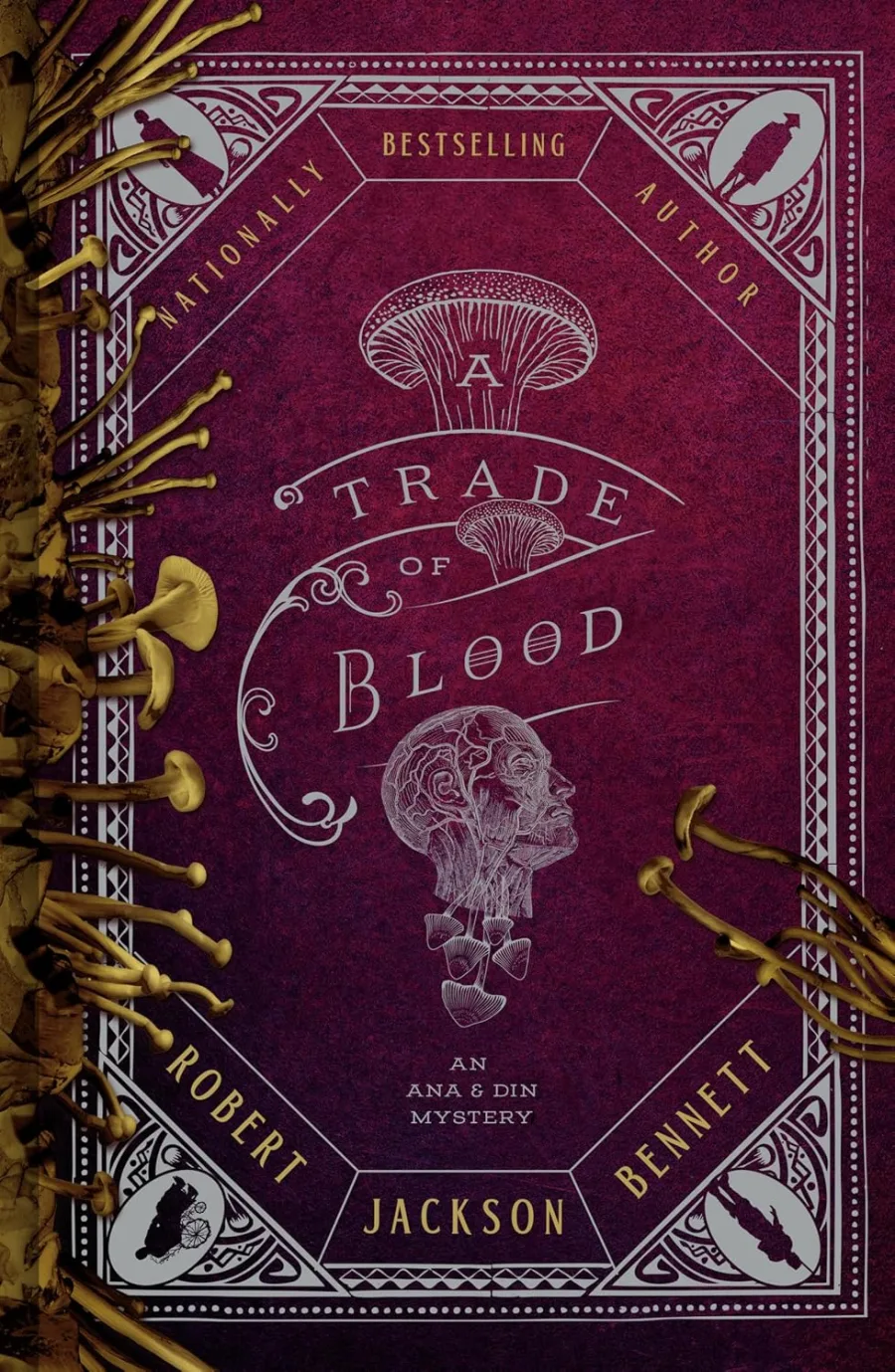
A Trade of Blood (Ana and Din Mysteries Book 3)
eBook
• 380 Pages
• USD 32.00
• English
• 9780593723869
No ratings yet
| Publisher | Del Rey |
|---|---|
| ISBN13 | 9780593723869 |
| ASIN/SKU | B0FK9DM2MP |
| Book Format | eBook |
| Language | English |
| Pages | 380 |
| List Price | USD 32.00 |
| Publishing Date | 04/08/2026 |
| Book Code | BD00069986 |
Buy this Book
Amazon Stores
Ebook Stores
Other Stores
Discover A Trade of Blood (Ana and Din Mysteries Book 3) by Robert Jackson Bennett. This book is published by Del Rey in eBook format, ISBN 9780593723869, ASIN B0FK9DM2MP, under Mystery, Thriller and Suspense, Supernatural Mysteries, Traditional Detective Mysteries.
Book Description
Detective Ana Dolabra must prove a condemned man’s innocence and confront a terrifying magical technology in this fantasy-mystery from the bestselling author of The Tainted Cup, winner of the Hugo and World Fantasy awards.
The heir to one of the Empire’s most powerful families sits in jail, accused of murder. His hands are covered in the victim’s blood, and he can neither deny his guilt nor explain his actions.
But if the great detective Ana Dolabra cannot save him from the noose, the farming canton of Sapirdad will explode into war, threatening to plunge the whole Empire into starvation and chaos.
As Ana investigates—her assistant Dinios Kol, as ever, acting as her eyes and ears—she fears her task is even more daunting than it seemed. For this murder is just the latest in a deeper, subtler web of death, woven by a mastermind with an ancient weapon at his disposal.
With their customary skill, Ana and Din pursue their adversary through the canton’s wild ranges, sprawling ranches, and reeking slaughterhouses. Yet even they are not prepared to learn the horrifying secret behind their opponent’s powers.
The heir to one of the Empire’s most powerful families sits in jail, accused of murder. His hands are covered in the victim’s blood, and he can neither deny his guilt nor explain his actions.
But if the great detective Ana Dolabra cannot save him from the noose, the farming canton of Sapirdad will explode into war, threatening to plunge the whole Empire into starvation and chaos.
As Ana investigates—her assistant Dinios Kol, as ever, acting as her eyes and ears—she fears her task is even more daunting than it seemed. For this murder is just the latest in a deeper, subtler web of death, woven by a mastermind with an ancient weapon at his disposal.
With their customary skill, Ana and Din pursue their adversary through the canton’s wild ranges, sprawling ranches, and reeking slaughterhouses. Yet even they are not prepared to learn the horrifying secret behind their opponent’s powers.
Author Biography
Robert is the author of the Hugo Award-winning novel The Tainted Cup and its sequel A Drop of Corruption, as well as The Divine Cities trilogy and The Founders Trilogy.
His work has received the Edgar Award, the Shirley Jackson Award, and the Phillip K. Dick Citation of Excellence, and he has been shortlisted for the World Fantasy, British Fantasy, and Locus Awards. He also dug a very good french drain in his backyard back in 2019.
He lives in Austin with his wife and two sons, one of whom is very large and one of whom is very loud, and he focuses on writing and not maintaining his website.
His work has received the Edgar Award, the Shirley Jackson Award, and the Phillip K. Dick Citation of Excellence, and he has been shortlisted for the World Fantasy, British Fantasy, and Locus Awards. He also dug a very good french drain in his backyard back in 2019.
He lives in Austin with his wife and two sons, one of whom is very large and one of whom is very loud, and he focuses on writing and not maintaining his website.
Editorial Reviews
“This is the best fantasy series currently being published, maybe the best mystery one too.”—John Joseph Adams, series editor of The Best American Science Fiction and Fantasy
“Bennett continues to make genre-blending appear effortless in his stellar third Ana and Din novel (after 2025’s A Drop of Corruption), a suspenseful whodunit set in an immersive and imaginative alternate world. . . . The case is as clever and fairly clued as ever, and it’s a pleasure to revisit these sharply drawn characters. This series shows no signs of slowing down.”—Publishers Weekly, starred review
“The Ana and Din mysteries are a perfect summer beach read. . . . The really clever thing about these books is that they provide all the easy pleasures of a classic whodunit but also include vivid and original world-building, which is no easy task in today’s crowded marketplace. . . . I’ve been recommending [them] to everyone I encounter.”—Emily Gould, New York Dinner Party newsletter
“Series fans will be delighted with the Romeo and Juliet–inspired plotline involving a complex mystery that astounds even the peevish detective. The introduction of a member of Din’s family plus new hints about Ana’s history will have readers eager for their next adventure.”—Booklist, starred review
“Masterfully combines an engrossing mystery, imaginative fantasy and frontier drama . . . Full of evocative writing and thoughtful world building, A Trade of Blood provides a window into yet another aspect of Bennett’s remarkably strange and brutal empire.”—BookPage
“Another highly recommended entry in the [series] . . . Will also appeal to those who are looking for new, different, and fascinating recreations of the greatest detectives and epic fantasy readers craving a dangerous world to plumb to its depths.”—Library Journal, starred review
“Imperial snoops Ana Dolabra and Dinios Kol are back on the job. . . . Fantasy meets procedural with a side of veganism, and it’s good merry mayhem.”—Kirkus Reviews
“Bennett continues to make genre-blending appear effortless in his stellar third Ana and Din novel (after 2025’s A Drop of Corruption), a suspenseful whodunit set in an immersive and imaginative alternate world. . . . The case is as clever and fairly clued as ever, and it’s a pleasure to revisit these sharply drawn characters. This series shows no signs of slowing down.”—Publishers Weekly, starred review
“The Ana and Din mysteries are a perfect summer beach read. . . . The really clever thing about these books is that they provide all the easy pleasures of a classic whodunit but also include vivid and original world-building, which is no easy task in today’s crowded marketplace. . . . I’ve been recommending [them] to everyone I encounter.”—Emily Gould, New York Dinner Party newsletter
“Series fans will be delighted with the Romeo and Juliet–inspired plotline involving a complex mystery that astounds even the peevish detective. The introduction of a member of Din’s family plus new hints about Ana’s history will have readers eager for their next adventure.”—Booklist, starred review
“Masterfully combines an engrossing mystery, imaginative fantasy and frontier drama . . . Full of evocative writing and thoughtful world building, A Trade of Blood provides a window into yet another aspect of Bennett’s remarkably strange and brutal empire.”—BookPage
“Another highly recommended entry in the [series] . . . Will also appeal to those who are looking for new, different, and fascinating recreations of the greatest detectives and epic fantasy readers craving a dangerous world to plumb to its depths.”—Library Journal, starred review
“Imperial snoops Ana Dolabra and Dinios Kol are back on the job. . . . Fantasy meets procedural with a side of veganism, and it’s good merry mayhem.”—Kirkus Reviews
Book Summary
Robert Jackson Bennett’s A Trade of Blood is the third novel in the Ana and Din mysteries, following The Tainted Cup and A Drop of Corruption. Like its predecessors, it combines a carefully constructed murder investigation with an unusual fantasy world shaped by science, biology, bureaucracy, and enormous living creatures. This time, however, Bennett takes his detectives away from the urban centers of the Empire and into the agricultural frontier, where cattle ranches, rival families, slaughterhouses, and food production hide a much larger and more disturbing secret.
The story begins with a brutal murder in Sapirdad, a farming canton on the edge of the Empire of Khanum. Zansay Burav, a young woman from one of the region’s most powerful cattle-ranching families, has been horribly butchered. The obvious suspect is Castus Armenta, the heir to a rival family. Castus is discovered fleeing the scene covered in Zansay’s blood. The evidence appears overwhelming, but there is a major problem: Castus has no memory of committing the murder. He cannot explain why he was there, what happened, or why Zansay is dead.
The case becomes politically dangerous because the Buravs and Armentas are not ordinary families. They dominate important parts of the local economy, with the Buravs controlling cattle and the Armentas deeply involved in the production of animal feed. Their rivalry has been simmering for years. If Castus is executed for Zansay’s murder, the feud could explode into open conflict. That conflict could disrupt food production in Sapirdad and eventually threaten the wider Empire with famine and chaos. The murder therefore becomes more than a question of individual guilt: solving it is essential to keeping the region from falling into violence.
The Imperial authorities send the brilliant but eccentric detective Ana Dolabra to investigate. Because Ana prefers to remain hidden and conduct much of her work from a distance, her assistant, Dinios Kol—or Din—serves as her eyes and ears. Din possesses extraordinary abilities that allow him to reconstruct and remember crime scenes with remarkable precision. He is methodical, patient, and practical, while Ana is unpredictable, intellectually aggressive, and willing to consider explanations that would seem absurd to almost anyone else.
Their first task is to determine whether Castus really killed Zansay. The physical evidence seems to say yes, but the crime scene contains details that do not fit. Most importantly, Zansay herself appears to have deliberately altered or staged portions of the scene after she had been attacked. That discovery suggests that the murder is not what it initially seems. Someone has manipulated the evidence, but the question is why.
As Ana and Din investigate, the mystery becomes increasingly complicated. Castus has no clear motive for killing Zansay. Although their families are enemies, the two young people were secretly lovers. Their relationship gives the murder an emotional dimension, but it does not explain the strange circumstances surrounding Zansay’s death.
Then Castus’s family begins to suffer a series of bizarre deaths.
Castus has three siblings, and each one becomes a potential victim. Their deaths suggest that the murder of Zansay is only one part of a much larger conspiracy. The investigators begin to suspect that someone is deliberately destroying the Armenta family. What first looked like a passionate crime between two young lovers gradually develops into a carefully organized campaign of murder.
The investigation takes Din and Ana deeper into the agricultural economy of Sapirdad. They travel through wild ranges, enormous ranches, and slaughterhouses, encountering the machinery and workers responsible for feeding the Empire. Bennett uses this setting to explore a disturbing question: what happens when living creatures are treated primarily as resources?
A particularly important clue is a strange fungus discovered during the investigation. At first it seems like an odd biological curiosity, but Ana recognizes that it may be connected to the killer’s method. The fungus is capable of influencing living organisms and, under the right conditions, controlling their behavior. Its effects are far more disturbing than ordinary poisoning or infection because it can turn living beings into tools that continue performing conditioned actions long after they should have stopped.
This discovery changes the nature of the mystery. Ana and Din are no longer simply searching for a murderer. They are confronting an ancient biological technology that can manipulate living bodies.
The fungus also connects the present-day murders to the distant history of the Empire. As Din investigates, he learns more about his own family and encounters relatives whose lives have been shaped by the history of the region. His sister Fotia becomes an especially important presence, giving readers a deeper understanding of Din beyond his role as Ana’s assistant. His personal history becomes unexpectedly connected to the larger mystery, making the investigation more emotionally meaningful for him.
Eventually, Din and Tauri uncover the terrifying source of the biological phenomenon. Deep beneath the landscape lies an ancient subterranean environment containing a vast reservoir or lake and evidence of beings that have been manipulated by the fungus for an extraordinarily long time. The discovery reveals that the technology involved is not a recent invention. It is a remnant of an ancient civilization and a reminder that the Empire's history is far older and stranger than most people realize.
The mastermind behind the murders has discovered how to exploit this ancient biological system. Instead of using conventional weapons, the killer can manipulate bodies, behavior, and biological processes. The result is a form of control that is terrifying precisely because it can make victims participate in their own destruction.
The investigation therefore exposes a deeper truth about power. The families of Sapirdad believe they control cattle because they breed, feed, confine, and slaughter them. But the ancient technology reveals that humans themselves can be treated in exactly the same way. The distinction between “master” and “livestock” suddenly becomes frighteningly fragile.
This is the central idea of A Trade of Blood. Bennett uses the murder mystery to examine the consequences of turning life into a commodity. The cattle industry is not merely background scenery. It becomes a mirror for the Empire itself. Humans have created systems designed to control animals for food, profit, and efficiency, but the novel asks what happens when another intelligence applies the same logic to humanity.
Ana understands the implications immediately. The investigation forces both her and Din to confront the possibility that the techniques used to control animals could eventually be applied to people. The novel's horror therefore comes not simply from the fungus or the grotesque murders, but from the realization that the same principles of exploitation can be extended from one species to another.
The final revelations solve the immediate murder mystery and expose the conspiracy behind the deaths, but Bennett deliberately leaves the larger world of the Empire unsettled. The ancient biological technology points toward dangers much greater than the Sapirdad killings. It suggests that humanity is living among forces and remnants it does not fully understand.
For Din, the case is also a journey into his own family history. For Ana, it is another demonstration that beneath the Empire's elaborate systems of law and order lie older, stranger forces. And for both detectives, the investigation reinforces a disturbing lesson: civilization may be less secure than it appears.
Ultimately, A Trade of Blood is a murder mystery with a much larger purpose. It asks how easily intelligence becomes cruelty when living beings are reduced to resources, and how dangerous human greed becomes when combined with powerful technology. Through Ana and Din's investigation, Bennett creates a world in which the most frightening monsters are not necessarily supernatural creatures. They may be systems, ideas, and technologies that allow one living thing to control another.
The result is a dark, inventive, and increasingly unsettling mystery—one in which solving a single murder opens a door onto the ancient history of an entire empire and forces its characters to consider a terrifying possibility: if humans can decide that other creatures exist only to serve them, what prevents something older and more powerful from making the same decision about humanity?
The story begins with a brutal murder in Sapirdad, a farming canton on the edge of the Empire of Khanum. Zansay Burav, a young woman from one of the region’s most powerful cattle-ranching families, has been horribly butchered. The obvious suspect is Castus Armenta, the heir to a rival family. Castus is discovered fleeing the scene covered in Zansay’s blood. The evidence appears overwhelming, but there is a major problem: Castus has no memory of committing the murder. He cannot explain why he was there, what happened, or why Zansay is dead.
The case becomes politically dangerous because the Buravs and Armentas are not ordinary families. They dominate important parts of the local economy, with the Buravs controlling cattle and the Armentas deeply involved in the production of animal feed. Their rivalry has been simmering for years. If Castus is executed for Zansay’s murder, the feud could explode into open conflict. That conflict could disrupt food production in Sapirdad and eventually threaten the wider Empire with famine and chaos. The murder therefore becomes more than a question of individual guilt: solving it is essential to keeping the region from falling into violence.
The Imperial authorities send the brilliant but eccentric detective Ana Dolabra to investigate. Because Ana prefers to remain hidden and conduct much of her work from a distance, her assistant, Dinios Kol—or Din—serves as her eyes and ears. Din possesses extraordinary abilities that allow him to reconstruct and remember crime scenes with remarkable precision. He is methodical, patient, and practical, while Ana is unpredictable, intellectually aggressive, and willing to consider explanations that would seem absurd to almost anyone else.
Their first task is to determine whether Castus really killed Zansay. The physical evidence seems to say yes, but the crime scene contains details that do not fit. Most importantly, Zansay herself appears to have deliberately altered or staged portions of the scene after she had been attacked. That discovery suggests that the murder is not what it initially seems. Someone has manipulated the evidence, but the question is why.
As Ana and Din investigate, the mystery becomes increasingly complicated. Castus has no clear motive for killing Zansay. Although their families are enemies, the two young people were secretly lovers. Their relationship gives the murder an emotional dimension, but it does not explain the strange circumstances surrounding Zansay’s death.
Then Castus’s family begins to suffer a series of bizarre deaths.
Castus has three siblings, and each one becomes a potential victim. Their deaths suggest that the murder of Zansay is only one part of a much larger conspiracy. The investigators begin to suspect that someone is deliberately destroying the Armenta family. What first looked like a passionate crime between two young lovers gradually develops into a carefully organized campaign of murder.
The investigation takes Din and Ana deeper into the agricultural economy of Sapirdad. They travel through wild ranges, enormous ranches, and slaughterhouses, encountering the machinery and workers responsible for feeding the Empire. Bennett uses this setting to explore a disturbing question: what happens when living creatures are treated primarily as resources?
A particularly important clue is a strange fungus discovered during the investigation. At first it seems like an odd biological curiosity, but Ana recognizes that it may be connected to the killer’s method. The fungus is capable of influencing living organisms and, under the right conditions, controlling their behavior. Its effects are far more disturbing than ordinary poisoning or infection because it can turn living beings into tools that continue performing conditioned actions long after they should have stopped.
This discovery changes the nature of the mystery. Ana and Din are no longer simply searching for a murderer. They are confronting an ancient biological technology that can manipulate living bodies.
The fungus also connects the present-day murders to the distant history of the Empire. As Din investigates, he learns more about his own family and encounters relatives whose lives have been shaped by the history of the region. His sister Fotia becomes an especially important presence, giving readers a deeper understanding of Din beyond his role as Ana’s assistant. His personal history becomes unexpectedly connected to the larger mystery, making the investigation more emotionally meaningful for him.
Eventually, Din and Tauri uncover the terrifying source of the biological phenomenon. Deep beneath the landscape lies an ancient subterranean environment containing a vast reservoir or lake and evidence of beings that have been manipulated by the fungus for an extraordinarily long time. The discovery reveals that the technology involved is not a recent invention. It is a remnant of an ancient civilization and a reminder that the Empire's history is far older and stranger than most people realize.
The mastermind behind the murders has discovered how to exploit this ancient biological system. Instead of using conventional weapons, the killer can manipulate bodies, behavior, and biological processes. The result is a form of control that is terrifying precisely because it can make victims participate in their own destruction.
The investigation therefore exposes a deeper truth about power. The families of Sapirdad believe they control cattle because they breed, feed, confine, and slaughter them. But the ancient technology reveals that humans themselves can be treated in exactly the same way. The distinction between “master” and “livestock” suddenly becomes frighteningly fragile.
This is the central idea of A Trade of Blood. Bennett uses the murder mystery to examine the consequences of turning life into a commodity. The cattle industry is not merely background scenery. It becomes a mirror for the Empire itself. Humans have created systems designed to control animals for food, profit, and efficiency, but the novel asks what happens when another intelligence applies the same logic to humanity.
Ana understands the implications immediately. The investigation forces both her and Din to confront the possibility that the techniques used to control animals could eventually be applied to people. The novel's horror therefore comes not simply from the fungus or the grotesque murders, but from the realization that the same principles of exploitation can be extended from one species to another.
The final revelations solve the immediate murder mystery and expose the conspiracy behind the deaths, but Bennett deliberately leaves the larger world of the Empire unsettled. The ancient biological technology points toward dangers much greater than the Sapirdad killings. It suggests that humanity is living among forces and remnants it does not fully understand.
For Din, the case is also a journey into his own family history. For Ana, it is another demonstration that beneath the Empire's elaborate systems of law and order lie older, stranger forces. And for both detectives, the investigation reinforces a disturbing lesson: civilization may be less secure than it appears.
Ultimately, A Trade of Blood is a murder mystery with a much larger purpose. It asks how easily intelligence becomes cruelty when living beings are reduced to resources, and how dangerous human greed becomes when combined with powerful technology. Through Ana and Din's investigation, Bennett creates a world in which the most frightening monsters are not necessarily supernatural creatures. They may be systems, ideas, and technologies that allow one living thing to control another.
The result is a dark, inventive, and increasingly unsettling mystery—one in which solving a single murder opens a door onto the ancient history of an entire empire and forces its characters to consider a terrifying possibility: if humans can decide that other creatures exist only to serve them, what prevents something older and more powerful from making the same decision about humanity?
Sample Chapters
Sample Chapters will be added soon…
Reader Reviews
No reviews yet.
A Trade of Blood (Ana and Din Mysteries Book 3)
Download Cover Image
Do you want to download the full cover image for A Trade of Blood (Ana and Din Mysteries Book 3)?