
The Nerd Reich: Silicon Valley Fascism and the War on Democracy
Hardcover
• 352 Pages
• USD 30.00
• English
• 9781668221402
No ratings yet
| Publisher | Avid Reader Press / Simon & Schuster |
|---|---|
| ISBN13 | 9781668221402 |
| ASIN/SKU | 1668221403 |
| Book Format | Hardcover |
| Language | English |
| Pages | 352 |
| List Price | USD 30.00 |
| Publishing Date | 18/08/2026 |
| Dimensions | 6 x 1.2 x 9 inches |
| Weight | 1.14 pounds |
| Book Code | BD00070146 |
Buy this Book
Amazon Stores
Ebook Stores
Other Stores
Discover The Nerd Reich: Silicon Valley Fascism and the War on Democracy by Gil Durán. This book is published by Avid Reader Press / Simon and Schuster in Hardcover format, ISBN 9781668221402, ASIN 1668221403, under Politics and Social Sciences, Political Economy, Civics and Citizenship.
Book Description
“This transfixing debut from journalist Durán investigates the antidemocratic ideologies espoused by tech billionaires linked to the second Trump administration...It’s an ominous look at an insular elite arrayed against American democracy.” —Publishers Weekly (starred review)
A fearless and urgent chronicle of the tech-authoritarian movement from its early days in San Francisco politics to its current moment on the international stage, exploring the wild and dystopian ambition of the technocrats at its center, and offering a road map to resistance.
When Silicon Valley says it is ‘‘moving fast and breaking things,’’ the world interprets the chaos as a necessary cost of innovation. Gil Durán reveals something far more sinister: a decades-long campaign to replace elected governments with corporate rule.
Drawing on insider political experience and new investigations, Durán traces this ideology from its philosophical roots in The Sovereign Individual by James Dale Davidson and Lord William Rees-Mogg. He introduces its modern apostles—Peter Thiel, Marc Andreessen, Balaji Srinivasan, and Elon Musk—and shows how the promise of technological liberation has transformed into a global movement for digital feudalism, powered by cryptocurrency, artificial intelligence, and the algorithmic propaganda of social media.
The Nerd Reich explains the origins, strategies, and ambitions of Silicon Valley’s war on democracy for the first time. From San Francisco’s weaponized elections and secret billionaire projects to the White House, Durán exposes how the world’s richest men are building a new political order.
The Nerd Reich is more than a hidden history, it’s an urgent warning: democracy is being dismantled not by coups or tanks, but by code, capital, and the illusion of innovation. Durán insists there is still time to fight back—if we act now.
A fearless and urgent chronicle of the tech-authoritarian movement from its early days in San Francisco politics to its current moment on the international stage, exploring the wild and dystopian ambition of the technocrats at its center, and offering a road map to resistance.
When Silicon Valley says it is ‘‘moving fast and breaking things,’’ the world interprets the chaos as a necessary cost of innovation. Gil Durán reveals something far more sinister: a decades-long campaign to replace elected governments with corporate rule.
Drawing on insider political experience and new investigations, Durán traces this ideology from its philosophical roots in The Sovereign Individual by James Dale Davidson and Lord William Rees-Mogg. He introduces its modern apostles—Peter Thiel, Marc Andreessen, Balaji Srinivasan, and Elon Musk—and shows how the promise of technological liberation has transformed into a global movement for digital feudalism, powered by cryptocurrency, artificial intelligence, and the algorithmic propaganda of social media.
The Nerd Reich explains the origins, strategies, and ambitions of Silicon Valley’s war on democracy for the first time. From San Francisco’s weaponized elections and secret billionaire projects to the White House, Durán exposes how the world’s richest men are building a new political order.
The Nerd Reich is more than a hidden history, it’s an urgent warning: democracy is being dismantled not by coups or tanks, but by code, capital, and the illusion of innovation. Durán insists there is still time to fight back—if we act now.
Author Biography
Gil Durán was born in Tulare, California, in 1976. The grandson of Mexican immigrant farmworkers, he got his first taste of work in the fields, but took an interest in journalism after winning the local newspaper’s “My Mom Is the Best” contest in the fifth grade. In the tenth grade, his family moved from California to Kentucky, where he dropped out of high school for a year, then returned and befriended an English teacher who encouraged him to apply to college. He graduated DePauw University in 1998 and started his journalism career at the San Jose Mercury News. As the newspaper industry hit turbulence, he pivoted to politics and spent ten years as an advisor to politicians including Jerry Brown, Dianne Feinstein, and Kamala Harris. In 2018, he returned to journalism as California opinion editor of The Sacramento Bee, and then became editorial page editor of the San Francisco Examiner. Now an independent journalist, he publishes two newsletters: The Nerd Reich, focused on extremist tech politics, and FrameLab, focused on political language.
Editorial Reviews
"Reader take note: Gil Durán is a deep, thoughtful, and expansive observer of events that shape the current and future of our American democracy." —George Lakoff, author of The All New Don't Think of an Elephant!: Know Your Values and Frame the Debate
"A clear and compelling account of the threats posed by technofascism to democracies everywhere." —Ruth Ben-Ghiat, historian and author of Strongmen: Mussolini to the Present
"Gil Durán is an essential voice on this technofascist moment—where it comes from and where we are going." —Carole Cadwalladr, investigative journalist, The Nerve
"The Nerd Reich is a clarion warning about the rise of techno-fascist sociopaths who seek to profit off of our collective misery. In clear, compelling and meticulously-researched detail, Gil Durán sounds the alarm about this incestuous cabal of broligarchs. He brings the receipts and the righteous rage." —Wajahat Ali, The Left Hook
"A detailed guidebook for understanding why Big Tech now seeks not just wealth but political domination." —Kirkus Reviews
“Durán, a journalist and former political adviser, lays out the narrative in exacting detail, outlining the connections between these men (and it is all men) and the origins of their often deeply weird beliefs, many of which view everyone outside their circle or opposed to their agenda as expendable.” —The Guardian
"The Nerd Reich is a fantastically unputdownable must-read." —The Irish Times
"A clear and compelling account of the threats posed by technofascism to democracies everywhere." —Ruth Ben-Ghiat, historian and author of Strongmen: Mussolini to the Present
"Gil Durán is an essential voice on this technofascist moment—where it comes from and where we are going." —Carole Cadwalladr, investigative journalist, The Nerve
"The Nerd Reich is a clarion warning about the rise of techno-fascist sociopaths who seek to profit off of our collective misery. In clear, compelling and meticulously-researched detail, Gil Durán sounds the alarm about this incestuous cabal of broligarchs. He brings the receipts and the righteous rage." —Wajahat Ali, The Left Hook
"A detailed guidebook for understanding why Big Tech now seeks not just wealth but political domination." —Kirkus Reviews
“Durán, a journalist and former political adviser, lays out the narrative in exacting detail, outlining the connections between these men (and it is all men) and the origins of their often deeply weird beliefs, many of which view everyone outside their circle or opposed to their agenda as expendable.” —The Guardian
"The Nerd Reich is a fantastically unputdownable must-read." —The Irish Times
Book Summary
Gil Durán’s The Nerd Reich: Silicon Valley Fascism and the War on Democracy is an urgent work of political journalism about the transformation of Silicon Valley from a place associated with technological innovation and liberal culture into a powerful center of authoritarian political ideas. Durán’s central argument is that the political turn of influential technology billionaires did not happen suddenly. What may look like a recent alliance between wealthy technology figures and right-wing politics is, in his telling, the result of decades of ideological development, networking, experimentation, and growing hostility toward democratic government. The book was published by Avid Reader Press/Simon & Schuster in August 2026.
The book begins with a question that has become increasingly difficult to ignore: why have some of America’s most powerful technology entrepreneurs become so interested in politics? For years, Silicon Valley was commonly imagined as a progressive or socially liberal world populated by unconventional entrepreneurs, programmers, investors, and idealists. Durán argues that this image concealed an important contradiction. Some technology elites became deeply skeptical of democracy itself, particularly when democratic institutions appeared to interfere with their ambitions.
For Durán, the important story is therefore not simply that billionaires became conservative. It is that a section of the technology elite began developing an entirely different conception of government. Instead of seeing democracy as a necessary foundation of a free society, these thinkers increasingly treated government as inefficient, intrusive, or even dangerous. Their ideal future was one in which technological systems, private companies, wealthy entrepreneurs, and market forces could replace many of the functions traditionally performed by democratic institutions.
A major intellectual influence in Durán’s account is The Sovereign Individual, written by James Dale Davidson and Lord William Rees-Mogg. The book imagined a future in which technological change would weaken the power of governments and strengthen wealthy individuals. Durán presents this work as an important ideological bridge between libertarian economic thinking and the more radical political ideas that later emerged in parts of Silicon Valley. Peter Thiel, in particular, becomes an important figure in this intellectual history.
The appeal of these ideas becomes clearer when viewed through the culture of Silicon Valley. Technology entrepreneurs are accustomed to thinking in terms of disruption. A company identifies an established system, declares it outdated, builds a replacement, and presents the destruction of the old system as evidence of progress. Durán argues that some technology elites eventually began applying the same logic to politics. If government is inefficient, why reform it gradually? Why not replace it?
This is where the book’s central concern with “technofascism” emerges. Durán is not simply arguing that technology companies are powerful. His concern is that certain powerful figures have developed political visions in which concentrated private power, technological control, nationalism, authoritarianism, and hostility toward democratic institutions reinforce one another. The result, he argues, resembles a form of digital feudalism in which ordinary citizens possess less meaningful power while wealthy technological elites acquire greater control over information, infrastructure, money, and political decision-making.
Durán examines a group of influential figures who have helped shape this intellectual environment, including Peter Thiel, Marc Andreessen, Balaji Srinivasan, and Elon Musk. He also examines less famous but highly influential thinkers such as Curtis Yarvin, whose political ideas reject conventional liberal democracy and imagine alternatives based on corporate or authoritarian rule. Publishers Weekly notes that Yarvin advocates what Durán characterizes as “corporate dictatorship,” illustrating how ideas once confined to obscure intellectual circles have increasingly entered mainstream political conversations.
One of the book’s strengths is that Durán does not portray this movement as a perfectly organized conspiracy. Instead, he shows how networks of people, money, ideas, conferences, online communities, companies, political campaigns, and personal relationships can gradually create a shared political environment. The participants may disagree with one another on particular questions, but they can still converge around a common suspicion of democratic institutions and a belief that exceptional individuals should have greater freedom to reshape society.
Cryptocurrency is one important part of this story. To its supporters, cryptocurrency promises independence from traditional financial institutions and government control. Durán sees a darker political possibility in the same technology. If money can be detached from democratic regulation, taxation, and national institutions, then enormous private fortunes could become increasingly difficult for governments to control. Cryptocurrency thus becomes part of the broader dream of creating systems in which individuals and corporations operate with fewer democratic constraints.
Artificial intelligence and social media add another layer. Technology does not merely create new products; it shapes how people communicate, obtain information, understand political events, and form opinions. Durán argues that algorithmically driven platforms can become instruments of political influence, particularly when their owners have strong ideological commitments. Control over information can become a form of political power, even when it does not look like traditional political power.
The book also takes readers back to San Francisco, where Durán draws on his own experience in politics and journalism. His background is important because he is not observing the technology industry entirely from the outside. He spent years working as a political adviser before returning to journalism, and this experience gives his account a particular interest in the ways technology wealth entered local politics. The publisher describes the book as drawing on both insider political experience and new investigations.
San Francisco becomes an important early laboratory in Durán’s story. Political campaigns, elections, billionaires, technology companies, and local government became increasingly entangled. What might initially have looked like isolated political battles gradually revealed a larger transformation: wealthy technology figures were learning how political power worked and discovering that enormous financial resources could give them influence far beyond the traditional boundaries of business.
From there, Durán follows the movement beyond Silicon Valley and into national politics. The rise of Donald Trump and the transformation of the Republican Party provide the larger political context. Some technology billionaires who had previously appeared distant from traditional conservative politics moved increasingly close to Trump and his allies. Elon Musk became an especially visible example, while Peter Thiel’s connections to figures including JD Vance helped demonstrate the growing overlap between Silicon Valley wealth and right-wing political networks.
Durán argues that this development should not be dismissed as ordinary political opportunism. In his view, the political alliance reflects a deeper convergence of interests. Right-wing movements seeking to weaken government regulation can benefit from technology wealth, while technology billionaires seeking fewer restrictions can benefit from political movements hostile to regulatory institutions. What emerges is a mutually reinforcing relationship between capital and political power.
Yet The Nerd Reich is not only about billionaires. Its larger subject is democracy itself. Durán repeatedly asks what happens when private individuals possess resources and technological capabilities comparable to those of governments. A billionaire can own a major social platform, influence public conversation, fund political movements, invest in emerging technologies, and build relationships with political leaders. The traditional distinction between economic power and political power begins to disappear.
This is why the title is deliberately provocative. “Nerd Reich” captures Durán’s argument that a new form of authoritarian politics can emerge from people who do not resemble the traditional image of fascist leaders. They may speak the language of innovation, mathematics, entrepreneurship, science fiction, markets, and technological progress. Their methods may involve algorithms, venture capital, cryptocurrencies, artificial intelligence, and online propaganda rather than uniforms and military coups. But, Durán argues, the underlying danger is still the concentration of power and the rejection of democratic accountability.
Importantly, the book ends not simply with despair but with a call for resistance. Durán believes the future has not yet been decided. Democracy can respond by recognizing the political dimensions of technology, strengthening institutions, demanding accountability from powerful corporations and individuals, and refusing to treat technological innovation as automatically beneficial simply because it is new.
The deepest message of The Nerd Reich is therefore a warning about language as much as politics. Words such as “innovation,” “disruption,” “freedom,” and “efficiency” can sound harmless or even inspiring. But they can also conceal political choices about who gets to make decisions and who must live with the consequences. Durán asks readers to look beyond the technological surface and examine the power structures underneath it.
Ultimately, The Nerd Reich presents a troubling but important picture of the modern political landscape. Its central fear is not that technology itself is authoritarian, but that technology can give extraordinary power to people who have become hostile to democratic limits. The danger, in Durán’s view, is a world where citizens remain formally free while real power increasingly belongs to private networks of billionaires, corporations, platforms, and ideological entrepreneurs.
The book’s final appeal is consequently straightforward: democracy must not surrender its authority merely because technology moves faster than politics. Innovation should serve human beings rather than place them under the control of a new technological aristocracy. Durán’s warning is that the battle for democracy is no longer fought only in parliaments, elections, and courts. It is also being fought inside companies, computer systems, financial networks, social-media platforms, and the minds of the people who control them.
In that sense, The Nerd Reich is less a prediction of an inevitable authoritarian future than an alarm bell. It asks readers to recognize the political consequences of concentrated technological power before those consequences become impossible to reverse. Its underlying hope is that once citizens understand how these forces work, they can still choose a different future—one in which technology strengthens democracy rather than becoming a tool for dismantling it.
The book begins with a question that has become increasingly difficult to ignore: why have some of America’s most powerful technology entrepreneurs become so interested in politics? For years, Silicon Valley was commonly imagined as a progressive or socially liberal world populated by unconventional entrepreneurs, programmers, investors, and idealists. Durán argues that this image concealed an important contradiction. Some technology elites became deeply skeptical of democracy itself, particularly when democratic institutions appeared to interfere with their ambitions.
For Durán, the important story is therefore not simply that billionaires became conservative. It is that a section of the technology elite began developing an entirely different conception of government. Instead of seeing democracy as a necessary foundation of a free society, these thinkers increasingly treated government as inefficient, intrusive, or even dangerous. Their ideal future was one in which technological systems, private companies, wealthy entrepreneurs, and market forces could replace many of the functions traditionally performed by democratic institutions.
A major intellectual influence in Durán’s account is The Sovereign Individual, written by James Dale Davidson and Lord William Rees-Mogg. The book imagined a future in which technological change would weaken the power of governments and strengthen wealthy individuals. Durán presents this work as an important ideological bridge between libertarian economic thinking and the more radical political ideas that later emerged in parts of Silicon Valley. Peter Thiel, in particular, becomes an important figure in this intellectual history.
The appeal of these ideas becomes clearer when viewed through the culture of Silicon Valley. Technology entrepreneurs are accustomed to thinking in terms of disruption. A company identifies an established system, declares it outdated, builds a replacement, and presents the destruction of the old system as evidence of progress. Durán argues that some technology elites eventually began applying the same logic to politics. If government is inefficient, why reform it gradually? Why not replace it?
This is where the book’s central concern with “technofascism” emerges. Durán is not simply arguing that technology companies are powerful. His concern is that certain powerful figures have developed political visions in which concentrated private power, technological control, nationalism, authoritarianism, and hostility toward democratic institutions reinforce one another. The result, he argues, resembles a form of digital feudalism in which ordinary citizens possess less meaningful power while wealthy technological elites acquire greater control over information, infrastructure, money, and political decision-making.
Durán examines a group of influential figures who have helped shape this intellectual environment, including Peter Thiel, Marc Andreessen, Balaji Srinivasan, and Elon Musk. He also examines less famous but highly influential thinkers such as Curtis Yarvin, whose political ideas reject conventional liberal democracy and imagine alternatives based on corporate or authoritarian rule. Publishers Weekly notes that Yarvin advocates what Durán characterizes as “corporate dictatorship,” illustrating how ideas once confined to obscure intellectual circles have increasingly entered mainstream political conversations.
One of the book’s strengths is that Durán does not portray this movement as a perfectly organized conspiracy. Instead, he shows how networks of people, money, ideas, conferences, online communities, companies, political campaigns, and personal relationships can gradually create a shared political environment. The participants may disagree with one another on particular questions, but they can still converge around a common suspicion of democratic institutions and a belief that exceptional individuals should have greater freedom to reshape society.
Cryptocurrency is one important part of this story. To its supporters, cryptocurrency promises independence from traditional financial institutions and government control. Durán sees a darker political possibility in the same technology. If money can be detached from democratic regulation, taxation, and national institutions, then enormous private fortunes could become increasingly difficult for governments to control. Cryptocurrency thus becomes part of the broader dream of creating systems in which individuals and corporations operate with fewer democratic constraints.
Artificial intelligence and social media add another layer. Technology does not merely create new products; it shapes how people communicate, obtain information, understand political events, and form opinions. Durán argues that algorithmically driven platforms can become instruments of political influence, particularly when their owners have strong ideological commitments. Control over information can become a form of political power, even when it does not look like traditional political power.
The book also takes readers back to San Francisco, where Durán draws on his own experience in politics and journalism. His background is important because he is not observing the technology industry entirely from the outside. He spent years working as a political adviser before returning to journalism, and this experience gives his account a particular interest in the ways technology wealth entered local politics. The publisher describes the book as drawing on both insider political experience and new investigations.
San Francisco becomes an important early laboratory in Durán’s story. Political campaigns, elections, billionaires, technology companies, and local government became increasingly entangled. What might initially have looked like isolated political battles gradually revealed a larger transformation: wealthy technology figures were learning how political power worked and discovering that enormous financial resources could give them influence far beyond the traditional boundaries of business.
From there, Durán follows the movement beyond Silicon Valley and into national politics. The rise of Donald Trump and the transformation of the Republican Party provide the larger political context. Some technology billionaires who had previously appeared distant from traditional conservative politics moved increasingly close to Trump and his allies. Elon Musk became an especially visible example, while Peter Thiel’s connections to figures including JD Vance helped demonstrate the growing overlap between Silicon Valley wealth and right-wing political networks.
Durán argues that this development should not be dismissed as ordinary political opportunism. In his view, the political alliance reflects a deeper convergence of interests. Right-wing movements seeking to weaken government regulation can benefit from technology wealth, while technology billionaires seeking fewer restrictions can benefit from political movements hostile to regulatory institutions. What emerges is a mutually reinforcing relationship between capital and political power.
Yet The Nerd Reich is not only about billionaires. Its larger subject is democracy itself. Durán repeatedly asks what happens when private individuals possess resources and technological capabilities comparable to those of governments. A billionaire can own a major social platform, influence public conversation, fund political movements, invest in emerging technologies, and build relationships with political leaders. The traditional distinction between economic power and political power begins to disappear.
This is why the title is deliberately provocative. “Nerd Reich” captures Durán’s argument that a new form of authoritarian politics can emerge from people who do not resemble the traditional image of fascist leaders. They may speak the language of innovation, mathematics, entrepreneurship, science fiction, markets, and technological progress. Their methods may involve algorithms, venture capital, cryptocurrencies, artificial intelligence, and online propaganda rather than uniforms and military coups. But, Durán argues, the underlying danger is still the concentration of power and the rejection of democratic accountability.
Importantly, the book ends not simply with despair but with a call for resistance. Durán believes the future has not yet been decided. Democracy can respond by recognizing the political dimensions of technology, strengthening institutions, demanding accountability from powerful corporations and individuals, and refusing to treat technological innovation as automatically beneficial simply because it is new.
The deepest message of The Nerd Reich is therefore a warning about language as much as politics. Words such as “innovation,” “disruption,” “freedom,” and “efficiency” can sound harmless or even inspiring. But they can also conceal political choices about who gets to make decisions and who must live with the consequences. Durán asks readers to look beyond the technological surface and examine the power structures underneath it.
Ultimately, The Nerd Reich presents a troubling but important picture of the modern political landscape. Its central fear is not that technology itself is authoritarian, but that technology can give extraordinary power to people who have become hostile to democratic limits. The danger, in Durán’s view, is a world where citizens remain formally free while real power increasingly belongs to private networks of billionaires, corporations, platforms, and ideological entrepreneurs.
The book’s final appeal is consequently straightforward: democracy must not surrender its authority merely because technology moves faster than politics. Innovation should serve human beings rather than place them under the control of a new technological aristocracy. Durán’s warning is that the battle for democracy is no longer fought only in parliaments, elections, and courts. It is also being fought inside companies, computer systems, financial networks, social-media platforms, and the minds of the people who control them.
In that sense, The Nerd Reich is less a prediction of an inevitable authoritarian future than an alarm bell. It asks readers to recognize the political consequences of concentrated technological power before those consequences become impossible to reverse. Its underlying hope is that once citizens understand how these forces work, they can still choose a different future—one in which technology strengthens democracy rather than becoming a tool for dismantling it.
Sample Chapters
Sample Chapters will be added soon…
Reader Reviews
No reviews yet.
The Nerd Reich: Silicon Valley Fascism and the War on Democracy
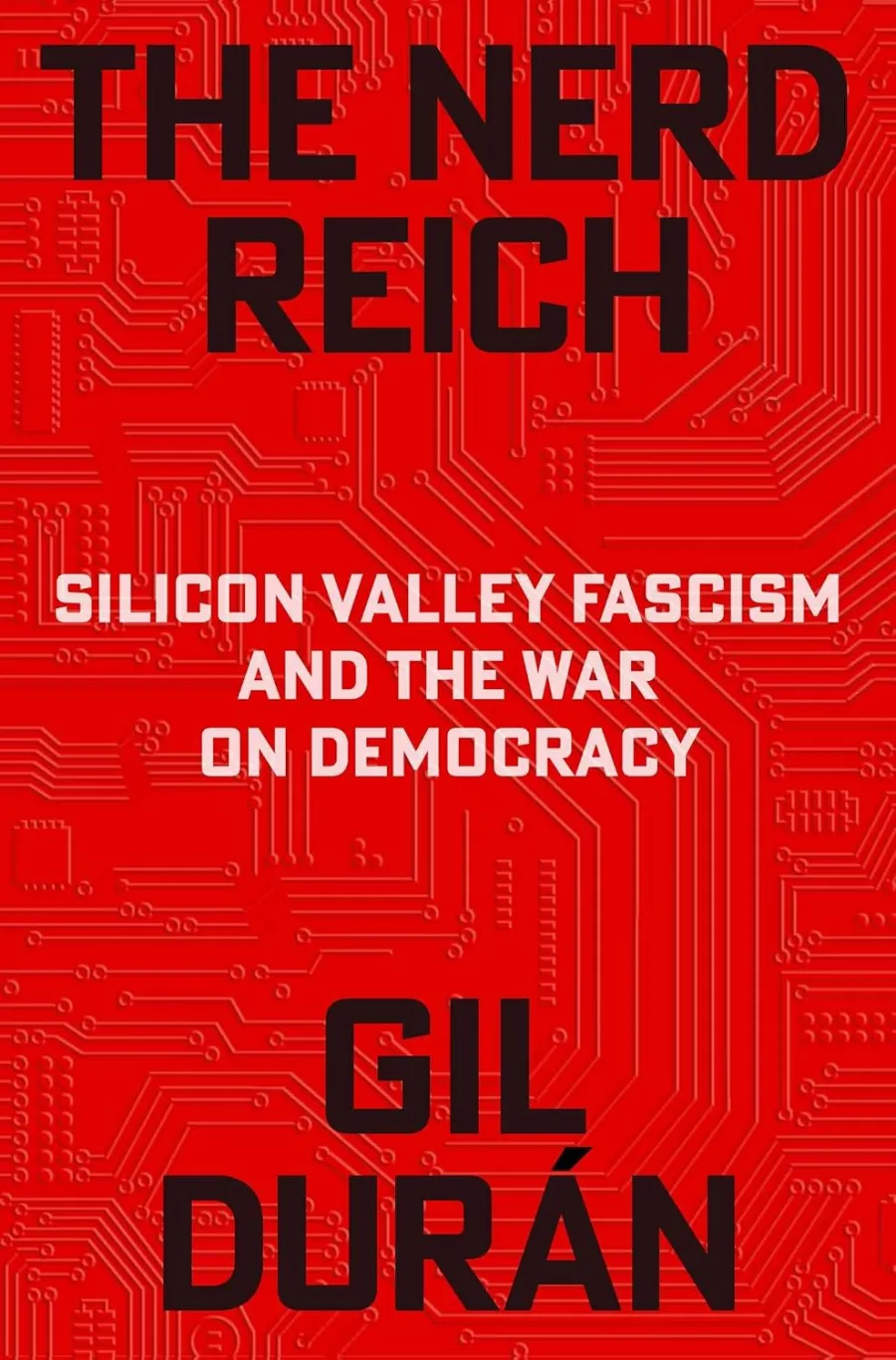
Download Cover Image
Do you want to download the full cover image for The Nerd Reich: Silicon Valley Fascism and the War on Democracy?