
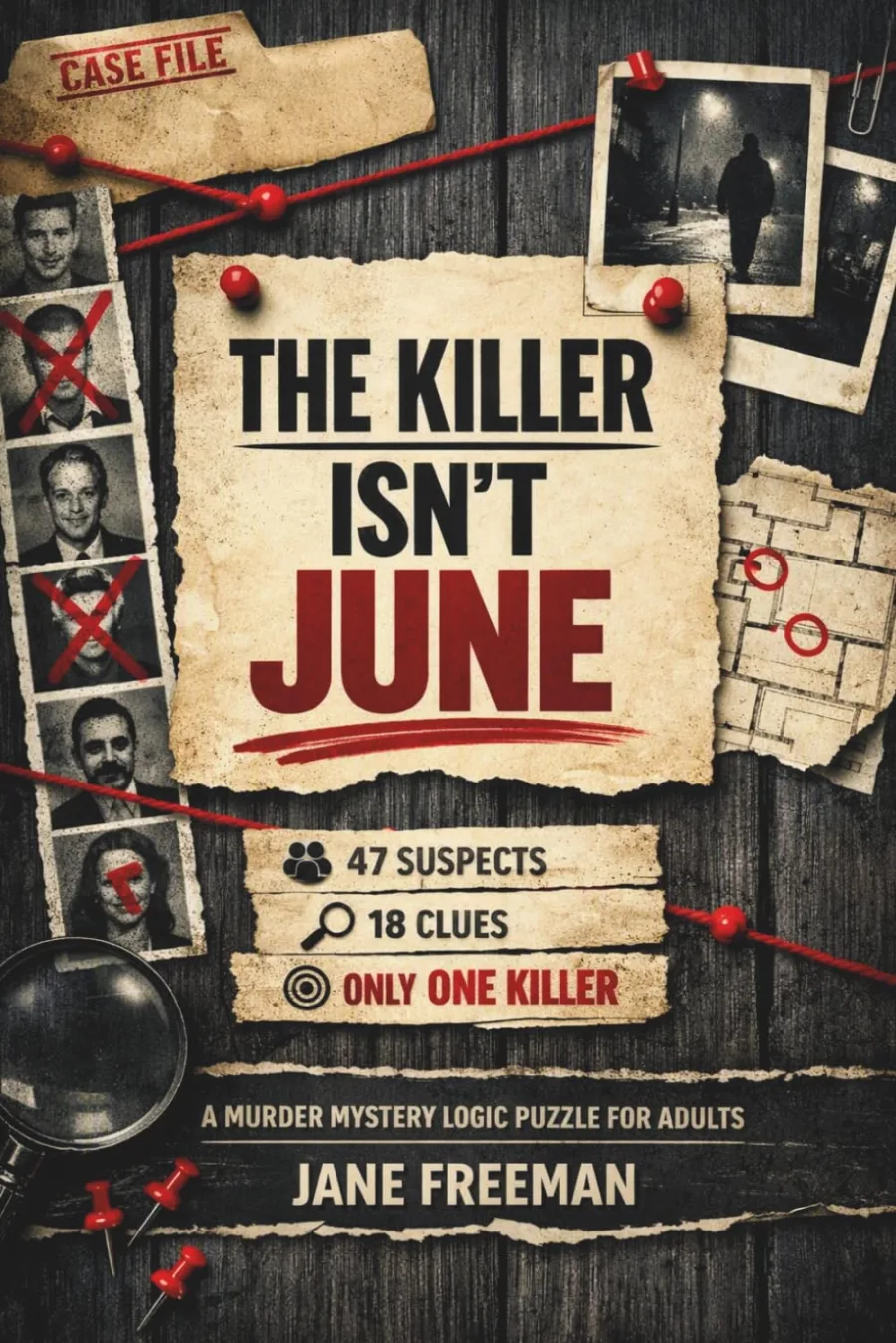
The Killer Isn’t June
Paperback
• 36 Pages
• USD 12.99
• English
• 9798192516010
No ratings yet
| Publisher | Independently Published |
|---|---|
| ISBN13 | 9798192516010 |
| ASIN/SKU | B0HF7QK1L3 |
| Book Format | Paperback |
| Language | English |
| Pages | 36 |
| List Price | USD 12.99 |
| Publishing Date | 13/08/2026 |
| Dimensions | 6 x 0.09 x 9 inches |
| Weight | 3.68 ounces |
| Book Code | BD00070155 |
Buy this Book
Amazon Stores
Ebook Stores
Other Stores
Discover The Killer Isn’t June by Jane Freeman. This book is published by Independently Published in Paperback format, ISBN 9798192516010, ASIN B0HF7QK1L3, under Humor and Entertainment, Children's Puzzle Books, Logic and Brain Teasers.
Book Description
Lord Julian Ravenswick is dead. Forty-seven people were in the house that night. Forty-six of them are innocent.
You have eighteen clues. One suspect fits every single one of them. The rest is up to you.
Welcome to Ravenswick Hall — a rain-lashed manor, a murdered financier, and a guest list long enough to make any detective's head spin. Family. Staff. Business associates. Guests who'd never set foot in the house before that night. Somewhere among the forty-seven of them is the person who slipped into the library, picked up the letter-opener, and walked back out into the party as if nothing had happened.
This isn't a story you read passively. It's a working logic puzzle disguised as a locked-room mystery, and it plays completely fair: every fact you need is on the page, nothing is hidden, and there is exactly one solution. Eighteen short chapters, each one revealing a single new piece of evidence — a torn thread, a cold teacup, a muddy footprint, a hair caught on a windowsill — and each one eliminating a group of suspects from your list. Cross off names as you go. Watch the field narrow from forty-seven to one. Then find out if you were right.
Inside, you'll find:
A full cast of 47 suspects, each with their own alibi, motive, and quirks
18 atmospheric clue-chapters that build a real murder investigation, one fact at a time
A complete elimination system — no guessing, no red herrings, just pure deduction
A satisfying, fully justified reveal that ties every clue back together
A Solution Grid appendix so you can check your work or self-correct if you get stuck
Whether you're a lifelong mystery reader, a die-hard puzzle solver, or someone who just wants a genuinely challenging way to spend an evening, The Killer Isn't June is built to be worked through with a pencil, a cup of tea, and a healthy suspicion of everyone in the room.
Forty-seven suspects. Eighteen clues. Only one killer.
Start crossing off names — and find out who's really been sitting across the table from you all along.
You have eighteen clues. One suspect fits every single one of them. The rest is up to you.
Welcome to Ravenswick Hall — a rain-lashed manor, a murdered financier, and a guest list long enough to make any detective's head spin. Family. Staff. Business associates. Guests who'd never set foot in the house before that night. Somewhere among the forty-seven of them is the person who slipped into the library, picked up the letter-opener, and walked back out into the party as if nothing had happened.
This isn't a story you read passively. It's a working logic puzzle disguised as a locked-room mystery, and it plays completely fair: every fact you need is on the page, nothing is hidden, and there is exactly one solution. Eighteen short chapters, each one revealing a single new piece of evidence — a torn thread, a cold teacup, a muddy footprint, a hair caught on a windowsill — and each one eliminating a group of suspects from your list. Cross off names as you go. Watch the field narrow from forty-seven to one. Then find out if you were right.
Inside, you'll find:
A full cast of 47 suspects, each with their own alibi, motive, and quirks
18 atmospheric clue-chapters that build a real murder investigation, one fact at a time
A complete elimination system — no guessing, no red herrings, just pure deduction
A satisfying, fully justified reveal that ties every clue back together
A Solution Grid appendix so you can check your work or self-correct if you get stuck
Whether you're a lifelong mystery reader, a die-hard puzzle solver, or someone who just wants a genuinely challenging way to spend an evening, The Killer Isn't June is built to be worked through with a pencil, a cup of tea, and a healthy suspicion of everyone in the room.
Forty-seven suspects. Eighteen clues. Only one killer.
Start crossing off names — and find out who's really been sitting across the table from you all along.
Author Biography
Author Biography will be added soon…
Editorial Reviews
Editorial Reviews will be added soon…
Book Summary
The Killer Isn’t June by Jane Freeman is an interactive murder-mystery puzzle built around a simple but intriguing challenge: Lord Julian Ravenswick is dead, forty-seven people were present in the house, and only one of them is the murderer. Rather than telling the reader to sit back and follow a detective as clues are gradually uncovered, the book places the reader directly in the role of investigator. The central mystery is not simply about discovering who had a motive, but about carefully examining every piece of information and determining which suspect matches all the evidence. The book presents eighteen clues and asks the reader to eliminate the innocent suspects until only the real killer remains.
The story takes place at Ravenswick Hall, a rain-lashed manor that provides the perfect atmosphere for a traditional closed-circle mystery. Lord Julian Ravenswick, a wealthy financier, has been murdered, and the circumstances immediately make everyone in the house suspicious. With forty-seven people gathered under the same roof, the list of possible suspects is large enough to make the investigation seem overwhelming. Family members, household staff, business associates, and guests all have different relationships with the victim, and each person brings a different combination of personality, history, motive, and alibi to the case. The setting creates the familiar feeling of an isolated English manor mystery, where nobody can easily disappear and everyone has a reason to be questioned.
What makes the book unusual is the way the mystery is structured. Instead of depending on dramatic detective scenes, long interrogations, or a single investigator explaining the solution, the reader is given the tools to solve the murder personally. The eighteen clues gradually narrow the field. Each clue contains information that can be used to eliminate suspects, and the challenge is to apply the clues accurately rather than simply guessing which character seems most suspicious. The book is therefore as much a logic puzzle as it is a murder mystery. Readers have to pay close attention, compare information, reconsider assumptions, and keep track of which suspects can still possibly be guilty.
At first, the large cast can make the investigation appear complicated. Forty-seven suspects mean that there are many possible combinations of motives and alibis. A traditional mystery might encourage the reader to focus on the most obviously suspicious character, but The Killer Isn’t June takes a different approach. A person who appears guilty may be eliminated by one small detail, while a quieter character may continue to fit the evidence. This forces the reader to resist making conclusions based only on personality or appearances. The real solution comes from connecting the clues and patiently narrowing the possibilities.
The eighteen clue-chapters are particularly important because they give the investigation its structure. Rather than functioning merely as pieces of information scattered through a conventional narrative, the clues are designed to build the case one fact at a time. Readers can work through them systematically, crossing out suspects as they become impossible. This creates a sense of progress that is different from ordinary suspense fiction. Every successful deduction feels like a small victory. Instead of waiting for the detective to reveal an answer, the reader experiences the satisfaction of discovering it independently.
The book also gives its suspects enough individual character to make the puzzle feel like a genuine murder investigation rather than a dry mathematical exercise. Each suspect has an alibi, a possible motive, and distinctive traits or circumstances. This creates the impression that everyone in Ravenswick Hall has something that could potentially matter. At the same time, the clues are designed to separate genuine evidence from distractions. The reader must decide which facts are decisive and which apparent suspicions do not actually prove anything. The result is a mystery that rewards patience and careful observation more than intuition alone.
An important part of the appeal is that the book does not require readers to be professional puzzle solvers. The central idea is straightforward: start with the full group of suspects, apply each clue, eliminate the people who cannot fit, and continue until one person remains. The process resembles solving a logic-grid puzzle, but it is presented within the atmosphere of a murder case. The book therefore works for readers who enjoy classic whodunits as well as people who like deduction games and brain teasers. The publisher description specifically presents it as something that can be worked through with a pencil and patience, emphasizing the hands-on nature of the experience.
The title itself adds another layer of intrigue. The Killer Isn’t June immediately suggests that June has somehow become associated with the crime or that the reader is being warned not to make an obvious assumption. Rather than simply asking “Who killed Lord Julian Ravenswick?”, the title encourages the reader to question the first impression and look beyond the most apparent possibility. This fits the larger philosophy of the book: suspicion is not proof, and the answer has to be established through evidence.
As the clues accumulate, the investigation becomes increasingly focused. Suspects who initially seem equally possible begin to disappear from consideration. A motive alone is not enough. An opportunity alone is not enough. Even a suspicious alibi cannot make someone the killer if another clue rules that person out. The reader therefore learns to think like an investigator, examining the case as a complete pattern rather than focusing on isolated details. The eventual solution is intended to be satisfying because it is fully justified by the clues rather than being introduced as an arbitrary twist. The book also includes a Solution Grid appendix, allowing readers to check their reasoning or correct themselves if they become stuck.
Ultimately, The Killer Isn’t June is less about watching someone solve a murder and more about solving the murder yourself. Its appeal comes from the combination of an atmospheric manor-house setting, a large collection of suspects, carefully arranged clues, and the satisfaction of gradually reducing a seemingly impossible mystery to one answer. The book turns the familiar murder mystery format into an active reading experience. Instead of simply asking what happens next, it continually asks the reader to think: Who can be eliminated? Which clue matters most? Whose story does not fit? And, finally, which person is left when every piece of evidence has been applied?
For readers who enjoy murder mysteries, logic puzzles, deduction games, and classic closed-circle investigations, Jane Freeman’s The Killer Isn’t June offers a refreshing change from an ordinary whodunit. It combines storytelling with problem-solving and makes the reader an essential part of the investigation. The real pleasure is not merely reaching the final answer, but experiencing the gradual realization that the seemingly enormous list of suspects can actually be reduced, clue by clue, until the truth becomes impossible to ignore.
The story takes place at Ravenswick Hall, a rain-lashed manor that provides the perfect atmosphere for a traditional closed-circle mystery. Lord Julian Ravenswick, a wealthy financier, has been murdered, and the circumstances immediately make everyone in the house suspicious. With forty-seven people gathered under the same roof, the list of possible suspects is large enough to make the investigation seem overwhelming. Family members, household staff, business associates, and guests all have different relationships with the victim, and each person brings a different combination of personality, history, motive, and alibi to the case. The setting creates the familiar feeling of an isolated English manor mystery, where nobody can easily disappear and everyone has a reason to be questioned.
What makes the book unusual is the way the mystery is structured. Instead of depending on dramatic detective scenes, long interrogations, or a single investigator explaining the solution, the reader is given the tools to solve the murder personally. The eighteen clues gradually narrow the field. Each clue contains information that can be used to eliminate suspects, and the challenge is to apply the clues accurately rather than simply guessing which character seems most suspicious. The book is therefore as much a logic puzzle as it is a murder mystery. Readers have to pay close attention, compare information, reconsider assumptions, and keep track of which suspects can still possibly be guilty.
At first, the large cast can make the investigation appear complicated. Forty-seven suspects mean that there are many possible combinations of motives and alibis. A traditional mystery might encourage the reader to focus on the most obviously suspicious character, but The Killer Isn’t June takes a different approach. A person who appears guilty may be eliminated by one small detail, while a quieter character may continue to fit the evidence. This forces the reader to resist making conclusions based only on personality or appearances. The real solution comes from connecting the clues and patiently narrowing the possibilities.
The eighteen clue-chapters are particularly important because they give the investigation its structure. Rather than functioning merely as pieces of information scattered through a conventional narrative, the clues are designed to build the case one fact at a time. Readers can work through them systematically, crossing out suspects as they become impossible. This creates a sense of progress that is different from ordinary suspense fiction. Every successful deduction feels like a small victory. Instead of waiting for the detective to reveal an answer, the reader experiences the satisfaction of discovering it independently.
The book also gives its suspects enough individual character to make the puzzle feel like a genuine murder investigation rather than a dry mathematical exercise. Each suspect has an alibi, a possible motive, and distinctive traits or circumstances. This creates the impression that everyone in Ravenswick Hall has something that could potentially matter. At the same time, the clues are designed to separate genuine evidence from distractions. The reader must decide which facts are decisive and which apparent suspicions do not actually prove anything. The result is a mystery that rewards patience and careful observation more than intuition alone.
An important part of the appeal is that the book does not require readers to be professional puzzle solvers. The central idea is straightforward: start with the full group of suspects, apply each clue, eliminate the people who cannot fit, and continue until one person remains. The process resembles solving a logic-grid puzzle, but it is presented within the atmosphere of a murder case. The book therefore works for readers who enjoy classic whodunits as well as people who like deduction games and brain teasers. The publisher description specifically presents it as something that can be worked through with a pencil and patience, emphasizing the hands-on nature of the experience.
The title itself adds another layer of intrigue. The Killer Isn’t June immediately suggests that June has somehow become associated with the crime or that the reader is being warned not to make an obvious assumption. Rather than simply asking “Who killed Lord Julian Ravenswick?”, the title encourages the reader to question the first impression and look beyond the most apparent possibility. This fits the larger philosophy of the book: suspicion is not proof, and the answer has to be established through evidence.
As the clues accumulate, the investigation becomes increasingly focused. Suspects who initially seem equally possible begin to disappear from consideration. A motive alone is not enough. An opportunity alone is not enough. Even a suspicious alibi cannot make someone the killer if another clue rules that person out. The reader therefore learns to think like an investigator, examining the case as a complete pattern rather than focusing on isolated details. The eventual solution is intended to be satisfying because it is fully justified by the clues rather than being introduced as an arbitrary twist. The book also includes a Solution Grid appendix, allowing readers to check their reasoning or correct themselves if they become stuck.
Ultimately, The Killer Isn’t June is less about watching someone solve a murder and more about solving the murder yourself. Its appeal comes from the combination of an atmospheric manor-house setting, a large collection of suspects, carefully arranged clues, and the satisfaction of gradually reducing a seemingly impossible mystery to one answer. The book turns the familiar murder mystery format into an active reading experience. Instead of simply asking what happens next, it continually asks the reader to think: Who can be eliminated? Which clue matters most? Whose story does not fit? And, finally, which person is left when every piece of evidence has been applied?
For readers who enjoy murder mysteries, logic puzzles, deduction games, and classic closed-circle investigations, Jane Freeman’s The Killer Isn’t June offers a refreshing change from an ordinary whodunit. It combines storytelling with problem-solving and makes the reader an essential part of the investigation. The real pleasure is not merely reaching the final answer, but experiencing the gradual realization that the seemingly enormous list of suspects can actually be reduced, clue by clue, until the truth becomes impossible to ignore.
Sample Chapters
Sample Chapters will be added soon…
Reader Reviews
No reviews yet.
The Killer Isn’t June
Download Cover Image
Do you want to download the full cover image for The Killer Isn’t June?