
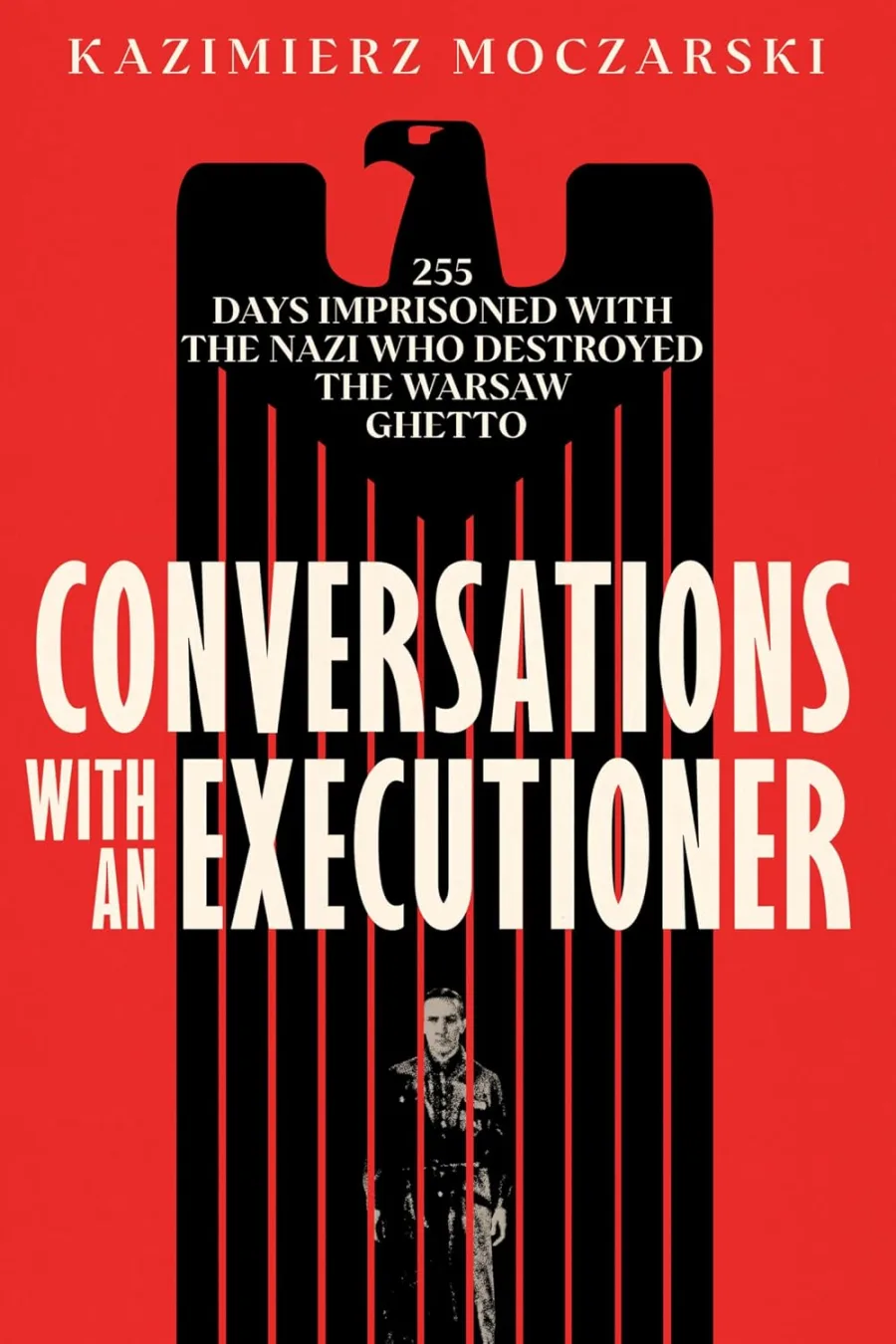
Conversations with an Executioner
Paperback
• 480 Pages
• USD 24.53
• English
• 9781586424480
No ratings yet
| Publisher | Steerforth |
|---|---|
| ISBN13 | 9781586424480 |
| ASIN/SKU | 1586424483 |
| Book Format | Paperback |
| Language | English |
| Pages | 480 |
| List Price | USD 24.53 |
| Publishing Date | 18/08/2026 |
| Dimensions | 5.98 x 1.23 x 8.96 inches |
| Weight | 1.25 pounds |
| Book Code | BD00070156 |
Buy this Book
Amazon Stores
Ebook Stores
Other Stores
Discover Conversations with an Executioner by Kazimierz Moczarski. This book is published by Steerforth in Paperback format, ISBN 9781586424480, ASIN 1586424483, under Politics and Social Sciences, Criminology, Politics and Government.
Book Description
A remarkable firsthand account of the rise and fall of the Nazis told from the inside of a prison cell.
The first complete English translation of the international classic work of World War II literature and investigative journalism.
Warsaw, 1949: freedom fighter and journalist Kazimierz Moczarski is being held in a maximum-security prison, accused of being an enemy of the state by the Polish secret police. A survivor of the Warsaw Uprising, he is horrified to find himself locked up in a cell with the notorious Nazi official responsible for the destruction of the Warsaw Ghetto and the death of over 50,000 people: Jürgen Stroop.
For 255 days, Stroop talks to Moczarski of his life, entirely unrepentant of the crimes for which he would soon be executed himself. Conversations with an Executioner is Moczarski’s firsthand account of these extraordinary exchanges, giving disturbing insight into the mind of one of history’s most brutal war criminals.
Through his conversations with Stroop, Moczarski details the opportunities that the rise of the Nazi party in Germany presented for marginalized, mediocre characters like Stroop to gain prestige and power under the new regime—and the consequences that came for them after its fall. Unflinchingly examining some of humanity’s darkest moments, his work is a towering literary achievement, steeped in keen journalistic enterprise and psychological insight.
Widely translated and adapted for stage and screen in over 15 languages, this lost classic of World War II literature is now available in its first ever complete English translation.
The first complete English translation of the international classic work of World War II literature and investigative journalism.
Warsaw, 1949: freedom fighter and journalist Kazimierz Moczarski is being held in a maximum-security prison, accused of being an enemy of the state by the Polish secret police. A survivor of the Warsaw Uprising, he is horrified to find himself locked up in a cell with the notorious Nazi official responsible for the destruction of the Warsaw Ghetto and the death of over 50,000 people: Jürgen Stroop.
For 255 days, Stroop talks to Moczarski of his life, entirely unrepentant of the crimes for which he would soon be executed himself. Conversations with an Executioner is Moczarski’s firsthand account of these extraordinary exchanges, giving disturbing insight into the mind of one of history’s most brutal war criminals.
Through his conversations with Stroop, Moczarski details the opportunities that the rise of the Nazi party in Germany presented for marginalized, mediocre characters like Stroop to gain prestige and power under the new regime—and the consequences that came for them after its fall. Unflinchingly examining some of humanity’s darkest moments, his work is a towering literary achievement, steeped in keen journalistic enterprise and psychological insight.
Widely translated and adapted for stage and screen in over 15 languages, this lost classic of World War II literature is now available in its first ever complete English translation.
Author Biography
Kazimierz Moczarski was born in Warsaw in 1907, and studied law at Warsaw University and the Sorbonne. During the Nazi Germany occupation of Poland, he fought as an officer in the Polish Resistance. In 1945, he was arrested by the new Communist regime as an enemy of the state, and was sentenced to ten years in prison. It was during this time that he was locked up with the Nazi war criminal, Jürgen Stroop. After his release, Moczarski worked as a journalist, and began writing his masterpiece, Conversations with an Executioner. Moczarski died in 1975, weakened by years of torture during his time in prison.
Editorial Reviews
"A Polish classic which evokes the past but also sheds light on the predicaments of the present." — Anne Applebaum, author of Autocracy, Inc.
"This volume hits hard and is a taut, direct, and haunting blend of journalistic precision and visceral storytelling that will grip historians, Holocaust scholars, and general readers."
—Library Journal, Starred Review
"An astonishing account.... Superbly translated by Sean Gasper Bye, this latest edition confirms Moczarski’s 'report' as a masterpiece of 20th-century literature."
—The Telegraph
"It’s a stark X-ray of a Nazi soul."
—Publishers Weekly
"This fascinating revelation of how a good little middle class boy turns into a Nazi mass murderer is all the more chilling for the forensic, at times witty, style in which his horrified cellmate and near-victim records it. A page-turner and must-read for understanding the workings of the Holocaust."
—Adam Zamoyski, author of Poland: A History
"An extraordinary book, almost impossible to categorize: simultaneously an act of witness and a work of the imagination, a brilliant portrait of a mediocre man’s rise within the Nazi hierarchy, unsparing and yet deeply human." — Jane Rogoyska, author of Hotel Exile
"Quite simply one of the most remarkable books to emerge out of World War II. Part unlikely memoir and part biography, it gives an insight into the Nazi mind that is as fascinating as it is chilling. Outstanding."
—Roger Moorehouse, author of Wolfpack: Inside Hitler’s U-Boat War
"A remarkable document. By turns shocking and chilling but always compelling, Moczarski's prison conversations with a senior, serial and shameless Nazi killer provide an invaluable insight into the heart of a hideous ideology."
—Jonathan Dimbleby, author of Endgame 1944
"Essential reading for all those interested in the Nazi occupation of Poland, the mass murder of Polish Jews and the larger history of the Second World War."
—Antony Polonsky, Emeritus Professor of Holocaust Studies, Brandeis University and Chief Historian, Global Education Outreach Project, Museum of Polish Jews in Warsaw
"A remarkable feat of reportage and timely insight into the Nazi mind."
—Charlie English, author of The CIA Book Club
"An intriguing document that portrays Stroop as the exemplary perpetrator: a mediocrity promoted above his abilities, but fanatical in his allegiance to Hitler, Himmler and Nazi ideology. Moczarski, working from memory, brings to light the workings of the Nazi mind with penetrating insight."
—Dan Stone, author of The Holocaust: An Unfinished History
"Extraordinary, original, gripping, and painfully relevant to our times."
—Philippe Sands, author of East West Street
"A richly textured three-dimensional portrait of a two-dimensional mass murderer who presided over the liquidation of the Warsaw Ghetto, never revealing a hint of a conscience. Although Hannah Arendt did not coin the phrase 'the banality of evil' until much later, Jürgen Stroop already embodied it."
—Andrew Nagorski, author of Hitlerland
"This volume hits hard and is a taut, direct, and haunting blend of journalistic precision and visceral storytelling that will grip historians, Holocaust scholars, and general readers."
—Library Journal, Starred Review
"An astonishing account.... Superbly translated by Sean Gasper Bye, this latest edition confirms Moczarski’s 'report' as a masterpiece of 20th-century literature."
—The Telegraph
"It’s a stark X-ray of a Nazi soul."
—Publishers Weekly
"This fascinating revelation of how a good little middle class boy turns into a Nazi mass murderer is all the more chilling for the forensic, at times witty, style in which his horrified cellmate and near-victim records it. A page-turner and must-read for understanding the workings of the Holocaust."
—Adam Zamoyski, author of Poland: A History
"An extraordinary book, almost impossible to categorize: simultaneously an act of witness and a work of the imagination, a brilliant portrait of a mediocre man’s rise within the Nazi hierarchy, unsparing and yet deeply human." — Jane Rogoyska, author of Hotel Exile
"Quite simply one of the most remarkable books to emerge out of World War II. Part unlikely memoir and part biography, it gives an insight into the Nazi mind that is as fascinating as it is chilling. Outstanding."
—Roger Moorehouse, author of Wolfpack: Inside Hitler’s U-Boat War
"A remarkable document. By turns shocking and chilling but always compelling, Moczarski's prison conversations with a senior, serial and shameless Nazi killer provide an invaluable insight into the heart of a hideous ideology."
—Jonathan Dimbleby, author of Endgame 1944
"Essential reading for all those interested in the Nazi occupation of Poland, the mass murder of Polish Jews and the larger history of the Second World War."
—Antony Polonsky, Emeritus Professor of Holocaust Studies, Brandeis University and Chief Historian, Global Education Outreach Project, Museum of Polish Jews in Warsaw
"A remarkable feat of reportage and timely insight into the Nazi mind."
—Charlie English, author of The CIA Book Club
"An intriguing document that portrays Stroop as the exemplary perpetrator: a mediocrity promoted above his abilities, but fanatical in his allegiance to Hitler, Himmler and Nazi ideology. Moczarski, working from memory, brings to light the workings of the Nazi mind with penetrating insight."
—Dan Stone, author of The Holocaust: An Unfinished History
"Extraordinary, original, gripping, and painfully relevant to our times."
—Philippe Sands, author of East West Street
"A richly textured three-dimensional portrait of a two-dimensional mass murderer who presided over the liquidation of the Warsaw Ghetto, never revealing a hint of a conscience. Although Hannah Arendt did not coin the phrase 'the banality of evil' until much later, Jürgen Stroop already embodied it."
—Andrew Nagorski, author of Hitlerland
Book Summary
Conversations with an Executioner by Kazimierz Moczarski is a remarkable and deeply disturbing account of one of the darkest periods of the twentieth century. The book is based on an extraordinary experience Moczarski himself endured in a Polish prison in 1949, when he was forced to share a cell for 255 days with Jürgen Stroop, the former SS general responsible for the destruction of the Warsaw Ghetto. Moczarski had been a member of the Polish resistance and had fought against the Nazis, while Stroop had been one of the men responsible for carrying out Nazi terror. The two men therefore represented completely opposite sides of the Second World War, yet imprisonment brought them into an unlikely and unforgettable relationship.
Moczarski's situation was especially tragic because he was not imprisoned as a Nazi collaborator or criminal. After the war, Stalinist authorities in Poland arrested him and accused him of being an enemy of the new communist state. He was subjected to brutal treatment and spent years in prison, including several years under a death sentence. In this atmosphere of fear and uncertainty, he suddenly found himself sharing a cell with Stroop. The situation was almost impossible to comprehend. Moczarski had fought against Nazi Germany, and Stroop had been a leading Nazi official, yet both were prisoners of the postwar Polish authorities. Their third cellmate was Gustav Schielke, a former German policeman and SS officer. For 255 days, the three men lived together in the confined space of a prison cell.
The central part of the book consists of conversations between Moczarski and Stroop. Rather than presenting Stroop simply as a monstrous figure without explanation, Moczarski carefully listens to him and reconstructs his life story. Stroop talks freely about his childhood, his family, his education, his military experiences, and his gradual involvement with the Nazi movement. What makes these conversations so unsettling is that Stroop does not present himself as a repentant criminal. He speaks about his past with pride, self-importance, and an extraordinary lack of moral understanding. Even after the collapse of Nazi Germany and while awaiting execution, he remains largely convinced that he served a worthy cause.
Through Stroop's recollections, Moczarski explores how an apparently ordinary and ambitious man could become an instrument of mass murder. Stroop was not portrayed as someone who had always been an obvious monster. Instead, his story reveals how ambition, obedience, nationalism, racism, resentment, and the desire for recognition could gradually become connected to a destructive political ideology. The Nazi system gave men like Stroop opportunities to rise in status and authority. He embraced the system, followed its leaders, and became increasingly committed to its racial and political beliefs. This transformation is one of the book's most frightening subjects because it suggests that evil can grow through ordinary human weaknesses rather than appearing suddenly in an obviously monstrous form.
A major portion of the conversations concerns Stroop's role in the destruction of the Warsaw Ghetto. In 1943, he was placed in charge of the German operation to suppress the Warsaw Ghetto Uprising and destroy the ghetto. Stroop speaks about the operation in disturbing detail, describing the systematic attacks, deportations, executions, and destruction carried out under his command. His descriptions reveal not only the enormous scale of the violence but also the bureaucratic and organized character of the Nazi machinery of destruction. The murder of thousands of Jewish people was treated by Stroop as an operation to be planned, measured, reported, and presented to his superiors.
One of the most chilling aspects of the book is Stroop's attitude toward his own actions. He does not seem to understand the moral horror that Moczarski sees so clearly. Instead, Stroop frequently speaks in the language of duty, discipline, obedience, and loyalty. He presents himself as a soldier who carried out orders and served the German state. This makes his testimony particularly important. Moczarski is not interested only in listing Stroop's crimes; he wants to understand how a person could commit or supervise such crimes and still regard himself as honorable. The gap between Stroop's self-image and the reality of his actions becomes one of the central tensions of the book.
Moczarski's approach is remarkably controlled. He does not turn the book into an emotional argument in which he constantly condemns Stroop. Instead, he allows Stroop to speak and then places his statements within the larger historical reality. This gives the book its unusual psychological power. Readers are forced to listen to the executioner explain himself, and the more he talks, the clearer his moral blindness becomes. His words become evidence against him. His confidence, vanity, prejudices, and excuses reveal the mentality that allowed Nazi crimes to be carried out on such a massive scale.
The book also provides insight into the structure of the Nazi regime. Stroop discusses figures such as Hitler and Himmler and explains his relationship with the SS hierarchy. His career shows how Nazi institutions rewarded ideological loyalty and aggressive obedience. The regime transformed political fanaticism into a system of administration and violence. Stroop's personal ambition was therefore connected to a much larger machine. He wanted advancement and recognition, and the Nazi system provided both when he demonstrated his willingness to enforce its goals.
At the same time, Moczarski's own presence in the story gives the book another dimension. He is not a detached historian interviewing Stroop decades later. He is a former resistance fighter sitting only a few feet away from a man whose forces had helped destroy the world Moczarski had fought to defend. His own imprisonment by the communist authorities creates a strange historical irony. The war has ended, but Moczarski remains a prisoner, while Stroop is also awaiting his fate. The book therefore connects two different systems of political repression and shows how violence and authoritarianism continued to shape Europe after the fall of Nazi Germany.
The psychological contrast between the two men is also important. Moczarski is interested in understanding Stroop, but understanding does not mean forgiving him. Throughout the book, there is an awareness that studying the mind of a perpetrator is necessary if society is to understand how atrocities become possible. Stroop's story demonstrates how ideology can erase empathy and how institutions can turn prejudice into organized violence. His refusal to genuinely confront his responsibility makes the conversations even more disturbing.
The book's form adds to its power. It reads partly like a memoir, partly like an oral history, and partly like an investigative psychological study. Moczarski recreated the conversations from memory because he was unable to keep notes while imprisoned. After his release, he carefully reconstructed the material and verified historical details where possible. The work was eventually published in Poland in a censored form, while the complete uncensored version appeared after the fall of communism. Moczarski himself died in 1975 and did not live to see the later publication of the complete work.
Ultimately, Conversations with an Executioner is much more than a biography of Jürgen Stroop. It is an examination of how ordinary ambitions can become attached to destructive ideologies, how authoritarian systems reward obedience, and how people can participate in terrible crimes while convincing themselves that they are acting honorably. The book's greatest strength is that it does not make evil easy to understand by turning its perpetrator into a simple caricature. Instead, Moczarski shows the disturbing human mechanisms behind Stroop's transformation.
The result is a haunting historical work that remains important because it asks questions that extend far beyond the Holocaust. How does hatred become normal? Why do people surrender their judgment to political authority? How can individuals participate in cruelty while believing themselves to be decent? And what happens when an entire system rewards obedience rather than conscience? Moczarski never provides easy answers, but by patiently listening to the executioner, he allows readers to see the frightening process for themselves. Conversations with an Executioner ultimately becomes both a record of historical atrocity and a warning about the human capacity to justify violence when ideology, ambition, and unquestioning obedience take control.
Moczarski's situation was especially tragic because he was not imprisoned as a Nazi collaborator or criminal. After the war, Stalinist authorities in Poland arrested him and accused him of being an enemy of the new communist state. He was subjected to brutal treatment and spent years in prison, including several years under a death sentence. In this atmosphere of fear and uncertainty, he suddenly found himself sharing a cell with Stroop. The situation was almost impossible to comprehend. Moczarski had fought against Nazi Germany, and Stroop had been a leading Nazi official, yet both were prisoners of the postwar Polish authorities. Their third cellmate was Gustav Schielke, a former German policeman and SS officer. For 255 days, the three men lived together in the confined space of a prison cell.
The central part of the book consists of conversations between Moczarski and Stroop. Rather than presenting Stroop simply as a monstrous figure without explanation, Moczarski carefully listens to him and reconstructs his life story. Stroop talks freely about his childhood, his family, his education, his military experiences, and his gradual involvement with the Nazi movement. What makes these conversations so unsettling is that Stroop does not present himself as a repentant criminal. He speaks about his past with pride, self-importance, and an extraordinary lack of moral understanding. Even after the collapse of Nazi Germany and while awaiting execution, he remains largely convinced that he served a worthy cause.
Through Stroop's recollections, Moczarski explores how an apparently ordinary and ambitious man could become an instrument of mass murder. Stroop was not portrayed as someone who had always been an obvious monster. Instead, his story reveals how ambition, obedience, nationalism, racism, resentment, and the desire for recognition could gradually become connected to a destructive political ideology. The Nazi system gave men like Stroop opportunities to rise in status and authority. He embraced the system, followed its leaders, and became increasingly committed to its racial and political beliefs. This transformation is one of the book's most frightening subjects because it suggests that evil can grow through ordinary human weaknesses rather than appearing suddenly in an obviously monstrous form.
A major portion of the conversations concerns Stroop's role in the destruction of the Warsaw Ghetto. In 1943, he was placed in charge of the German operation to suppress the Warsaw Ghetto Uprising and destroy the ghetto. Stroop speaks about the operation in disturbing detail, describing the systematic attacks, deportations, executions, and destruction carried out under his command. His descriptions reveal not only the enormous scale of the violence but also the bureaucratic and organized character of the Nazi machinery of destruction. The murder of thousands of Jewish people was treated by Stroop as an operation to be planned, measured, reported, and presented to his superiors.
One of the most chilling aspects of the book is Stroop's attitude toward his own actions. He does not seem to understand the moral horror that Moczarski sees so clearly. Instead, Stroop frequently speaks in the language of duty, discipline, obedience, and loyalty. He presents himself as a soldier who carried out orders and served the German state. This makes his testimony particularly important. Moczarski is not interested only in listing Stroop's crimes; he wants to understand how a person could commit or supervise such crimes and still regard himself as honorable. The gap between Stroop's self-image and the reality of his actions becomes one of the central tensions of the book.
Moczarski's approach is remarkably controlled. He does not turn the book into an emotional argument in which he constantly condemns Stroop. Instead, he allows Stroop to speak and then places his statements within the larger historical reality. This gives the book its unusual psychological power. Readers are forced to listen to the executioner explain himself, and the more he talks, the clearer his moral blindness becomes. His words become evidence against him. His confidence, vanity, prejudices, and excuses reveal the mentality that allowed Nazi crimes to be carried out on such a massive scale.
The book also provides insight into the structure of the Nazi regime. Stroop discusses figures such as Hitler and Himmler and explains his relationship with the SS hierarchy. His career shows how Nazi institutions rewarded ideological loyalty and aggressive obedience. The regime transformed political fanaticism into a system of administration and violence. Stroop's personal ambition was therefore connected to a much larger machine. He wanted advancement and recognition, and the Nazi system provided both when he demonstrated his willingness to enforce its goals.
At the same time, Moczarski's own presence in the story gives the book another dimension. He is not a detached historian interviewing Stroop decades later. He is a former resistance fighter sitting only a few feet away from a man whose forces had helped destroy the world Moczarski had fought to defend. His own imprisonment by the communist authorities creates a strange historical irony. The war has ended, but Moczarski remains a prisoner, while Stroop is also awaiting his fate. The book therefore connects two different systems of political repression and shows how violence and authoritarianism continued to shape Europe after the fall of Nazi Germany.
The psychological contrast between the two men is also important. Moczarski is interested in understanding Stroop, but understanding does not mean forgiving him. Throughout the book, there is an awareness that studying the mind of a perpetrator is necessary if society is to understand how atrocities become possible. Stroop's story demonstrates how ideology can erase empathy and how institutions can turn prejudice into organized violence. His refusal to genuinely confront his responsibility makes the conversations even more disturbing.
The book's form adds to its power. It reads partly like a memoir, partly like an oral history, and partly like an investigative psychological study. Moczarski recreated the conversations from memory because he was unable to keep notes while imprisoned. After his release, he carefully reconstructed the material and verified historical details where possible. The work was eventually published in Poland in a censored form, while the complete uncensored version appeared after the fall of communism. Moczarski himself died in 1975 and did not live to see the later publication of the complete work.
Ultimately, Conversations with an Executioner is much more than a biography of Jürgen Stroop. It is an examination of how ordinary ambitions can become attached to destructive ideologies, how authoritarian systems reward obedience, and how people can participate in terrible crimes while convincing themselves that they are acting honorably. The book's greatest strength is that it does not make evil easy to understand by turning its perpetrator into a simple caricature. Instead, Moczarski shows the disturbing human mechanisms behind Stroop's transformation.
The result is a haunting historical work that remains important because it asks questions that extend far beyond the Holocaust. How does hatred become normal? Why do people surrender their judgment to political authority? How can individuals participate in cruelty while believing themselves to be decent? And what happens when an entire system rewards obedience rather than conscience? Moczarski never provides easy answers, but by patiently listening to the executioner, he allows readers to see the frightening process for themselves. Conversations with an Executioner ultimately becomes both a record of historical atrocity and a warning about the human capacity to justify violence when ideology, ambition, and unquestioning obedience take control.
Sample Chapters
Sample Chapters will be added soon…
Reader Reviews
No reviews yet.
Conversations with an Executioner
Download Cover Image
Do you want to download the full cover image for Conversations with an Executioner?